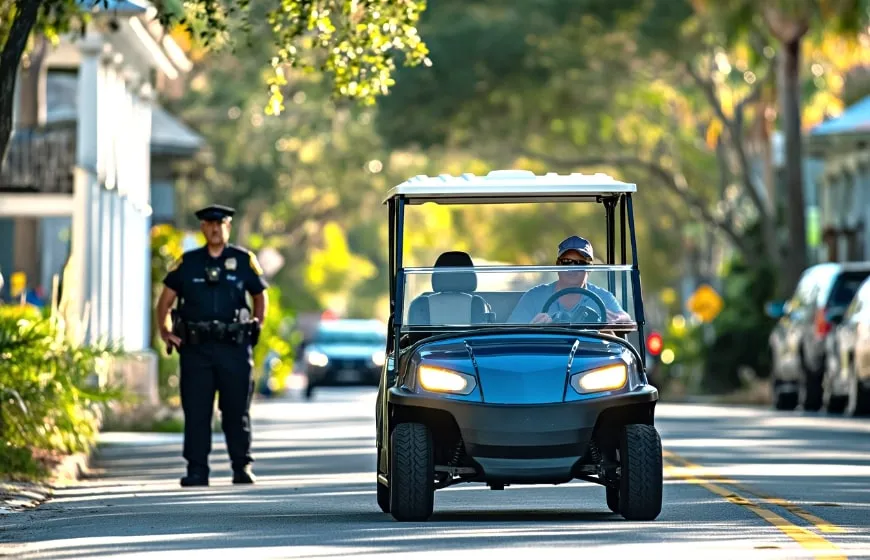
Most of the time, you do not need a driver's license to drive a standard golf cart on private property or a golf course, but you often do need one once you move onto public roads or into LSV territory.
If you want the short answer:
- Private property: usually no license required
- Golf courses: usually no license required, but course rules often set a minimum age
- Public roads: many states or local ordinances require a license, learner's permit, or other ID
- Street-legal LSVs/NEVs: almost always require a valid driver's license
- Rental carts: rental companies usually require a valid license even if local law is looser
- Age rules: there is no nationwide minimum for standard carts; the state, locality, route, and property owner control
That is why this question confuses people. A standard golf cart, a neighborhood cart, and a street-legal low-speed vehicle are not treated the same way. If you blur those together, you get the wrong answer.
For an exact state answer, use the golf cart laws by state hub or try our street-legal golf cart checker. If your cart will be driven on public streets, pair this page with the street-legal golf cart hub, golf cart insurance by state hub, and registration guide. This article explains the national pattern, but the state law page gives the final answer for license, age, registration, and local-route rules.
Quick Answer: When a License Is Required
The cleanest way to answer this query is by where and how you drive.
| Where you drive | Standard golf cart | Street-legal LSV / NEV |
|---|---|---|
| Private property | Usually no license | Usually no road-use issue, private-owner rules still apply |
| Golf course | Usually no license | Rarely relevant |
| Gated or golf-cart community | Depends on community and local law | Often licensed-driver treatment |
| Public roads or city streets | Often yes, or local ordinance sets conditions | Yes in most cases |
| Rental use | Rental company usually requires one | Rental company usually requires one |
If you are only using a standard cart on private land, the answer is usually no. If you are asking about neighborhood streets, crossings, or any cart capable of 20-25 mph, the answer usually shifts toward yes.
Can You Drive a Golf Cart Without a License?
Yes, in some situations. But the safe answer depends on where the cart is driven, not just what the vehicle looks like.
You are usually in the clearest no-license category when:
- the cart stays on private property
- the cart is used on a golf course under course rules
- the cart is used inside a private setting where the owner or HOA allows it
- the cart is not being operated as a road vehicle
You should assume a license, permit, government ID, or rental-company approval may be needed when:
- the cart enters public streets
- the route includes road crossings
- the cart is advertised as street legal
- the cart is an LSV or NEV
- the cart is rented in a beach town, resort, campground, or vacation community
This is also why can you drive a golf cart without a license and is this golf cart street legal are two different questions. A cart can have lights, mirrors, and seat belts but still be limited to certain roads, certain hours, certain drivers, or a local permit program. If road use is the goal, check the state golf cart laws, then confirm the city or county rule where you will actually drive.
Standard Golf Carts vs LSVs
This distinction matters more than most people realize.
| Feature | Standard golf cart | LSV / NEV |
|---|---|---|
| Typical speed | Around 12-15 mph | 20-25 mph |
| Intended use | Golf courses, private property, limited local paths | Public roads where allowed |
| Equipment | Minimal or no road equipment | Lights, signals, mirrors, seat belts, windshield, more |
| Registration | Often not required | Commonly required |
| License requirement | Often depends on local use | Usually yes |
The federal low-speed-vehicle standard matters because it is the line between a casual golf cart conversation and a road-vehicle conversation. Under 49 CFR 571.500, an LSV is regulated around the 20-25 mph range and must have equipment such as lights, turn signals, mirrors, windshield, VIN, parking brake, and seat belts. That is why LSVs tend to bring license, title, registration, and insurance questions with them.
If your cart is being converted for road use, read our street-legal golf cart guide. If you are not sure whether your cart even qualifies, our golf cart speed guide explains the 20-25 mph threshold, and our LSV vs golf cart guide explains when a factory LSV is cleaner than a converted cart.
State Examples: Why the Final Answer Is Local
There is no single national answer. State law, local ordinance, and vehicle classification all matter. These examples show why a generic internet answer is risky:
| State | Standard golf cart public-road snapshot | License / ID snapshot | Detailed guide |
|---|---|---|---|
| Florida | Designated road use is common in cart-friendly areas | Under 18 generally need a learner's permit or driver license; 18+ generally need government-issued photo ID. LSVs require a driver license. | Florida golf cart laws |
| South Carolina | Public-highway use requires a permit decal, registration certificate, liability insurance, and local-route compliance | Public-highway operators must be at least 16, hold a valid driver's license, and carry registration, insurance proof, and the license. | South Carolina golf cart laws |
| Texas | Public-road use is limited and highly local | Road use often ties into local authorization, route limits, and golf cart plate rules. Verify DPS and local rules before assuming unlicensed use is allowed. | Texas golf cart laws |
| California | Public-road use is narrower and more route-specific | Standard golf carts and NEVs are treated differently. If you are using public streets, assume licensed-driver treatment unless a local golf-cart rule clearly says otherwise. | California golf cart laws |
| North Carolina | Cities and counties can authorize golf carts on certain local streets | Public-street operation is ordinance-driven, and minors should not assume they can drive on public streets. | North Carolina golf cart laws |
The safest rule is this: use state summaries to narrow the answer, then check the local ordinance where you actually plan to drive.
Current official examples worth checking:
- Florida's 2025 golf cart statute says public-road golf cart operation is prohibited except where the statute allows it, and then sets different driver-document rules for operators under 18 and 18 or older.
- South Carolina's current golf-cart statute requires a public-highway operator to be at least 16, hold a valid driver's license, and carry the registration certificate, proof of liability insurance, and driver's license.
- 49 CFR 571.500 explains why 20-25 mph road-use vehicles are treated differently from standard golf carts.
Use the interactive map for a state-by-state view, then click through to your state for the full rule set.
Age Requirements by State
Age rules are part of this query whether people type them or not. In GSC, age-related queries already overlap with the license page.
| Driving situation | Typical age pattern | Typical license pattern |
|---|---|---|
| Private property | No fixed statewide minimum in many places | Usually no license |
| Golf course | Course rule, often 16+ | Usually no license |
| Private community | Often 14-16+ | May or may not require license |
| Public roads | Usually 16+ | Usually yes |
| LSV / NEV road use | Usually 16+ | Yes in most cases |
Important edge cases:
- Some places allow younger teens to operate a standard cart in limited areas
- A learner's permit may satisfy the rule in some jurisdictions
- HOA, resort, and rental rules can be stricter than state law
- Once the cart is treated as an LSV, expect regular road-driver rules to apply
If age is your main concern, read our full legal age to drive a golf cart guide.
Public Roads vs Private Property Rules
This is the distinction most people actually need.
Private Property, Courses, and Communities
On private property, the law is usually more flexible. That does not mean the rules disappear.
- golf courses can set their own age and supervision rules
- HOAs and private communities can require a license even when state law does not
- insurers and rental companies can impose stricter driver requirements
Public Roads and Street Crossings
Once you move onto public roads, the legal bar usually rises.
- a driver's license, learner's permit, or government-issued ID may be required
- a golf cart permit, decal, or local registration may be required
- local ordinance may limit where the cart can be driven
- lights, mirrors, and other equipment may become mandatory
- title, registration, and insurance may apply if the cart is treated as an LSV
If you are trying to sort out registration and paperwork, our golf cart titles and registration guide is the right follow-up, and our golf cart registration by state guide gives you the quickest 50-state permit and plate snapshot. If you are buying instead of converting, our best street legal golf carts guide is the cleaner shopping path.
Do You Need a Golf Cart Permit Too?
Sometimes. A driver's license answers who can operate the cart. A golf cart permit, decal, plate, or local registration answers whether that cart can be operated on a specific public road system.
That means you may need both:
- a legal driver
- an approved cart
- an approved road or route
- proof of insurance, if the state or local rule requires it
South Carolina is a good example of this split: the public-highway rule includes both driver requirements and cart paperwork. Florida is a different example: public-road use depends heavily on designated roads, local authorization, and the driver-document rule. The practical takeaway is the same in both places: do not stop at "I have a license." Check the cart paperwork and route rule too.
Use the golf cart registration by state guide for permit and plate rules, then use the golf cart bill of sale form and VIN decoder if you are buying a cart and need ownership paperwork before registration.
Rentals and Guest Drivers
Rental companies usually ask a different question than state law: who creates the least liability?
- most vacation rentals require a valid driver license
- many require the primary driver to be 18 or 21+
- guest-driver rules can be narrower than local law
FAQ
Do you need a license to drive a golf cart on a golf course?
Usually no. Most golf courses do not require a driver license, but many courses still require drivers to meet a minimum age and follow course rules.
Do you need a license to drive a golf cart on private property?
Usually no. A standard golf cart on private property typically does not require a driver license, though the owner, insurer, HOA, or rental company can still impose stricter rules.
Do you need a driver's license to drive a golf cart on the road?
Often yes. Once a golf cart is operated on public roads, many states or local ordinances require a valid license, learner's permit, or another approved form of identification. Street-legal LSVs usually require a licensed driver.
Can you drive a golf cart without a license?
Sometimes, but usually only on private property, golf courses, or other private settings where the owner allows it. Public-road use is different and often requires a driver license, learner permit, government ID, cart permit, local registration, or LSV paperwork.
Do you need a permit to drive a golf cart?
Sometimes. Some states, cities, beach towns, and golf-cart communities require a permit, decal, plate, local registration, or proof of insurance before a cart can use approved public roads. That is separate from whether the driver needs a license.
Can a 14-year-old drive a golf cart?
Sometimes, but only in certain places. Some states or local rules allow younger teens to drive a standard golf cart in limited situations. Public-road use is much stricter and usually trends toward 16+.
What's the difference between golf cart and LSV license requirements?
A standard golf cart is usually treated more like a limited-use vehicle. An LSV or NEV is a road-use vehicle capable of roughly 20-25 mph and is usually regulated much more like a car, including license, equipment, registration, and insurance requirements.
Do you need a license to rent a golf cart while on vacation?
Almost always yes. Rental operators usually require a valid driver license even when local law is less strict, because their insurance and liability standards are tighter.
Do you need insurance to drive a golf cart?
It depends on how you use it. A private-property golf cart often does not need separate coverage by law, but a street-legal LSV usually does. Check our golf cart insurance guide for the detailed breakdown.
Conclusion
For most readers, the practical answer is simple:
- private property or golf course: usually no license
- public roads: often yes
- LSV / NEV: treat it as a licensed-road-use vehicle
If you want the exact answer for your location, start with the relevant state golf cart laws page, then check your city, county, HOA, or course rules. This guide is the national explainer; the state page gives the final license and age answer. If your question is really about age, go next to our legal age guide. If your question is really about road use, follow up with our street-legal golf cart guide.
Golf Cart Search
Find the Best Golf Carts of 2026
Compare top-rated models, read expert reviews, and find the perfect cart for your needs.