
Golf Cart Batteries: Complete Guide to Types, Lifespan & Costs (2026)

Everything you need to know about golf cart batteries in 2026. Compare lithium vs lead-acid, learn expected lifespan, replacement costs, maintenance tips, and signs of battery failure.

Michael
Michael
Jan 12th, 202617 min read
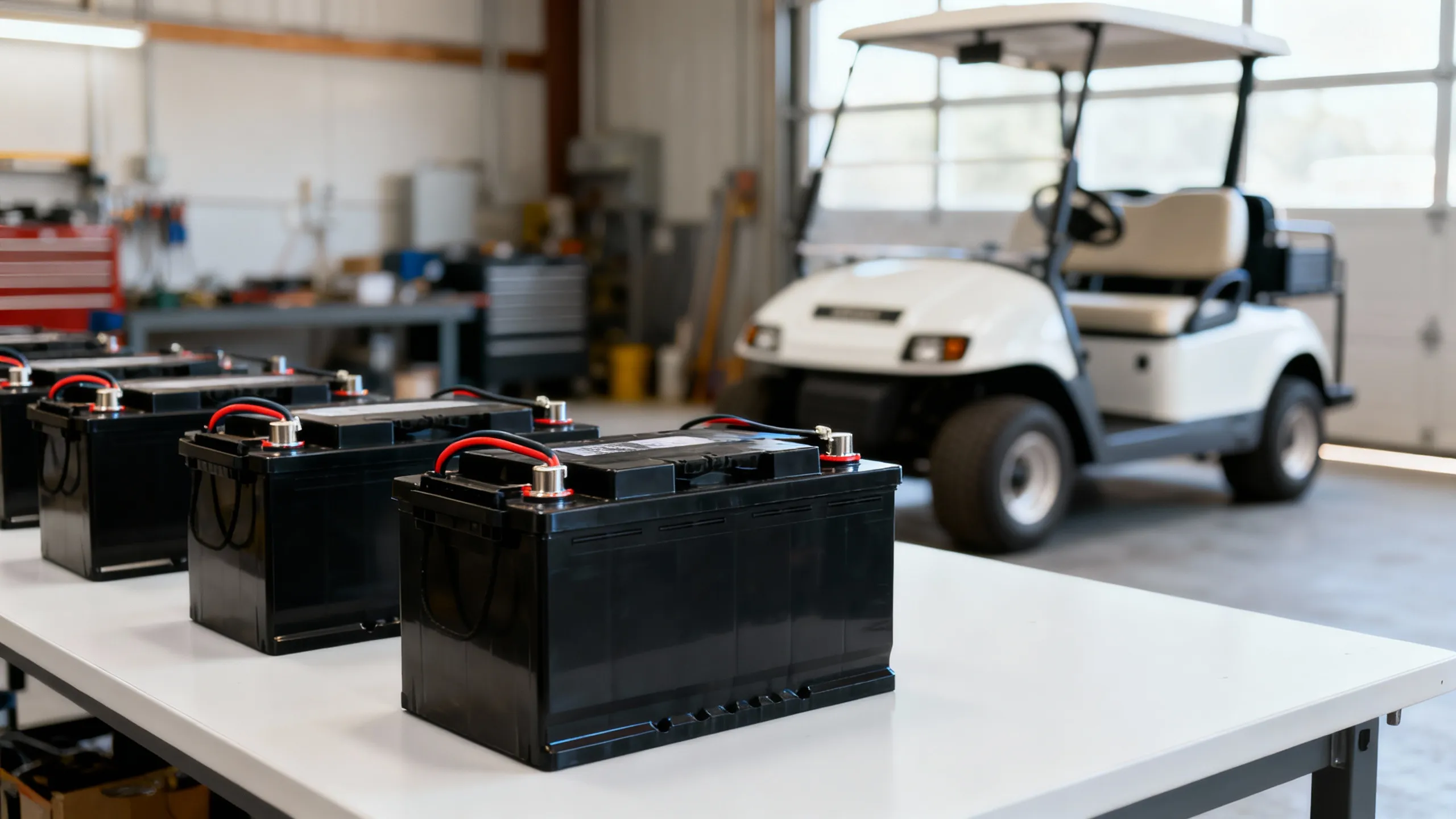
Golf cart battery types comparison showing lead-acid and lithium batteries

Golf Cart Batteries: Complete Guide to Types, Lifespan & Costs

Golf cart batteries are the heart of any electric cart, directly impacting performance, range, and long-term ownership costs. Replacing worn-out batteries? Upgrading to lithium? Buying your first electric golf cart? Understanding battery options helps you make the right choice. This guide covers everything you need to know about golf cart batteries in 2026.

4-6 Years
Lead-Acid Lifespan
10-20 Years
Lithium Lifespan
$800-$1.5K
Lead-Acid Cost
$2K-$5K
Lithium Cost

Types of Golf Cart Batteries

There are four main types of golf cart batteries. Each type performs differently and costs a different amount. Here's what you need to know to pick the right one.

Lead-Acid Flooded Batteries

Lead-acid flooded batteries are the most common and affordable option for golf carts. These traditional batteries contain liquid electrolyte (sulfuric acid and water) and require regular maintenance including water level checks and terminal cleaning.

Key Characteristics:

  • Cost: $100-$200 per battery ($600-$1,500 for full set)
  • Lifespan: 4-6 years or 500-1,000 charge cycles
  • Maintenance: High (monthly water checks, terminal cleaning)
  • Weight: 60-80 lbs per battery
  • Best for: Budget-conscious buyers, occasional use

AGM (Absorbed Glass Mat) Batteries

AGM batteries are a sealed lead-acid variant that eliminates the need for water maintenance. The electrolyte is absorbed in fiberglass mats, making them spill-proof and more resistant to vibration.

Key Characteristics:

  • Cost: $200-$350 per battery ($1,200-$2,000 for full set)
  • Lifespan: 5-7 years or 800-1,200 charge cycles
  • Maintenance: Low (no water required, occasional terminal cleaning)
  • Weight: 55-75 lbs per battery
  • Best for: Those wanting reduced maintenance without lithium cost

Gel Batteries

Gel batteries use a silica-based gel electrolyte instead of liquid, offering excellent deep-cycle performance and resistance to extreme temperatures. They're less common in golf carts due to higher cost and specific charging requirements.

Key Characteristics:

  • Cost: $250-$400 per battery ($1,500-$2,400 for full set)
  • Lifespan: 5-7 years or 1,000-1,500 charge cycles
  • Maintenance: Low (sealed, no water required)
  • Weight: 55-75 lbs per battery
  • Best for: Extreme climates, deep-cycle applications

Lithium-Ion (LiFePO4) Batteries

Lithium iron phosphate (LiFePO4) batteries are the newest option. They cost more upfront but perform better, last much longer, and need no maintenance.

Key Characteristics:

  • Cost: $2,000-$5,000 for complete system
  • Lifespan: 10-20 years or 2,000-5,000 charge cycles
  • Maintenance: None required
  • Weight: 25-35 lbs per battery (50-70% lighter than lead-acid)
  • Best for: Frequent users, those wanting best performance and lowest long-term cost

Battery Type Comparison at a Glance

Feature
Lead-Acid
AGM
Lithium-Ion
Full Set Cost
$800-$1,500
$1,200-$2,000
$2,000-$5,000
Lifespan
4-6 years
5-7 years
10-20 years
Charge Cycles
500-1,000
800-1,200
2,000-5,000
Charge Time
8-10 hours
6-8 hours
2-4 hours
Weight (Set)
360-480 lbs
330-450 lbs
100-150 lbs
Maintenance
High
Low
None
Warranty
1-2 years
2-3 years
8-10 years

How Long Do Golf Cart Batteries Last?

How long your batteries last depends on the type, how you use them, how well you maintain them, and the weather. Here's what affects battery life and replacement costs.

Lifespan by Battery Type

Lead-Acid Flooded: 4-6 years with proper maintenance, or 500-1,000 charge cycles. Heavy users (daily operation) may see 3-4 years, while light users with excellent maintenance can achieve 6-7 years.

AGM Batteries: 5-7 years typically, with 800-1,200 charge cycles. The sealed design prevents many common failure modes of flooded batteries.

Lithium-Ion: 10-20 years or 2,000-5,000 charge cycles. Many lithium batteries outlast the golf cart itself. According to Battle Born Batteries, lithium batteries typically last 5-10 times longer than lead-acid alternatives.

Factors That Affect Battery Life

🔋

Charging Habits

Charging after every use extends battery life significantly. Deep discharges (below 50% for lead-acid, below 20% for lithium) accelerate wear. Overcharging also damages batteries—always use an automatic charger.

Impact: High
🌡️

Temperature

Extreme heat accelerates chemical degradation, while cold reduces capacity. Lead-acid batteries lose 10-20% capacity at freezing temperatures. Ideal storage is 50-80°F (10-27°C).

Impact: High
đź”§

Maintenance

Lead-acid batteries require monthly water checks, terminal cleaning, and equalization charges. Neglected maintenance can cut lifespan in half. Lithium batteries require no maintenance.

Impact: High
📊

Usage Frequency

Daily use wears batteries faster than occasional use, but batteries that sit too long also degrade. Fleet carts averaging 2-3 rounds daily typically need replacement every 4-5 years.

Impact: Medium
⛰️

Terrain

Hilly terrain and frequent acceleration increase current draw, accelerating wear. Carts used primarily on flat ground typically achieve longer battery life than those regularly climbing hills.

Impact: Medium
⚖️

Load Weight

Heavier loads (multiple passengers, cargo) increase power consumption and battery stress. Consistently overloading your cart reduces battery lifespan. See our guide on how much a golf cart weighs for weight considerations.

Impact: Medium

Lithium vs Lead-Acid: Complete Comparison

The choice between lithium and lead-acid batteries is the most significant decision for golf cart owners. While lithium costs 2-3x more upfront, the total cost of ownership over 10 years often favors lithium for regular users.

Cost Analysis: 10-Year Total Ownership

Lead-Acid Batteries

$1,200 initial
Initial Purchase$1,200
Replacement (Year 5)$1,200
Replacement (Year 10)$1,200
Maintenance (10 years)$300
Electricity (less efficient)$400
10-Year Total$4,300

Lithium Batteries

$3,500 initial
Initial Purchase$3,500
Replacement (Year 5)$0
Replacement (Year 10)$0
Maintenance (10 years)$0
Electricity (95% efficient)$250
10-Year Total$3,750

Performance Differences

Beyond cost, lithium batteries offer significant performance advantages:

Consistent Power Output: Lead-acid batteries lose power as they discharge—a cart at 50% charge is noticeably slower than at 100%. Lithium batteries maintain consistent voltage and power throughout the entire discharge cycle, delivering full performance until depleted.

Faster Charging: Lithium batteries charge in 2-4 hours compared to 8-10 hours for lead-acid. This means you can recharge during lunch for afternoon use, something impossible with lead-acid.

Weight Reduction: A typical lithium conversion saves 200-300 pounds. This improves acceleration, hill climbing, and range while reducing wear on tires, brakes, and suspension. For more on weight considerations, see our golf cart weight guide.

Range: Lithium's higher energy density and efficiency typically provides 25-50% more range per charge than lead-acid batteries of equivalent size.

When Lead-Acid Still Makes Sense

Despite lithium's advantages, lead-acid batteries remain the right choice in certain situations:

  • Limited budget: If you can't afford $2,500+ upfront
  • Infrequent use: Less than once per week
  • Short ownership: Planning to sell the cart within 2-3 years
  • Older carts: Carts with compatibility issues or limited remaining lifespan

Golf Cart Battery Replacement Costs

Knowing replacement costs helps you budget ahead. Prices depend on battery type, brand, voltage, and whether you install them yourself or hire someone.

2026 Golf Cart Battery Prices

Battery Type
Per Battery
36V System (6 batteries)
48V System (6 batteries)
6V Lead-Acid Flooded
$100-$150
$600-$900
N/A
8V Lead-Acid Flooded
$150-$200
N/A
$900-$1,200
6V AGM
$200-$300
$1,200-$1,800
N/A
8V AGM
$250-$350
N/A
$1,500-$2,100
Lithium (Drop-in Kit)
N/A (sold as system)
$2,000-$3,500
$2,500-$5,000

For context on total golf cart ownership costs, see our comprehensive golf cart pricing guide.

7 Signs Your Golf Cart Batteries Need Replacement

Recognizing the warning signs of failing batteries helps you plan for replacement before being stranded. Here are the most common indicators that your batteries are nearing end of life:

1

Significantly Reduced Range

If your cart used to travel 25-30 miles per charge but now only manages 15-20 miles, battery capacity has degraded significantly. A 30%+ reduction in range typically indicates batteries nearing end of life.

2

Slow Acceleration & Hill Climbing

Struggling to accelerate or climb hills that were previously easy indicates reduced power output. Weak batteries can't deliver the high current needed for acceleration.

3

Extended Charging Times

If charging takes significantly longer than the normal 8-10 hours (lead-acid) or 2-4 hours (lithium), batteries may be struggling to accept charge. Charging times exceeding 12 hours indicate serious degradation.

4

Visible Physical Damage

Bulging or swollen battery cases, cracks, leaking acid, or heavy corrosion on terminals are clear signs of battery failure. These conditions can be dangerous and require immediate attention.

5

Low Voltage Readings

A fully charged 6-volt battery should read 6.3-6.4V, and an 8-volt battery should read 8.4-8.5V. Readings below 6.1V or 8.1V after full charge indicate significant capacity loss.

6

Sulfur or Rotten Egg Smell

A strong sulfur smell indicates overcharging or internal damage causing hydrogen sulfide gas release. This is both a battery failure sign and a safety concern requiring immediate attention.

7

Age Beyond Expected Lifespan

Lead-acid batteries over 5-6 years old or lithium batteries over 10 years should be closely monitored or proactively replaced, even if not showing obvious symptoms.

Pro Tip: Test each battery individually with a voltmeter. One bad battery in a set drags down the entire pack's performance. If only one battery is failing and others are less than 2 years old, you might consider single replacement—but replacing all batteries together is generally recommended for optimal performance.

Golf Cart Battery Maintenance Guide

Good maintenance makes batteries last longer and work better. Different battery types need different care.

Lead-Acid Battery Maintenance

Monthly Maintenance Tasks

âś“
Check Water Levels

Water should cover the lead plates by 1/4 to 1/2 inch. Add only distilled water—never tap water, which contains minerals that damage cells. Check after charging when electrolyte levels are highest.

âś“
Clean Terminals

Remove corrosion with a mixture of baking soda and water using a wire brush. Rinse with clean water, dry thoroughly, and apply terminal protectant spray or petroleum jelly.

âś“
Check Cable Connections

Ensure all cable connections are tight and free of corrosion. Loose connections cause resistance, heat, and reduced performance. Tighten to specifications but don't over-torque.

âś“
Perform Equalization Charge

Once monthly, perform an equalization charge (extended overcharge) to balance cell voltages and remove sulfation buildup. Most smart chargers have an equalization mode.

Lithium Battery Maintenance

Lithium batteries require virtually no maintenance—this is one of their biggest advantages. However, follow these guidelines for optimal longevity:

  • Keep clean: Occasionally wipe down the battery housing to prevent dirt buildup
  • Check connections: Verify cable connections remain tight annually
  • Monitor BMS: Most lithium batteries have a Battery Management System (BMS) with indicators—watch for warning lights
  • Avoid extreme storage temperatures: Store between 32°F and 80°F (0°C to 27°C) when possible

Charging Best Practices

Regardless of battery type, proper charging habits are the single most important factor in battery longevity:

  1. Charge after every use - Even short trips should be followed by charging
  2. Use the correct charger - Mismatched chargers damage batteries and may be dangerous
  3. Don't interrupt charging cycles - Let the charger complete its full cycle
  4. Avoid deep discharges - Don't run lead-acid below 50% or lithium below 20%
  5. Charge before storage - Store batteries at 100% charge (lead-acid) or 50-80% (lithium)

For more maintenance information, see our complete golf cart repair and service guide.

Understanding Golf Cart Voltage Systems

Golf carts use either 36-volt or 48-volt electrical systems, which affects battery selection, performance, and compatibility.

How to Identify Your System Voltage

The easiest way to determine your golf cart's voltage is to count the batteries and identify their individual voltage:

Golf Cart Voltage Calculator

6 batteries Ă— 6 volts each
= 36V system
6 batteries Ă— 8 volts each
= 48V system
4 batteries Ă— 12 volts each
= 48V system
8 batteries Ă— 6 volts each
= 48V system

Tip: Count the fill caps (water holes) on each battery: 3 caps = 6V, 4 caps = 8V, 6 caps = 12V

36V vs 48V Systems Compared

Feature36-Volt System48-Volt System
Power OutputStandard~33% more power
Range25-35 miles typical40-50 miles typical
Hill ClimbingAdequateSuperior
EfficiencyGoodBetter
Common OnOlder carts, budget modelsNewer carts, premium models
Battery Options6Ă— 6V batteries6Ă— 8V or 4Ă— 12V batteries

Brand Compatibility Guide

Different golf cart brands may have specific battery tray sizes and configurations:

Club Car: Most models accommodate standard battery sizes. Precedent and Onward series typically use 48V systems with 8V batteries.

E-Z-GO: TXT and RXV models commonly use 48V systems. Battery compartments are designed for specific configurations—check your model's specifications.

Yamaha: Drive and Drive2 models use 48V systems. Yamaha carts often have unique battery tray designs requiring specific battery dimensions.

For information on golf cart performance by brand, see our guide on how fast golf carts can go.

Upgrading to Lithium Batteries

Converting from lead-acid to lithium batteries is one of the most popular golf cart upgrades. Here's what you need to know before making the switch.

What's Required for Lithium Conversion

A complete lithium conversion typically includes:

  1. Lithium battery pack ($2,000-$5,000) - Drop-in replacements are designed to fit existing battery compartments
  2. Lithium-compatible charger ($200-$400) - Lead-acid chargers cannot safely charge lithium batteries
  3. Mounting hardware ($50-$150) - May be needed to secure lighter lithium batteries
  4. Optional: Upgraded cables ($50-$100) - Heavier gauge cables maximize performance

Benefits After Conversion

200-300 lbs
Weight Reduction

Improves acceleration, braking, and reduces wear on tires and suspension

25-50%
More Range

Higher energy density means more miles per charge

4Ă— Faster
Charging Speed

Full charge in 2-4 hours vs 8-10 hours

Zero
Maintenance

No water checks, no terminal cleaning, no equalization

Conversion Considerations

Before converting, verify:

  • Controller compatibility - Most controllers work with lithium, but some older controllers may need replacement or reprogramming
  • Charger receptacle - You may need to install a new charging port for the lithium-specific charger
  • Warranty implications - Check if conversion affects any remaining cart warranty
  • Physical fit - Measure your battery compartment and compare to lithium pack dimensions

Frequently Asked Questions

Q

How long do golf cart batteries last?

A

Golf cart battery lifespan depends on the type: lead-acid batteries typically last 4-6 years with proper maintenance, AGM batteries last 5-7 years, and lithium-ion batteries can last 10-20 years or 2,000-5,000 charge cycles. Factors affecting lifespan include charging habits, maintenance, usage frequency, and climate conditions.

Q

How much does it cost to replace golf cart batteries?

A

Golf cart battery replacement costs vary by type: a full set of lead-acid batteries costs $800-$1,500, AGM batteries cost $1,200-$2,000, and lithium-ion batteries cost $2,000-$5,000. Individual 6-volt lead-acid batteries cost $100-$150 each, while 8-volt batteries cost $150-$200 each. Installation labor typically adds $50-$150.

Q

Are lithium golf cart batteries worth the cost?

A

Lithium batteries are worth the higher upfront cost for most golf cart owners. While they cost 2-3x more initially ($2,000-$5,000 vs $800-$1,500 for lead-acid), they last 3-5x longer (10-20 years vs 4-6 years), require zero maintenance, weigh 50-70% less, charge 4x faster, and provide consistent power throughout discharge. Over a 10-year period, lithium typically costs less than replacing lead-acid batteries twice.

Q

How do I know if my golf cart batteries are bad?

A

Signs of failing golf cart batteries include: significantly reduced range or runtime, slow acceleration especially uphill, longer charging times (over 8-10 hours), the cart slowing down before fully discharged, visible corrosion or bulging on battery cases, acid leaks or sulfur smell, dim headlights while driving, and voltage readings below 6.1V (6-volt) or 8.1V (8-volt) per battery when fully charged.

Q

Can I replace just one golf cart battery?

A

You should replace all golf cart batteries at the same time, not just one. Mixing old and new batteries causes the new battery to work harder compensating for weaker ones, significantly shortening its lifespan. The older batteries also drag down the performance of the new one. If one battery fails and others are more than 2 years old, replace the entire set for optimal performance and longevity.

Q

How often should I charge my golf cart batteries?

A

Charge your golf cart batteries after every use, regardless of how short the trip. Never let lead-acid batteries discharge below 50% capacity, as deep discharges significantly reduce lifespan. For lithium batteries, charging after each use is still recommended but they can safely discharge to 20% without damage. Always use an automatic charger designed for your battery type and voltage system.

Q

What is the difference between 36-volt and 48-volt systems?

A

36-volt systems use six 6-volt batteries, while 48-volt systems use either six 8-volt batteries or four 12-volt batteries. 48-volt systems provide approximately 33% more power, better hill-climbing ability, longer range (typically 40-50 miles vs 25-35 miles), and improved efficiency. Most newer golf carts use 48-volt systems, while older models typically have 36-volt systems.

Q

Can I upgrade my golf cart from lead-acid to lithium batteries?

A

Yes, most golf carts can be converted from lead-acid to lithium batteries, but it requires more than just swapping batteries. You typically need a lithium-compatible charger ($200-$400), may need a new battery mounting system due to different sizes, and should verify your controller and motor can handle lithium's higher voltage consistency. Complete conversion kits cost $2,500-$6,000 including batteries, charger, and mounting hardware.

Q

Why is my golf cart battery not holding a charge?

A

Common reasons for batteries not holding charge include: sulfation from sitting discharged too long, damaged cells from deep discharge cycles, old age (beyond 4-6 years for lead-acid), faulty charger not providing full charge, loose or corroded connections reducing charging efficiency, one bad battery affecting the entire pack, or water levels too low exposing plates. Test individual battery voltage to identify the problem source.

Q

How do I maintain lead-acid golf cart batteries?

A

Lead-acid battery maintenance includes: checking water levels monthly and adding distilled water to cover plates (never tap water), cleaning terminals with baking soda and water to prevent corrosion, applying terminal protectant spray, ensuring tight cable connections, equalizing charge monthly (overcharge cycle to balance cells), storing fully charged in cool dry location, and never letting batteries sit discharged for extended periods.

Conclusion: Choosing the Right Golf Cart Batteries

Selecting the right golf cart batteries involves balancing upfront cost, expected lifespan, maintenance requirements, and performance needs. For most golf cart owners who use their cart regularly, lithium batteries offer the best long-term value despite higher initial investment. However, lead-acid batteries remain a practical choice for budget-conscious buyers, occasional users, or those with older carts.

Key Takeaways:

  • Lead-acid batteries cost less upfront but require regular maintenance and replacement every 4-6 years
  • Lithium batteries cost 2-3x more initially but last 10-20 years with zero maintenance
  • Always replace all batteries together rather than individually
  • Proper charging habits are the most important factor in battery longevity
  • 48-volt systems provide better performance than 36-volt systems

Ready to find a dealer for your battery needs? Use our golf cart dealer finder to locate authorized service centers near you. For more information on golf cart costs, see our comprehensive pricing guide.

Share this post

Find the Best Golf Cart Deal Near You

Compare top-rated golf cart dealers in your area and protect your vehicle with professional repair.

Related posts

Stay in the loop

Stay Updated with Golf Cart News

Get the latest updates on golf cart services, tips, and exclusive offers delivered to your inbox.