
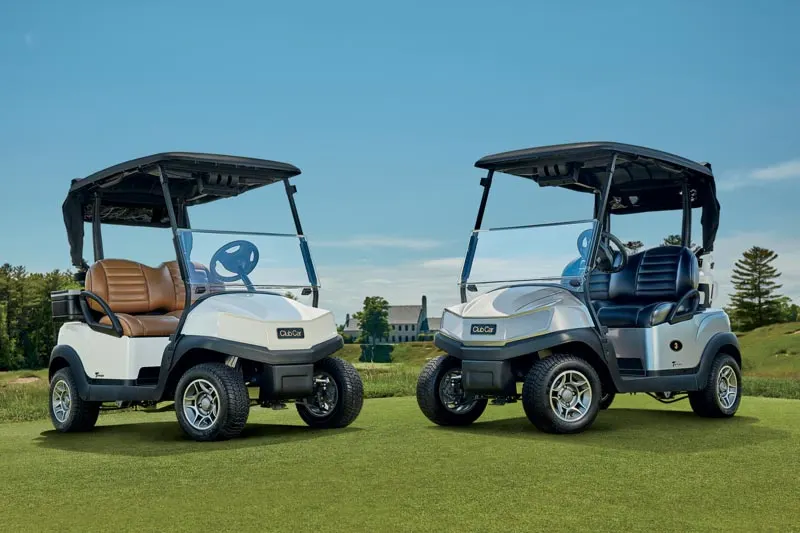
Our archived August 4, 2026 sample of 1,691 usable used dealer listings has a $5,999 median asking price. For a new-cart benchmark, E-Z-GO's model-year 2027 RXV 2 Valor S 48V starts at $9,274 MSRP, checked October 10, 2026. Neither number is your final purchase cost.
Compare the exact cart's out-the-door quote: vehicle, equipment, freight, preparation, dealer fees, applicable tax and registration. A price without its model, battery, date and included charges is a weak comparison.
New golf cart prices: dated examples
These are selected manufacturer starting prices checked October 10, 2026, not a nationwide new-cart price distribution or verified dealer invoices.
| Manufacturer listing | Starting price | What the price identifies |
|---|---|---|
| E-Z-GO MY2027 RXV 2 Valor S 48V AC | $9,274 | Two passengers, lead-acid electric |
| E-Z-GO MY2027 RXV 2 Valor S gas | $9,487 | Two passengers, 13.5-hp gas |
| E-Z-GO MY2027 RXV 2 Freedom ELiTE | $11,844 | Two passengers, lithium; different trim |
| Club Car Onward 2 Passenger | $10,099 | Non-lifted lineup starting MSRP; confirm powertrain in quote |
| Club Car Onward 4 Passenger | $11,299 | Non-lifted lineup starting MSRP; confirm powertrain in quote |
| Club Car Onward 6 Passenger | $15,799 | Non-lifted lineup starting MSRP; confirm powertrain in quote |
Sources: E-Z-GO RXV 2, Club Car personal lineup. E-Z-GO expressly excludes tax, freight, setup and dealer-added accessories. Obtain a written quote for every configuration; the Club Car lineup price does not establish the cost of each available battery option.
The two RXV Valor S rows provide a concrete counterexample to a universal electric premium: $9,274 − $9,487 = −$213. The electric starting MSRP is lower here. The Freedom lithium row is a different trim, so its price gap cannot isolate the price of lithium batteries.
A current model page can change to a new model year before the calendar year ends. These RXV figures are MY2027 prices, checked in October 2026; they should not be called MY2026 prices.
Treat a compact recreational cart, full-size personal transportation vehicle and certified low-speed vehicle as different purchasing categories. Seats, lights or a seller's speed claim alone do not establish road eligibility. Check the certification and local rules for the actual vehicle before paying extra for a “street legal” description. See the road-use guide.
Used golf cart prices: our saved listing sample
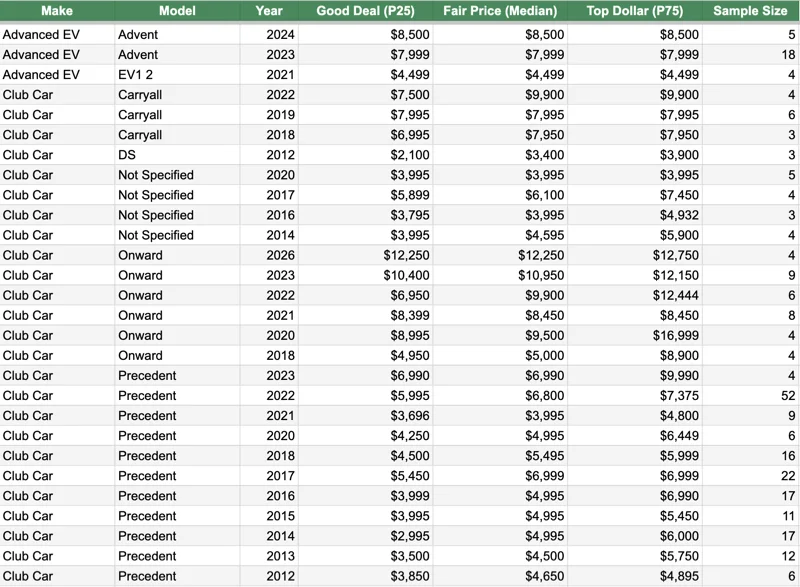
We reproduced the figures from our saved GolfCartResource dealer-listing collection on October 10. Its collection date remains August 4, 2026; it is not a live inventory feed.
The 1,812 raw records reduce to 1,691 with condition “Used,” a stated year and make, and numeric asking price from $1,000 through $30,000. We sorted prices and used the observation at zero-based index floor(n/2) as the median; even groups use the upper middle price. Percentiles use floor(n×0.25) and floor(n×0.75). These filters and conventions matter when reproducing the result.
| Observed group | Listings | Median asking price |
|---|---|---|
| All usable used listings | 1,691 | $5,999 |
| Advertised two passengers | 598 | $5,000 |
| Advertised four passengers | 804 | $6,595 |
| Advertised six passengers | 78 | $10,900 |
The overall rounded mean is $6,479; the observed 25th–75th percentile interval is $4,695–$7,895. The seating groups mix model years, equipment, battery labels and locations. Their differences do not measure the isolated value of adding seats, and other seating categories remain outside these three rows.
We did not verify every VIN, eliminate every repeated vehicle advertisement, or observe completed sales. The sample is dealer inventory, not a private-sale or trade-in dataset. It does not establish a fixed dealer markup, lithium premium or annual depreciation rate.
For example, the sample's E-Z-GO RXV median is $6,399 for 2020 models (60 listings) and $5,950 for 2022 models (52 listings). The newer group is $449 lower. That is a difference between mixed listing groups, not evidence that an individual cart gains or loses a set percentage each year.
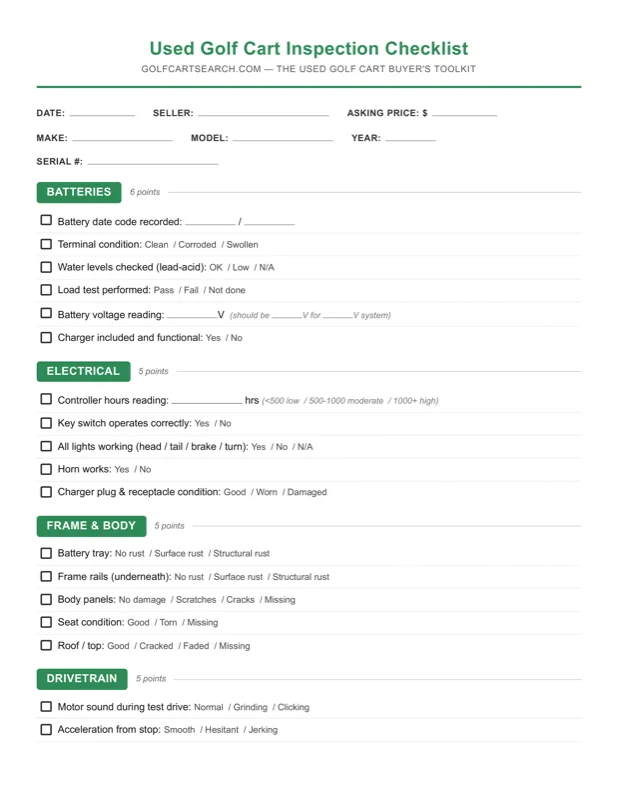
Use the full used-price analysis for brand counts and power-label limitations. The Buyer's Toolkit includes the saved pricing context and inspection materials. Compare current local peers before setting an offer.
Calculate the out-the-door price
Ask each seller for one itemized total with the same equipment and delivery destination. Record which charges are included in the advertised price and which are added later.
Hypothetical calculation, not a dealer quote or a local tax ruling:
| Item | Example |
|---|---|
| Cart | $10,000 |
| Freight | $500 |
| Preparation | $250 |
| Assumed taxable subtotal | $10,750 |
| Assumed 7% tax on that subtotal | $752.50 |
| Separate registration charge | $100 |
| Total | $11,602.50 |
Actual tax rates, taxable items and registration requirements depend on location and transaction. Replace every input with the dealer's written quote and applicable authority's rules. A posted “$10,000 cart” is $1,602.50 above its headline in this example; that is the result of these assumptions, not a standard fee percentage.
Similarly, a hypothetical $9,500 cart with $1,000 in added charges totals $10,500 before tax, while a comparable $10,000 cart with no added charges totals $10,000. The lower advertisement is $500 more expensive here. Compare totals before treating a discount as a saving.
Get separate prices for delivery, charger, battery, desired accessories, warranty and required road-use paperwork. A fleet discount or trade allowance needs a real written offer; no universal bulk-discount percentage is established here. See the dealer-fee guide.
Financing: compare total payments
Request the amount financed, interest rate, APR, term, payment schedule, total payments and required fees. The CFPB explains that APR includes relevant lender fees as well as interest, so comparing an interest rate with another loan's APR can mislead. CFPB explanation.
A hypothetical $7,000 purchase with $700 down leaves $6,300 financed. At a fixed 7% annual interest rate over 48 monthly payments, with no fees or balloon, the amortized payment is approximately $150.86 per month. The unrounded calculation produces approximately $7,241.34 in loan payments, or $941.34 interest; adding the down payment brings the purchase-and-interest total to approximately $7,941.34. Actual payment rounding can slightly change the last payment.
That is arithmetic, not an average customer payment, available lender quote or approval promise. Add any financed taxes and fees before calculating your payment. For advertised promotions, verify the eligible model, expiry, credit conditions and whether taking financing changes an available cash rebate. For leases, compare purchase-option, return, damage and mileage/use terms. See the financing guide.
Ownership costs: use your actual inputs
Budget for the exact vehicle's maintenance, battery condition, tires, insurance, storage, registration where applicable and possible repairs. The correct manual and a diagnosis determine service needs; an engine rebuild is not an automatic expense every five to seven calendar years.
For a used cart, obtain a written installed battery or repair quote when inspection identifies a likely expense. A $5,400 ask plus an assumed $900 quoted repair equals $6,300 before other charges. Compare that with an inspected $6,000 alternative rather than choosing the lower advertisement alone. The $900 is a hypothetical input, not a market repair estimate.
Charging formula: wall energy in kWh × your electricity price per kWh. A plug-in energy measurement over a representative recharge is better than treating every plug-in as a full charge.
If measuring battery energy instead, an assumed 4 kWh replenishment at assumed 90% charging efficiency needs 4 ÷ 0.90 = 4.44 kWh from the wall. At an assumed $0.20/kWh, that costs about $0.89. A tiny 0.1 kWh replenishment under the same assumptions costs about $0.02. These examples explain why “under ten cents per charge” cannot describe every recharge. They are not measured pack capacity, efficiency or a current tariff.
Get an insurance quote for your vehicle, location and use; verify any registration fee with the local authority. Neither an annual owner-savings average nor a car-replacement saving follows from cheap charging alone. Purchase cost, replaced trips, insurance and repairs all matter. The maintenance guide and insurance guide help identify the inputs.
Before you accept the price
- Match the exact year, trim, seating, battery and charger.
- Inspect condition and ownership documents; price identified repairs in writing.
- Confirm warranty scope and transfer eligibility, rather than assuming the longest headline applies.
- Obtain the itemized delivered total and financing disclosures, if financing.
- Check the seller, service access, returns and vehicle eligibility for your intended use.
For an online cart, inspect the current listing's seller, shipping charges, assembly, return shipping and service terms. This guide supplies no verified current Amazon cart price, stock status or free-shipping promise. Start with the used inspection checklist and dealer directory, then compare written offers for the cart you will actually receive.
Frequently asked questions
How much is a golf cart in 2026?
Our August 4, 2026 sample has a $5,999 median used dealer asking price. A new MY2027 E-Z-GO RXV 2 Valor S 48V starts at $9,274 MSRP, checked October 10, 2026. Compare exact configurations and written out-the-door totals.
What is the average used golf cart price?
The saved 1,691-listing sample has a rounded $6,479 mean and a $5,999 upper-middle median asking price. It is a dated dealer advertisement sample, not completed sales or a nationwide appraisal.
Do electric golf carts cost more than gas?
It depends on the configuration. The MY2027 RXV 2 Valor S 48V starts at $9,274 versus $9,487 for its gas counterpart. Lithium models and different trims require separate comparisons.
What fees should I check before buying?
Ask for vehicle, accessories, freight, preparation, dealer fees, applicable tax, registration and delivery in one written total. Confirm what the advertised price already includes.
How much does charging cost?
Multiply measured wall-energy kWh by your electricity tariff. The article’s hypothetical 4 kWh battery replenishment at 90% efficiency and $0.20/kWh costs about $0.89; a small top-off costs less.
How fast does a golf cart depreciate?
This one-day asking-price sample cannot establish annual depreciation. Compare exact models, condition and battery documents; value-retention claims need purchase and later sale evidence for comparable vehicles.
Golf Cart Search
Find the Best Golf Carts of 2026
Compare top-rated models, read expert reviews, and find the perfect cart for your needs.