
Best Golf Cart Chargers: 36V & 48V Buyer's Guide (2026)

Compare the best golf cart chargers for 36V and 48V systems. Covers Club Car, EZGO, and Yamaha with pricing, troubleshooting tips, and top picks.

Michael
Michael
Feb 27th, 202614 min read
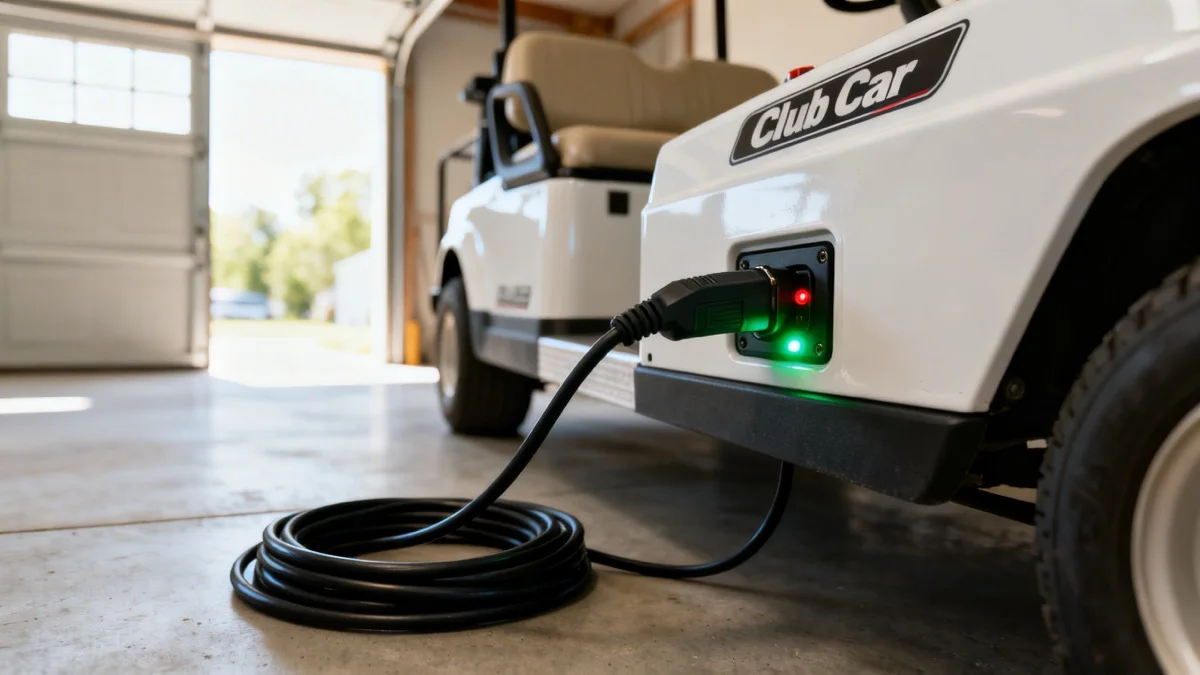
Golf cart battery charger connected to a white Club Car in a clean garage workshop

As an Amazon Associate, we earn from qualifying purchases. This helps support our site at no extra cost to you.

A dead golf cart charger is one of those problems you never think about until it happens. You pull your cart out for the first ride of spring, plug it in overnight, and wake up to the same dead battery indicator. Or worse, your charger has been slowly cooking your batteries for months without you realizing it.

Whether you need a replacement charger, an upgrade from the basic unit that came with your cart, or a new charger for a lithium battery conversion, this guide covers everything. We break down chargers by voltage, brand, battery type, and budget so you can find the right match for your specific golf cart.

Budget Chargers $80 - $120

Mid-Range Chargers $250 - $300

Premium Chargers $350 - $500+

Cost Per Charge $0.50 - $1.50

How to Choose the Right Golf Cart Charger

Buying the wrong charger can damage your batteries or even cause a fire. Before you shop, you need to nail down four things: voltage, connector type, battery chemistry, and amperage.

Step 1: Determine Your Voltage System

Golf carts run on either 36V or 48V systems. Using the wrong voltage charger will destroy your batteries. Here is how to figure out which system you have:

Count your batteries and do the math:

Battery CountBattery VoltageSystem Voltage
66V36V
68V48V
86V48V
412V48V

If you are unsure what voltage each battery is, check the label on top. You can also find the system voltage on your controller label, your cart's serial number plate, or the sticker on your existing charger.

Step 2: Identify Your Connector Type

Golf cart charger plugs are brand-specific and not interchangeable. The three most common types:

  • Club Car (3-pin round): Used on Precedent and DS models. The round plug with three prongs in a triangular pattern.
  • EZGO (D-style / Powerwise 2-pin): The rectangular plug used on EZGO TXT models. Older models use a different "SB50" connector.
  • Yamaha (2-pin round / MAC): The round plug with two prongs used on Yamaha G29 Drive and Drive2 models.
  • Crowfoot: A flat, three-pronged plug used on some older Club Car, EZGO, and Yamaha models. This is the most "universal" connector.

When ordering a charger, always confirm the connector matches your specific cart model and year. The same brand can use different plugs across different model years.

Step 3: Match Your Battery Chemistry

This is where people make expensive mistakes. Lead-acid and lithium batteries need completely different chargers.

Lead-acid (flooded, AGM, gel): Standard golf cart chargers work with these. Most chargers on the market are designed for lead-acid batteries. Some premium models like the Schauer JAC series let you switch between flooded and AGM/gel profiles.

Lithium (LiFePO4): These batteries require a dedicated lithium charger with a specific voltage curve. A 48V lithium charger outputs 58.4V at peak (compared to 51-52V for lead-acid). Using a lead-acid charger on lithium batteries will damage them and creates a fire risk. If you have recently completed a lithium conversion, make sure your charger matches.

Step 4: Choose Your Amperage

Charger amperage determines how fast your batteries charge. Most golf cart chargers fall between 10 and 20 amps.

  • 10-13 amps: Slower charge, gentler on batteries, good for occasional use
  • 15 amps: The standard sweet spot for most carts. Balances speed and battery longevity.
  • 18-20 amps: Faster charge times but generates more heat. Fine for lead-acid, but check your lithium manufacturer's recommendation before going above 15A.

A 15-amp charger on a typical 48V lead-acid system takes about 8-10 hours from a deep discharge. Bump up to 18 amps and that drops to 6-8 hours.

Smart Charger Features Worth Paying For

Modern smart chargers are significantly better for your batteries than older single-stage units. Look for:

  • Multi-stage charging: The charger adjusts its output through bulk, absorption, and float stages based on battery condition.
  • Automatic shutoff: Stops charging when batteries are full. Essential for leaving the charger connected overnight or during winter storage.
  • Temperature compensation: Adjusts charging voltage based on ambient temperature. Critical in hot climates like Florida and Arizona.
  • Float/maintenance mode: Keeps batteries topped off with a low trickle charge after reaching full. Safe for long-term connection with a smart charger.
  • IP67 waterproofing: Important if you charge outdoors or in humid environments.

Best Golf Cart Chargers: Our Top Picks for 2026

After researching dozens of chargers and cross-referencing owner reviews, here are the best options by category. We focused on chargers with smart charging capabilities, solid warranties, and proven reliability across real-world use.

Quick Comparison

ChargerVoltageAmpsBest ForPrice
EXEFCH 48V (Club Car)48V15ABudget Club Car pick~$97
EXEFCH 36V (EZGO TXT)36V18ABudget EZGO pick~$97
EXEFCH 48V (Yamaha)48V15ABudget Yamaha pick~$97
MODZ Max4848V15AMid-range Club Car~$275
MODZ Max3636V15AMid-range EZGO~$275
Delta-Q QuiQ48V18APremium / fleet use~$400+

Best Budget: EXEFCH 48V 15A for Club Car

The EXEFCH 48V is a smart charger that punches well above its price point. At around $97, it costs a fraction of premium options while delivering 9-stage intelligent charging, IP67 waterproofing, and a 5-year warranty.

Key specs: 48V / 15A output, 18-foot heavy-duty cable, works with or without the On-Board Computer (OBC), weighs just 5.2 pounds, and runs quieter than 40dB. The built-in temperature sensor adjusts charging parameters automatically.

This charger is compatible with Club Car Precedent and DS models with the standard 3-pin round connector. For lead-acid batteries only.

Check Price on Amazon

Best Budget for EZGO: EXEFCH 36V 18A for EZGO TXT

The 36V version of the EXEFCH line is built for EZGO TXT models with the D-style Powerwise 2-pin plug. Same smart charging technology, same 5-year warranty, same lightweight design at 5.5 pounds.

Key specs: 36V / 18A output delivers a full charge in roughly 7 hours. Auto shutoff with over-voltage and over-current protection. IP67 waterproof with ultra-quiet operation. Automatically switches to maintenance mode once batteries reach full charge.

Check Price on Amazon

Best Budget for Yamaha: EXEFCH 48V 15A for Yamaha G29

EXEFCH also makes a Yamaha-specific version for the G29 Drive and Drive2 models. Same 9-stage charging, same build quality, same 5-year warranty. Compatible with the Yamaha 2-pin round connector.

If you own a Yamaha G19 through G22, EXEFCH offers a separate model with the correct connector for those older carts.

Check Price on Amazon

Best Mid-Range: MODZ Max48 for Club Car

The MODZ Max48 is a step up in build quality and charging intelligence. Its internal microprocessor monitors battery capacity and ambient temperature in real time, adjusting the charge profile continuously. The "plug and forget" smart float technology means it is completely safe to leave connected indefinitely.

Key specs: 48V / 15A output, 7 pounds, die-cast aluminum casing, IP67 weather resistance. Detects OBC presence automatically and charges accordingly. Available for Club Car DS and Precedent models.

At $275-$300, the MODZ costs about three times the budget options. The tradeoff: hundreds of verified positive reviews, an established brand reputation, and charging algorithms refined over years of production. If you want peace of mind and plan to keep your cart for the long haul, the MODZ is worth the premium.

Check Price on Amazon

The MODZ Max36 (MODZ Max36 for EZGO TXT) offers the same features for 36V EZGO systems at a similar price point.

Best Premium: Delta-Q QuiQ 48V

The Delta-Q QuiQ is what you will find stock on many new EZGO carts. It is the OEM choice for a reason: 93% energy efficiency, completely sealed passive cooling (no fans to fail), and 10 lab-validated charge profiles built in.

Key specs: 48V / 18A output (1000W), IP66 sealed construction, handles extreme temperatures, moisture, vibration, and chemical exposure. Available in both on-board and off-board configurations.

At $400-$500+, the Delta-Q is for serious owners, fleet operators, or anyone who wants the same charger their manufacturer trusts. It is the gold standard in the industry and built to last decades.

Check Price on Amazon

Golf Cart Chargers by Brand

Each major golf cart manufacturer uses different connectors, voltages, and onboard electronics. Here is what you need to know for the three biggest brands.

Club Car Charger Guide

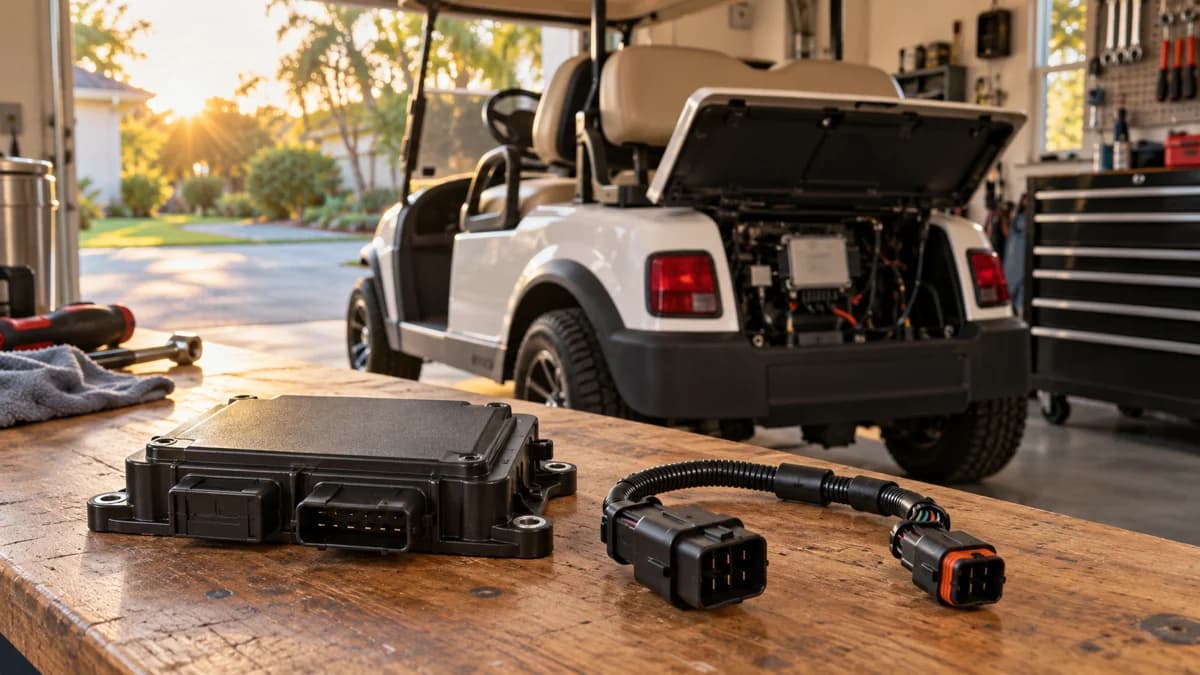
Club Car models present a unique challenge because of the On-Board Computer (OBC). The OBC is a circuit board inside the cart that communicates with the charger to control the charging process. When the OBC fails, your charger will not activate even if the charger itself works perfectly.

Common Club Car setups:

  • Precedent (2004+): 48V system, 3-pin round connector, OBC-equipped
  • DS (1995-2004): 48V system, 3-pin round connector, OBC on most models
  • Older DS (pre-1995): 36V system, crowfoot connector

Club Car OBC troubleshooting: If your charger clicks but will not start charging, the OBC is the most likely culprit. Some aftermarket chargers (including the EXEFCH models above) are designed to bypass the OBC and charge directly, which is a major advantage if your OBC has failed and you do not want to pay $200+ for a replacement board.

EZGO Charger Guide

EZGO carts have gone through several charger plug generations, so matching the right connector to your model year is critical.

Common EZGO setups:

  • TXT (1996+): 36V system, D-style Powerwise 2-pin plug
  • RXV (2008+): 48V system, RXV-specific plug (Delta-Q onboard charger standard)
  • Older models (pre-1996): 36V system, SB50 connector or crowfoot

The EZGO RXV comes with a Delta-Q onboard charger from the factory. If your onboard charger fails, replacement OEM units run $300-$500. Aftermarket alternatives are available for less but check compatibility carefully.

Yamaha Charger Guide

Yamaha carts use a 2-pin round connector (sometimes called a MAC connector) that is unique to the brand.

Common Yamaha setups:

  • Drive2 (2017+): 48V system, 2-pin round connector
  • G29 Drive (2007-2016): 48V system, 2-pin round connector
  • G22 (2003-2006): 48V system, different 2-pin connector
  • G19/G16 (older): 36V or 48V depending on model, various connectors

Yamaha carts do not use an OBC system like Club Car, which means charger compatibility is more straightforward. Match the voltage, plug type, and battery chemistry, and you are good to go.

Lithium Battery Charger Requirements

More golf cart owners are switching to lithium batteries every year. If you are converting from lead-acid to lithium or buying a cart with lithium batteries, your charger situation changes completely.

Why Lead-Acid Chargers Will Not Work with Lithium

A standard lead-acid charger tops out at 51-52V for a 48V system. A lithium LiFePO4 battery pack needs 58.4V to reach full charge. Your lead-acid charger will only charge lithium batteries to about 80%, leaving significant range on the table.

More importantly, the charging curve is different. Lead-acid chargers use an equalization stage that pushes voltage higher to mix battery acid. On lithium cells, this equalization voltage can cause swelling, venting, or thermal runaway. It is not worth the risk.

What to Look for in a Lithium Charger

  • Correct peak voltage: 58.4V for 48V systems, 43.8V for 36V systems
  • CC/CV charging profile: Constant current until target voltage, then constant voltage until current tapers off
  • No equalization stage: This feature damages lithium cells
  • BMS communication (optional): Some chargers communicate with the Battery Management System for optimized charging
  • 15A recommended: Most lithium battery manufacturers recommend 15 amps to balance charge speed and cell longevity

Most lithium conversion kits from brands like LOSSIGY, LiTime, and Eco Battery include a matched charger. If you need to buy one separately, budget $150-$300 for a quality lithium-specific charger. Our lithium battery conversion guide covers the full process including charger selection.

Troubleshooting: Golf Cart Charger Not Working

Before you spend money on a new charger, run through these common issues. Many charger problems are actually battery or connection problems in disguise.

Charger Will Not Turn On

Check the basics first:

  1. Test the power outlet with another device. A tripped GFCI outlet is a common culprit.
  2. Inspect the charger fuse (usually accessible on the exterior).
  3. Check the charger cord for damage, fraying, or rodent chewing.

If the outlet and fuse are fine:

  • Your batteries may be below the charger's minimum activation voltage. Most chargers need at least 25-30V from a 36V pack or 35-40V from a 48V pack to start. Batteries that sit discharged for months can drop below this threshold.
  • Fix: Charge each battery individually with a standard 12V automotive charger for 15-20 minutes to bring the pack above the minimum voltage, then try the golf cart charger again.

Charger Clicks but Does Not Charge

Clicking means the charger detects the battery pack and is trying to engage, but something is preventing it from starting the charge cycle.

Most likely causes:

  • One or more batteries are dead or severely imbalanced
  • Corroded or loose battery terminal connections
  • Failed OBC on Club Car models
  • A single bad battery dragging the pack voltage below the activation threshold

Fix: Check each battery individually with a voltmeter. A healthy 6V battery should read 6.2-6.4V, an 8V battery should read 8.2-8.5V, and a 12V battery should read 12.6-12.8V. Any battery reading significantly lower than these numbers is likely the problem. For more diagnostic steps, see our troubleshooting guide.

Charger Runs but Batteries Stay Dead

If the charger appears to charge (lights indicate charging, fan runs) but your batteries remain dead after a full cycle:

  • The charger may be faulty and not actually delivering current. Test with an ammeter on the output cable.
  • Your batteries may be sulfated beyond recovery. This happens when lead-acid batteries sit discharged for extended periods.
  • The charger may be shutting off prematurely due to incorrect voltage detection.

Charger Will Not Shut Off

A charger that runs endlessly is overcharging your batteries, boiling the electrolyte, and shortening battery life dramatically.

Common causes:

  • Failed auto-shutoff circuit in the charger (charger needs replacement)
  • Failed OBC on Club Car (the OBC tells the charger when to stop)
  • One or more batteries that cannot hold a charge, causing the charger to keep trying

If your charger is running for more than 12 hours on what should be a standard recharge, unplug it and investigate. Overcharging lead-acid batteries produces hydrogen gas and excessive heat, both of which are safety hazards.

Charging Costs and Times

One of the biggest advantages of electric golf carts is how cheap they are to charge compared to fueling a gas cart.

How Long Does It Take to Charge?

Battery TypeCharger AmpsTime to Full Charge
Lead-acid (36V)15A6-8 hours
Lead-acid (36V)18A5-7 hours
Lead-acid (48V)15A8-10 hours
Lead-acid (48V)18A6-8 hours
Lithium (48V)15A2-4 hours
Lithium (48V)20A1.5-3 hours

These times assume a full discharge cycle. If you charge after every use (recommended), the actual charge time will be much shorter since you are only topping off.

What Does It Cost to Charge?

At the national average electricity rate of $0.16 per kWh:

  • 36V lead-acid system: ~$0.50-$0.80 per full charge
  • 48V lead-acid system: ~$0.80-$1.20 per full charge
  • 48V lithium system: ~$0.60-$0.90 per full charge (lithium is more energy-efficient)

Over a year of regular use, most owners spend $50-$150 on electricity. Compare that to $500-$800+ per year for gas on a gas-powered golf cart. That is roughly $0.02-$0.04 per mile for electric versus $0.08-$0.15 per mile for gas.

Safety Tips for Charging Your Golf Cart

Fire departments in golf cart communities across Florida, South Carolina, and Arizona have issued specific warnings about golf cart charging fires. Most incidents are preventable.

Ventilation Is Critical

Lead-acid batteries release hydrogen gas during charging. Hydrogen is lighter than air, odorless, and highly flammable. In a closed garage, it can accumulate near the ceiling and ignite from a spark, pilot light, or electrical switch.

Best practices:

  • Always crack the garage door or open a window during charging
  • Never charge near water heaters, furnaces, or anything with a pilot light
  • Install a simple hydrogen gas detector if you charge indoors regularly

Lithium batteries produce minimal off-gassing during normal operation but can release toxic fumes if a cell fails. Ventilation is still a smart precaution.

Electrical Safety

  • Use a dedicated circuit for your golf cart charger. Sharing a circuit with other high-draw appliances can trip breakers or cause overheating.
  • Plug directly into a wall outlet. Avoid extension cords, which can overheat under the sustained high-current draw of a golf cart charger.
  • Install a surge protector to shield your charger from power spikes during storms. A $30 surge protector can save a $300 charger.

General Charging Rules

  • Charge on a flat, dry surface
  • Keep the charging area clear of flammable materials (gas cans, solvents, rags)
  • Inspect charger cords and battery connections regularly for wear or corrosion
  • Replace any charger with a damaged cord, cracked housing, or burning smell immediately
  • Never charge a visibly damaged or swollen battery

Charger Maintenance and Lifespan

A quality golf cart charger should last 10-20 years. Budget models may last 3-5 years. Here is how to get the most life out of yours.

Extending Charger Life

  • Use a surge protector. Power surges are the number one charger killer. Lightning strikes and grid fluctuations can fry the internal electronics instantly.
  • Keep it dry. Even IP67-rated chargers last longer when stored in a dry location. Water intrusion over time corrodes internal components.
  • Store properly. During extended periods of non-use, disconnect the charger and store it indoors. Extreme heat and cold degrade electronic components. See our winterization guide for seasonal storage tips.
  • Keep connections clean. Corroded charger plugs create resistance, generating heat that damages both the plug and the charger's output circuitry. Clean terminals with a wire brush and apply dielectric grease.
  • Let it breathe. Do not cover the charger or block ventilation openings during use. Overheating is the second most common cause of charger failure after power surges.

When to Replace vs. Repair

Replace the charger if:

  • It will not turn on at all (after verifying the outlet and fuse)
  • It overcharges or will not shut off
  • Charge times have increased significantly (taking 12+ hours regularly)
  • You smell burning plastic or see scorch marks
  • You are converting from lead-acid to lithium batteries
  • The charger is over 15 years old and showing inconsistent performance

Consider repair if:

  • Just the plug or cord is damaged (replacement cords are $30-$50)
  • A single fuse blew (usually caused by a power surge)
  • The charger works intermittently (often a loose internal connection that a shop can fix for $50-$100)

For routine golf cart maintenance including battery and charger care, check our complete year-round maintenance guide.

How to Determine Which Charger You Need

Still not sure which charger to buy? Here is the quick decision path:

Step 1: Count batteries and determine your voltage (36V or 48V). See the battery guide if you need help.

Step 2: Check your battery type. Lead-acid or lithium?

Step 3: Identify your cart brand and model year for the correct connector.

Step 4: Set your budget:

  • Under $120: The EXEFCH chargers offer excellent value with smart charging, waterproofing, and 5-year warranties. Available for Club Car, EZGO, and Yamaha.
  • $250-$300: The MODZ Max series delivers proven reliability with hundreds of positive reviews and microprocessor-controlled charging.
  • $350+: Delta-Q and Schauer for professional-grade performance, fleet use, or when you want the best available.

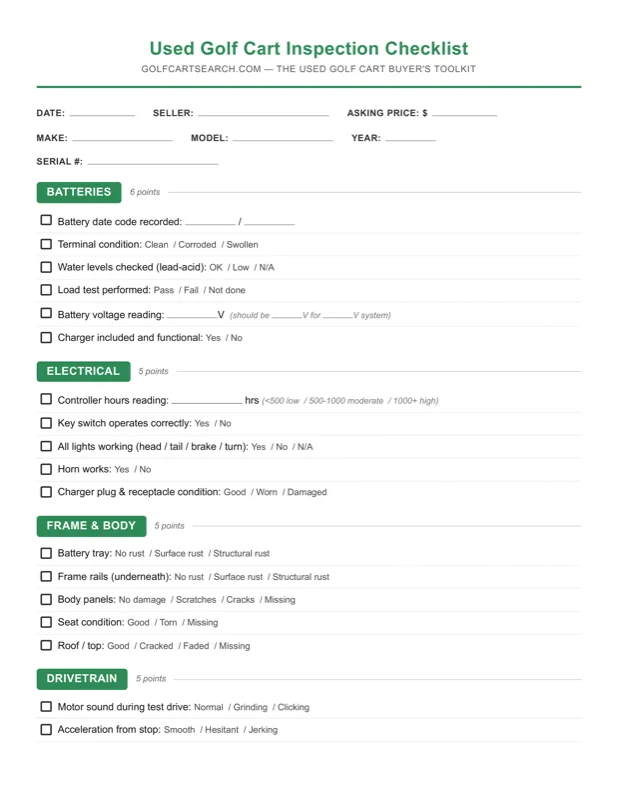
If you are shopping for a new golf cart, the charger is usually included. For used golf carts, always check the charger condition as part of your inspection. A missing or damaged charger is a $100-$500 expense you should factor into the purchase price.

Once your charging situation is sorted, check out our golf cart accessories guide for other upgrades worth considering. If your cart needs to be street legal, you will also want lights, mirrors, and a windshield, all of which draw power and make a reliable charger even more important.

Browse local dealers and find golf carts for sale with chargers included on our dealer directory. You can also compare specific models from Club Car, EZGO, Yamaha, Icon, and Star EV on our brand comparison pages. Check your state's requirements on our golf cart laws page and review insurance options before hitting the road.

Frequently Asked Questions

What charger comes standard with a new golf cart?

Most new golf carts include a charger from the factory. Club Car typically includes a Lester or EZGO-branded unit. EZGO RXV models come with a Delta-Q onboard charger. Yamaha includes a JW2-H2107 or equivalent. If buying from a dealer, confirm the charger is included and note its amperage and features. If you are buying used, the original charger may be missing or worn out.

Can I use a higher-amp charger to charge faster?

You can, within reason. Going from a 10-amp to a 15-amp charger is fine for most battery packs. Going from 15 to 20 amps is also acceptable for most lead-acid systems but generates more heat. For lithium batteries, always follow the manufacturer's amperage recommendation. Using too high an amperage charger can void your battery warranty and reduce cell longevity.

What is an On-Board Computer (OBC) and why does it matter?

The OBC is a circuit board found in Club Car models (primarily Precedent and newer DS carts) that sits between the charger and batteries. It controls the charging process and tells the charger when to start and stop. When the OBC fails, the charger will not activate. OBC replacement costs $150-$250 at a repair shop. Some aftermarket chargers are designed to work with or without the OBC, bypassing this potential failure point.

Do golf cart chargers work in cold weather?

Most chargers function in temperatures down to 32F (0C), but charging efficiency decreases in the cold. Lead-acid batteries accept charge more slowly in cold weather and can be damaged by charging below freezing. Lithium LiFePO4 batteries should not be charged below 32F at all. Chargers with temperature compensation automatically adjust for these conditions. For seasonal storage tips, see our winterization guide.

Should I charge my golf cart after every use?

Yes. Topping off after every use keeps your batteries in their optimal charge range and prevents sulfation in lead-acid batteries. With a smart charger that has auto-shutoff, there is no downside to plugging in after every ride. The charger will bring batteries to full and switch to maintenance mode automatically. For range optimization, consistent charging habits make the biggest difference.

Share this post

Golf Cart Search

Find the Best Golf Carts of 2026

Compare top-rated models, read expert reviews, and find the perfect cart for your needs.
Browse Top-Rated Carts

Related posts

Stay in the loop

Stay Updated with Golf Cart News

Get the latest updates on golf cart services, tips, and exclusive offers delivered to your inbox.