Best Golf Cart Enclosures: Covers, Rain & Sunbrella
Last Updated: February 2026
This article contains affiliate links. As an Amazon Associate, we earn from qualifying purchases at no extra cost to you.
Quick Answer: Best Golf Cart Enclosure
Most golf cart owners should buy a model-specific 600D soft enclosure that matches the cart brand, model, seat layout, and roof length. It costs about $100 to $300, fits much tighter than a universal cover, and lasts about 3 to 5 years. Choose a universal over-the-top enclosure for occasional rain, a Sunbrella track-style or hinged-door enclosure for year-round use, and a hard cab only for commercial or extreme-weather carts.
A golf cart enclosure is a removable or semi-permanent cover that attaches to your cart's roof and frame, protecting you from rain, wind, cold, and sun while you drive. Enclosures are the single best way to turn a fair-weather golf cart into a year-round vehicle.
We talk to golf cart owners every day, and weather protection is one of the most common topics that comes up — especially from owners in retirement communities, northern states, and coastal areas where rain is a constant. The problem? Most "best enclosure" articles online are thin product lists with no real buying advice. Nobody explains the material differences, nobody covers newer cart brands like ICON and Evolution, and nobody talks about how enclosures, windshields, and heaters work together as a system.
That's what this guide is for. We break down every enclosure type, compare materials with real lifespan data, show you exactly what fits your cart, and help you build a complete weather protection setup based on your climate and budget.
Quick Answer: What Enclosure Should I Get?
Best Golf Cart Enclosures: Quick Picks
| Need | Best enclosure type | Best material | Typical cost |
|---|---|---|---|
| Occasional rain or budget use | Universal over-the-top enclosure | 300D-600D polyester | $35-$80 |
| Most owners | Model-specific soft enclosure | 600D polyester with PU coating | $100-$300 |
| Sunny climates and long-term ownership | Track-style enclosure | Sunbrella solution-dyed acrylic | $400-$800 |
| Daily drivers and mobility concerns | Hinged-door enclosure | Sunbrella or marine vinyl | $600-$1,200 |
| Commercial or extreme weather | Hard cab | Aluminum plus polycarbonate/acrylic | $1,500-$3,000+ |
If you are comparing golf cart covers and enclosures, remember the key difference: an enclosure is driveable and has windows/doors, while a storage cover is only for a parked cart.
Best Materials for Golf Cart Covers and Enclosures
| Material | Best for | Expected life | Watch-out |
|---|---|---|---|
| 600D polyester with PU coating | Most golf cart enclosures | 3-5 years | Water-resistant, not perfectly waterproof |
| Marine-grade vinyl | Rainy and coastal climates | 5-7 years | Can trap condensation and feel stiff in cold weather |
| Sunbrella solution-dyed acrylic | Premium UV resistance and year-round use | 10+ years | Higher upfront price |
| Clear PVC windows | Visibility on soft enclosures | 2-3 years | Yellows and cracks before the main fabric fails |
| Polycarbonate or acrylic panels | Hard cabs and premium windows | 10+ years | Adds cost and weight |
For most buyers, 600D polyester is the best value. Sunbrella is the best premium material when fading, UV exposure, and long-term outdoor use matter most.
What's in This Guide
Enclosure vs Cover: What's the Difference?
A golf cart enclosure and a golf cart cover serve completely different purposes, and confusing the two is one of the most common mistakes buyers make.
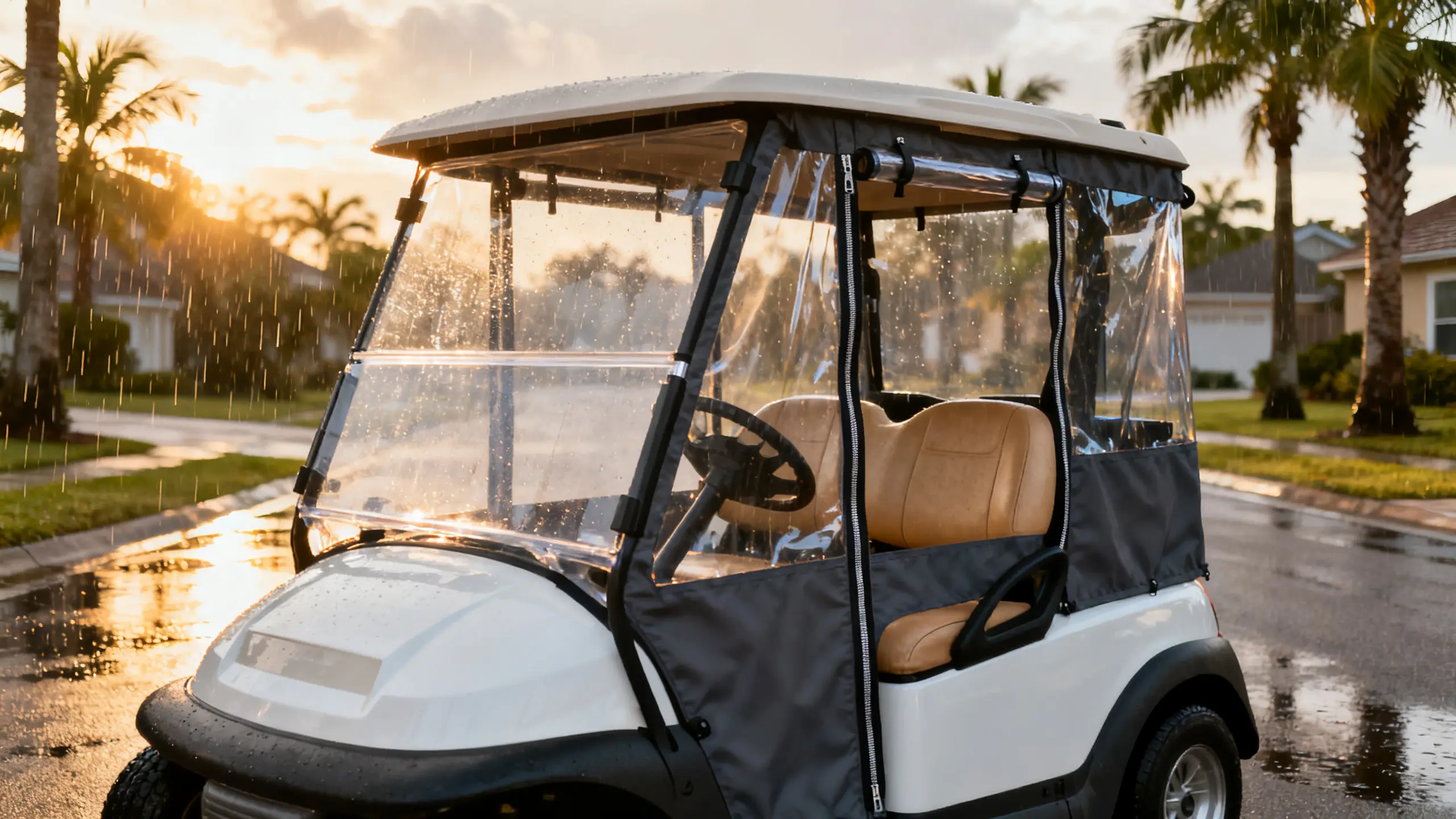
A driveable enclosure attaches to the roof and wraps around the sides and back of your cart. It has clear vinyl or polycarbonate windows so you can see while driving, plus zippered or roll-up doors for getting in and out. You leave it on the cart and drive with it installed.
A storage cover drapes over the entire cart — roof, windshield, body, and sometimes the wheels. It protects the cart from dust, rain, bird droppings, and UV damage while parked. You cannot drive with a storage cover on.
| Feature | Driveable Enclosure | Storage Cover |
|---|---|---|
| Purpose | Ride in rain, wind, cold | Protect cart while parked |
| Windows | Clear PVC/polycarbonate | No windows (opaque) |
| Doors | Zippered or hinged entry | No entry points |
| Can you drive with it? | Yes | No |
| Typical price | $80-$1,200 | $30-$150 |
| Install time | 15-45 minutes | 2-5 minutes |
| Left on cart? | Yes, semi-permanent | Removed before driving |
Bottom Line: If you want to ride your cart in bad weather, you need an enclosure. If you just want to keep your cart clean while it sits in the driveway or garage, a storage cover is enough. Many owners buy both — an enclosure for the riding season and a cover for long-term storage. For storage covers, see our golf cart covers buyer's guide.
5 Types of Golf Cart Enclosures
Golf cart enclosures come in five distinct types. Each has trade-offs in price, durability, weather protection, and convenience. Here's what separates them.
1. Universal Over-the-Top Enclosures
The most affordable option. A single piece of fabric that drapes over the roof and down both sides, secured with elastic cords and hooks under the cart. Designed to fit most 2-passenger or 4-passenger carts regardless of brand.
- Best for: Budget buyers, occasional use, seasonal protection
- Material: 300D-600D polyester
- Weather protection: Basic — blocks rain and wind, but gaps at corners and bottom let cold air in
- Fit: Loose and baggy (one-size-fits-most approach)
- Install time: 10-15 minutes
- Cost: $35-80
- Lifespan: 1-3 years
Downsides: Universal fit means the enclosure doesn't contour to your cart. Expect flapping at highway speeds (25+ mph), poor seal against driving rain, and visible gaps where cold air enters. Fine for light rain and mild cold, but not for serious winter riding.
2. Model-Specific Soft Enclosures
A step up from universal. These enclosures are cut and sewn to fit a specific golf cart brand and model (e.g., "EZGO TXT 2014+" or "Club Car Precedent 2004-2024"). They use the cart's existing attachment points — roof edges, windshield frame, rear struts — for a tighter fit.
- Best for: Most golf cart owners (best balance of price, fit, and protection)
- Material: 600D polyester with waterproof (polyurethane) coating, marine-grade vinyl, or canvas
- Weather protection: Good — contoured fit reduces gaps significantly
- Fit: Snug, tailored to your cart's dimensions
- Install time: 15-30 minutes
- Cost: $100-300
- Lifespan: 3-5 years
This is the sweet spot for most buyers. A model-specific 600D enclosure at $100-200 provides 80% of the weather protection of a $600+ premium enclosure at a fraction of the cost.
3. Track-Style Enclosures
A semi-permanent system where aluminum tracks are mounted to the cart's roof edges. Fabric panels slide into the tracks, creating a tight, rattle-free seal. Premium models use Sunbrella fabric — a special type of acrylic where the color is baked into every fiber before weaving, not dyed on after. This is why it resists fading for 10+ years and comes with a 10-year manufacturer warranty.
- Best for: Year-round riders, retirement communities, owners who want a clean look
- Material: Sunbrella acrylic or heavy-duty marine canvas
- Weather protection: Very good — track system eliminates flapping and most air gaps
- Fit: Precise (custom-measured or model-specific panels)
- Install time: 30-45 minutes first time (track mounting), then 5 minutes to slide panels in/out
- Cost: $400-800
- Lifespan: 8-12+ years (Sunbrella fabric)
Key advantage: Once the tracks are installed, you can slide the panels off in summer and back on in fall in under 5 minutes. The track system also holds up much better in wind than snap or hook systems.
4. Hinged-Door Enclosures
The premium soft enclosure option. Features real swinging doors on hinges, often with magnetic or latch closures. Doors open outward like a car, eliminating the awkwardness of unzipping a panel every time you get in or out.
- Best for: Daily drivers, owners with mobility concerns, premium setups
- Material: Sunbrella, marine vinyl, or combination
- Weather protection: Excellent — doors seal tightly with weatherstripping
- Fit: Custom or model-specific
- Install time: 30-60 minutes (one-time installation)
- Cost: $600-1,200
- Lifespan: 8-12+ years
The convenience factor is real. If you get in and out of your cart 10+ times a day (common in golf cart communities like The Villages or Peachtree City), unzipping a panel every time gets old fast. Owners on golf cart forums consistently call hinged doors "the best upgrade I ever made" — and once you use them, it's hard to go back to zippers.
5. Hard Cab / Permanent Enclosures
Rigid enclosures made from aluminum frames with hard plastic (polycarbonate) or acrylic windows. These are essentially a car cabin bolted onto your golf cart. Manufactured by companies like Curtis Industries.
- Best for: Commercial fleets, extreme climates, owners who want maximum protection
- Material: Aluminum frame, polycarbonate / acrylic glazing
- Weather protection: Excellent — full seal, no fabric degradation
- Fit: Model-specific (bolt-on)
- Install time: 1-3 hours (professional recommended)
- Cost: $1,500-3,000+
- Lifespan: 15+ years
Trade-off: Hard cabs add 50-100 lbs to your cart, reducing range on electric carts by 5-10%. They also make the cart significantly wider, which can be an issue in tight garage spaces. But for cold-climate year-round use or commercial operations, nothing else comes close.
Enclosure Type Comparison
| Type | Price | Lifespan | Weather Protection | Fit Quality | Install | Best For |
|---|---|---|---|---|---|---|
| Universal over-the-top | $35-80 | 1-3 yrs | Fair | Loose | 10-15 min | Budget / occasional |
| Model-specific soft | $100-300 | 3-5 yrs | Good | Snug | 15-30 min | Most owners |
| Track-style | $400-800 | 8-12+ yrs | Very good | Precise | 30-45 min | Year-round riders |
| Hinged-door | $600-1,200 | 8-12+ yrs | Excellent | Custom | 30-60 min | Daily drivers |
| Hard cab | $1,500-3,000+ | 15+ yrs | Excellent | Bolt-on | 1-3 hrs | Commercial / extreme |
Enclosure Materials Compared
The material your enclosure is made from determines how long it lasts, how well it blocks weather, and how it feels to use. This is where most buying guides fall short — they mention material names without explaining what they actually mean for you.
| Material | Lifespan | Water Resistance | UV Resistance | Breathability | Feel | Price Tier |
|---|---|---|---|---|---|---|
| 300D polyester | 1-3 years | Fair (water-resistant) | Fair (fades in 1-2 seasons) | Moderate | Thin, lightweight | Budget |
| 600D Oxford polyester (waterproof coated) | 3-5 years | Good (water-resistant, not waterproof) | Moderate (some fading) | Moderate | Sturdy, moderate weight | Mid-range |
| Marine-grade vinyl | 5-7 years | Excellent (waterproof) | Good | Poor (traps condensation) | Stiff, plasticky | Mid-premium |
| Sunbrella (solution-dyed acrylic) | 10+ years | Very good (breathable water-repellent) | Excellent (color won't fade) | Excellent | Soft, fabric-like | Premium |
| Clear PVC (windows) | 2-3 years | Excellent | Poor (yellows with UV) | N/A | Stiff when cold | All tiers |
What "Solution-Dyed" Means: Standard fabrics are woven white and then dyed on the surface. UV rays break down surface dye, causing fading within 1-3 years. Sunbrella fabric is "solution-dyed," meaning the color is baked into each fiber before weaving. The color literally cannot wash out or bleach away. According to Sunbrella's manufacturer warranty, their fabric is guaranteed against fading, mildew, and loss of strength for a full 10 years.
The PVC Window Problem
Regardless of how premium your enclosure fabric is, the clear PVC windows are the weak link. PVC yellows, becomes brittle, and loses clarity after 2-3 years of UV exposure. This is true even on $800+ Sunbrella enclosures.
What to do about it:
- Apply a UV-protectant spray (like 303 Aerospace Protectant) to PVC windows every 3-4 months
- Never fold enclosures with PVC windows in cold weather — the material cracks
- When storing, roll the enclosure rather than folding it to avoid permanent creases in the windows
- Budget for replacement windows every 3-4 years (most manufacturers sell them separately for $30-80)
Avoid This Mistake: Never use Windex, ammonia-based cleaners, or paper towels on PVC windows. Ammonia causes permanent hazing, and paper towels leave micro-scratches that compound over time. Use mild dish soap, warm water, and a microfiber cloth. This applies to every enclosure at every price point.
How to Choose the Right Size
Golf cart enclosures are sized by two factors: passenger capacity and roof length. Getting the wrong size is the #1 reason for returns, so measure before you buy.
Step 1: Count Your Seats
| Configuration | Description | Typical Enclosure Label |
|---|---|---|
| 2-passenger | Front bench seat only | "2-passenger" or "standard" |
| 2+2 (rear-facing) | Front bench + rear-facing flip seat | "4-passenger rear-facing" |
| 4-passenger (forward-facing) | Front bench + forward-facing rear bench | "4-passenger forward-facing" |
| 6-passenger | Front bench + two rear benches or limo-style | "6-passenger" or "stretch" |
Step 2: Measure Your Roof
Grab a tape measure and measure the roof from front edge to back edge along the centerline. This is the single most important measurement for enclosure fit.
| Roof Classification | Roof Length | Typical Carts | Enclosure Size |
|---|---|---|---|
| Short roof | 54-61" | Standard 2-passenger | 2-passenger enclosure |
| Standard roof | Up to 68" | 2+2 with rear-facing seat | 4-passenger (rear-facing) |
| Long / extended roof | ~80" | 4-passenger forward-facing | 4-passenger (forward-facing) |
| Extra-long roof | 94-124" | 6-passenger | 6-passenger enclosure |
Roof Matters More Than Seat Count: A common mistake is ordering a "4-passenger enclosure" because your cart has 4 seats, without checking roof length. If you added a rear flip seat but kept the factory short roof, you need a 2-passenger enclosure, not a 4-passenger one. The enclosure attaches to the roof, not the seats. Measure the roof.
If your roof is damaged or too short for your seating layout, you may need a replacement or extended top before adding an enclosure. Our golf cart tops and canopies guide covers sizing, materials, and pricing for every major brand.
Step 3: Check Brand and Model Compatibility
If you're buying a model-specific enclosure (recommended), you need to know your exact cart brand, model, and year. Here's where to find it:
- EZGO: Serial number plate under the passenger-side glove box or under the seat
- Club Car: Serial number plate under the front passenger-side dashboard
- Yamaha: On the frame under the seat or on a plate behind the front bumper
- ICON / Evolution: VIN plate on the driver-side dashboard
Newer Brands Note: If you own an ICON, Evolution, Advanced EV, Star EV, or Bintelli cart, enclosure options are more limited than for EZGO, Club Car, or Yamaha. Some model-specific enclosures are starting to appear from brands like 10L0L and Ace Golf Cart Covers. If you can't find a model-specific fit, a universal enclosure with adjustable straps is your best option until the aftermarket catches up. Check back in this guide — we update it as new products launch.
Best Enclosures by Use Case
Different riders need different enclosure setups. A golfer in Arizona has completely different needs than a retiree in Michigan. Here's what we recommend based on how and where you use your cart.
| Use Case | Recommended Type | Material | Est. Cost | Key Feature |
|---|---|---|---|---|
| Golf course (3-season) | Universal over-the-top | 300D-600D polyester | $35-80 | Lightweight, easy on/off |
| Neighborhood cruising | Model-specific soft | 600D polyester (PU-coated) | $100-200 | Good fit, solid protection |
| Retirement community (year-round) | Track-style or hinged-door | Sunbrella or marine vinyl | $400-1,200 | Convenience + durability |
| Cold climate / northern states | Model-specific + heater + windshield | 600D or marine vinyl | $150-350 (enclosure only) | Full weather system approach |
| Rainy / coastal climate | Marine vinyl model-specific | Marine-grade vinyl | $150-300 | Waterproof, salt-resistant |
| Hunting / off-road | Heavy-duty universal | 600D+ with reinforced seams | $80-150 | Rugged, branch-resistant |
| Commercial / rental fleet | Hard cab | Aluminum + polycarbonate | $1,500-3,000 | Vandal-resistant, long life |
Climate-Specific Recommendations
Where you live matters just as much as what cart you drive. Here's how to pick the right setup for your climate.
Hot & sunny climates (Florida, Arizona, Texas): Your main enemy is UV damage, not cold. Choose a Sunbrella enclosure if budget allows — the solution-dyed fabric won't fade. Keep PVC windows treated with UV protectant. A tinted windshield also reduces heat buildup significantly. In summer, remove side panels for airflow and add a clip-on fan or misting system to stay cool.
Cold & snowy climates (Michigan, Minnesota, Wisconsin): An enclosure alone is not enough below 50°F. You need the full system: enclosure + windshield + heater. Marine vinyl is more windproof than polyester but causes more condensation issues. See our complete weather protection system section below for the right setup.
Rainy & humid climates (Pacific Northwest, Gulf Coast): Marine-grade vinyl provides the best waterproofing, but ventilation is critical to prevent fogging and mildew. Choose an enclosure with roll-up side panels so you can open up airflow on humid days.
Mild year-round (Southern California, Carolinas): A mid-range 600D model-specific enclosure handles everything you'll encounter. You may only need it for occasional rain or cool mornings, so easy on/off convenience matters most.
Complete Weather Protection System
Here's what most enclosure guides miss: an enclosure is just one piece of a weather protection system. In mild weather, an enclosure alone is enough. In serious cold, rain, or wind, you want multiple layers working together.
Level 1: Enclosure Only
- Blocks: Rain, wind, light cold
- Comfortable down to: ~50°F
- Cost: $80-300
- Best for: 3-season use, mild climates
An enclosure by itself keeps you dry and blocks wind. On a 55°F day, that's usually enough. But the enclosure doesn't generate heat, so as temperatures drop, you'll feel it.
Level 2: Enclosure + Windshield
- Blocks: Rain, wind, cold, debris
- Comfortable down to: ~40-45°F
- Additional cost: $100-350 for windshield
- Best for: Extended 3-season use, street-legal carts
A fold-down windshield adds a rigid barrier in front that blocks cold air much better than a flexible enclosure panel. Windshields also keep road debris, bugs, and rain out of your face at speed. If your cart is street-legal, most states require a windshield anyway. According to NHTSA's Low-Speed Vehicle regulations, LSVs must meet Federal Motor Vehicle Safety Standards that include windshield requirements. Check your state's golf cart laws for specifics. If your main question is whether the cart itself is actually safe to drive in wet weather, read our rain driving safety guide for braking, standing-water, and charging-after-rain mistakes to avoid.
ZivPlay EZGO TXT Fold-Down Windshield on AmazonLevel 3: Enclosure + Windshield + Heater
- Blocks: Rain, wind, cold, extreme cold
- Comfortable down to: ~25-30°F
- Additional cost: $30-150 for heater
- Best for: Northern climates, winter riding, year-round use
Adding a heater transforms your enclosed cart from "tolerable in cold" to "genuinely comfortable." Two options:
Portable propane heaters ($30-80) like the Mr. Heater MH4GC are cup-holder-sized and produce 2,400-4,000 BTU. They work immediately and require no installation. Downside: propane fumes in an enclosed space require cracking a window for ventilation.
Electric heaters for 48V carts ($50-150) wire directly into your cart's electrical system. No fumes, no refilling propane, and they double as a defroster for your windshield. The trade-off is a 5-10% reduction in battery range per charge. For a full breakdown of both propane and electric options by brand and voltage, see our golf cart heater buyer's guide.
JNOD 48V Electric Golf Cart Heater on AmazonLevel 4: Full System (Enclosure + Windshield + Heater + Accessories)
For the ultimate cold-weather setup, add:
- Heated seat covers ($30-80) for direct body warmth
- Floor mats ($30-60) to insulate from cold metal floorboards
- A phone mount to keep your GPS and music accessible without removing gloves
Cost to Build the Full System: A complete weather protection setup — mid-range enclosure ($150) + fold-down windshield ($150) + electric heater ($100) + heated seat covers ($50) — runs about $450 total. That's less than 5% of what most golf carts cost and turns a 6-month vehicle into a 12-month vehicle.
Brand-Specific Enclosure Recommendations
EZGO TXT / RXV / Valor / Liberty
EZGO is the most popular golf cart brand in the U.S., and the aftermarket reflects it — you'll find the widest selection of enclosures for EZGO models. EZGO carts are also the most compatible with enclosures because their roof mounting points are standardized across models.
Our pick for most EZGO owners: A model-specific 600D enclosure in the $100-200 range. EZGO owners on forums overwhelmingly recommend going model-specific over universal — the fit difference is dramatic. These enclosures match the TXT and RXV body styles precisely, with cutouts for mirrors, lights, and rear seat configurations.
Doorworks Two-Passenger Enclosure on AmazonPremium pick: DoorWorks track-style enclosure with Sunbrella fabric ($500-700). Slides on and off in minutes once the tracks are installed.
Club Car Precedent / Onward / Tempo / DS
Club Car's Precedent-platform carts (Precedent, Onward, Tempo) share a common roof and body design, so one enclosure fits all three. The older DS model requires a different enclosure.
Our pick: A Precedent-specific 600D enclosure ($100-200). Make sure the listing specifies "Precedent/Onward/Tempo" — DS enclosures are shaped differently and will not fit.
If your search is specifically for Club Car Sunbrella enclosures, look at premium track-style or hinged-door systems rather than budget universal covers. Sunbrella makes the most sense for Club Car owners who keep the cart outside, ride year-round, or want a cleaner semi-permanent enclosure. Confirm DS versus Precedent/Onward/Tempo fit before ordering because the roof and windshield frame are not interchangeable.
Watch out: Club Car changed the roof design between 2004 and 2008 models. Enclosures labeled "2004-2024" should fit all, but some budget brands don't specify the year range. When in doubt, check your roof measurements and contact the seller.
Yamaha Drive / Drive2 / G29
Yamaha's Drive-platform carts (sold as G29, Drive, and Drive2 depending on model year) have a distinctive body shape that differs from EZGO and Club Car. The roof attachment points are in different positions, so EZGO/Club Car enclosures will not work on Yamaha carts.
Our pick: A Yamaha Drive/Drive2-specific 600D enclosure ($100-200). Fewer options exist compared to EZGO and Club Car, but 10L0L, Formosa, and Greenline all make Yamaha-specific models.
ICON / Evolution / Star EV / Advanced EV / Bintelli
These newer brands have gained significant market share since 2020, but the aftermarket for enclosures is still catching up. Model-specific enclosures are hard to find for most of these brands.
Current options:
- ICON i40/i60: Specialist retailers sell different fitted enclosures for four-passenger i40/i40L and six-passenger i60/i60L carts. Use our ICON accessories and fitment guide to match the model, year, roof, seat direction, and lifted status.
- Kandi Kruiser: Kandi sells separate soft enclosures for the legacy 4P, current 4Pro, 4Pro Forward, and legacy 6P. Use our Kandi Kruiser accessory fitment guide before assuming seat count determines compatibility.
- Evolution Classic/Forester: Check Ace Golf Cart Covers for model-specific options
- Star EV: Sirius-specific enclosures are available from specialist suppliers, but Capella and J Model owners should confirm roof, windshield, and passenger-layout fitment. Use our Star EV accessories guide before buying.
- Advanced EV / Bintelli: Universal enclosures are currently your best bet. Measure your roof carefully.
Newer Brand Owners: The aftermarket for ICON, Evolution, Star EV, and Advanced EV enclosures is growing fast. If you can't find a model-specific fit today, check again in 3-6 months. In the meantime, a universal enclosure with adjustable straps and extra securing hooks will get you through the season. The fit won't be as tight, but it still blocks the bulk of wind and rain.
Common Problems & How to Solve Them
We read through hundreds of posts on Buggies Gone Wild, Cartaholics, and Reddit's r/golfcarts to find the most common enclosure complaints. Most come down to buying the wrong type or skipping basic maintenance. Here are the top issues and how to fix them.
Fogging and Condensation
The problem: PVC windows fog up from inside, reducing visibility to near zero in cold or humid conditions. This is the #1 complaint with golf cart enclosures.
Why it happens: When warm, moist air from your breath hits the cold PVC surface, water condenses on the inside. Vinyl and PVC enclosures are especially bad because they don't breathe.
How to fix it:
- Crack a side zipper 2-3 inches to create cross-ventilation
- Apply anti-fog spray (like Rain-X Anti-Fog) to the inside of PVC windows every 2-4 weeks
- Install a small 12V or USB fan to circulate air inside the enclosure
- If you have a heater, aim it at the windshield — warm air keeps the surface above the temperature where moisture forms
- Choose a Sunbrella enclosure if possible — it breathes far better than marine vinyl
Flapping and Noise at Speed
The problem: The enclosure flaps loudly in the wind, especially above 15 mph. The noise is annoying, and constant flapping wears out the fabric faster.
Why it happens: Loose fit (universal enclosures) or insufficient attachment points. Wind gets under the fabric and billows it outward.
How to fix it:
- Add aftermarket bungee cords or tie-down straps at the bottom edges
- Install snap buttons at strategic points (most cart frames accept self-tapping snaps)
- Switch to a model-specific or track-style enclosure for a tighter fit
- Tuck excess fabric under the seat or tie it down — loose material is the main wind catcher
PVC Windows Yellowing
The problem: Clear windows turn yellow and hazy after 1-2 years, reducing visibility and making the enclosure look old.
Why it happens: UV radiation breaks down the chemicals that keep PVC flexible. Over time, the material stiffens, yellows, and becomes cloudy. Heat speeds this up.
How to fix it:
- Apply UV-protectant spray (303 Aerospace Protectant) every 3-4 months — this is the single most effective prevention
- Park in shade whenever possible (UV is the primary cause)
- Budget for replacement windows every 3-4 years (available from most manufacturers for $30-80 per panel)
- For severe yellowing, a marine plastic polish (like Meguiar's PlastX) can restore partial clarity
Zipper Failures
Zippers jam, separate, or straight-up break — usually because dirt and sand build up in the teeth over time. Cold weather makes it worse by stiffening the zipper tape.
The fix is simple maintenance: brush the zippers clean once a month and hit them with beeswax or silicone spray every couple of months. If you're shopping for a new enclosure, look for YKK-brand zippers on the product listing. They cost more but outlast generic zippers by a wide margin. And if a zipper gets stuck, don't force it. Work it gently back and forth — forcing it breaks the slider and then you're replacing the whole panel.
Snap Deterioration
Snaps loosen over time as the fabric around them stretches, and in coastal areas, salt air corrodes the metal. Both problems get worse the more you remove and reattach the enclosure.
To prevent it, reinforce snap attachment points with a dab of fabric adhesive or an extra patch of material on the inside. If snaps are already corroded, a stainless steel snap repair kit ($5-15) lets you replace individual snaps without replacing the whole enclosure. Coastal owners should rinse metal hardware with fresh water after days with heavy salt air exposure.
How Much Do Golf Cart Enclosures Cost?
We checked prices across Amazon, Golf Cart Garage, 10L0L, DoorWorks, and major golf cart parts retailers in early 2026. Here's what you can expect to pay:
| Enclosure Type | Price Range | Example Brands | Durability |
|---|---|---|---|
| Budget universal (over-the-top) | $35-80 | VEVOR, Classic Accessories, Kiseer | 1-3 years |
| Mid-range universal | $80-150 | 10L0L, Formosa Covers, KAKIT | 2-4 years |
| Model-specific soft (600D) | $100-300 | 10L0L, Greenline, Doorworks | 3-5 years |
| Track-style (Sunbrella/canvas) | $400-800 | DoorWorks, RedDot, National Golf Cart Covers | 8-12+ years |
| Hinged-door premium | $600-1,200 | DoorWorks (Sunbrella or marine vinyl) | 8-12+ years |
| Hard cab (permanent) | $1,500-3,000+ | Curtis Industries | 15+ years |
| Storage cover (non-driveable) | $30-150 | Classic Accessories Fairway, Formosa | 2-5 years |
Cost Per Year of Use
Price alone doesn't tell the full story. A $60 enclosure that lasts 2 years costs $30/year. A $600 Sunbrella enclosure that lasts 12 years costs $50/year. Here's how the math works out:
| Type | Price | Lifespan | Cost Per Year |
|---|---|---|---|
| Budget universal ($60) | $60 | ~2 years | $30/yr |
| Mid-range model-specific ($150) | $150 | ~4 years | $37.50/yr |
| Track-style Sunbrella ($600) | $600 | ~12 years | $50/yr |
| Hard cab ($2,000) | $2,000 | ~15 years | $133/yr |
Best Value: For most owners, the mid-range model-specific enclosure at $100-200 offers the lowest cost per year of use and the least hassle. Budget enclosures need replacing every 1-2 years (adding up to the same total cost), while premium enclosures last longer per dollar but require a bigger upfront commitment. Sunbrella track-style enclosures make financial sense if you plan to keep your cart for 5+ years.
Complete Weather Protection System Costs
If you're building a full cold-weather setup, here's what to budget:
| Component | Budget Setup | Mid-Range Setup | Premium Setup |
|---|---|---|---|
| Enclosure | $60 (universal) | $150 (model-specific 600D) | $600 (track-style Sunbrella) |
| Windshield | $100 (basic fixed) | $150 (fold-down) | $250 (tinted fold-down) |
| Heater | $35 (propane cup-holder) | $100 (48V electric) | $150 (48V + defroster) |
| Extras | — | $50 (phone mount + floor mats) | $130 (heated seats + mats + mount) |
| Total | $195 | $450 | $1,130 |
Installation: DIY vs Professional
DIY Installation (Most Enclosure Types)
Most soft enclosures — universal, model-specific, and even track-style — can be installed by one person with basic tools. No special skills required.
Universal enclosures (10-15 minutes):
- Drape the enclosure over the roof with the windshield panel facing forward
- Attach elastic cords or hooks to the cart frame underneath
- Adjust the fit by tightening or loosening the hook positions
- Zip up the door panels and check for alignment
Model-specific soft enclosures (15-30 minutes):
- Start by draping the enclosure over the roof and aligning the attachment points
- Snap or hook the top edge to the roof lip
- Secure the sides to the windshield frame and rear struts
- Attach bottom straps under the cart body
- Zip door panels and check that windows align with the frame
Track-style enclosures (30-45 minutes first time):
- Mount aluminum tracks to the roof edges using self-tapping screws (drill required)
- Slide the top panel into the tracks from front to back
- Attach side panels to the track and secure at the bottom
- Adjust tension and alignment
Tools needed for most installations: Phillips screwdriver, drill (for track-style only), zip ties (backup), and patience for alignment.
When to Hire a Professional
Consider professional installation ($50-150 labor) for:
- Hard cab enclosures — These bolt to the frame and require precise alignment. A misaligned hard cab can stress the roof structure.
- Hinged-door enclosures — Door alignment is critical. If the hinges are off by even 1/4 inch, the doors won't close properly.
- Track-style on carts without existing holes — Drilling into your roof requires confidence. If you're not comfortable with it, a golf cart dealer can install the tracks in 30 minutes.
Pro Tip: Most golf cart dealers will install enclosures purchased elsewhere for a reasonable labor fee ($50-100). If you buy an enclosure online and want professional installation, call your local dealer before purchasing to confirm they'll install third-party products. Find golf cart dealers near you.
Frequently Asked Questions
What is the best golf cart enclosure?
For most owners, the best golf cart enclosure is a model-specific 600D polyester soft enclosure that matches the cart brand, model, seat layout, and roof length. It usually costs $100 to $300, fits better than a universal cover, and lasts about 3 to 5 years. Choose Sunbrella or a hinged-door enclosure if you ride year-round or want a premium setup.
What are the best materials for golf cart covers and enclosures?
The best all-around enclosure material is 600D polyester with a waterproof coating because it balances price, durability, and weather resistance. Sunbrella solution-dyed acrylic is the premium choice for UV resistance and long life. Marine-grade vinyl is the most waterproof but traps condensation. Clear PVC windows are common, but they usually yellow before the main fabric wears out.
Are Sunbrella golf cart enclosures worth it?
Sunbrella golf cart enclosures are worth it for year-round riders, sunny climates, retirement communities, and owners who plan to keep the cart for several years. Sunbrella shade and marine fabrics carry a 10-year limited warranty, resist fading better than standard polyester, and breathe better than vinyl, but the upfront cost is much higher.
Are Club Car Sunbrella enclosures available?
Yes. Club Car Sunbrella enclosures are commonly available through premium track-style or hinged-door systems, including DoorWorks-style options. Match the enclosure to the exact Club Car platform, such as DS versus Precedent, Onward, or Tempo, because roof shape and windshield frame compatibility affect fit.
Are golf cart enclosures worth it?
Yes. An enclosure extends your riding season by 3-4 months in northern climates and keeps you dry year-round everywhere else. Budget enclosures start at $35-80, making them one of the cheapest upgrades that meaningfully changes how much you use your cart. Compared to the $8,000-15,000 cost of the cart itself, spending $100-300 on an enclosure is a small investment for a big quality-of-life improvement.
What's the difference between an enclosure and a cover?
An enclosure has clear windows and zippered doors — you drive with it on. A cover is opaque and drapes over the entire cart for storage protection — you cannot drive with it on. Enclosures cost $80-1,200 and covers cost $30-150. Many owners use both: an enclosure during riding season and a cover for winter storage. See our winterization guide for proper long-term storage tips.
Will a universal enclosure fit my golf cart?
It will physically fit, but loosely. Universal enclosures use elastic hooks and a one-size-fits-most design that leaves gaps at the corners and bottom. For $40-100 more, a model-specific enclosure provides a significantly tighter fit with less wind noise, better weather sealing, and a cleaner look. If budget is the only concern, a universal enclosure is better than no enclosure — but model-specific is always the better choice.
How do I stop my enclosure from fogging up?
Fogging is caused by warm, moist breath hitting cold PVC windows. To prevent it: crack a side zipper 2-3 inches for airflow, apply anti-fog spray (Rain-X Anti-Fog works well) to the inside of windows every 2-4 weeks, and consider a small USB fan to circulate air. If you have an electric heater, aim it at the windshield — warm air keeps the surface above the temperature where moisture forms and prevents condensation.
What's the best enclosure material?
For most buyers, 600D polyester with PU coating hits the best balance of price ($100-200), durability (3-5 years), and weather protection. If you're willing to invest more upfront, Sunbrella (solution-dyed acrylic) is the gold standard — it lasts 10+ years, never fades, and breathes to reduce condensation. Avoid 300D polyester unless you're on a strict budget; it degrades too quickly in sun and rain to be a good value long-term.
How long do golf cart enclosures last?
Lifespan depends almost entirely on material: 300D polyester lasts 1-3 years, 600D polyester lasts 3-5 years, marine vinyl lasts 5-7 years, and Sunbrella lasts 10+ years. Clear PVC windows are the weak link on every enclosure, yellowing in 2-3 years regardless of the fabric quality. Proper care (UV protectant spray, gentle cleaning, rolling rather than folding) can add 1-2 years to any enclosure's life.
Do enclosures work on lifted golf carts?
Standard enclosures may leave gaps at the bottom on lifted carts because the extra 3-6 inches of height creates more space between the roof and the ground. Look for enclosures listed as "compatible with lifted carts" or those with extra-long side panels and adjustable bottom straps. DoorWorks and some custom shops offer made-to-measure enclosures for lifted carts at additional cost. For a full guide on lift kits and compatibility, see our tires and wheels guide.
Do I need a heater too, or is an enclosure enough?
An enclosure blocks wind and rain but doesn't generate heat. In temperatures above 50°F, an enclosure alone is typically comfortable. Below 50°F, most riders find a heater makes a significant difference for rides longer than 10-15 minutes. Portable propane heaters ($30-80) work immediately. For 48V electric carts, a hardwired electric heater ($50-150) is cleaner and doubles as a defroster. The full system (enclosure + windshield + heater) keeps you comfortable down to 25-30°F.
Conclusion
A golf cart enclosure is the most practical upgrade you can make if weather limits how often you ride. Here's the short version of everything we covered:
Key Takeaways:
- Know the difference: Enclosures are for driving (have windows + doors). Covers are for storage (opaque, drape over entire cart). Don't confuse them
- Most buyers should get a model-specific 600D enclosure at $100-200 — it's the best balance of fit, protection, and price
- Material matters more than brand: 600D polyester lasts 3-5 years, marine vinyl lasts 5-7 years, Sunbrella lasts 10+ years
- Measure your roof before buying — roof length determines enclosure size, not seat count
- Clear PVC windows are the weak link on every enclosure — treat them with UV protectant every 3-4 months
- For cold weather, build a system: enclosure + windshield + heater gets you comfortable down to 25-30°F for about $450 total
- Newer brands (ICON, Evolution) have limited options today — universal enclosures with adjustable straps are your best bet for now
Ready to find a dealer who carries enclosures or can help with installation? Find golf cart dealers near you.
For more ways to protect and upgrade your cart, check out our complete accessories guide which covers 20+ must-have accessories beyond weather protection.
Related Guides
Golf Cart Search
Find the Best Golf Carts of 2026
Compare top-rated models, read expert reviews, and find the perfect cart for your needs.