Golf Cart Maintenance Checklist 2026: Cost, Tips & Schedule
Affiliate Disclosure: This article contains affiliate links. If you purchase through these links, we may earn a small commission at no extra cost to you. This helps support our site and allows us to continue providing free golf cart guides.
Here's a number that might surprise you: a well-maintained golf cart can last 20+ years. A neglected one? Often just 5-8 years before major failures start piling up.
The difference isn't luck. It's maintenance. And the good news is that most golf cart maintenance is straightforward, takes minimal time, and costs far less than the repairs you'll avoid. For a full breakdown of how long each component lasts and what affects overall longevity, see our golf cart lifespan guide.
This golf cart maintenance checklist covers everything you need to know about maintaining both electric and gas golf carts in 2026. We'll show you exactly what to do, how often to do it, what it costs, and why each task matters. Whether you're a new owner or just want to get more years out of your cart, you'll find actionable checklists and specific intervals—not vague advice like "check regularly."
Golf Cart Maintenance Checklist 2026: Quick Schedule
For most owners, golf cart maintenance costs $200-$600 per year if you mix DIY checks with one professional service visit. The core routine is simple: charge and inspect often, keep batteries healthy, check tires monthly, service brakes twice a year, and handle gas engine oil and filters on schedule.
| Maintenance interval | Electric golf cart checklist | Gas golf cart checklist | Typical cost |
|---|---|---|---|
| After every use | Charge the cart; quick visual check | Check fuel level; quick visual check | $0 |
| Weekly | Check lead-acid battery water during heavy use | Look for fuel leaks, oil spots, rough idle, or new noises | $0-$5 |
| Monthly | Clean terminals, check water, tire pressure, lights, steering | Check oil level, tire pressure, lights, steering | $5-$25 |
| Every 3 months / 125 hours | Full battery inspection, brake check, lubrication | Oil/filter change, air filter check, brake check, lubrication | $25-$100 DIY |
| Every 6 months | Brake inspection, cable check, suspension inspection | Brake inspection, fuel filter, spark plug, cables, suspension | $50-$150 |
| Annual | Professional service, charger test, load test batteries | Professional tune-up, engine service, brake/suspension review | $150-$400 |
The fastest maintenance tip: set a repeating monthly reminder for tire pressure, battery terminals, lights, horn, steering response, and fluid checks. Those 20 minutes catch most problems before they become tow-home failures.
Why Golf Cart Maintenance Matters: The ROI Case
Let's talk money. Maintenance isn't just about keeping your cart running—it's one of the best investments you can make as a golf cart owner.
The Maintenance ROI: Maintained vs. Neglected Carts
The Bottom Line: Spending $1,500 on maintenance over 5 years preserves $2,200+ in resale value and avoids $1,500+ in emergency repairs. That's a 250%+ return on your maintenance investment. Curious how much your cart is actually worth today? Check our guide on how to determine your golf cart's current value.
Beyond the financial case, proper maintenance means:
- Reliability — Your cart starts every time, no surprises
- Safety — Brakes work, steering responds, lights function
- Performance — Full power, full range, smooth operation
- Peace of mind — No anxiety about breakdowns mid-round or mid-neighborhood
Electric vs. Gas: Know Your Cart
Before diving into maintenance tasks, you need to know what type of cart you have. The maintenance requirements differ significantly.
Electric vs. Gas Golf Cart Maintenance Overview
How to identify your cart type:
- Electric: Has a battery compartment (usually under the seat), a charger receptacle, and no exhaust pipe
- Gas: Has a gas tank, exhaust pipe, and engine with oil dipstick
For a deeper comparison, see our electric vs. gas golf cart guide.
Electric Golf Cart Maintenance Schedule
Electric carts are generally lower maintenance than gas carts, but they have one critical component that demands attention: the batteries. Battery failure is the #1 reason electric golf carts end up in the shop—and proper maintenance can extend battery life by 2-3 years.
After Every Use: Charging
Task: Plug in your cart to charge after every use.
This is the single most important habit for electric cart owners. Here's why:
- Prevents deep discharge: Lead-acid batteries suffer permanent capacity loss when deeply discharged
- Ensures readiness: Your cart is always ready to go
- Extends battery life: Consistent charging prevents sulfation buildup
Smart Charger Safety: Modern smart chargers (also called "automatic" or "intelligent" chargers) monitor battery state and stop charging when full. You can safely leave your cart plugged in without overcharging concerns. However, older "dumb" chargers can overcharge—if yours doesn't shut off automatically, unplug when the charge cycle completes.
Weekly Tasks (Heavy Use) / Monthly Tasks (Moderate Use)
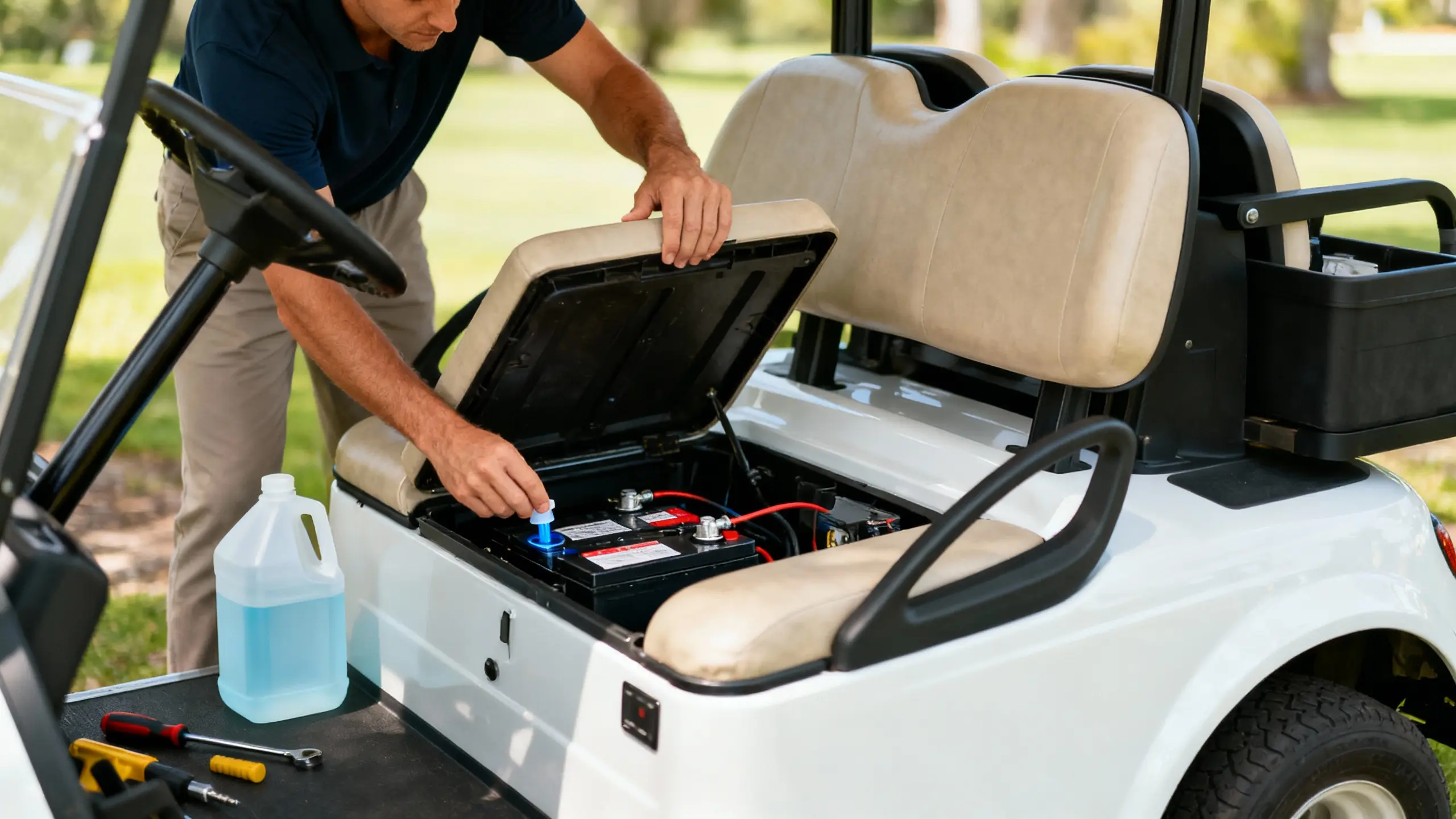
Check Battery Water Levels (Lead-Acid Only)
If you have flooded lead-acid batteries (the most common type), water level maintenance is critical. Skip this if you have lithium or AGM batteries.
Charge First, Then Check
Always check water levels AFTER a full charge cycle. Charging causes electrolyte expansion, and adding water before charging can cause overflow and acid damage. If you are tired of opening every cap by hand, our guide to golf cart battery watering systems explains when a single-point kit is worth the cost.
Remove Vent Caps
Pop off the caps on each battery cell. Most batteries have 3 or 6 caps per battery. Use a flashlight to see inside.
Check the Level
Water should cover the lead plates by 1/4" to 1/2". If you can see the tops of the plates, the water is too low. If water is at the bottom of the fill well, it's too high.
Add Distilled Water Only
Use ONLY distilled water—never tap water. Tap water contains minerals that coat the plates and reduce battery capacity. Fill to 1/4" to 1/2" above the plates, not higher.
Replace Caps Securely
Press caps back into place firmly. Loose caps allow acid mist to escape, which corrodes nearby components.
Why Distilled Water Matters: Tap water contains calcium, magnesium, and other minerals. When water evaporates during charging, these minerals stay behind and coat the battery plates. Over time, this reduces the battery's ability to hold a charge. A gallon of distilled water costs $1-2 and protects batteries worth $800-$1,500+.
Frequency Guidelines
| Usage Level | Water Check Frequency | Why |
|---|---|---|
| Heavy (daily driving) | Weekly | High charging frequency = more evaporation |
| Moderate (2-3x/week) | Every 2 weeks | Standard evaporation rate |
| Light (weekly or less) | Monthly | Lower charging cycles |
| Hot climate (90°F+) | More frequent | Heat accelerates evaporation |
| Cold climate | Less frequent | Slower evaporation |
Monthly Tasks (Electric)
Clean Battery Terminals
Corrosion on battery terminals is a silent performance killer. That white, crusty buildup you see? It's reducing power transfer and can eventually prevent your cart from running.
If corrosion returns quickly or a cable feels warm after driving, use our golf cart battery cable size and replacement guide to decide whether the cable set needs replacement instead of another cleaning.
What you need:
- Baking soda
- Water
- Old toothbrush or wire brush
- Clean rag
- Terminal protector spray (optional but recommended)
Steps:
- Mix 1 tablespoon baking soda in 1 cup water
- Disconnect negative cable first, then positive
- Apply solution to terminals and cables, scrub with brush
- Rinse with clean water, dry completely
- Reconnect positive first, then negative
- Apply terminal protector spray to prevent future corrosion
Check Tire Pressure
Proper tire pressure affects range, handling, and tire life. Electric carts are especially sensitive because low pressure increases rolling resistance and drains batteries faster.
Recommended Golf Cart Tire Pressure (PSI)
Pro Tip: Use the vehicle pressure label or exact owner manual. The tire sidewall maximum is not automatically the cart's operating pressure. Check every 2-4 weeks and after sharp temperature changes.
Use our golf cart tire pressure chart for sourced E-Z-GO, Club Car, and Yamaha examples and the correct process when your model is not listed.
Brand-specific rule: Match the exact model, year, and approved tire package. Current official examples span 16-26 PSI, and two carts using the same nominal tire size can still have different specifications.
Quarterly Tasks (Every 3 Months)
Full Battery Inspection
Go beyond water levels and do a comprehensive battery check:
- Visual inspection: Look for cracks, bulging, or leaking
- Terminal condition: Check for corrosion returning
- Cable inspection: Look for fraying, cracking, or loose connections
- Voltage test: Use a multimeter to check individual battery voltage
- Load test: Consider a load test if range has decreased
For a complete list of recommended tools including multimeters, torque wrenches, and brand-specific socket sizes, see our essential golf cart tool kit guide.
Brake Inspection
Check brake function every 3-6 months:
- Pedal feel: Should be firm, not spongy
- Stopping power: Cart should stop smoothly without pulling
- Parking brake: Should hold cart on incline
- Visual check: Inspect pads/shoes for wear, cables for fraying
Lubrication
Apply lubricant to moving parts:
- Steering linkage
- Suspension pivot points
- Pedal mechanisms
- Any squeaky hinges or joints
Use white lithium grease or manufacturer-recommended lubricant.
Annual Professional Service (Electric)
Even if you handle all DIY maintenance, an annual professional inspection catches issues you might miss. A trained technician will:
- Perform full electrical system diagnostic
- Check controller and solenoid function
- Inspect motor brushes and connections
- Verify charger operation
- Comprehensive brake system inspection
- Suspension and steering check
- Safety systems verification
Cost: $100-$300 for electric cart annual service
Battery Deep Dive: Lead-Acid vs. Lithium
Battery maintenance differs dramatically based on battery type. Here's what you need to know:
Lead-Acid Batteries
Most CommonKey Maintenance Rules:
- Charge after every use
- Check water weekly to monthly
- Use only distilled water
- Clean terminals monthly
- Never let batteries sit discharged
- Equalize charge monthly (if charger supports)
Lithium Batteries
Premium OptionKey Maintenance Rules:
- No water maintenance needed
- Store at 50-70% charge (NOT full)
- Never charge below 32°F (0°C)
- Avoid complete discharge
- Check BMS indicator lights monthly
- Keep connections clean and tight
Charging Best Practices
Using the right charger is critical. A mismatched charger can undercharge (reducing capacity) or overcharge (damaging batteries permanently).
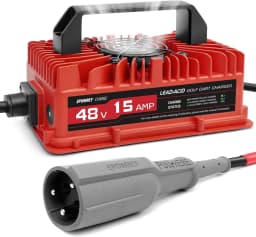
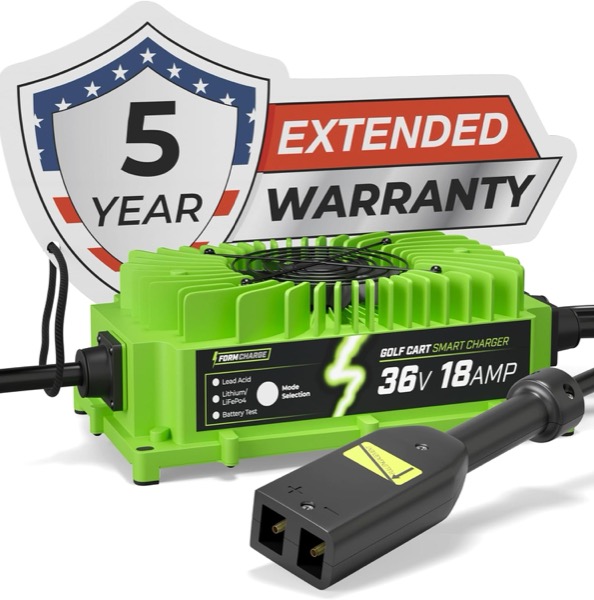
Charger matching rules:
- Voltage must match exactly: 36V charger for 36V system, 48V for 48V
- Chemistry must match: Lead-acid chargers don't work properly with lithium (and vice versa)
- Amperage affects charge time: Higher amps = faster charging, but don't exceed battery specifications
For more on batteries, replacement costs, and when to upgrade, see our complete golf cart battery guide.
Gas Golf Cart Maintenance Schedule
Gas carts require engine maintenance similar to a small automobile or lawn mower. The upside: no battery watering. The downside: more moving parts and fluids to manage.
For the engine-specific version of this schedule, see our gas golf cart tune-up guide for oil, filters, spark plugs, and brand fitment checks.
Add the wide drive belt, narrow starter/generator belt, and clutch inspection to this schedule; our golf cart drive belt size and replacement guide explains belt fitment, while our golf cart clutch problems guide covers primary and secondary clutch symptoms.
After Every Use
Check fuel level — Running out of gas can damage the fuel pump and introduce air into fuel lines. Keep at least 1/4 tank.
Weekly Tasks
- Visual fuel system inspection — Look for leaks around tank, lines, and carburetor
- Listen for unusual sounds — Knocking, pinging, or rough idle can indicate problems
- Check for oil spots — Fresh spots under the cart indicate leaks
Monthly Tasks (Gas)
Check Oil Level
Park on Level Ground
Ensure the cart is on flat, level surface for accurate reading. Wait 5 minutes after running to let oil settle.
Locate and Remove Dipstick
Find the dipstick (usually has a yellow or orange handle). Pull it out and wipe clean with a rag.
Check Level
Reinsert dipstick fully, then remove and check oil level. Should be between MIN and MAX marks. Also check oil color—should be amber to light brown, not black or milky.
Add Oil If Needed
If low, add small amounts of 10W-30 oil (most common recommendation) and recheck. Don't overfill.
Oil condition warning signs:
- Black/dark: Due for change
- Milky/frothy: Water contamination (serious issue)
- Metallic flakes: Internal wear (needs professional inspection)
- Gritty texture: Contamination (change immediately)
Quarterly Tasks (Every 125 Hours or 3 Months)
Oil Change
The most important maintenance task for gas carts. Old oil loses lubrication properties and becomes acidic, damaging engine internals.
Change intervals:
- Standard use: Every 125 hours or 6 months
- Heavy use: Every 100 hours or 3 months
- New engine: First change at 8-10 hours, then standard intervals
What you need:
- 10W-30 motor oil (1-1.5 quarts typical)
- Oil filter (if applicable to your model)
- Drain pan
- Socket wrench for drain plug
- Funnel
- Rags
Oil Specifications by Brand
Note: Always check your owner's manual for model-specific requirements. Capacities vary by model year and engine type.
Air Filter Inspection/Replacement
A clogged air filter restricts airflow, reducing power and fuel efficiency. Inspect every 3-4 months, replace annually or when visibly dirty.
Signs of a dirty air filter:
- Reduced power/acceleration
- Black exhaust smoke
- Decreased fuel economy
- Engine running rough
Every 6 Months
Fuel Filter Replacement
The fuel filter catches debris before it reaches the carburetor. Replace every 6-12 months depending on fuel quality and usage.
Spark Plug Inspection
Check spark plug condition:
- Normal: Light tan or gray deposits
- Fouled: Black, oily deposits (running rich or oil burning)
- Worn: Electrode eroded (replace)
Replace spark plugs annually or when worn. Gap to manufacturer specification (typically 0.028-0.030").
Annual Professional Service (Gas)
A professional service for gas carts should include:
- Compression test
- Carburetor inspection/adjustment
- Valve adjustment (if needed)
- Full fuel system inspection
- Exhaust system check
- All fluid changes
- Brake system inspection
- Safety systems verification
Cost: $150-$400 for gas cart annual service
For commercial or fleet vehicles like Cushman carts, maintenance intervals are often shorter due to heavier use -- see our Cushman golf cart review for model-specific service recommendations.
Universal Maintenance (Both Electric & Gas)
These tasks apply to all golf carts regardless of power source.
Tires and Wheels
Monthly:
- Check tire pressure (18-22 PSI typical)
- Inspect for cracks, bulges, or punctures
- Check tread wear and pattern
Quarterly:
- Rotate tires if wear is uneven
- Check wheel lug nuts for tightness
- Inspect wheel bearings for play
Replace tires when:
- Tread is worn smooth
- Sidewall cracking is significant
- Age exceeds 5-6 years (rubber degrades)
Brakes
Golf cart brakes are critical safety equipment. Don't delay maintenance.
Every 6 Months:
- Test stopping power
- Check pedal feel (should be firm)
- Verify parking brake holds
- Visual inspection of pads/shoes and cables
Warning signs requiring immediate attention:
- Spongy brake pedal
- Cart pulls to one side when braking
- Grinding or squealing noise
- Increased stopping distance
- Parking brake doesn't hold
Steering and Suspension
Monthly:
- Check steering response (should be smooth, not loose or binding)
- Listen for clunks or squeaks when turning
Quarterly:
- Lubricate steering linkage
- Check tie rod ends for wear
- Inspect suspension bushings
If the cart pulls on flat pavement or shows uneven front tire wear, use the golf cart alignment guide to separate toe problems from brake drag, bearing play, and worn steering parts.
Electrical System (Both Types)
Monthly:
- Test all lights (headlights, taillights, turn signals if equipped)
- Check horn function
- Inspect visible wiring for damage
Annually:
- Have professional check controller/solenoid (electric)
- Verify ignition system (gas)
- Test safety switches
Exterior and Interior Care
Regular cleaning isn't just cosmetic—it protects your investment and helps you spot problems early.
Monthly:
- Wash body with mild soap and water
- Clean seats with appropriate cleaner
- Check for rust or corrosion on frame — our rust prevention and corrosion guide covers the best sprays, undercoatings, and treatment steps if you find any
Seasonally:
- Apply UV protectant to seats and dashboard
- Wax painted surfaces
- Treat vinyl and rubber with conditioner
For detailed cleaning techniques, product recommendations, and a seasonal cleaning calendar, see our complete golf cart cleaning guide.
Protection recommendation:

For more on enclosures and covers, see our best golf cart accessories guide.
Golf Cart Maintenance Cost Breakdown
Understanding maintenance costs helps you budget and make smart decisions about DIY vs. professional service.
Annual Golf Cart Maintenance Costs
DIY Maintenance Costs
Professional Service Costs
Cost of NOT Maintaining (Repairs)
Bottom line: $200-$400 in annual maintenance prevents $1,000-$3,000+ in repairs. See exactly how maintenance costs add up over time with our free Cost of Ownership Calculator.
Top 10 Maintenance Mistakes (And How to Avoid Them)
Learning from others' mistakes can save you hundreds or thousands of dollars.
Adding Water to Batteries BEFORE Charging
The problem: Electrolyte expands during charging. Water added before charging overflows, taking battery acid with it and causing corrosion damage.
The fix: Always charge first, then add water. The only exception is if plates are exposed—add just enough to cover them, then charge, then top off.
Using Tap Water Instead of Distilled
The problem: Tap water contains minerals (calcium, magnesium, iron) that coat battery plates, reducing capacity by 20-30% over time.
The fix: Use only distilled water. It costs $1-2 per gallon at any grocery store. Your batteries cost $800-$1,500+.
Letting Lead-Acid Batteries Sit Discharged
The problem: Lead-acid batteries suffer permanent capacity loss when left discharged. Sulfation crystallizes on plates and can't be reversed.
The fix: Charge after every use. If storing, use a battery maintainer. Never let batteries sit more than 30 days without charging.
Storing Lithium Batteries Fully Charged
The problem: Unlike lead-acid, lithium batteries degrade faster when stored at 100% charge. High voltage causes accelerated cell aging.
The fix: Store lithium batteries at 50-70% charge. Check every 2-3 months and recharge to this range if needed.
Charging Lithium Batteries Below Freezing
The problem: Charging lithium-ion batteries below 32°F (0°C) causes lithium plating—permanent, irreversible damage that reduces capacity and can cause fires.
The fix: Never charge lithium batteries when they or the ambient temperature is below 32°F. Wait until they warm up naturally.
Ignoring the Tow/Run Switch During Storage
The problem: Leaving the cart in "Run" mode allows electronics to slowly drain batteries over storage periods.
The fix: Switch to "Tow" or "Storage" mode before any period of non-use longer than a week.
Neglecting Tire Pressure
The problem: Low pressure increases rolling resistance (reducing range 10-15%), causes uneven wear, and can damage tires. Many owners never check pressure.
The fix: Check pressure every 2-4 weeks. Set a phone reminder if needed. Takes 2 minutes.
Skipping Oil Changes (Gas Carts)
The problem: Old oil loses lubrication properties and becomes acidic. Engine wear accelerates dramatically, leading to early failure.
The fix: Change oil every 125 hours or 6 months, whichever comes first. Mark your calendar.
Using the Wrong Charger
The problem: Mismatched voltage or chemistry damages batteries. A 48V charger on a 36V system, or a lead-acid charger on lithium batteries, causes permanent harm.
The fix: Match charger voltage exactly to your system. Use chemistry-specific chargers (lead-acid vs. lithium).
Waiting Until Something Breaks
The problem: Reactive maintenance costs 3-5x more than preventive maintenance. Small issues become big repairs.
The fix: Follow a maintenance schedule. Simple prevention prevents 80% of common failures.
DIY vs. Professional Service: When to Do What
DIY-Friendly Tasks
No Special Skills Needed- Charging batteries after use
- Checking/adding battery water
- Cleaning battery terminals
- Checking tire pressure
- Checking fluid levels (oil, fuel)
- Cleaning exterior/interior
- Testing lights and horn
- Visual inspections
DIY with Basic Skills
Basic Tools Required- Changing oil (gas carts)
- Replacing air filter
- Replacing fuel filter
- Replacing spark plug
- Lubricating moving parts
- Adjusting tire pressure
- Simple brake adjustments
- Replacing fuses/bulbs
Leave to Professionals
Specialized Knowledge- Controller diagnostics/replacement
- Motor brush replacement
- Solenoid testing/replacement
- Carburetor rebuilding
- Compression testing
- Brake system overhaul
- Electrical troubleshooting
- Speed controller programming
When to call a professional immediately:
- Cart won't move at all
- Burning smell or smoke
- Sparking from any component
- Brake failure or significant reduction
- Strange noises from motor/engine
- Visible damage to controller or wiring
Need to find a service provider? Use the golf cart service near you directory or compare ranked golf cart repair shops by state before booking annual service, brake work, or battery testing. If the cart cannot be driven in, compare mobile golf cart repair providers for on-site diagnostics.
Printable Golf Cart Maintenance Checklist 2026
Use this comprehensive checklist to stay on track. Print it out or save it on your phone.
Golf Cart Maintenance Checklist
Check off tasks as you complete themAfter Every Use (Electric)
Weekly Tasks
Monthly Tasks
Quarterly Tasks (Every 3 Months / 125 Hours)
Every 6 Months
Annual Tasks
Seasonal Maintenance Tips
Spring (Coming Out of Storage)
Before your first ride of the season:
- Fully charge batteries
- Check water levels (lead-acid)
- Inspect for rodent damage
- Check tire pressure (likely low)
- Test brakes
- Run through full checklist
- Take a short test drive before normal use
For complete spring prep, see our spring golf cart maintenance checklist.
Summer (Peak Use Season)
During heavy use periods:
- Check battery water more frequently (weekly)
- Monitor tire pressure (heat increases PSI)
- Keep cart clean to prevent heat buildup
- Ensure adequate ventilation during charging
- Watch for overheating signs
Fall (Pre-Storage Prep)
Before storage season:
- Deep clean inside and out
- Full battery charge (lead-acid) or 50-70% (lithium)
- Add fuel stabilizer (gas carts)
- Set tires to the vehicle cold-pressure specification
- Apply rust prevention if needed
- Consider professional service before storage
Winter (Storage Period)
During storage:
- Use battery maintainer (lead-acid)
- Check batteries monthly
- Don't charge lithium below 32°F
- Keep covered or enclosed
- Check for rodent activity monthly
Tracking Your Maintenance
Keeping records helps you stay on schedule and adds value when selling.
What to track:
- Date of each maintenance task
- Hours/miles (if your cart has a meter)
- Parts replaced and costs
- Professional service invoices
- Any issues noted
How to track:

Simple tracking options:
- Smartphone notes app with dated entries
- Google Sheet or Excel spreadsheet
- Dedicated maintenance app
- Paper log kept with owner's manual
- Photos of receipts saved in a folder
Frequently Asked Questions
What is the golf cart maintenance checklist for 2026?
A practical 2026 golf cart maintenance checklist is: charge electric carts after every use, check battery water weekly to monthly for lead-acid batteries, check tire pressure every 2-4 weeks, clean battery terminals monthly, inspect brakes every 6 months, change gas cart oil every 125 hours or 6 months, and schedule professional service once a year.
How often should I service my golf cart?
Golf carts should receive professional service annually or every 100-125 hours of operation. Between professional services, perform DIY maintenance on a schedule: daily charging (electric), weekly battery water checks during heavy use, monthly tire pressure and terminal cleaning, and quarterly brake inspections. Most owners spend 15-30 minutes per month on routine maintenance tasks.
What maintenance does an electric golf cart need?
Electric golf carts require battery-focused maintenance: charge after every use, check water levels weekly to monthly (lead-acid only), clean terminals monthly, and keep batteries fully charged during storage. Additionally, check tire pressure every 2-4 weeks, inspect brakes every 6 months, lubricate moving parts quarterly, and get annual professional service. Lithium batteries require less maintenance than lead-acid but have different charging rules.
How much does annual golf cart maintenance cost?
Annual golf cart maintenance costs $200-$600 depending on whether you DIY or use professionals. DIY maintenance costs $50-$150/year (distilled water, cleaners, filters, oil). Professional service runs $100-$300 for electric carts and $150-$400 for gas carts annually. Major repairs if maintenance is neglected can cost $800-$2,000+ (battery replacement, carburetor rebuild), making preventive maintenance a smart investment.
What are the most important golf cart maintenance tips?
The most important golf cart maintenance tips are: keep electric carts charged, never let lead-acid batteries run dry, use only distilled water, check tire pressure every 2-4 weeks, clean battery terminals monthly, change gas cart oil on schedule, inspect brakes twice a year, and store the cart clean, covered, and charged.
How often should I add water to golf cart batteries?
Check battery water levels weekly during heavy use (daily driving) or monthly during moderate use. Add distilled water AFTER charging, not before, filling to 1/4" to 1/2" above the lead plates. Never use tap water as minerals damage batteries. In hot climates or during summer, check more frequently as heat accelerates water evaporation. Lithium batteries don't require water—this applies only to flooded lead-acid batteries.
How long do golf carts last with proper maintenance?
With proper maintenance, golf carts last 15-20+ years compared to just 5-8 years without maintenance. Electric carts can last 20-40 years with diligent care. The key factors are battery maintenance (the most common failure point), regular service intervals, and protecting the cart from elements. A well-maintained cart also retains 70-80% of its value after 5 years versus 50-60% for neglected carts.
What PSI should golf cart tires be?
Most published golf cart specifications fall between 18 and 22 PSI cold, but current manufacturer examples range from 16 to 26 PSI by model and tire package. Use the vehicle pressure label or exact owner manual, not a universal tire-type chart or the tire sidewall maximum. Check pressure every 2-4 weeks and after sharp temperature changes.
How often should I change oil in a gas golf cart?
Change gas golf cart oil every 125 hours of operation or every 6 months, whichever comes first. For brand-new carts, perform the first oil change after just 8-10 hours to remove manufacturing debris. Use 10W-30 oil as recommended by most manufacturers (EZGO, Club Car, Yamaha). Always drain oil while the engine is warm for complete drainage.
Should I charge my golf cart after every use?
Yes, charge your electric golf cart after every use, even short trips. This practice prevents deep discharge cycles that damage lead-acid batteries and ensures your cart is always ready. Modern smart chargers prevent overcharging, so leaving the cart plugged in is safe. Exception: lithium batteries can be charged less frequently but should still be charged before dropping below 20% capacity.
Can I do golf cart maintenance myself?
Yes, most golf cart maintenance is DIY-friendly. Tasks like checking tire pressure, adding battery water, cleaning terminals, and checking fluid levels require no special skills. Intermediate tasks like changing oil (gas carts) or replacing filters need basic tools. Leave complex electrical work, brake system repairs, and controller diagnostics to professionals. DIY maintenance saves $150-$300 annually versus full professional service.
What are signs my golf cart needs service?
Warning signs include: reduced range or power (battery issues), slow acceleration, unusual noises (grinding, clicking, squealing), difficulty steering, spongy or weak brakes, visible corrosion on terminals, low or discolored oil, hard starting (gas carts), burning smell, and uneven tire wear. Address these promptly—small issues become expensive repairs if ignored.
How do I maintain lithium golf cart batteries?
Lithium batteries require different care than lead-acid: no water maintenance needed, store at 50-70% charge (not full), never charge below 32°F (0°C), and avoid complete discharge. Check BMS indicator lights monthly. Lithium batteries last 8-10+ years with proper care versus 4-6 years for lead-acid. They cost more upfront but require less maintenance and last longer.
What is the difference between maintaining gas vs electric carts?
Electric carts focus on battery maintenance (charging, watering, terminal cleaning) while gas carts focus on engine maintenance (oil changes, air filters, fuel system). Electric carts are generally lower maintenance with fewer moving parts. Gas carts require more frequent service intervals but don't have the battery replacement costs. Both need universal maintenance: tires, brakes, steering, and exterior care.
How often should I check golf cart brakes?
Inspect golf cart brakes every 6 months or immediately if you notice reduced stopping power, squealing, grinding, or the cart pulling to one side. Check brake pads for wear (replace when thin), inspect cables for fraying, test brake fluid level (if applicable), and verify the parking brake holds. Brakes are safety-critical—don't delay service if you notice any issues.
Do I need to maintain a golf cart I rarely use?
Yes, rarely-used carts still need maintenance. Lead-acid batteries self-discharge 5-15% monthly and can be damaged if left uncharged. Check and charge batteries every 30 days minimum, even if not using the cart. Run gas carts for 10-15 minutes monthly to circulate fluids. Check tire pressure before each use after extended sitting. A maintenance routine prevents the "hasn't been used in 6 months and now it won't start" problem.
How do I maintain my golf cart in winter?
For winter storage, follow the battery maker storage charge guidance, add fuel stabilizer to gas carts when the manual calls for it, set tires to the vehicle cold-pressure specification, clean thoroughly, and use a quality cover. For year-round winter use, check pressure more often and follow the battery manual temperature limits. See our complete winterization guide for model-specific steps.
The Bottom Line
Golf cart maintenance isn't complicated. It just requires consistency. Spend 15-30 minutes per month on basic tasks, and you'll:
- Extend lifespan from 5-8 years to 15-20+ years
- Preserve value — 70-80% retention vs. 50-60% for neglected carts
- Avoid repairs — $200-$600/year prevents $1,000-$3,000+ in emergency fixes
- Ensure reliability — Your cart starts every time
- Stay safe — Brakes work, lights work, steering responds
Key takeaways by cart type:
Electric Carts:
- Charge after every use
- Check battery water weekly (heavy use) to monthly (moderate use)
- Use only distilled water
- Clean terminals monthly
- Different rules for lithium vs. lead-acid
Gas Carts:
- Change oil every 125 hours or 6 months
- Replace air filter every 3-4 months
- Check fuel system regularly
- Keep up with spark plugs and fuel filters
All Carts:
- Check tire pressure every 2-4 weeks
- Inspect brakes every 6 months
- Annual professional service
- Keep it clean and protected
The investment is small. The payoff is huge. Start your maintenance routine today.
Related Guides
Golf Cart Search
Find the Best Golf Carts of 2026
Compare top-rated models, read expert reviews, and find the perfect cart for your needs.