Street Legal Golf Cart
A street legal golf cart is not just a cart with lights. To use a golf cart on public roads, you need the right vehicle class, equipment, paperwork, insurance, and local permission for the roads you plan to drive.
This page gives you the plain-English overview. Use it to decide whether you should buy a factory LSV, convert an existing cart, or stop and check your state laws before spending money.
A standard golf cart often depends on local permissions. A true LSV or NEV usually needs a 20 to 25 mph road-use setup and a cleaner DMV path.
Most road-use setups need headlights, brake lights, turn signals, mirrors, windshield, horn, reflectors, and seat belts for each passenger.
The paperwork is often harder than the parts. Verify the VIN, MCO or title path, plate requirements, and bill of sale before buying or converting.
Registered LSVs usually need liability insurance and a valid driver. Private-property carts and golf-course carts are a different legal category.
What Makes a Golf Cart Street Legal?
The broad answer is that a road-use golf cart must meet the equipment, speed, paperwork, and location rules that apply where you drive. The specific answer changes by state, city, vehicle class, and road speed limit.
The most common clean path is a low-speed vehicle, often called an LSV or NEV. That path usually means a cart that can operate in the 20 to 25 mph range, has required safety equipment, includes VIN or manufacturer paperwork, and can be registered and insured for public-road use.
Golf Cart vs LSV vs Converted Cart
A normal golf cart, a factory LSV, and a converted cart can look similar in a driveway. The legal and paperwork path can be very different.
| Setup | Speed | Paperwork | Road-use answer |
|---|---|---|---|
| Standard golf cart | Often under 20 mph | Serial number, bill of sale, and sometimes a local permit | Usually local-route or private/community-road permission |
| Street legal LSV / NEV | 20 to 25 mph | VIN, MCO or title, registration, plate, and insurance | Cleaner public-road path on roads commonly posted 35 mph or less |
| Converted golf cart | Depends on upgrades | Equipment plus proof the state will accept the cart | Possible in some places, blocked by paperwork in others |
Street Legal Golf Cart Equipment Checklist
State rules vary, but these are the items buyers and owners should expect to verify before calling a cart street legal.
Headlights, taillights, brake lights, and reflectors
Turn signals, horn, rearview mirror, and side mirrors
DOT windshield or approved windshield setup where required
Seat belts for every seating position used on roads
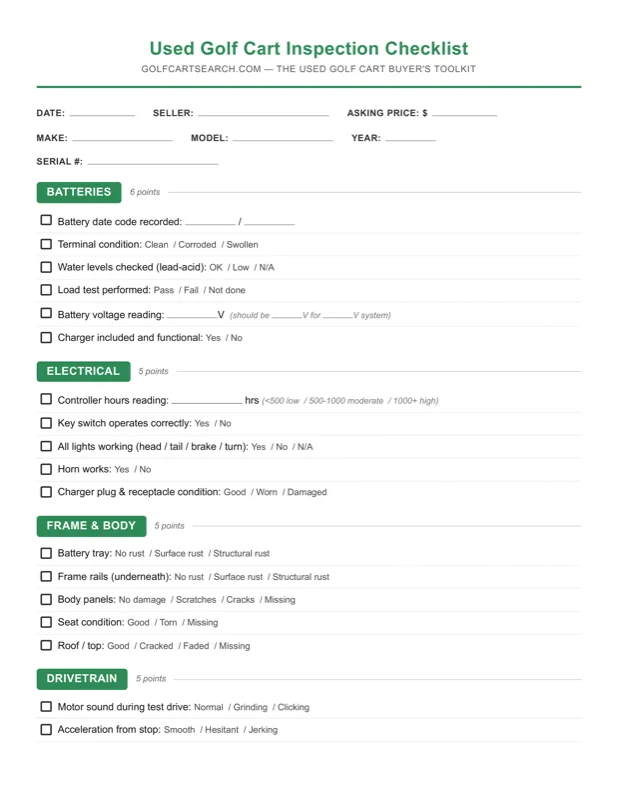
VIN, MCO or MSO, title path, bill of sale, and registration
Liability insurance and a valid driver when road use requires it
Can You Drive a Golf Cart on the Road?
Sometimes. A street legal LSV is commonly limited to roads with posted speed limits of 35 mph or less, plus local rules about crossings, daylight operation, route maps, or community permits. A standard golf cart can be even more limited.
That is why a generic national answer is not enough. Use the street-legal golf cart checker for a fast state answer, then confirm the details on your state law page before driving.
Buy Factory Street Legal or Convert a Golf Cart?
If you have not bought the cart yet, a factory LSV is usually the cleaner road-use path. The vehicle is more likely to come with the equipment, VIN, manufacturer paperwork, and registration support you need.
Converting an existing cart can work when local rules allow it and the paperwork is clean. It can also become a bad project if the cart lacks a usable title path, cannot reach the required speed, or needs more equipment than the cart is worth.
Next Steps by Question
Street legality is a cluster, not one page. Open the guide that matches the specific decision you are making next.
Street Legal Golf Cart Questions
Quick answers for street legal golf cart requirements, equipment, registration, insurance, and road-use rules.
What is a street legal golf cart?
A street legal golf cart is a golf-cart-style vehicle set up for approved public-road use. In many states, the cleanest road-use path is a low-speed vehicle or neighborhood electric vehicle with required equipment, VIN paperwork, registration, insurance, and a valid driver.
What makes a golf cart street legal?
Common requirements include headlights, taillights, brake lights, turn signals, mirrors, windshield, horn, reflectors, seat belts, a 20 to 25 mph speed capability, VIN or manufacturer paperwork, registration, plate, and insurance. Exact rules vary by state and city.
Can any golf cart be made street legal?
Not always. Equipment can be added to many carts, but paperwork is often the hard part. Some older or untitled carts cannot clear the LSV registration path even if they have lights, mirrors, and seat belts.
Do street legal golf carts need insurance?
Usually yes for registered road-use carts and low-speed vehicles. Private-property golf cart use is a different insurance question, but public-road use commonly requires liability coverage.
Do you need a license to drive a street legal golf cart?
Usually yes on public roads, especially if the cart is registered as an LSV or NEV. Private property, golf courses, resorts, and local community roads can follow different rules.
What roads can a street legal golf cart use?
LSVs are commonly limited to roads with posted speed limits of 35 mph or less, with local restrictions and crossing rules. Standard golf carts often have narrower local-route permissions.