
As an Amazon Associate, we earn from qualifying purchases. This helps support our site at no extra cost to you.
If you are trying to figure out golf cart registration by state, the first thing to know is that most states do not treat a standard golf cart the same way they treat a road-ready NEV or LSV.
That is where most owners get tripped up. A seller says a cart is "street legal," the DMV says it needs a VIN, your town says you need a local permit, and the state law says something different again.
This guide gives you the clean version. We will cover where a standard golf cart can use a permit, decal, or special plate, where you need full title and registration, and when the smarter move is to skip the conversion headache and buy a factory-ready road-use cart instead. If you are still deciding which models are worth buying in the first place, use our best street legal golf carts guide alongside this page.
If you are trying to sort out ownership paperwork more broadly, including bills of sale, title transfer, and buying a cart with no title, start with our golf cart ownership transfer guide and golf cart titles and registration guide. This page is built specifically to own the by-state registration question.
If your main question is what the permit, plate, title, or LSV path will actually cost, use our golf cart registration cost by state guide alongside this one. It now breaks out high-confusion cost searches like Arizona golf cart registration, California golf cart registration, Minnesota local permit renewals, and whether a golf cart title is issued.
If you want the fastest personalized answer before reading the full 50-state table, start with our street-legal golf cart checker. For the definition-first version of the same decision, use the low speed vehicle guide. Together, they help separate local-permit carts, title-and-plate LSV paths, and states where the answer depends heavily on city rules.
50 States Registration paths compared
3 Common Paths No registration, local permit, or full NEV registration
35 mph or Less Most common road-speed cap
20 to 25 mph Typical NEV / LSV speed band
Quick Answer: Do Golf Carts Need Registration?
Usually, no for private property, golf-course use, or carts that never touch public roads.
Usually, yes in some form once you want public-road access.
That "yes" can mean three very different things:
-
No state registration path for a standard cart Your state only wants road-use vehicles to be treated as NEVs or LSVs, which means title, registration, plate, VIN, and insurance.
-
Local permit, decal, or special golf-cart plate Your city, county, or state gives standard golf carts a narrower paperwork path for limited road use.
-
Full motor-vehicle style registration Your cart is really being treated as an NEV or LSV, not a casual golf cart, so the DMV process looks much closer to a car.
The cleanest way to think about it is this:
- Standard golf cart: limited-use rules, if allowed at all
- NEV / LSV: public-road rules, title and registration almost always required
If you still need to sort out who can legally drive the cart after it is plated or permitted, read our golf cart license guide. If you are trying to get the vehicle ready for public roads first, use our street-legal golf cart guide.
Three Registration Paths by State
Before you jump into the full table, decide which bucket your state probably falls into. Most bad advice comes from treating every road-use golf cart like it has the same DMV process.
States with golf-cart plates, permits, or decals
These states have some kind of defined paperwork path for standard golf carts, but it is still limited. A permit, decal, or golf-cart plate usually does not mean the cart is titled and registered like a normal car.
Good examples:
- Texas: a Texas Golf Cart plate can apply for limited on-road use, while NEVs use the normal title and registration path
- South Carolina: a DMV golf cart permit and registration certificate matter for public-road use
- Minnesota: local permits are central to the road-use path
- Virginia: local authorization and optional special plates can matter, but LSVs are separate
States where local permits decide the practical answer
In many states, the state sets the baseline but the city, county, village, or HOA decides whether a standard golf cart can actually drive on local roads. That is why searches like "golf cart registration in Colorado" or "golf cart permit in Wisconsin" usually need a state page plus a local ordinance check.
Common local-permit states include Georgia, Illinois, Indiana, Iowa, Kansas, Kentucky, Michigan, North Carolina, Ohio, and Wisconsin.
States where NEV or LSV registration is the real road-use path
Some states do not give a standard golf cart a clean public-road registration path. If you want reliable road access, you are usually looking at a vehicle that can qualify as an NEV or LSV with a VIN, title, registration, plate, and insurance.
This pattern is especially important in states like California, Florida, Arizona, New York, Pennsylvania, Oregon, and Tennessee. The exact rule still varies, but the practical shopping advice is the same: do not buy a casual golf cart and assume DMV registration will be simple.
Why Registration Rules Get Confusing So Fast
The registration question is rarely about paperwork alone. It is really about vehicle classification.
| Vehicle type | Typical top speed | Usual paperwork path | Common use case |
|---|---|---|---|
| Standard golf cart | 12 to 15 mph | Usually none for private use, sometimes local permit for roads | Golf course, campground, neighborhood loop |
| Faster standard cart | 15 to 20 mph | Often still not enough for full road status | Private roads, local short trips |
| NEV / LSV | 20 to 25 mph | Title, registration, plate, insurance | Roads with speed limits of 35 mph or less |
This is why a standard cart with mirrors and lights still may not be easy to register. The DMV often wants a VIN, manufacturer paperwork, and a clear road-use classification. That is also why factory-ready models can save a lot of time once you know your state path.
If you are still comparing categories, our electric vs gas golf cart comparison, best golf carts, and best golf cart brands pages can help narrow the vehicle before you deal with paperwork.
Golf Cart Registration by State: 50-State Quick Table
Use this table as the high-level answer. For any state where local ordinances matter, click through to the individual law page before buying or plating anything.
| State | Standard golf cart road-use paperwork | NEV / LSV paperwork | Key note |
|---|---|---|---|
| Alabama | Local golf-cart path, or use LSV route | Title, registration, plate, insurance | Yes (LSV only; local act required) |
| Alaska | Use LSV/NEV route instead | Title, registration, plate, insurance | Yes (LSV only) |
| Arizona | Use LSV/NEV route instead | Title, registration, plate, insurance | Yes (LSV or limited-use carts on 35 mph roads or less) |
| Arkansas | Local ordinance or permit usually required | If treated as LSV/NEV, title and registration | Yes (Local Ordinance Required) |
| California | Limited local golf-cart areas only | Title, registration, plate, insurance | NEVs can use 35 mph roads, golf carts stay narrow |
| Colorado | Local golf-cart path, or use LSV route | Title, registration, plate, insurance | Yes (LSVs allowed; golf carts by local ordinance) |
| Connecticut | Use LSV/NEV route instead | Title, registration, plate, insurance | Yes (LSVs allowed; golf carts generally not street legal) |
| Delaware | No standard-cart road registration path | Title, registration, plate, insurance | No, golf carts not street legal, LSVs only |
| Florida | Local use in cart-friendly areas | Title, registration, plate, insurance | LSVs are the cleaner road-use path |
| Georgia | Local ordinance or permit usually required | If treated as LSV/NEV, title and registration | Yes (Local Ordinance Required) |
| Hawaii | Use LSV/NEV route instead | Title, registration, plate, insurance | Yes (NEV/LSV only) |
| Idaho | Local golf-cart path, or use LSV route | Title, registration, plate, insurance | Yes (LSV statewide; golf carts with local permission) |
| Illinois | Local ordinance or permit usually required | Title, registration, plate, insurance | Yes (Local Ordinance Required) |
| Indiana | Local ordinance or permit usually required | If treated as LSV/NEV, title and registration | Yes (Local Ordinance Required) |
| Iowa | Local ordinance or permit usually required | If treated as LSV/NEV, title and registration | Yes (Local Ordinance Required) |
| Kansas | Local ordinance or permit usually required | If treated as LSV/NEV, title and registration | Yes (Local Ordinance Required) |
| Kentucky | Local ordinance or permit usually required | If treated as LSV/NEV, title and registration | Yes (Local Ordinance and inspection required) |
| Louisiana | Local designation, state off-road decal | Title, registration, plate, insurance | Designated roads and local ordinance path |
| Maine | Local ordinance or permit usually required | If treated as LSV/NEV, title and registration | Yes (Local Ordinance Required) |
| Maryland | No standard-cart road registration path | Title, registration, plate, insurance | Golf carts are narrow-use, LSV route is the real path |
| Massachusetts | No standard-cart road registration path | Title, registration, plate, insurance | Standard carts are not normal road vehicles |
| Michigan | Local golf-cart path, or use LSV route | Title, registration, plate, insurance | Local ordinance path for carts, full state path for LSVs |
| Minnesota | Local permit required | Title, registration, plate, insurance | Permit-driven state for standard carts |
| Mississippi | Local golf-cart path, or use LSV route | Title, registration, plate, insurance | Local ordinance determines road use |
| Missouri | Local ordinance or permit usually required | If treated as LSV/NEV, title and registration | Yes (Local Ordinance Required) |
| Montana | State-specific limited-use path | If treated as LSV/NEV, title and registration | Special-license or local path |
| Nebraska | Local ordinance or permit usually required | If treated as LSV/NEV, title and registration | Municipally approved path |
| Nevada | Approved zones only | Title, registration, plate, insurance | Golf carts stay in approved zones, LSVs broader |
| New Hampshire | Use LSV/NEV route instead | Title, registration, plate, insurance | NEV route is the useful path |
| New Jersey | Use LSV/NEV route instead | Title, registration, plate, insurance | LSV framework controls road use |
| New Mexico | Local golf-cart path, or use LSV route | Title, registration, plate, insurance | NEC / LSV framework matters most |
| New York | No standard-cart road registration path | Title, registration, plate, insurance | Only LSV-style vehicles really work |
| North Carolina | Local golf-cart path, or use LSV route | Title, registration, plate, insurance | Local ordinance is critical |
| North Dakota | Local golf-cart path, or use LSV route | Title, registration, plate, insurance | LSV route available |
| Ohio | Local ordinance for under-speed carts | Title, registration, plate, insurance | Golf cart and LSV rules are separate |
| Oklahoma | Local golf-cart path, or use LSV route | Title, registration, plate, insurance | Local ordinance decides standard-cart use |
| Oregon | No standard-cart road registration path | Title, registration, plate, insurance | LSVs only |
| Pennsylvania | No standard-cart road registration path | Title, registration, plate, insurance | Standard carts stay narrow, LSVs do the road work |
| Rhode Island | Use LSV/NEV route instead | Title, registration, plate, insurance | LSVs allowed, standard golf carts not truly road-legal |
| South Carolina | Permit and registration for road use | Title, registration, plate, insurance | One of the strictest golf-cart states |
| South Dakota | Local golf-cart path, or use LSV route | Title, registration, plate, insurance | Local ordinance path for standard carts |
| Tennessee | No standard-cart road registration path | Title, registration, plate, insurance | Registered LSV or MSV path matters |
| Texas | Texas Golf Cart plate in limited-use areas | Title, registration, plate, insurance | Plate is not the same as full registration |
| Utah | No standard-cart road registration path | Usually not available unless vehicle reclassified | Standard carts are not street legal by default |
| Vermont | Use LSV/NEV route instead | Title, registration, plate, insurance | NEV route is the real answer |
| Virginia | Local ordinance, special plate optional | Title, registration, plate, insurance | Golf cart and LSV rules are separate |
| Washington | Golf Cart Zone only | Title, registration, plate, insurance | Standard carts live inside golf cart zones |
| West Virginia | Use LSV/NEV route instead | Title, registration, plate, insurance | LSV path matters most |
| Wisconsin | Local ordinance or permit usually required | If treated as LSV/NEV, title and registration | Local ordinance controls standard carts |
| Wyoming | MPV path or narrow local use | Title, registration, plate, insurance | MPV framework matters more than classic golf-cart rules |
The Four States Buyers Ask About Most
The table gives you the overview. These four states generate the most confusion because they mix standard golf-cart use, local ordinances, and full NEV paperwork in different ways.
Texas Registration Rules
Texas is probably the single most misunderstood state because the Texas Golf Cart plate sounds like full DMV registration, but it is not.
- a standard golf cart is not titled like a normal car
- the Golf Cart plate is for limited on-road use in the situations Texas law allows
- a true NEV follows the more familiar title, registration, and insurance path
That is why Texas owners need to separate two questions:
- Do I just need limited local road access?
- Do I want a cleaner public-road vehicle path?
If the answer is #2, an NEV is usually the better fit. Our Texas golf cart laws page and golf cart insurance guide are the next two pages to read.
California Registration Rules
California also trips people up because it treats standard golf carts and NEVs very differently.
- a standard golf cart stays in a narrow local lane, tied to golf-cart transportation areas and related local rules
- a registered NEV can use roads with speed limits of 35 mph or less
- if you want everyday neighborhood driving, the practical answer is usually buy or build an NEV
That is why California is one of the clearest examples of the bigger pattern in this article: if you want real road use, the state is nudging you away from "golf cart" status and toward an NEV classification. Use our California golf cart laws page for the exact road-use distinctions.
South Carolina Registration Rules
South Carolina is one of the stricter golf-cart states, and that is exactly why it gets so much search volume.
- the state has a defined permit and registration path for golf carts on public roads
- the rules are narrower than many buyers assume
- this is not a state where you should casually assume a neighborhood cart can just roll onto public streets
If you are buying in coastal South Carolina, golf-cart-heavy communities can make the rules feel casual. The paperwork is not casual. Read South Carolina golf cart laws before you shop.
Florida Registration Rules
Florida has a reputation for being golf-cart friendly, which is true, but it still helps to separate the casual golf-cart path from the cleaner LSV path.
- standard golf carts can work in cart-friendly communities and designated local settings
- LSVs are the broader road-use solution
- if you want insurance, registration clarity, and easier buyer-to-DMV paperwork, the LSV route is usually cleaner
Our Florida golf cart laws page, Florida insurance page, and best golf carts for neighborhoods article are useful follow-ups.
When a Factory-Built Street-Legal Cart Is Easier Than Converting One
If your main goal is to end up with a cart that can be insured, plated, and used legally on roads with speed limits of 35 mph or less, factory paperwork matters.
That is where buyers often waste money. They buy a used cart, start adding mirrors, lights, turn signals, seat belts, and a windshield, then learn the DMV still wants documentation, inspection, or a VIN path that is not simple.
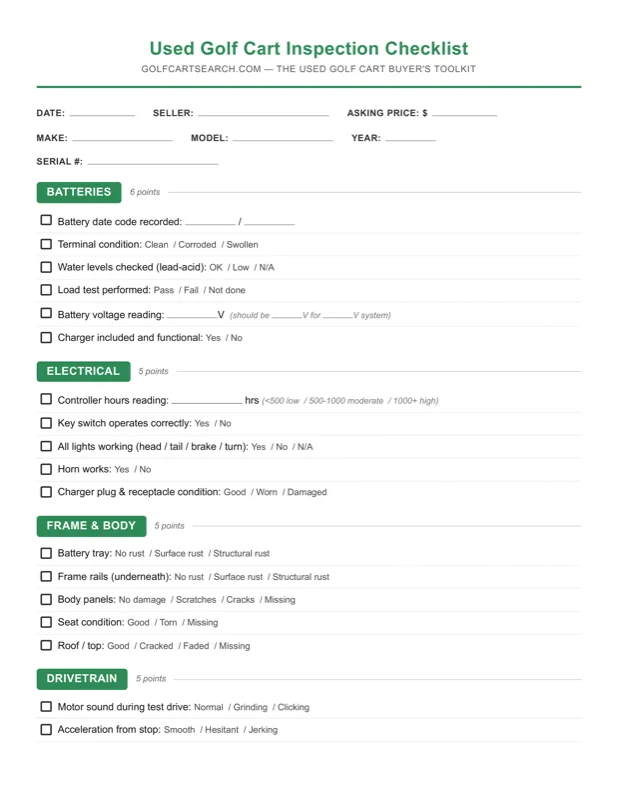
If that sounds like your situation, read our used golf cart buying guide before you spend on conversion parts.
For buyers who would rather start closer to the finish line, factory-equipped models can make the registration step much easier.
Best value factory-ready option
The AODES Trailcross is still one of the most useful examples of a budget-friendly road-use-oriented cart. It is not the only path, but it is one of the clearest examples of how buying the right vehicle first can simplify the legal side later.
See our full AODES Trailcross breakdown
Best for longer-range neighborhood use
If you care more about advertised range than lowest entry price, the SDLANCH SDLGC80 is a 60V four-seat listing to research. Its Amazon page showed an in-stock offer around $9,800 on August 18, 2026, but a marketplace listing does not prove the cart includes the paperwork or equipment your state requires.
Check SDLANCH SDLGC80 Availability on AmazonBest portable option if your road-use needs are narrow
If you mainly want something compact for a resort, campground, or mixed-use property, the Kandi Collapsible Mini is a different kind of solution. It will not replace a fully road-focused neighborhood cart, but it is worth knowing about if portability matters as much as registration.
See our full Kandi Collapsible Mini breakdown
You can also browse golf carts for sale if you want dealer inventory and real-world local availability instead of Amazon-only options.
If You Are Converting a Cart, Buy for the DMV Checklist First
If you already own the cart and plan to convert it, registration problems usually come from missing documentation or missing safety equipment.
The smart order is:
- confirm your state and local road-use path
- confirm whether you need a VIN or inspection
- build the cart to the registration standard, not just the cosmetic standard
That means headlights, tail lights, turn signals, mirrors, parking brake, reflectors, and often a compliant windshield and seat belts. Our street-legal conversion guide, LED lights guide, mirror guide, and seat belt guide go deeper on the parts side.
For 1995–2013 E-Z-GO TXT or Medalist owners with 0.75-inch square struts, the tinted ZivPlay windshield can improve comfort. Do not assume it satisfies a street-legal or LSV windshield rule; verify local glass, tint, and wiper requirements separately.
ZivPlay EZGO TXT Windshield →Do not assume that adding parts automatically creates a registerable vehicle. In many states, the hard part is not the hardware. It is the paperwork path.
The Smartest Way to Use This Guide
Use the table above as the starting filter, then do the next step based on your actual goal:
- Private-property cart only: you probably do not need registration
- Neighborhood cart with narrow local road use: look for permit, decal, or golf-cart plate rules
- Reliable public-road legality: move straight toward an NEV or LSV path
From here, the best next pages are:
- golf cart laws by state
- golf cart titles and registration guide
- how to make your golf cart street legal
- do you need a license to drive a golf cart
- golf cart insurance guide
- serial number and VIN decoder guide
- how much is a golf cart
- best golf carts for neighborhoods
If you are still early in the buying process, compare best golf carts, best golf cart brands, and local inventory on our dealer directory before you commit to a build.
Registration Questions People Ask Most
Do golf carts need registration in every state?
No. Many states do not require any registration for a standard golf cart that stays on private property. The paperwork question usually appears when you want public-road access.
What is the easiest road-legal path for most buyers?
In most states, the cleanest path is a proper NEV or LSV with clear paperwork, insurance, and a registration process the DMV already understands.
Is a golf-cart plate the same thing as full registration?
No. Texas is the best example of why this matters. A special golf-cart plate is often a limited-use authorization, not full motor-vehicle registration.
Can I register a used golf cart with no title?
Sometimes, but it depends on the state and on whether the vehicle is being treated as a standard golf cart or a road-use NEV. If you are buying used, start with a strong bill of sale and ownership trail.
What if my city allows golf carts but the state is stricter?
You need both layers to work. Local permission does not erase state requirements for classification, lighting, licensing, or insurance.
What if I only want to cross a road near a golf course?
Some states and local governments allow narrow crossing or designated-route use for standard golf carts. That is very different from broader public-road legality.
Do I need insurance if I have a permit or plate?
Often yes, or at least you should expect it to matter. Some states tie it directly to the road-use classification, while some local permit systems leave more room. Our insurance guide covers the common patterns.
Should I convert my current cart or buy one that is already road-ready?
If registration is your main goal, buying a factory-ready vehicle is often easier than trying to retrofit a cart and then explain it to the DMV.
Does speed matter for registration?
Yes. The jump from casual golf cart to NEV or LSV usually starts when the vehicle is built for 20 to 25 mph road use and equipped to match.
Which pages should I check next?
Start with your state golf cart law page, then read the street-legal guide, license guide, and titles guide.
Golf Cart Search
Find the Best Golf Carts of 2026
Compare top-rated models, read expert reviews, and find the perfect cart for your needs.