
15 Best Golf Cart Communities in America (2026)
The 15 best golf cart communities in America ranked with cart counts, path miles, home prices, and local rules. From The Villages to Bald Head Island.
Yes, you can get a DUI on a golf cart in all 50 states. Penalties, BAC limits, real cases, and state-by-state laws for Florida, Georgia, Texas, and more.

As an Amazon Associate, we earn from qualifying purchases. This helps support our site at no extra cost to you.
The short answer is yes. You can get a DUI on a golf cart in all 50 states, and the penalties are the same as driving a car drunk.
This surprises a lot of people. Golf carts feel casual. They top out at 15-25 mph. You see them on golf courses, in retirement communities, and on beach town streets. But in the eyes of the law, a golf cart is a motor vehicle, and operating one while intoxicated is a criminal offense that can land you in jail, suspend your license, and leave you with a permanent record.
This guide covers the specific penalties by state, the BAC limits that apply, where these laws are enforced (including private property and golf courses), and real cases that show how seriously law enforcement treats golf cart DUI. If you live in or visit a golf cart community, this is worth understanding before your next evening out.
Most state DUI statutes use broad language like "motor vehicle" or "any vehicle" rather than listing specific vehicle types. A golf cart, whether gas or electric powered, is a self-propelled device capable of transporting people. That meets the definition of "motor vehicle" in virtually every jurisdiction.
There is no "golf cart exception" to drunk driving laws. Courts across the country have confirmed this. In Georgia, the Court of Appeals ruled in Simmons v. State that DUI law applies to golf carts on golf cart paths, not just public streets. Florida statute 316.193 explicitly classifies golf carts as motor vehicles. Arizona includes them by name in ARS section 28-101(30).
The reasoning is straightforward: golf carts have no doors, no airbags, and most have no seatbelts. An impaired driver is arguably more dangerous in a golf cart than in a car because there is less protection for everyone involved. About 3 out of 5 golf cart accidents involve alcohol, and roughly 40% of injuries come from people falling out of the cart.
Penalties vary significantly by state. Here is a comparison of first-offense DUI penalties in the states with the most golf cart activity. These apply identically to golf carts and cars.
| State | Fine | Jail Time | License Suspension |
|---|---|---|---|
| Florida | $500–$1,000 | Up to 6 months | 180 days minimum |
| Georgia | $300–$1,000 | 10 days–12 months | 1 year |
| South Carolina | Up to $400 | 48 hours–30 days | 6 months |
| Arizona | $1,250+ | 10 days minimum | 90 days |
| Texas | Up to $2,000 | 72 hours–180 days | 90 days–1 year |
| California | Varies | Up to 6 months | 4 months |
| Ohio | $565–$1,075 | 3 days minimum | 1–3 years |
| North Carolina | Varies by level | Varies by level | 1 year |
| Michigan | $100–$500 | Up to 93 days | Up to 6 months |
| Nevada | $400–$1,000 | 2 days–6 months | 185 days |
For the full rules on golf cart operation in each state, visit our state-by-state golf cart laws pages.
Florida is the epicenter of golf cart DUI enforcement thanks to communities like The Villages where 85,000+ carts are daily transportation. Under Florida Statute 316.193, golf carts are explicitly classified as motor vehicles.
First-offense penalties include $500 to $1,000 in fines, up to 6 months in jail, at least 180 days of license suspension, mandatory DUI classes, community service, and probation. If your BAC is 0.15 or higher, or a minor is in the cart, penalties jump to $1,000 to $2,000 in fines with a mandatory ignition interlock device for 6 months.
Florida's implied consent law applies to golf carts. Refusing a breathalyzer results in automatic license suspension.
Full details on Florida golf cart laws.
Georgia's DUI law (O.C.G.A. 40-6-391) applies to "any moving vehicle," and the courts have confirmed this includes golf carts on dedicated cart paths. In Peachtree City, where 11,000 registered carts share 100+ miles of paths, police have made 17 DUI arrests of golf cart drivers in a single year.
First-offense penalties are steep: $300 to $1,000 in fines, a mandatory 24 hours in jail (up to 12 months), 40 hours of community service, 1 year of license suspension, 12 months of probation, and a mandatory clinical alcohol evaluation.
Full details on Georgia golf cart laws.
Arizona has some of the toughest DUI laws in the country, and they apply fully to golf carts. ARS 28-1381 explicitly includes golf carts in the definition of motor vehicles. Penalties apply on public roads and on private properties accessible to the public, including Sun City and other golf cart communities.
A first offense carries a minimum of 10 consecutive days in jail (9 can be suspended if you complete alcohol screening), at least $1,250 in fines and surcharges, 90 days of license suspension, and up to 12 months with an ignition interlock device. Refusing a breathalyzer triggers a 12-month automatic license suspension.
Full details on Arizona golf cart laws.
Texas Penal Code 49.04 classifies golf carts as motor vehicles for DWI purposes, whether gas or electric. The law applies on public highways and on any private land accessible as a "public place," which includes most golf cart communities and golf courses.
A first-offense DWI (Class B misdemeanor) carries up to $2,000 in fines and 72 hours to 180 days in jail. If your BAC is 0.15 or higher, it escalates to a Class A misdemeanor with up to $4,000 in fines and up to 1 year in jail.
Full details on Texas golf cart laws.
South Carolina treats golf carts as motor vehicles under its DUI statute. This applies on public roads, within gated communities like Hilton Head Island, and potentially on private property like golf courses.
First-offense penalties are relatively lighter than other states: up to $400 in fines, 48 hours to 30 days in jail, and 6 months of license suspension. But repeat offenses escalate quickly. A third offense brings $3,800 to $6,300 in fines, 60 days to 3 years in jail, and 2 years of license suspension.
Full details on South Carolina golf cart laws.
The blood alcohol concentration limits for golf carts are identical to those for cars. There is no separate standard.
| Driver Category | BAC Limit | Notes |
|---|---|---|
| Adults 21+ | 0.08% | Standard across all states |
| Commercial license holders | 0.04% | Applies even when not in a commercial vehicle |
| Drivers under 21 | 0.00%–0.02% | Zero tolerance, varies by state |
| Enhanced penalty threshold | 0.15%–0.17% | Higher penalties, varies by state |
You can also be charged with DUI below 0.08% if an officer determines you are impaired. This is a judgment call based on field sobriety tests, driving behavior, and other observations. Being "under the limit" does not guarantee you will not be charged.
In 42 states, open container laws apply to all motor vehicles on public roads, and that includes golf carts. Having an open beer, wine, or cocktail in your golf cart while driving on a public road is illegal in most of the country.
Florida specifically prohibits possessing or consuming an open container of alcohol in a golf cart or low-speed vehicle on the street. Georgia (O.C.G.A. 40-6-253) prohibits open containers in the passenger area of any vehicle on a public highway, with fines up to $200 and 2 points on your driving record.
A few states are exceptions. Mississippi has no open container law. Alaska, Connecticut, Delaware, Missouri, Rhode Island, Tennessee, and Virginia allow passengers (not drivers) to have open containers in certain situations.
The bottom line: do not assume that the casual, open-air nature of a golf cart means open container laws do not apply. In most states, they do.
One of the most common questions is whether DUI laws apply on private property. The answer depends on the state, but the trend is clear: most states enforce DUI laws anywhere the public has access.
Florida, California, Texas, Georgia, Michigan, Maine, and Minnesota all enforce DUI laws on private property that is accessible to the public. Golf cart communities, resort areas, golf courses open to non-members, and gated neighborhoods with shared roads all qualify.
In Florida, the statute uses the language "within this state," which covers all locations, public or private. In Texas, the law applies on any private land accessible as a "public place." Michigan MCL 257.625 applies regardless of whether the area is public or private.
Generally yes. Most golf courses are considered premises accessible to the public, even private clubs where guests are invited. Enforcement is rare because police do not typically patrol golf courses, but a crash, altercation, or other incident that brings law enforcement to the scene can absolutely result in DUI charges.
Living in a gated community does not protect you from DUI charges. Courts have consistently ruled that shared community roads, even behind gates, are accessible to enough people (residents, guests, service workers, delivery drivers) to qualify as public or semi-public spaces. If you live in The Villages, Peachtree City, or any of the top golf cart communities, DUI law applies on the cart paths and community roads.
Driving a golf cart on your own enclosed, private land (like a farm or ranch not open to the public) may be outside DUI enforcement in some states. But this is a narrow exception that varies by jurisdiction. Do not count on it.
These are not hypothetical scenarios. Golf cart DUI arrests happen regularly, and some have had fatal consequences.
The Villages, with 85,000+ golf carts and a vibrant evening entertainment scene across three town squares, is the most active area for golf cart DUI enforcement.
DUI manslaughter (March 2025). Richard Allen Keil, 58, was charged with DUI manslaughter after a 60-year-old passenger fell from his golf cart and died. He had swerved to avoid a parked vehicle on San Martino Drive during overnight hours.
Fatal crash (December 2025). A 64-year-old man was charged with DUI after a golf cart crash fatally injured his wife. Officers reported bloodshot eyes and the smell of alcohol from 3 feet away.
Twice the legal limit (Late 2024). A 40-year-old resident was arrested near Lake Sumter Landing after cutting into a police officer's lane. He admitted to drinking "quite a bit" and recorded a 0.178 BAC, more than twice the 0.08 legal limit.
Golf cart chase (July 2024). A man led Sumter County deputies on a chase through The Villages in a golf cart, facing charges of fleeing and eluding law enforcement, resisting arrest, and DUI.
With 11,000 registered carts and 100+ miles of paths, Peachtree City sees regular golf cart DUI enforcement. Police made 17 golf cart DUI arrests in a single year. The Georgia Court of Appeals confirmed in Simmons v. State that DUI law applies on dedicated golf cart paths, not just public streets. A state government official was among those arrested for DUI on a golf cart.
Put-in-Bay, the Lake Erie island where golf carts are the primary transportation, has a reputation as a party destination. Golf cart OVI (Operating a Vehicle Impaired) arrests are common during tourist season. In June 2020, a high-profile incident involving the arrest of tourists on a golf cart led to two officers resigning and the police chief being placed on leave after the confrontation escalated.
The consequences extend far beyond the courtroom. A golf cart DUI conviction affects your life in the same ways as a car DUI.
A golf cart DUI suspends your license to drive all motor vehicles, not just golf carts. First-offense suspensions range from 90 days (Arizona) to 1 year (Georgia). You may be eligible for a restricted or hardship license to drive to work, but that varies by state and is not guaranteed. Check our guide on whether you need a license to drive a golf cart for more on licensing requirements.
A golf cart DUI creates a permanent criminal record identical to a car DUI. It is typically a misdemeanor for a first offense and can escalate to a felony with prior convictions or aggravating factors (high BAC, injuries, minors in the vehicle). This record shows up on employment background checks, housing applications, and professional license reviews.
Your car insurance premiums will increase dramatically after a golf cart DUI conviction, often doubling or tripling. Many states require an SR-22 certificate (proof of financial responsibility) for 3 years after a DUI. Some insurers will drop you entirely, forcing you into the high-risk insurance market. Read our golf cart insurance guide for more on coverage requirements and costs.
Most states require completion of an alcohol education or treatment program, ranging from a few hours to several months of classes. Community service hours are common (40 hours minimum in Georgia). Probation periods of 6 to 12 months are standard. And in states like Arizona and Florida, an ignition interlock device on your car may be required even though the offense occurred in a golf cart.
Golf cart communities are social places. Town squares, clubhouses, restaurants, and evening events are part of the lifestyle. You do not have to avoid having a drink. You do have to avoid driving your cart afterward.
Designate a sober driver. Just like you would with a car. If you are going out to dinner or to the town square, decide in advance who is driving the cart home.
Walk or use a rideshare. Many golf cart communities are compact enough to walk home from restaurants and entertainment areas. In larger communities like The Villages, rideshare services and local taxi options are available. Keep your phone accessible with a mount like the Haxmuti Magnetic Phone Holder (~$20) → so you can call a ride without fumbling.
Know your limits. The 0.08% BAC threshold is lower than most people think. For a 160-pound person, two standard drinks in an hour can put you at or near the limit. For a 120-pound person, it can be just one drink.
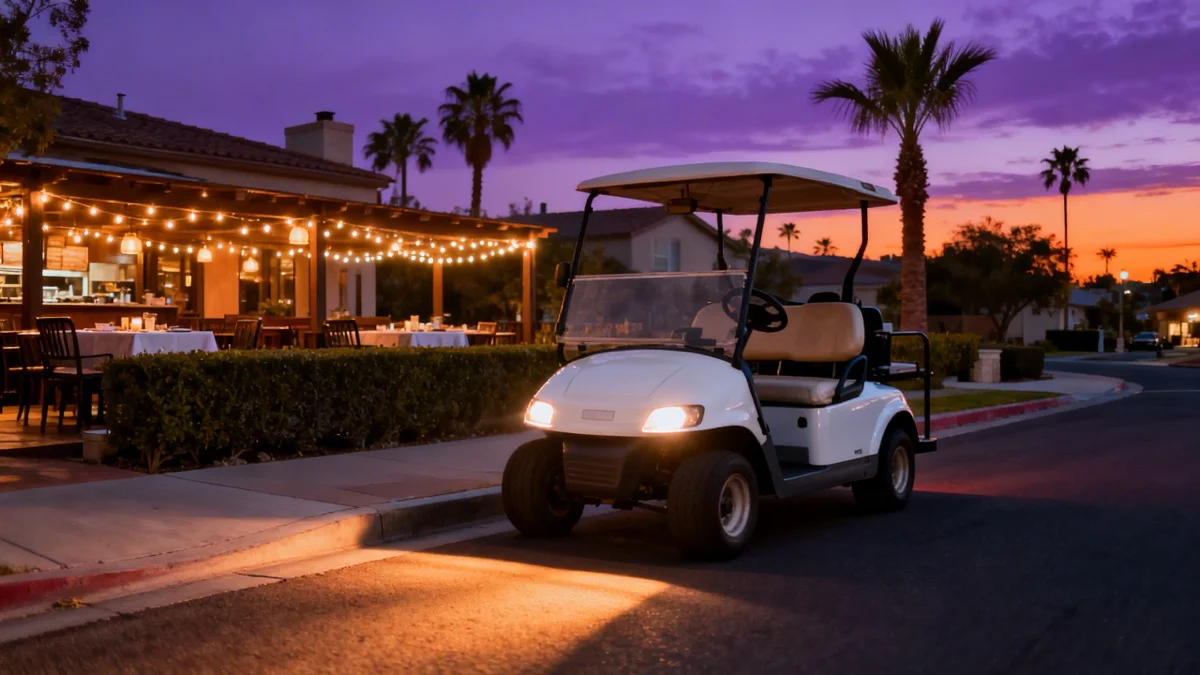
Make your cart visible at night. If you are driving sober after dark, make sure your cart has proper headlights and taillights. Many golf cart DUI incidents happen at night on poorly lit paths. Being visible protects you from other impaired drivers, and having working lights ensures you are not violating street-legal requirements that could give officers a reason to stop you.
Do not assume private property protects you. As covered above, most golf cart communities fall under DUI jurisdiction. The gates do not create a legal shield.
Yes, in all 50 states. Golf carts are classified as motor vehicles under DUI statutes. The same 0.08% BAC limit applies. Penalties are identical to a car DUI, including fines, jail time, license suspension, and a criminal record.
Yes. The charge, penalties, and long-term consequences are the same. Courts do not give lighter sentences because the vehicle was a golf cart. The conviction goes on your record as a standard DUI/DWI.
Yes. Your license to drive all motor vehicles is suspended, not just your right to drive a golf cart. First-offense suspensions range from 90 days to 1 year depending on the state.
In 42 states, yes. Having an open alcoholic beverage in a golf cart on a public road is illegal. Florida specifically prohibits it. Mississippi is the notable exception with no open container law. Check your state's golf cart laws for specifics.
In many states, yes. Florida, California, Texas, Georgia, Michigan, and others enforce DUI on private property accessible to the public. Golf cart communities, resort areas, and golf courses all typically qualify.
Penalties vary by state: fines from $300 to $2,000, jail time from 48 hours to 6 months, license suspension from 90 days to 1 year, mandatory alcohol education, community service, and probation. Arizona is the toughest with a minimum 10 days in jail. South Carolina has the lightest first-offense penalties.
Yes. Expect premiums to double or triple. You may need an SR-22 filing for 3 years. Some insurers will cancel your policy. A golf cart DUI is treated identically to a car DUI by insurance companies.
Yes. The Villages has regular golf cart DUI enforcement, including arrests for DUI manslaughter. With 85,000+ carts and active nightlife at three town squares, police patrol for impaired cart drivers, especially in evening hours.
Golf Cart Search
Compare top-rated models, read expert reviews, and find the perfect cart for your needs.
The 15 best golf cart communities in America ranked with cart counts, path miles, home prices, and local rules. From The Villages to Bald Head Island.

Complete spring golf cart maintenance checklist with real costs. Battery revival, tire checks, brakes, cleaning, and more for electric and gas carts.

Evolution golf cart review covering every model from $6,695 to $17,595, common problems, warranty details, and honest comparisons to Club Car and EZGO.
Get the latest updates on golf cart services, tips, and exclusive offers delivered to your inbox.