
As an Amazon Associate, we earn from qualifying purchases. This helps support our site at no extra cost to you.
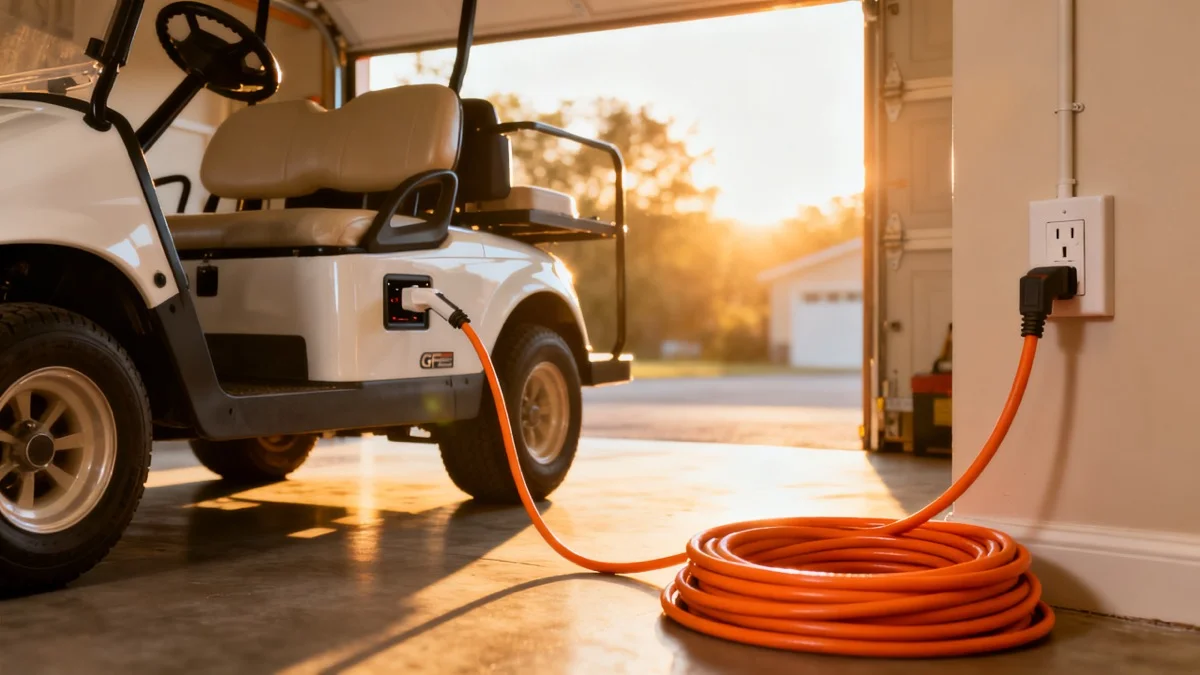
If you are asking whether you can use a golf cart charger extension cord, the honest answer is: sometimes, for a short temporary charge, with the right cord and the right outlet. For everyday charging, a dedicated outlet near the cart is safer.
Golf cart chargers are not like phone chargers. A typical 36V or 48V charger can pull 10 to 15 amps from a 120V outlet for several hours. That steady load is exactly where cheap extension cords, loose garage outlets, power strips, and damp carport connections get into trouble.
This guide gives you the practical version: what gauge cord to use, how long is too long, when a hot plug means danger, what a safe garage charging setup looks like, and when it is time to pay an electrician instead of stretching another cord across the floor.
Golf Cart Charger Extension Cord: Quick Answer
For one short charge, a heavy-duty extension cord can work if all of these are true:
- The charger manual does not prohibit extension cords.
- The cord is outdoor rated, grounded, and in good condition.
- The cord is 12 AWG for a short run, or 10 AWG for a longer temporary run.
- The cord is fully uncoiled.
- The outlet is grounded and GFCI-protected.
- The plug, outlet, and cord stay cool during charging.
- The connection stays dry and off the ground.
If any of those are not true, do not use the extension cord.
For routine charging, install a dedicated 120V, 20-amp GFCI outlet where the charger cord reaches the cart without an extension. That is the same charging-station advice we give in our golf cart garage setup guide, because it prevents most of the unsafe workarounds owners end up using.
Why Golf Cart Chargers Are Hard on Extension Cords
Most golf cart chargers plug into a standard 120V household outlet. That part makes them look harmless. The problem is the duration and current draw.
A charger for a 36V EZGO or older 36V cart may pull around 10 to 12 amps during the bulk charge phase. Many 48V chargers for Club Car, Yamaha, ICON, Star EV, and Advanced EV setups can draw 12 to 15 amps. Some high-output chargers draw even more.
That current does not last for five minutes. A lead-acid cart may charge for 6 to 10 hours, as we break down in our golf cart charge-time guide. Lithium often finishes faster, but the charger still works hard during the early charge phase.
Extension cords add three risks:
- Voltage drop: Long or thin cords reduce voltage at the charger. The charger may run hotter, charge slower, or shut down.
- Heat buildup: Every plug, receptacle, and foot of wire adds resistance. Resistance turns into heat under sustained load.
- Damage exposure: Cords get pinched under garage doors, crushed by tires, dragged through wet grass, or left coiled where heat cannot dissipate.
The U.S. Consumer Product Safety Commission warns against overloading extension cords and using damaged cords. Golf cart charging is exactly the kind of long, high-load use where those warnings matter.
Safe Gauge and Length Rules
The safest cord is no cord. Plug the golf cart charger directly into a properly grounded outlet whenever possible.
If you need a temporary extension cord, use this rule of thumb:
| Charging Setup | Recommended Choice | Use Case |
|---|---|---|
| Best routine setup | No extension cord | Dedicated 20-amp GFCI outlet near the cart |
| Short temporary run | 12/3 outdoor cord | Up to about 25 feet, only if plugs stay cool |
| Longer temporary run | 10/3 outdoor cord | About 25 to 50 feet, only when unavoidable |
| Long routine run | Install an outlet | Any setup that needs more than 50 feet |
| Light household cord | Do not use | 16 AWG, flat indoor cords, lamp cords, or retractable reels |
The "3" in 12/3 or 10/3 means the cord has hot, neutral, and ground conductors. Do not use a two-prong cord. Do not cut off the grounding pin. Do not use a three-prong adapter to defeat a bad outlet.
Cord cost is usually not the deciding factor. A 25-foot 12/3 outdoor cord often costs about $20 to $45. A 50-foot 10/3 cord can cost $60 to $120. Those are reasonable prices, but once you are spending real money to patch around a bad charging location, compare it against the cost of a proper outlet.
The 7 Rules If You Must Use a Cord
1. Read the Charger Manual First
Some charger manufacturers discourage or prohibit extension cords. If the manual says not to use one, do not use one. That matters for warranty coverage, heat ratings, and safety.
If you are replacing an old charger, first make sure the new one matches voltage, connector, and battery chemistry. Our best golf cart chargers guide, best Club Car chargers guide, and best EZGO TXT chargers guide cover those fitment details.
For a 36V EZGO TXT owner using a D-style plug, the FORM 36V EZGO TXT charger is a good example of a modern smart charger with automatic shutoff. Confirm your cart and battery setup first.
Check Price on AmazonFor Club Car owners, plug style and onboard electronics matter. A 48V charger with a Club Car round plug is not automatically right for every DS or Precedent, especially if the cart still depends on an OBC. The Kohree 48V Club Car charger can make sense for the right lead-acid setup, but verify compatibility before ordering.
Check Price on Amazon2. Use an Outdoor-Rated Cord
Even if you charge inside a garage, use an outdoor-rated cord for temporary charging. Garages, carports, sheds, and driveways are rough environments. Cords face concrete abrasion, moisture, cold, heat, and vehicle traffic.
Look for markings that indicate outdoor use and a grounded three-prong design. Avoid old orange cords with cracked jackets, missing ground pins, loose ends, tape repairs, or plugs that wiggle in the outlet.
3. Keep the Cord Fully Uncoiled
A coiled cord traps heat. That is fine for a few minutes with a small tool, but it is a bad idea for a charger that may pull current for hours.
Lay the cord out in a loose path where air can move around it. Keep it away from sharp door edges, tire paths, mower blades, puddles, and anything flammable.
4. Plug Into the Wall, Not a Power Strip
Do not plug a golf cart charger into a power strip, cube tap, light-duty surge protector, outlet multiplier, timer, smart plug, or daisy-chained extension cord.
Those devices often are not designed for a sustained 10 to 15 amp charging load. They also add extra contact points that can loosen, corrode, and heat up. If you want surge protection, talk with an electrician about whole-home surge protection or an outlet setup rated for the load.
5. Keep Every Connection Dry
Water and golf cart charging do not mix. Outdoor charging needs GFCI protection, dry plugs, and connections kept off the ground.
Do not leave the cord connection in wet grass, on a damp driveway, or under a dripping roof edge. If rain is coming, stop charging unless the charger and all connections are protected exactly as the manufacturer requires.
For owners who store outside, our golf cart garage and storage guide has safer carport, shed, and floor setup options.
6. Check Temperature Early
After 15 minutes, touch the extension cord, wall plug, charger plug, and outlet cover. They should stay cool or barely warm. Check again after about an hour.
Stop charging if you notice:
- A plug that is hot to the touch.
- A soft, melted, or discolored cord end.
- A buzzing or crackling outlet.
- A breaker that trips repeatedly.
- A charger that smells like hot plastic.
- A cord that feels warm along its length.
Use a basic multimeter to check outlet voltage, pack voltage, and whether the charger is seeing reasonable input. The AstroAI digital multimeter is inexpensive enough for a garage toolbox and useful across battery, charger, and accessory troubleshooting.
Check Price on AmazonIf you are not comfortable checking voltage safely, call an electrician or a golf cart repair shop. You can find local service options through our repair directory.
7. Do Not Make It Your Overnight Habit
Modern smart chargers can be safe overnight when plugged directly into a proper outlet in a ventilated area. An extension cord changes that risk.
If you must use one temporarily, charge while you are home and awake. For routine overnight charging, install the outlet. It is not glamorous, but it is the fix that removes the weak link.
What a Safe Garage Charging Setup Looks Like
A good charging station is simple:
- A dedicated 120V, 20-amp GFCI circuit.
- A grounded outlet close to the cart.
- The charger mounted or placed off the floor.
- A clean cable path with no stretched cords.
- Ventilation, especially for flooded lead-acid batteries.
- Dry storage for the charger and plug.
- Enough space to open the seat and inspect batteries.
That setup works for neighborhood carts, golf course carts, and family carts used in places like The Villages, beach communities, and retirement neighborhoods.
Lead-acid batteries deserve extra ventilation because they can release hydrogen gas while charging. South Carolina Fire Safe's golf cart charging safety sheet specifically warns owners to charge in a well-ventilated area and keep sparks or flames away from batteries.
Lithium carts do not vent hydrogen during normal charging, but they still need the right charger and a safe AC power source. If you are converting from lead-acid to lithium, read our golf cart lithium battery conversion guide before reusing old charging habits.
Outdoor, Shed, and Carport Charging
Outdoor charging is common in warm golf cart markets like Florida, Arizona, South Carolina, and Texas. It can be safe, but the details matter more than they do in a dry garage.
For a carport, place the outlet on a weather-resistant GFCI box where the charger cord reaches the cart directly. Mount the charger out of splash zones. Keep the cart far enough under cover that wind-blown rain does not hit the charger or charge port.
For a detached shed, do not run a long extension cord from the house as a permanent charging circuit. A detached structure often needs its own properly installed electrical feed, grounding, and code-compliant outlets. The cost is higher than a simple garage outlet, often $500 to $1,500 depending on distance and trenching, but it is far safer than a 75-foot cord used every night.
If your cart is street legal or used on public roads, make sure charging setup is not your only safety concern. Laws vary by state, so check our golf cart laws guide and your local city rules before using a cart in traffic.
When the Cord Is Not the Real Problem
A hot plug or failed charging session does not always mean the extension cord caused the issue. It might be exposing another weak point.
Loose Charging Port
If the charger handle gets hot at the cart side, the charging port may be loose, corroded, or worn. That is common on older Club Car round plugs, EZGO D-style plugs, and Yamaha connectors that have spent years outdoors.
Start with our golf cart charging port problems guide. A replacement port or plug is cheaper than guessing on batteries or chargers.
CRC QD Electronic Cleaner is useful for cleaning electrical contacts because it dries quickly and leaves no heavy residue. Use it only with the charger unplugged and the circuit powered down.
Check Price on AmazonCorroded Battery Terminals
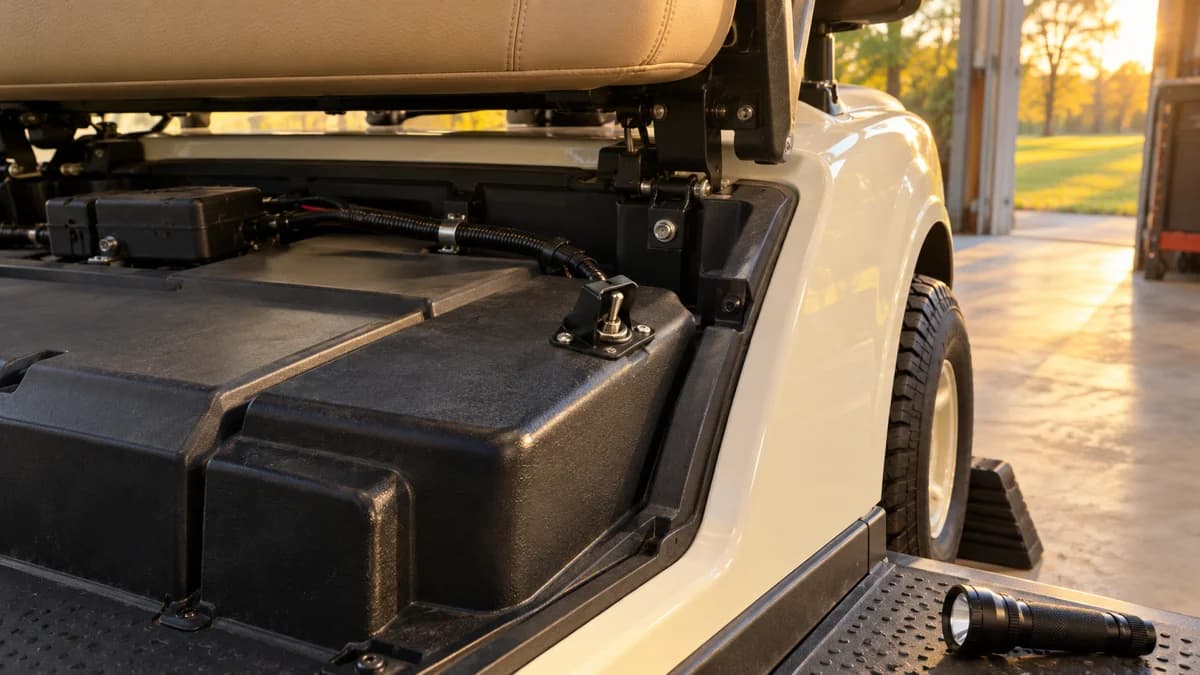
High resistance at the battery pack can make charging slow, inconsistent, or hot. Lift the seat and inspect each terminal. White, green, or blue buildup means corrosion.
Clean the terminals, tighten hardware to the battery manufacturer's spec, and protect clean connections. CRC Battery Terminal Protector is a cheap way to slow corrosion after the terminals are already clean.
Check Price on AmazonFor the full battery maintenance routine, see our golf cart battery guide, battery voltage chart, and maintenance checklist.
Wrong Charger or Wrong Battery Chemistry
A charger can plug in and still be wrong. A lead-acid charger should not be used on lithium unless the battery maker explicitly approves that charging profile. A 48V charger should not be used on a 36V system. A connector adapter does not solve an incompatible charger.
If you are unsure what you own, identify your brand first: Club Car, EZGO, Yamaha, ICON, Star EV, or Advanced EV. Then confirm pack voltage, battery chemistry, and connector type with our charger plug compatibility guide.
When to Install a Real Outlet
Install a proper charging outlet if any of these describe your setup:
- You charge more than once or twice a month.
- Your charger only reaches with an extension cord.
- You need more than 25 feet of cord.
- The outlet or plug gets warm.
- The breaker trips when the charger runs.
- You charge in a shed or carport.
- The existing garage outlet is old, loose, or ungrounded.
- You leave the cart charging overnight.
Most owners do not need a fancy EV charger. Standard golf cart chargers usually need a grounded 120V outlet, not a 240V electric-car circuit. The upgrade is usually about location, circuit capacity, GFCI protection, and avoiding shared loads.
Typical cost ranges:
- GFCI outlet replacement on an existing safe circuit: about $100 to $250 installed.
- New nearby dedicated 20-amp garage circuit: about $200 to $500.
- Detached shed or long exterior run: about $500 to $1,500 or more.
- Panel upgrade or difficult access: quote required.
If you are shopping for a new cart and planning where it will live, make charging part of the buying decision. Our best golf carts guide, best golf cart brands guide, and dealer directory can help you compare models, but the right home charging setup matters just as much after delivery.
Recommended Charging Setup by Cart Type
36V Lead-Acid Carts
Older 36V carts, especially EZGO TXT models, often use six 6V batteries and charge overnight. Use a compatible 36V smart charger, plug directly into a grounded outlet, and avoid thin cords. If you must use a temporary cord, keep it short and heavy.
48V Lead-Acid Carts
Many 48V carts draw enough current that a weak outlet or cord shows up quickly. Use a dedicated 20-amp GFCI circuit when possible. Watch for hot Club Car round plugs, corroded ports, and old OBC-related charging issues.
Lithium Golf Carts
Lithium reduces charge time and maintenance, but it does not remove AC-side safety rules. Use the lithium charger supplied or approved by the battery maker. Do not assume a shorter charging window makes a light-duty extension cord safe.
Neighborhood and Street-Legal Carts
Carts used every day in neighborhoods, lake communities, and resort towns need a permanent charging station. If your cart also has lights, turn signals, audio, heaters, or 12V accessories, keep accessory wiring separate from charger wiring. Our golf cart voltage reducer wiring guide explains that side of the electrical system.
FAQ
Can you charge a golf cart with an extension cord?
Yes, but only as a temporary setup with a heavy-duty outdoor-rated cord, GFCI protection, dry connections, and no heat at the plugs. For everyday charging, install an outlet close enough to plug the charger in directly.
What gauge extension cord should I use for a golf cart charger?
Use 12 AWG for a short temporary run up to about 25 feet. Use 10 AWG for a longer temporary run up to about 50 feet if the charger manufacturer allows it. Do not use 16 AWG household cords.
How long can the extension cord be?
Shorter is safer. Treat 25 feet as the practical limit for 12 AWG and 50 feet as the upper temporary limit for 10 AWG. If you need more than that, install an outlet.
Do I need a GFCI outlet?
Yes. Garages, carports, sheds, and outdoor charging areas should use GFCI protection. A dedicated 20-amp GFCI circuit is the best routine setup for most golf cart chargers.
Why is my plug hot?
A hot plug means resistance. The cause may be an undersized cord, loose outlet, corroded charge port, damaged plug, weak receptacle, or overloaded circuit. Stop charging until you find the cause.
Is overnight charging safe with an extension cord?
It is not a good habit. If you must use a cord temporarily, charge while you are home and awake. For overnight charging, use a smart charger plugged directly into a proper outlet in a ventilated area.
Can I use a power strip?
No. Avoid power strips, surge strips, adapters, outlet multipliers, smart plugs, timers, and daisy-chained cords. Plug the charger directly into a grounded outlet whenever possible.
Does a lithium cart need the same cord rules?
Yes. Lithium changes the battery side of the system, not the basic AC safety rules. The charger still pulls current through the outlet and cord.
What should I do if the breaker trips?
Stop charging and reduce the load. The charger may be sharing a circuit with a freezer, lights, tools, or garage door opener. A dedicated circuit usually fixes nuisance trips, but repeated tripping can also point to a charger or wiring fault.
How much does a safe outlet cost?
A simple nearby GFCI outlet or dedicated circuit often costs $200 to $500. A detached shed, trenching, or long run can cost $500 to $1,500 or more.
Golf Cart Search
Find the Best Golf Carts of 2026
Compare top-rated models, read expert reviews, and find the perfect cart for your needs.