
Best Golf Cart Floor Mats & Liners: Buyer's Guide (2026)
Best golf cart floor mats for EZGO, Club Car, Yamaha & ICON. Compare rubber, TPE, and silica gel liners with prices, fitment charts, and top picks for 2026.
Golf cart safety guide with accident statistics, driving tips, child safety rules, and must-have safety equipment. Protect your family with our 2026 checklist.

As an Amazon Associate, we earn from qualifying purchases. This helps support our site at no extra cost to you.
Golf carts aren't cars, and that's exactly why they're dangerous. No airbags. No doors. No crumple zones. Just an open frame moving at 15 to 25 mph with passengers who assume they're perfectly safe.
They're not. Over 23,000 people are injured in golf cart accidents every year in the United States, and that number has climbed 64% over the past decade. Children make up more than a third of those injuries. The most common cause? Falling or being ejected from the cart, something that proper safety habits and basic equipment can prevent.
Whether you drive your cart on a golf course, through your neighborhood, or on public roads, this guide covers the safety rules, equipment, and habits that keep you and your passengers protected. We'll also break down the actual accident statistics, child safety rules that every parent should know, and a pre-ride checklist you can run in 60 seconds.
Golf carts are often treated like toys, but the injury numbers tell a different story. Here's what the data from the Consumer Product Safety Commission (CPSC) and peer-reviewed medical research shows.
According to CPSC National Electronic Injury Surveillance System (NEISS) data, an estimated 23,000+ people visit U.S. emergency departments for golf cart injuries annually. Between 2015 and 2024, incidents rose from roughly 17,750 to over 29,000, a 64% increase. The year 2020 saw the biggest spike at over 43,000 incidents, likely driven by a pandemic-era surge in golf participation.
A 10-year study published in the AOAO Journal found that golf carts caused an estimated 35,453 emergency department visits for serious orthopedic injuries alone (fractures, dislocations, and amputations) between 2012 and 2021. Of those, 93% were fractures, and 33% required hospital admission.
| Injury Type | Percentage of Cases |
|---|---|
| Fractures | 24.7% |
| Contusions and abrasions | 22.7% |
| Internal organ injuries | 18.9% |
| Lacerations | 13.9% |
| Concussions | 3.2% |
Head injuries are the most common by body location, accounting for 26.1% of all cases. Face injuries add another 6.8%. Skull fractures represent 80% of head trauma cases, and intracranial hemorrhage occurs in 76% of neurosurgical golf cart injuries, according to research published in the National Institutes of Health.
Summer months (May through August) account for 44% of all golf cart injuries, with July peaking at 12% of the annual total. December has the highest rate of off-course incidents, with 21% of December injuries happening on roads versus the 12% average, likely due to holiday events and parades.
About 7% of golf cart incidents involve alcohol. Drinking on the golf course is common, but most people don't realize DUI laws apply to golf carts on public roads in nearly every state. A golf cart feels casual, but legally it's a motor vehicle. More on that below.
Golf carts look harmless, but their design creates specific hazards that cars simply don't have.
A standard golf cart has no doors, no windshield (or a small one), no airbags, and no seat belts unless aftermarket ones are added. There's nothing stopping a passenger from falling out during a sharp turn, a sudden stop, or a bump in the terrain. Falling or ejection causes 38% of all golf cart injuries, making it the single most common accident mechanism.
Golf carts weigh between 500 and 1,100 pounds depending on the model (check our golf cart weight guide for specifics). They sit high relative to their narrow wheelbase, with no anti-roll bars and minimal suspension. A sharp turn at even 12 to 15 mph can cause a rollover, particularly if the cart is loaded with passengers or cargo. Add a lift kit and the center of gravity rises even higher.
Most modern golf carts are electric, which means they're nearly silent. Pedestrians, cyclists, and other drivers may not hear you coming. This is especially dangerous in neighborhoods, parking lots, and anywhere people are walking. If your cart doesn't have a horn, tapping the brakes or calling out is your only option, and neither is reliable.
Standard golf carts are not required to meet any federal crash safety standards. Only low-speed vehicles (LSVs), which are street-legal carts that can reach 20 to 25 mph, must meet NHTSA safety requirements including seat belts, lights, and mirrors. The golf cart sitting in your garage likely has none of these unless you added them yourself.
These rules apply whether you're on the golf course, in a retirement community like The Villages, or cruising your neighborhood.
This is the number one cause of rollovers. Golf carts tip more easily than any other vehicle you've driven. Slow to walking speed (3 to 5 mph) before making a turn, and never jerk the steering wheel. On sloped terrain, drive straight up and down hills rather than across them at an angle.
No standing, no sitting on laps, no hanging off the back or sides. Every passenger should be in a designated seat, facing forward, with feet on the floorboard. Rear-facing flip seats increase ejection risk, so take extra caution with those.
Passengers should always hold onto the grab bar, frame, or any available handhold while the cart is moving. This sounds obvious, but most golf carts don't have seat belts, so your grip is the only thing keeping you in the seat over bumps and turns.
Golf cart brakes are not car brakes. Stopping distances grow fast above 12 to 15 mph, and the open design means any sudden stop can throw passengers forward. In neighborhoods, near pedestrians, and in parking lots, keep it slow. Check our speed guide for top speeds by brand and model.
DUI laws apply to golf carts in most states. If you've been drinking on the course, hand the keys to someone who hasn't. About 7% of golf cart injuries involve alcohol, and impaired reaction time on a vehicle with minimal braking and no safety restraints is a recipe for serious injury.
Only one person should operate the cart at a time. The driver should be at least 16 years old with a valid driver's license for public road use. Never let younger children drive, even on private property, no matter how "safe" it seems. The legal driving age varies by state, but safety experts recommend 16 as the minimum everywhere.
Visibility drops fast in low-light conditions, and golf carts are small and hard to see. Turn on your headlights and taillights any time the sun is low. If your cart doesn't have lights, avoid driving after sunset entirely.
Electric golf carts make almost no noise. Slow down near sidewalks, crosswalks, intersections, and any area where people walk. Make eye contact with pedestrians before proceeding. Use your horn or call out when approaching from behind.
Every golf cart has a weight capacity listed by the manufacturer. A standard 2-passenger cart typically handles 800 to 1,000 pounds including the driver. Overloading affects braking, steering, and rollover risk. If you need to carry more people, consider a 4-passenger or 6-passenger model rather than cramming extra riders onto a 2-seater.
Arms, legs, hands, and feet should stay inside the cart at all times. The open design makes it easy for limbs to contact the ground, curbs, other vehicles, or fixed objects during turns. This is especially important for children riding in the back.
Children account for 37% of all golf cart orthopedic injuries. About 6,500 children are injured in golf cart accidents annually in the U.S. Here's what every parent needs to know.
Nationwide Children's Hospital Center for Injury Research and Policy recommends these age guidelines, and the injury data supports them: the average age of injured children in golf cart accidents is 10.5 years, and the 12 to 16 age group accounts for 17% of all golf cart injuries.
This bears repeating: never use a car seat in a golf cart. Car seats are designed to work with a car's structure, including LATCH anchor points, seat belt tensioners, and crumple zones. Golf carts have none of these. A car seat in a golf cart will not protect your child in a crash and may give you a false sense of security.
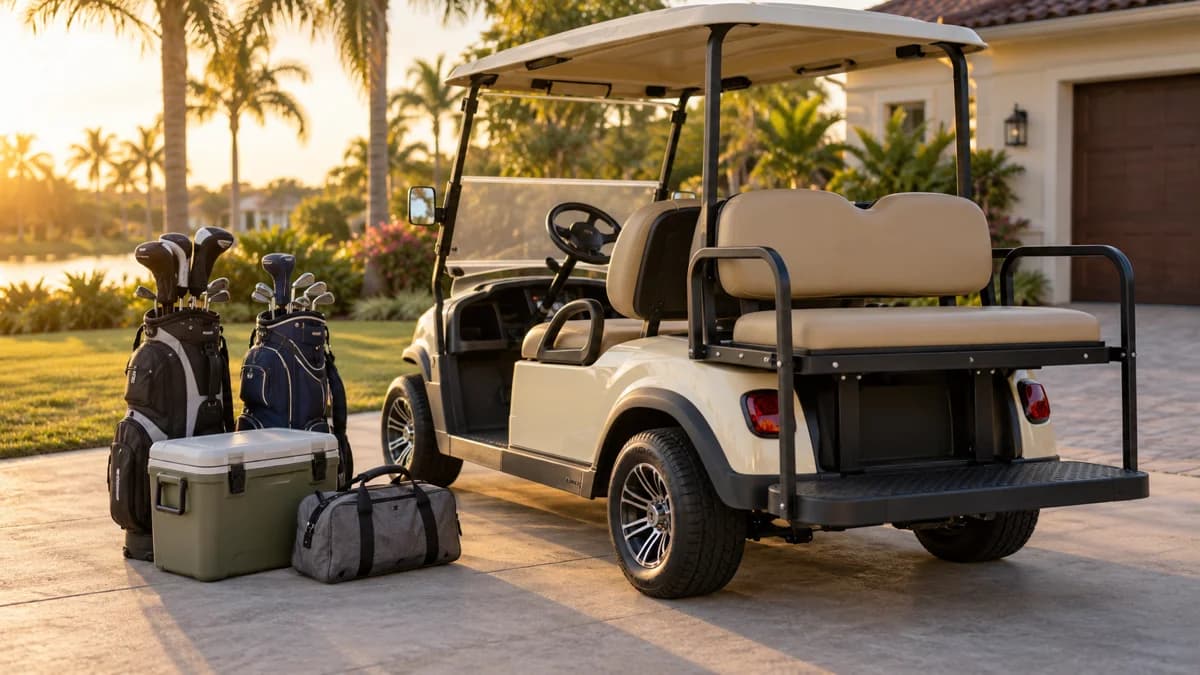
Rear-facing flip seats are popular on 4-passenger carts, but they're also the most dangerous seating position. Passengers face backward, which makes it harder to brace for stops, and ejection rates are higher from rear-facing seats. If children must ride in the back, make sure the seat has a grab bar installed and the child is old enough (at least 6) to hold on securely.
Before any ride, tell children the rules:
An adult should always be present and driving when children are passengers. Children should never operate a golf cart unsupervised, even on seemingly safe private property. The majority of child golf cart injuries happen on golf courses and at home, not on public roads.
A few affordable accessories cut your accident risk significantly. Here's what matters most, ranked by impact.
The single cheapest and most effective safety upgrade. A center-mounted rear view mirror costs $10 to $25 and gives you visibility behind the cart that's otherwise impossible. For full coverage, add side mirrors as well. If your cart is street legal, most states require at least one rear view mirror.
For a full breakdown of mirror types, sizes, and brand compatibility, see our complete golf cart mirrors guide.
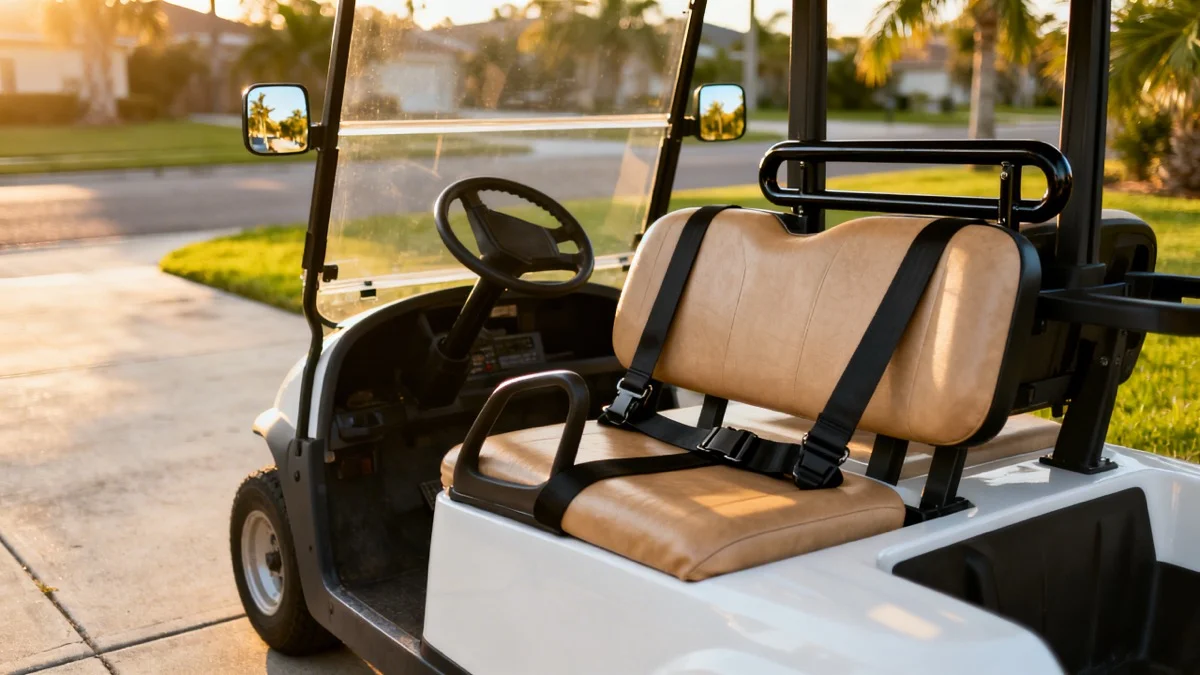
Only 5 states require seat belts on golf carts, but the data is clear: ejection and falls cause 38% of all injuries. Aftermarket retractable seat belt kits install in about 30 minutes and cost $25 to $80 per seat. Universal kits fit most Club Car, EZGO, and Yamaha models.
Check Price on AmazonVisibility is safety. LED headlight and taillight kits are brighter, use less battery power, and last longer than halogen. Most kits run $50 to $200 and include wiring harnesses for easy installation. Our LED lights guide covers the best options by brand and cart model.
Turn signals tell other drivers and pedestrians where you're going. A 10L0L universal turn signal kit includes the switch, wiring harness, hazard flasher, horn button, and brake light pad. It fits most EZGO, Club Car, and Yamaha carts with 12V systems.
Check Price on AmazonIf your cart has a rear flip seat, a grab bar is non-negotiable. It gives rear passengers something to hold onto during stops and turns, which is the primary way to prevent ejections from rear-facing seats. Universal grab bars fit most rear seat kits and cost $40 to $80.
Check Price on AmazonA working horn alerts pedestrians, cyclists, and other vehicles. Many golf carts come without one, but aftermarket horns are $10 to $30 and wire into most 12V to 48V systems. If you drive in a neighborhood or on public roads, a horn is typically required by law.
A windshield protects your face and eyes from wind, rain, bugs, and debris. More importantly for safety, it reduces the chance of being distracted by something hitting you while driving. Fold-down acrylic windshields start around $80, and impact-modified options run $150 to $300.
Holding your phone while driving is a distraction risk. A dedicated phone mount keeps your GPS visible and your hands on the wheel. The Haxmuti universal clamp holder fits EZGO, Club Car, and Yamaha roof struts and holds phones from 4.5 to 7 inches.
Check Price on Amazon| Equipment | Cost | Installation | Required for Street Legal? |
|---|---|---|---|
| Rear view mirror | $10 to $25 | 5 min, no tools | Yes |
| Side mirrors (pair) | $15 to $40 | 10 min, clamp-on | Yes (most states) |
| Seat belt kit (per seat) | $25 to $80 | 30 min, drill required | Yes (LSVs) |
| LED headlight/taillight kit | $50 to $200 | 1 to 2 hours | Yes |
| Turn signal kit | $30 to $60 | 1 to 2 hours | Yes |
| Rear grab bar | $40 to $80 | 30 min | No |
| Horn | $10 to $30 | 15 min | Yes |
| Windshield | $80 to $300 | 30 min to 1 hour | Yes (LSVs) |
For a complete rundown of all safety and comfort accessories, see our golf cart accessories guide.
Golf carts are increasingly popular for neighborhood transportation, especially in communities like The Villages, FL, Peachtree City, GA, and beach towns across Florida, South Carolina, and Texas. Driving on roads raises the safety stakes significantly.
Golf cart laws vary wildly by state. Some states allow golf carts on roads with posted speed limits up to 35 mph. Others restrict them to private property. Only 24 states require a valid driver's license to operate a golf cart on public roads. Check your state's specific requirements on our golf cart laws page.
If you drive on public roads, your cart should meet street-legal equipment standards. Federal requirements for LSVs include:
Even a street-legal golf cart tops out at 20 to 25 mph. You're sharing the road with vehicles going 30 to 45 mph, and your cart has no crash protection. Stick to low-speed residential streets, avoid busy intersections when possible, and never take a golf cart on a highway or road with a speed limit above 35 mph.
Golf carts are small, low to the ground, and hard for drivers to see at night. If you must drive after dark:
You can absolutely get a DUI on a golf cart. In most states, a golf cart on a public road is a motor vehicle under the law. The same blood alcohol limits apply, and the consequences include fines, license suspension, and criminal charges. If your community is known for golf cart culture and social events, plan a sober driver just like you would for any other vehicle.
Many states require golf cart insurance for street use, and it's smart to carry it even where it's not required. A basic liability policy runs $100 to $300 per year and covers damage you cause to others. Comprehensive coverage protects your cart too. Read our golf cart insurance guide for costs, coverage types, and state requirements.
Run through this checklist before driving. It takes about 60 seconds and catches the mechanical issues that cause accidents.
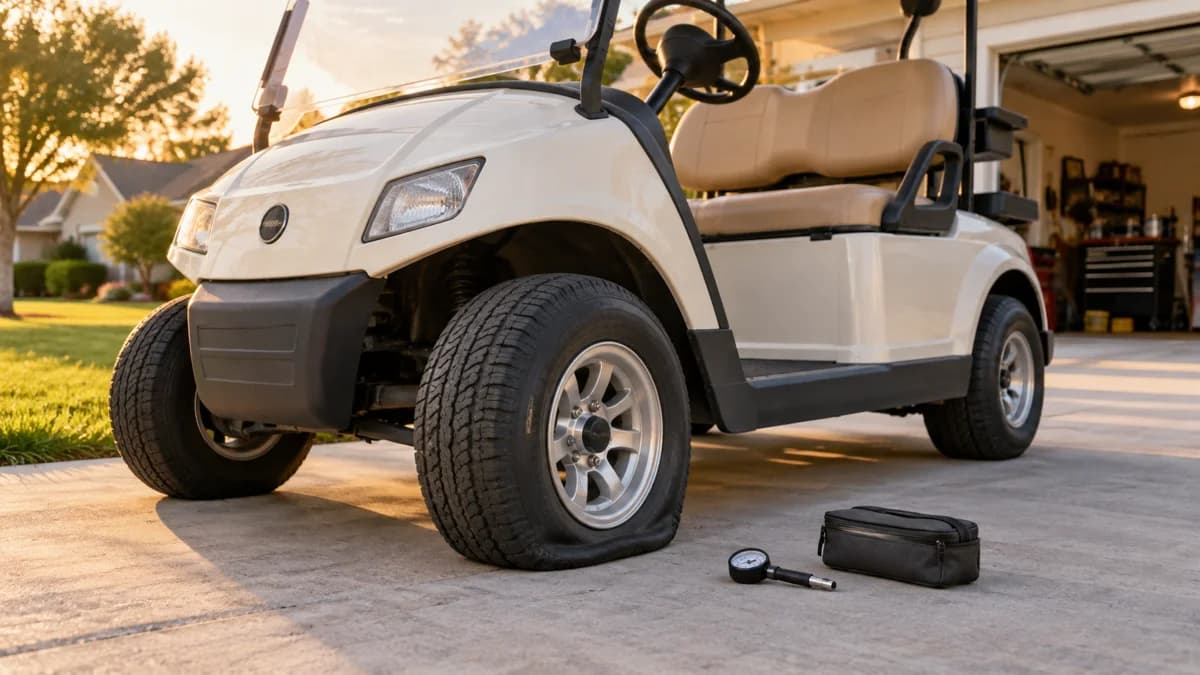
Tires: Look for low pressure, cracks, or uneven wear. A soft tire affects steering and can cause a blowout. Keep tires at the PSI listed on the sidewall (typically 18 to 22 PSI). See our tires guide for replacement specs.
Brakes: Press the brake pedal firmly before moving. It should feel solid, not spongy or soft. If the pedal goes to the floor, do not drive the cart. Check our troubleshooting guide for brake repair steps.
Lights: Flip the headlights and taillights on and off. Check brake lights by having someone watch while you press the pedal. Replace burned-out bulbs immediately.
Steering: Turn the wheel fully left and right before moving. It should respond smoothly without grinding, clicking, or resistance. Any play or looseness means the steering needs service.
Charge or Fuel: Check your battery level or fuel gauge. Running out of power on a public road creates a hazard. Keep at least 30% charge or a quarter tank of fuel before heading out.
Beyond the daily checklist, inspect these items monthly to keep your cart safe long-term:
For a complete maintenance schedule, see our golf cart maintenance guide.
If you or someone else is involved in a golf cart accident, here's how to respond.
Even if injuries seem minor, get checked by a doctor. Internal injuries and concussions don't always show symptoms immediately. The data shows that 18.9% of golf cart injuries involve internal organ damage, which may not be obvious at the scene.
For coverage details and filing claims, see our golf cart insurance guide.
Here's a summary of the key statistics referenced throughout this guide.
| Statistic | Number | Source |
|---|---|---|
| Annual golf cart injuries (U.S.) | 23,000+ | CPSC/NEISS |
| Injury increase, 2015 to 2024 | 64% | CPSC/NEISS |
| Most common cause of injury | Falls/ejection (38%) | CPSC/NEISS |
| Children injured per year | 6,500 | Swartz Law / CPSC |
| Children's share of orthopedic injuries | 37% | AOAO Journal |
| Head injuries as share of all injuries | 26% | CPSC/NEISS |
| Incidents involving alcohol | 7% | CPSC/NEISS |
| States requiring seat belts on golf carts | 5 | AOAO Journal |
| States requiring a driver's license | 24 | AOAO Journal |
| Fatality rate | 0.2% | CPSC/NEISS |
| Hospitalization rate | 13% | CPSC/NEISS |
Golf carts are practical, fun, and increasingly part of everyday transportation in communities across the country. Treating them with the same respect you'd give any vehicle on the road, buckling up, slowing down on turns, keeping children properly supervised, and maintaining your equipment, makes the difference between a safe ride and an emergency room visit.
If you're shopping for a golf cart, compare models on our best golf carts page, browse trusted dealers near you, or read our pricing guide to find the right cart for your family.
Golf Cart Search
Compare top-rated models, read expert reviews, and find the perfect cart for your needs.
Browse Top-Rated Carts
Best golf cart floor mats for EZGO, Club Car, Yamaha & ICON. Compare rubber, TPE, and silica gel liners with prices, fitment charts, and top picks for 2026.

Find the best golf cart heater for your setup. Compare propane vs electric by brand, voltage, and price with BTU ratings and compatibility charts.

Find the best golf cart rear seat kit for Club Car, EZGO, or Yamaha. Compare flip seats by price, weight capacity, and quality with install tips.
Get the latest updates on golf cart services, tips, and exclusive offers delivered to your inbox.