
As an Amazon Associate, we earn from qualifying purchases. This helps support our site at no extra cost to you.
Most golf cart clutch problems start with the same complaint: the engine sounds busy, but the cart does not pull like it should. It may jerk on takeoff, squeal, smell like hot rubber, crawl up hills, or rev high without matching speed.
That points you toward the gas cart's CVT system: the primary clutch, secondary clutch, and wide drive belt. A $30 belt can fix some problems. A sticking or worn clutch can ruin that new belt in one ride. The trick is knowing which part is the cause and which part is only showing the symptom.
This guide covers the practical diagnosis path for gas golf carts: bad clutch symptoms, primary versus secondary clutch problems, belt-versus-clutch checks, 2026 repair costs, brand notes for EZGO, Club Car, and Yamaha, and when the job is better left to a golf cart repair shop.
Gas Carts Clutch and CVT belt
$15-$35 Common clutch puller tool
$80-$300 Aftermarket clutch part range
$200-$800 Common installed repair range
Golf Cart Clutch Problems: Quick Diagnosis
Use this table before buying parts:
| Symptom | Most Likely Cause | First Check |
|---|---|---|
| Engine revs but cart barely moves | Slipping belt, stuck primary clutch, stuck secondary clutch | Inspect belt width, clutch movement, and belt dust |
| Jerky takeoff | Glazed belt, dirty sheaves, sticking clutch, weak mounts | Check clutch faces and engine mount movement |
| Burning rubber smell | Belt slip caused by load, contamination, or clutch problem | Stop driving and inspect belt sidewalls |
| New belt slips immediately | Wrong belt, worn sheaves, weak spring, misalignment | Verify OEM belt number and clutch condition |
| Belt keeps shredding | Clutch misalignment, damaged sheaves, wobble, overload | Do not install another belt until clutches are inspected |
| Rattle or wobble from clutch area | Loose hardware, worn bushing, damaged clutch, shaft issue | Stop and call a shop if anything wobbles |
The key point: a golf cart clutch problem rarely exists alone. It often shows up as belt squeal, weak hill climbing, rubber dust, or high rpm. That is why this post pairs with our golf cart drive belt size and replacement guide, but it does not replace it. Start with the belt if it is visibly bad. Move to the clutch if the belt is correct and the symptom remains.
How a Gas Golf Cart Clutch Works
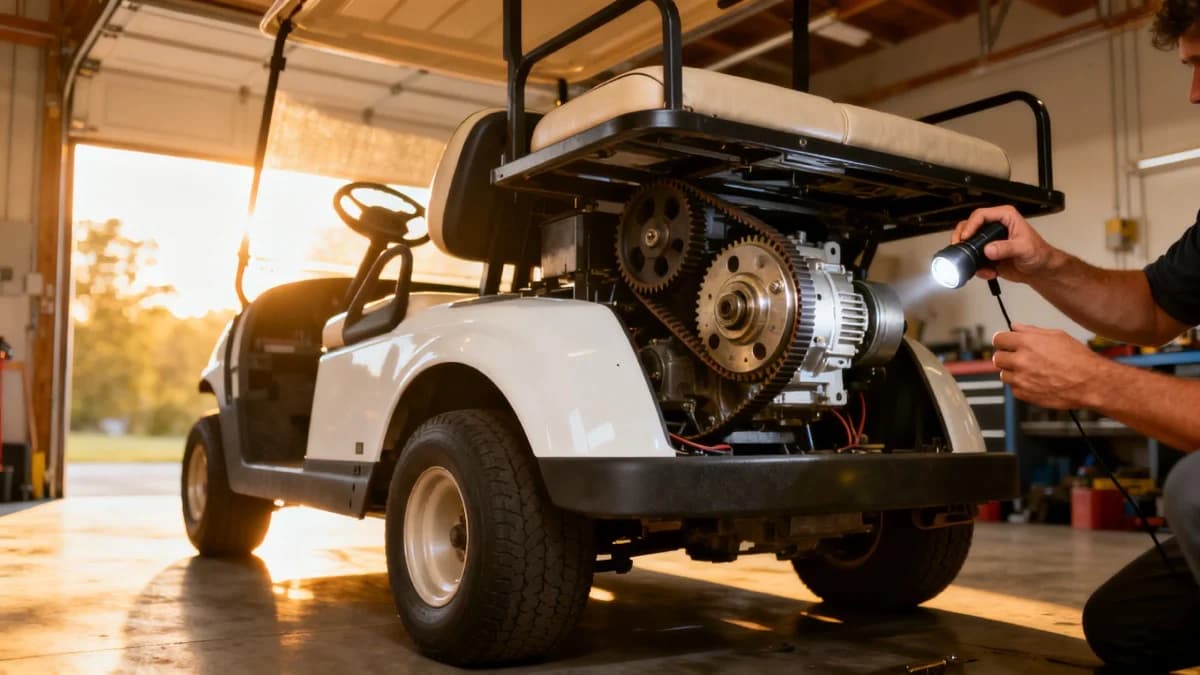
Most gas golf carts use a continuously variable transmission, commonly called a CVT. The system has three main pieces:
- Primary clutch: mounted on the engine crankshaft.
- Secondary clutch: mounted on the transaxle input shaft.
- Drive belt: the wide belt between the two clutches.
At low rpm, the belt sits low in the primary clutch and higher in the secondary. As engine speed increases, the primary clutch closes and squeezes the belt. The belt rides higher in the primary and forces the secondary clutch to react. That changing belt position gives the cart low-speed pulling power and higher-speed travel without manual shifting.
Golf Cart Report's clutch explainer describes the same basic two-clutch layout, and DURACLUTCH's CVT belt failure guide makes the broader powersports point that belts often fail because the clutch system creates the wrong conditions.
Golf carts are lighter and slower than most UTVs, but the principle is the same: clean clutch faces, correct belt fitment, smooth sheave movement, spring pressure, and alignment all matter.
Primary Drive Clutch Symptoms
The primary clutch is the engine-side clutch. It responds directly to engine rpm. When it wears, sticks, or fails to squeeze the belt correctly, the engine may rev while the cart feels lazy.
High RPM With Weak Movement
This is the classic primary-clutch complaint. You press the accelerator, the engine spins up, but the cart does not launch cleanly. It may move eventually, but it feels like the drivetrain is slipping.
Possible causes:
- Worn clutch weights or ramps.
- Dirty or rusty sheave movement.
- Weak or damaged spring.
- Grooved clutch faces.
- Wrong or worn drive belt.
- Engine mount movement changing alignment.
Do not assume the clutch is bad before checking the belt. A narrowed or glazed belt can mimic a weak primary clutch. If the belt is cracked, frayed, or missing chunks, start with our drive belt guide.
Jerky or Grabby Takeoff
A cart that jumps into motion instead of launching smoothly often has inconsistent belt engagement. The primary clutch may be sticking, the belt may be flat-spotted, or the sheaves may be glazed and grabbing in pulses.
This is common on carts that sit for months, carts used in dusty or sandy areas, and carts that have been driven with a slipping belt for too long.
Rattle, Wobble, or Visible Runout
If the primary clutch wobbles, stop. Wobble can point to loose hardware, worn bushings, a damaged clutch, crankshaft issues, or a clutch that is not seated correctly. Do not keep test-driving a wobbling clutch. It can damage the belt, crankshaft, and nearby components.
Stuck Closed or Stuck Open
A primary clutch can stick in a position where it either will not grab the belt or will not release normally. That can cause hard shifting into motion, a cart that creeps, a belt that stays loaded at idle, or inconsistent launch behavior.
The fix may be cleaning, service, rebuild parts, or full clutch replacement. The right answer depends on the model, clutch condition, and parts availability.
Secondary Driven Clutch Symptoms
The secondary clutch, also called the driven clutch, sits on the transaxle side. It reacts to belt load and spring tension. When it sticks, loses spring pressure, or wears its sheaves, the cart can feel weak even if the engine and primary clutch are healthy.
Poor Hill Climbing
A weak secondary clutch often shows up on hills first. The cart may feel fine across flat pavement, then fall on its face when carrying passengers uphill.
Possible causes:
- Weak secondary spring.
- Sticking sheave movement.
- Worn or grooved pulley faces.
- Belt riding too low.
- Oversized tires or heavy loads beyond the stock clutch setup.
This matters for hunting carts, farm carts, lifted carts, and carts with rear seats or cargo boxes. Added load can make a marginal clutch problem obvious.
Slow Backshift After Letting Off
When you slow down, the CVT should return toward a low-speed ratio. A secondary clutch that does not backshift smoothly can leave the cart feeling sluggish when you accelerate again.
You may notice this after coasting into a turn, stopping on a hill, or slowing for a speed bump and pressing the pedal again.
Belt Dust Near the Driven Clutch
Heavy black dust around the secondary clutch is a clue that the belt is slipping or being overheated. Some dust is normal on an older belt. Piles of dust, strings of rubber, or a belt that keeps shredding point to a system problem.
Gates' CVT belt failure analysis guide lists clutch misalignment and pulley-angle problems among the causes of belt edge and sidewall damage. That is powersports guidance, not golf-cart-specific fitment, but the wear pattern logic applies well to gas-cart CVTs.
Belt Problem or Clutch Problem?
This is where owners spend money twice. They replace the belt, the cart feels better for a day, then the new belt squeals, burns, or shreds.
Start with these checks:
Replace the Belt First When It Is Clearly Bad
Replace the belt first if you see:
- Cracks across the rubber.
- Frayed edges.
- Missing chunks.
- Severe glazing.
- Belt sidewalls polished smooth.
- Belt width worn noticeably narrow.
- Wrong OEM number or wrong size.
For a common EZGO TXT or Medalist Robin-engine setup, the 10L0L drive belt listing cross-references 72054-G01, 72024-G01, and 72025-G01. Verify your engine and model year before ordering.
10L0L EZGO TXT/Medalist drive beltFor Yamaha owners doing a broader gas-cart service, the 10L0L tune-up kit with belts can make sense when the cart needs filters, spark plug, and belts together. Verify G-series, G29, and Drive2 fitment first.
10L0L Yamaha tune-up kit with beltsInspect the Clutch First When the Belt Is New
Move clutch diagnosis to the front of the line if:
- A new correct belt still slips.
- The belt rides off-center.
- The clutch sheaves are grooved.
- Either clutch wobbles.
- The cart jerks badly at takeoff.
- The belt shreds again quickly.
- You see oil or grease on clutch faces.
- The secondary clutch does not open and close smoothly.
Do not use belt dressing. It can attract dirt and make clutch engagement less predictable. Clean, dry clutch faces and the correct belt are the goal.
Brand Notes: EZGO, Club Car, and Yamaha
EZGO Clutch Problems
Older EZGO gas carts are common, and they have a wide spread of engines, clutches, and model-year quirks. TXT, Medalist, Marathon, Workhorse, RXV, and newer EX1-powered carts should not be treated as one fitment family.
Common EZGO clutch-related complaints:
- Engine revs high before the cart pulls.
- Squeal or bark on takeoff.
- Drive belt slips after replacement.
- Cart is weak with rear passengers.
- Starter generator belt noise is mistaken for CVT slip.
Many older EZGO gas carts use a 19779G1-style drive clutch puller, but that does not mean every EZGO clutch uses it. Verify the engine and OEM clutch before ordering, especially if the cart has an aftermarket clutch.
Check EZGO Clutch Puller PricesFor broader TXT versus RXV ownership issues, see our EZGO TXT vs RXV guide and E-Z-GO review.
Club Car Clutch Problems
Club Car gas carts, especially DS and Precedent models, usually have good parts availability. The clutch complaint pattern is similar: lazy launch, belt dust, weak hills, and new belts that do not stay happy.
Common Club Car clutch checks:
- Confirm whether it is a DS, Precedent, Carryall, or utility model.
- Match the gas engine and year before buying a clutch or puller.
- Inspect engine mounts because movement can create alignment problems.
- Check the starter generator belt separately if the noise happens while cranking.
Many Club Car DS and Precedent gas clutch pullers are listed around OEM reference 1014496 or 5707. Verify fitment before ordering.
Check Club Car Clutch Puller PricesIf you are comparing Club Car models before buying a used gas cart, read our Club Car review and Club Car DS vs Precedent guide.
Yamaha Clutch Problems
Yamaha gas carts are smooth when healthy, but clutch wear is a known long-term maintenance item. Our Yamaha review notes that gas-model clutch wear can cause sluggish acceleration, burning smell, or engine rpm that does not match cart speed, with replacement often in the $200 to $400 range for common repairs.
Yamaha clutch complaints often involve:
- G16, G22, G29, or Drive carts that hesitate.
- Secondary clutch movement that feels sticky.
- Weak hill climbing after adding rear seats or larger tires.
- Confusion between early G29 and later Drive belt or clutch fitment.
Many Yamaha gas drive clutch pullers are sold around OEM reference 90890-01876-00, but model years matter. G1, G2, G9, G11, G14, G16, G22, G29, and Drive2 should be checked individually.
Check Yamaha Clutch Puller PricesFor more Yamaha-specific buying notes, see our Yamaha golf cart review.
Golf Cart Clutch Replacement Cost in 2026
Most clutch repair costs fall into these ranges:
| Repair Path | Typical Cost | Best For |
|---|---|---|
| Clean and inspect clutches | $0-$150 | Light dust, minor glazing, first diagnosis |
| Brand-specific clutch puller | $15-$35 | DIY clutch removal when fitment is known |
| Drive belt replacement | $20-$120 DIY, $90-$250 installed | Cracked, narrowed, glazed, or wrong belt |
| Aftermarket clutch part | $80-$300 | Older carts where OEM cost is hard to justify |
| OEM or premium clutch part | $250-$600 | Commercial, high-use, or high-value carts |
| Installed clutch repair | $200-$800 | Stuck, worn, wobbling, or damaged clutch system |
Clutch repair is usually worth doing on a solid gas Club Car, EZGO, or Yamaha with a healthy engine, good frame, and clean transaxle. It gets harder to justify when the cart also needs brakes, tires, seats, rust repair, and fuel-system work. Use our used golf cart buying guide, used prices by brand guide, and value guide before over-repairing a tired cart.
DIY Diagnosis Steps
Step 1: Make the Cart Safe
Park on level ground. Set the parking brake. Turn the key off and remove it. Let the engine cool. Chock the wheels if needed. Keep hands and loose clothing away from the belt and clutch area.
Step 2: Photograph the Clutch Area
Take photos before removing guards or belts. Capture the primary clutch, secondary clutch, belt routing, washers, spacers, covers, and any visible part numbers.
Step 3: Inspect the Belt
Look for cracks, glazing, fraying, missing chunks, and heavy dust. Measure width if possible. A narrow belt can make a good clutch look weak.
Step 4: Inspect Clutch Faces
The sheave faces should be smooth, dry, and free of grooves, oil, grease, and rubber buildup. Wipe light dust with a clean rag. If using cleaner, spray it on the rag rather than flooding bearings or seals.
Step 5: Check Movement Without Starting the Engine
Rotate the secondary clutch by hand if your model allows it and watch whether the belt and sheaves move smoothly. Do not pry against the pulley faces unless the service manual calls for it.
Step 6: Check Mounts and Alignment
Loose engine mounts, damaged transaxle mounts, or bent brackets can change clutch alignment. That causes repeat belt wear even when both clutches are technically alive.
Step 7: Decide Whether Clutch Removal Is Worth It
Removing a clutch usually requires the correct puller. A mixed SAE and metric socket set is useful because brand hardware varies, and a proper tool kit prevents rounded fasteners.
DEWALT mixed socket setIf you do not have the right puller, do not improvise with a generic jaw puller unless the service manual specifically allows it. Clutches can be press-fit, spring-loaded, and easy to damage.
When to Call a Golf Cart Repair Shop
Use a shop if:
- The clutch wobbles.
- The belt shredded and wrapped around the shaft.
- You cannot identify the cart model or engine.
- The correct new belt slips immediately.
- The secondary clutch seems stuck.
- You need to disassemble spring-loaded clutch components.
- The cart has a performance clutch or engine swap.
- The clutch puller does not match cleanly.
- The cart is used commercially and downtime matters.
You can find local help through our repair directory. If the cart is becoming a money pit, compare replacement options through the dealer directory, best golf carts guide, and best golf cart brands guide.
Preventing Repeat Clutch and Belt Problems
Keep the CVT Area Clean
Dust and belt debris accelerate wear. Inspect the clutch area during spring prep and before heavy riding seasons. Our spring maintenance checklist and maintenance guide cover the broader schedule.
Do Not Overload a Stock Clutch Setup
Rear seats, cargo boxes, coolers, lift kits, large tires, and steep hills all add load. If the cart has multiple upgrades from our customization guide, clutch and belt wear may show up sooner.
Fix Fuel and Engine Issues Too
A weak engine can feel like a clutch problem, and a clutch problem can feel like a weak engine. If the engine sputters, surges, starts poorly, or loses power when hot, check fuel, spark, compression, and maintenance items before blaming the CVT alone.
For engine-versus-drivetrain context, see our electric vs gas golf cart guide, Yamaha review, and golf cart troubleshooting guide.
Listen for New Noises
New squeal, bark, rattle, scrape, or launch shudder is useful information. Stop early and inspect. Driving until the belt fails can turn a small service job into a clutch, belt, and cleanup repair.
FAQ
How do I know if my golf cart clutch is bad?
Look for high engine rpm with low cart speed, jerky takeoff, slipping, burning rubber smell, weak hill climbing, heavy belt dust, clutch wobble, or a new correct belt that still slips.
Do electric golf carts have clutches?
Most electric carts do not use an external belt-and-clutch CVT. Electric no-move problems usually involve batteries, cables, solenoids, controllers, motor issues, or wiring.
What is the primary clutch?
The primary clutch is the engine-side clutch. It closes as rpm rises and squeezes the belt so the cart can launch and accelerate.
What is the secondary clutch?
The secondary clutch is on the transaxle side. It reacts to belt movement, spring pressure, and load. A sticking secondary can make the cart weak on hills or slow to backshift.
Should I replace the belt before the clutch?
Replace the belt first if it is visibly worn, cracked, narrow, glazed, or the wrong size. Inspect the clutch first if the belt is new and correct but still slips.
Can a bad clutch ruin a new belt?
Yes. Misalignment, grooved sheaves, wobble, weak spring pressure, sticking movement, or overload can shred or glaze a new belt quickly.
How much does clutch repair cost?
Expect $50 to $150 for basic inspection or cleaning, $15 to $35 for a puller tool, $80 to $300 for many aftermarket clutch parts, and $200 to $800 installed for common clutch repairs.
Can I use a universal clutch puller?
Usually no. Golf cart clutch pullers are brand-specific and sometimes clutch-specific. Match the puller to the cart model, year, engine, and clutch style.
Why does my gas golf cart jerk when taking off?
Common causes include a glazed belt, dirty clutch faces, sticking clutch movement, weak secondary spring pressure, worn mounts, or clutch misalignment.
Is a clutch repair worth it on an old gas cart?
Often yes if the rest of the cart is solid. If the clutch repair is one item in a long list of engine, brake, tire, seat, and rust problems, compare the repair total against the cart's market value.
Golf Cart Search
Find the Best Golf Carts of 2026
Compare top-rated models, read expert reviews, and find the perfect cart for your needs.