Golf Cart Troubleshooting Guide: Common Problems and Fixes
Golf cart not working? Don't panic. Most golf cart problems have simple causes and straightforward fixes. This golf cart troubleshooting guide walks you through the most common issues, how to diagnose them, and what it costs to repair them.
Whether your cart won't start, runs slow, makes strange noises, or just acts weird - we'll help you figure out what's wrong and whether you can fix it yourself or need a pro.
Want the shorter interactive path? Use the free golf cart troubleshooter to enter your symptom and get likely causes, repair cost ranges, DIY checks, and local repair shop next steps.
This article contains affiliate links. As an Amazon Associate, we earn from qualifying purchases at no extra cost to you.
Golf Cart Troubleshooting Guide: Quick Problem Chart
Before You Start: Safety First
Working on golf carts involves electrical systems with serious voltage. According to OSHA electrical safety guidelines, voltages above 50V can be hazardous. Follow these safety rules:
- Disconnect batteries before working on electrical components
- Wear safety glasses when working around batteries (acid risk)
- Remove jewelry - rings and watches can short circuits and cause burns
- Work in ventilated areas - batteries produce hydrogen gas when charging
- Know your limits - if something seems dangerous or confusing, call a pro
High Voltage Warning: A 48V golf cart system can deliver a serious shock. Always disconnect the main battery cables before working on the controller, motor, or wiring. If you're not comfortable with electrical work, find a professional repair shop instead.
Golf Cart Problems and Repair Cost Overview
Before we dive into specific problems, here's what common repairs typically cost. Knowing these numbers helps you decide between DIY and professional repair.
| Problem | Parts Cost | Labor Cost | Total Installed | DIY Difficulty |
|---|---|---|---|---|
| Battery replacement (full set) | $600-$1,200 | $100-$200 | $800-$1,500 | Moderate |
| Solenoid replacement | $30-$80 | $50-$150 | $100-$250 | Easy |
| Controller replacement | $150-$400 | $150-$250 | $300-$600 | Hard |
| Charger replacement | $150-$400 | $50-$100 | $200-$500 | Easy |
| Motor replacement | $200-$600 | $200-$400 | $400-$1,000+ | Hard |
| Ignition switch | $20-$50 | $50-$100 | $75-$150 | Moderate |
| Potentiometer (throttle) | $30-$60 | $50-$100 | $80-$160 | Moderate |
| Fuses | $5-$20 | $0-$50 | $5-$50 | Easy |
| Battery cables | $50-$100 | $50-$100 | $100-$200 | Easy |
If the cable row looks like your problem, our golf cart battery cable size and replacement guide explains when to use 6, 4, or 2 AWG and how to avoid repeat terminal melting.
Shop Rate Tip: Golf cart repair shops typically charge $60-$100 per hour. A diagnosis alone often costs $50-$75. If you're quoted much higher, get a second opinion.
Problem 1: Golf Cart Won't Start
This is the most common issue. Let's work through it step by step. For a detailed walkthrough of every no-start cause with brand-specific tips, see our golf cart won't start guide.
Electric Golf Cart Troubleshooting: Won't Start Checklist
Turn the key - do you see any lights or hear any sounds? If nothing at all, check if the key switch is working. Try wiggling it while turning.
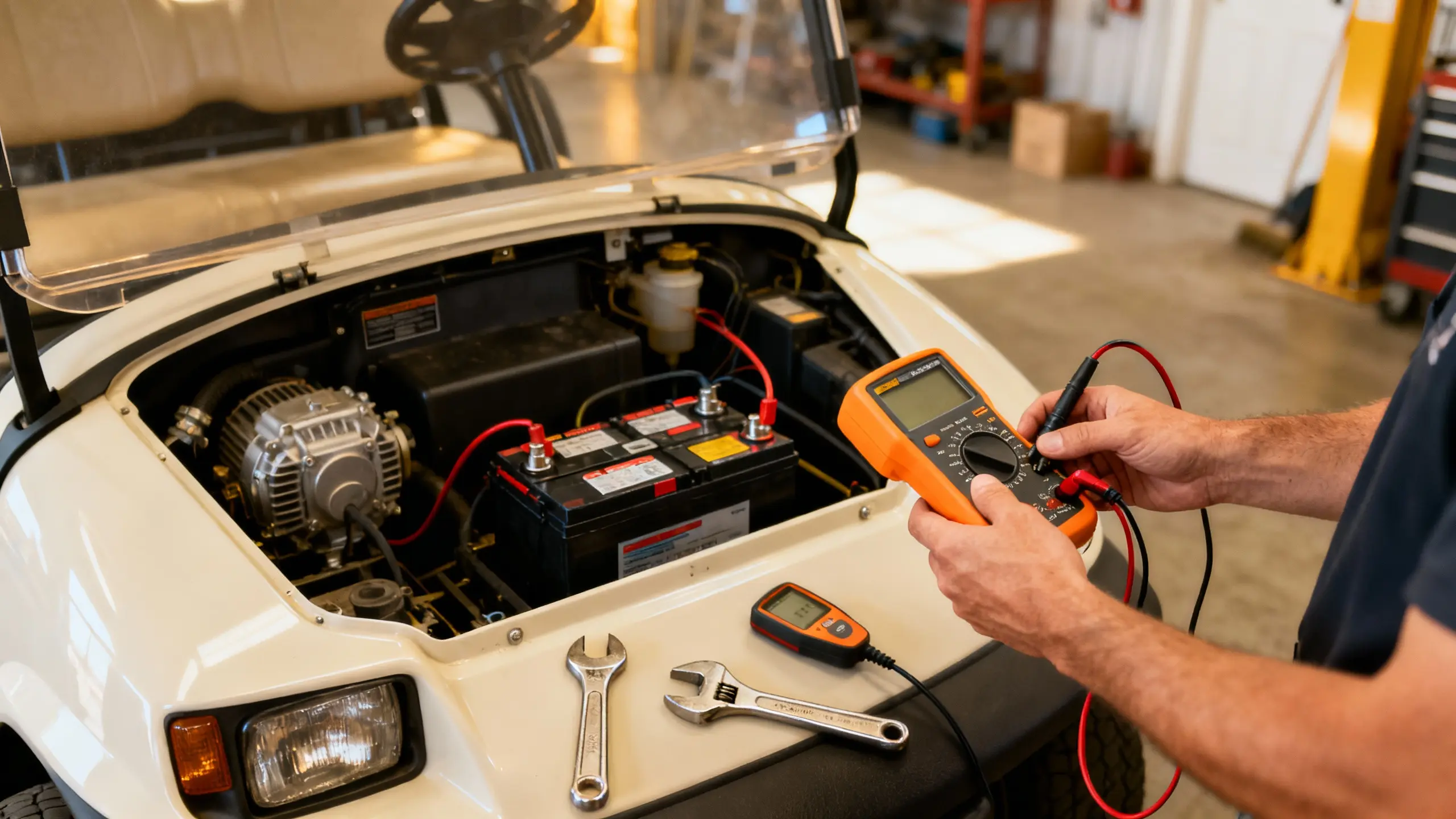
Use a multimeter to check total pack voltage. A 48V system should read 48-52V when charged. Below 44V and the cart may not start. Check individual batteries too - one dead battery kills the whole pack. Need help choosing the right diagnostic tools? Our golf cart tool kit guide covers everything you need.
Look for corrosion (white/green buildup) on terminals. Clean with baking soda and water. Tighten all connections - they should be snug but not overtightened.
Locate the main fuse (usually near batteries or controller). Check if it's blown. Replace with same amperage rating only.
For brand-specific fuse locations, see our golf cart fuse box guide.
Make sure the tow/run switch is in "Run" position. This is a common oversight. On some carts it's under the seat.
Press the accelerator. Do you hear a click from under the seat? No click = solenoid or controller issue. Click but no movement = motor or mechanical issue.
Gas Carts: Won't Start Checklist
Obvious but often overlooked. Make sure there's fresh fuel in the tank. Old fuel (3+ months) can cause starting problems.
Remove the spark plug and inspect it. Clean off any carbon buildup. Check the gap (typically 0.028-0.030 inches). Replace if worn or damaged.
A clogged air filter can prevent starting. Remove and inspect - it should be clean enough to see through. Replace if dirty.
Gas carts have a starter battery. It should read 12.6V+ when charged. If it's low, charge or jump it to test.
Disconnect the fuel line at the carburetor. Turn on the fuel valve - fuel should flow freely. No flow = clogged fuel filter or line.
Problem 2: Clicking Sound But Won't Move
If you hear a click when you press the pedal but the cart doesn't move, you've got a solenoid issue. Good news - this is usually an easy fix.
For the full symptom chart, multimeter test steps, and gas-versus-electric differences, read our golf cart solenoid symptoms and replacement guide.
What's Happening
The solenoid is basically a heavy-duty electrical switch. It connects battery power to the motor. The clicking means it's trying to engage but can't complete the circuit.
Likely Causes
Low Battery Voltage
The solenoid needs enough voltage to fully engage. Weak batteries can cause clicking without movement.
Most Common - 50%Bad Solenoid
The contacts inside the solenoid wear out over time. Eventually they can't carry enough current.
Common - 30%Corroded Connections
Corrosion on the solenoid terminals or cables prevents good electrical contact.
Less Common - 15%Wiring Issue
Loose, damaged, or corroded wires between batteries, solenoid, and motor.
Less Common - 5%How to Fix It
- Charge your batteries fully - This fixes the problem about half the time
- Clean the solenoid terminals - Remove cables, clean with wire brush, reconnect tightly
- Test the solenoid - With a multimeter, check for continuity when engaged
- Replace if needed - Solenoids are cheap ($30-80) and easy to swap
Solenoid replacement is one of the easiest golf cart repairs. It's usually 2-4 wires and 2 bolts. Take a photo before disconnecting so you remember where everything goes.
Problem 3: Cart Runs Slow or Loses Power
Your cart starts fine but feels weak, slow, or loses power quickly. Here's how to track down the cause.
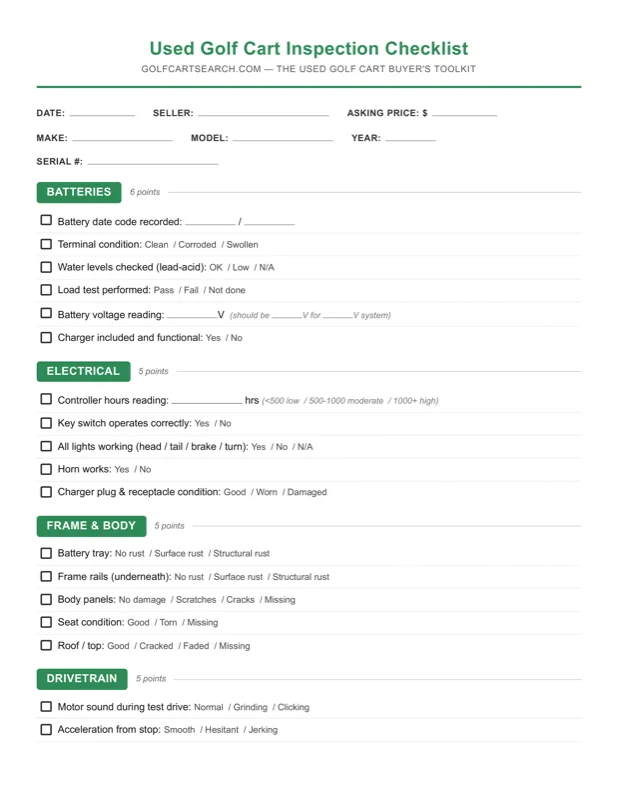
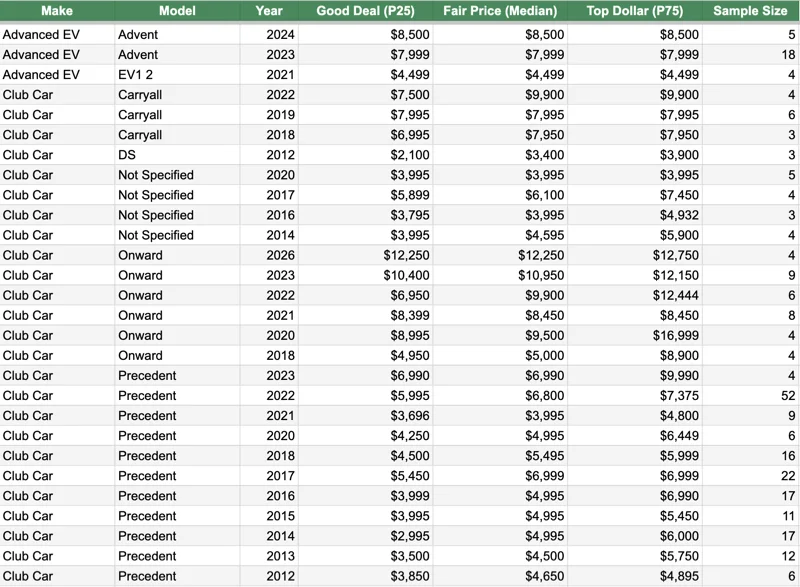
Evaluating a used cart? Our Buyer's Toolkit ($29) includes a 25-point inspection checklist that covers all these issues, plus pricing data so you know what to offer.
Check These First
Quick Checks (5 minutes)
- Tire pressure: Low pressure can reduce speed by 2-3 mph. Check all tires.
- Parking brake: Make sure it's fully released. A dragging brake kills speed.
- Tow/run switch: Confirm it's in "Run" mode.
- Forward/reverse switch: Try cycling it a few times to clean the contacts.
Battery Issues (Most Common)
About 70% of "slow cart" problems trace back to batteries. According to Battery University, proper voltage testing is the best way to check battery health. Here's how to test them:
Resting Voltage Test:
- Fully charge the batteries
- Let them sit for 2+ hours
- Measure each battery individually:
- 6V battery: Should read 6.2-6.4V
- 8V battery: Should read 8.2-8.5V
- 12V battery: Should read 12.6-12.8V
Load Test (more accurate):
- Measure voltage while driving uphill or under load
- If voltage drops significantly (more than 20%), batteries are weak
Hydrometer Test (lead-acid batteries):
- Use a battery hydrometer to check specific gravity of each cell
- Reading of 1.275-1.300 indicates a healthy cell
- Readings below 1.225 indicate a weak or dead cell
One Bad Battery: Even one weak battery drags down the whole pack. If you find one battery significantly lower than the others, that's your problem. Sometimes you can replace just that one, but batteries of different ages don't play well together.
Controller Issues
If batteries test good, the speed controller might be failing. Signs include:
- Inconsistent speed
- Jerky acceleration
- Cart cuts out at random
- Error codes (if your cart has a display)
Controller replacement is expensive ($300-600 installed) and not a DIY job for most people. Get a professional diagnosis before replacing.
Motor Issues
Motor problems are less common but do happen:
- Grinding or whining noises
- Burning smell
- Cart struggles even with good batteries
- Brushes worn down (can be replaced)
For more on golf cart performance, see our guide on how fast golf carts can go.
Problem 4: Jerky or Hesitant Acceleration
The cart lurches, hesitates, or accelerates unevenly. This is frustrating but usually fixable.
Common Causes
By far the most common cause. Connections can loosen over time from vibration. Clean and tighten every terminal.
Fixes problem 40% of the timeThe throttle pedal uses a variable resistor to tell the controller how much power you want. When it fails, the signal is erratic.
Fixes problem 25% of the timeThe controller interprets throttle input and regulates motor power. When it starts to fail, acceleration becomes unpredictable.
Fixes problem 20% of the timeWorn motor brushes can cause intermittent contact, leading to jerky operation.
Fixes problem 10% of the timeBrand-Specific Notes
EZGO TXT: Jerky acceleration is often the solenoid. These carts are known for solenoid wear.
Club Car Precedent: Check the speed sensor on the motor. A failing sensor causes hesitation and speed fluctuations. For older electric Precedent carts with surging, dead pedal spots, or uneven throttle response, our Club Car MCOR symptoms guide shows how to separate MCOR trouble from battery and speed-sensor issues.
Yamaha Drive: The throttle cable can stick or bind. Check for smooth cable movement.
Problem 5: Charger Won't Work
You plug in the charger and nothing happens. Here's how to diagnose it.
Why Chargers Don't Start
Automatic chargers need minimum voltage to "see" the batteries. If your pack is below 25-30V (on a 48V system), the charger won't turn on. This is the #1 cause.
Fix: Manually charge each battery with a 12V car charger for 10-15 minutes to boost voltage, then try the golf cart charger again.
Corrosion or loose connections at the charge port or batteries can prevent charging.
Fix: Clean all terminals and the charge port contacts. Check cable condition.
Many chargers have an internal fuse that can blow from power surges.
Fix: Open the charger case and check/replace the fuse. Make sure to match the amperage rating.
Club Car uses an On-Board Computer that tells the charger when to start/stop. If the OBC fails, the charger won't engage.
Fix: OBC replacement or bypass (requires professional installation).
Chargers wear out, especially in humid environments. Typical lifespan is 5-10 years.
Fix: Replace the charger ($200-$500 depending on voltage and brand).
For more on battery care and charging, check our golf cart batteries guide. For a full charger troubleshooting and buying walkthrough, see our golf cart charger guide. If the handle gets hot, the plug has to be wiggled, or the cart stays disabled after unplugging, use our golf cart charging port problems guide. If you are still matching connectors or trying to decide whether an overnight charge is normal, the charger plug compatibility guide and charge-time guide are the next two pages to open.
Need professional help with your golf cart? Find golf cart repair shops near you that can diagnose and fix the problem. Compare Repair Shops Near You
Problem 6: Brakes Not Working Properly
Let me be clear: brake problems are safety issues. Don't ignore them. For a full walkthrough of brake inspection, adjustment, and replacement, see our dedicated golf cart brake maintenance guide.
Symptoms and Causes
| Symptom | Likely Cause | Fix |
|---|---|---|
| Soft/spongy pedal | Air in lines, worn pads, stretched cable | Bleed brakes, replace pads, adjust cable |
| Grinding noise | Worn pads (metal on metal) | Replace pads immediately |
| Pulls to one side | Uneven pad wear, stuck caliper | Replace pads, free up caliper |
| Doesn't hold on hills | Worn pads, stretched cable, adjustment needed | Replace/adjust as needed |
| Squealing | New pads bedding in, glazed pads, debris | Usually normal, clean if persistent |
Brake Adjustment
Most golf cart brakes need periodic adjustment as pads wear:
- Locate the adjustment nut - Usually on the brake cable near the pedal or at the drum
- Tighten incrementally - Turn the nut to take up slack in the cable
- Test - The pedal should engage about 1-2 inches from the floor
- Don't overtighten - Brakes shouldn't drag when released
Brake pad replacement is doable for handy DIYers. You'll need basic tools and a jack. Watch a YouTube video for your specific cart model first.
Problem 7: Strange Noises
Golf carts shouldn't make loud or unusual sounds. Here's what different noises mean:
Brand-Specific Troubleshooting
Each brand has its quirks. Here's what to know:
EZGO Troubleshooting
Common EZGO Problems
TXT Models:
- Solenoid failures are very common - keep a spare
- Speed sensor issues cause inconsistent speed
- Controller problems on high-mileage carts
RXV Models:
- More complex electronics - harder to DIY
- Regenerative braking can mask brake wear
- Display error codes help diagnosis (check manual)
Unique to EZGO:
- Older 36V systems are less powerful than 48V competitors
- 2-cycle gas engines (pre-1991) need different maintenance
- Most parts readily available and affordable
Club Car Troubleshooting
Common Club Car Problems
Precedent/Onward Models:
- OBC (On-Board Computer) failures prevent charging
- Speed sensor on motor causes hesitation when failing
- IQ system allows speed adjustments but can glitch
DS Models:
- Simpler electronics - easier to troubleshoot
- Front suspension wears faster than competitors
- Check voltage reducer if accessories fail
Unique to Club Car:
- Aluminum frames mean no rust (big advantage)
- 48V system needs all batteries healthy
- OBC bypass is common when it fails
Yamaha Golf Cart Troubleshooting Guide
Common Yamaha Golf Car Problems
Drive/G29 Models:
- Throttle cable can stick or bind
- Charger relay failures prevent charging
- Speed controller less robust than competitors
Gas Models:
- Starter/generator issues on older carts
- Carburetor needs periodic cleaning
- Excellent engine reliability overall
Unique to Yamaha:
- Smaller aftermarket parts selection
- Gas models known for reliability
- Plastic body panels can crack
When to DIY vs. Call a Pro
Not every repair is a DIY job. Here's how to decide:
DIY-Friendly Repairs
- Cleaning battery terminals
- Checking/adding water to batteries
- Replacing fuses
- Replacing lights and bulbs
- Tire inflation and rotation
- Brake adjustment
- Solenoid replacement
- Battery replacement
- Air filter replacement (gas)
- Spark plug replacement (gas)
Call a Professional
- Controller replacement/repair
- Motor replacement/repair
- Wiring problems
- OBC issues (Club Car)
- Carburetor rebuild (gas)
- Valve adjustment (gas)
- Anything you're uncomfortable with
- When diagnosis is unclear
- High-voltage component work
- Warranty-covered repairs
Cost vs. Risk: A professional diagnosis typically costs $50-$75. If you're unsure what's wrong, this is money well spent. Wrong DIY repairs can turn a $100 problem into a $1,000 problem.
Preventing Problems: Basic Maintenance
Most golf cart problems are preventable with basic maintenance:
Maintenance Schedule
Weekly (or after every use):
- Charge batteries fully after each use
- Quick visual inspection for obvious issues
Monthly:
- Check tire pressure
- Check battery water levels (lead-acid)
- Inspect battery terminals for corrosion
- Test brakes
Every 6 Months:
- Clean battery terminals
- Lubricate moving parts
- Check all electrical connections
- Inspect belts (gas carts)
- Check brake pads
Annually:
- Professional inspection
- Battery load test
- Oil change (gas carts)
- Full brake inspection
- Check suspension components
Following this schedule can prevent most common problems and extend your cart's life significantly.
Frequently Asked Questions
How do I troubleshoot common golf cart problems?
Start with the simple checks: confirm the cart is in Run mode, charge the batteries, inspect battery terminals for corrosion, check the main fuse, verify tire pressure, and listen for a solenoid click when you press the pedal. Electric golf cart troubleshooting usually starts with battery voltage and connections. Gas cart troubleshooting starts with fuel, spark, air filter, and starter battery checks.
Why won't my golf cart start or move?
The most common reasons a golf cart won't start are dead or weak batteries, a faulty solenoid, corroded battery connections, or a blown fuse. For electric carts, check battery voltage first - you need at least 70% charge for the cart to operate. For gas carts, check fuel level, spark plug, and whether the engine turns over.
Why is my electric golf cart losing power or going slow?
An electric golf cart losing power is usually caused by weak or dying batteries, corroded connections, a failing controller, or low tire pressure. Check battery voltage under load - if it drops significantly, the batteries are weak. Clean all terminals and connections. Also check that tires are properly inflated.
How do I troubleshoot an electric golf cart?
For electric golf cart troubleshooting, check total pack voltage first, then inspect each battery, clean and tighten terminals, confirm the tow/run switch is in Run, inspect fuses, and listen for the solenoid click. If batteries and cables test good but the cart is slow, jerky, or cuts out, the controller, throttle sensor, solenoid, or motor may need professional diagnosis.
Why does my golf cart make a clicking noise but won't move?
A clicking noise without movement is almost always a solenoid problem. The clicking means it's trying to engage but failing. Causes include weak batteries (not enough voltage), corroded solenoid contacts, or a failing solenoid coil. Try charging batteries first, then check connections. If still clicking, the solenoid likely needs replacement ($100-$250 installed).
How much does it cost to fix common golf cart problems?
Golf cart repair costs vary: battery replacement runs $800-$1,500 for a full set, solenoid replacement costs $100-$250 installed, controller replacement is $300-$600 installed, motor replacement costs $400-$1,000+ installed. Simple fixes like cleaning connections, replacing fuses ($5-$20), or adjusting brakes ($50-$100) are much cheaper.
Can I fix my golf cart myself?
Many repairs are DIY-friendly: cleaning connections, replacing fuses, checking water levels, adjusting brakes, and even replacing solenoids or batteries. Leave controller and motor work to professionals. If you're uncomfortable with electrical work or the diagnosis is unclear, it's worth paying for professional help.
Why won't my golf cart charger turn on?
Chargers need minimum battery voltage to turn on (around 25-30V for a 48V system). If batteries are too dead, the charger won't start. Try manually charging individual batteries with a 12V car charger to boost voltage. Also check for a blown fuse inside the charger and clean all connections.
What should I check on a Yamaha golf cart first?
For Yamaha golf cart troubleshooting, start with the same basics: battery voltage, clean cable connections, tow/run switch, fuses, and solenoid click on electric models. On Yamaha Drive/G29 carts, also check for a sticking throttle cable, charger relay issues, and controller symptoms. On gas Yamaha carts, use the starter generator test guide before chasing fuel quality, spark plug, or carburetor problems.
Conclusion
Most golf cart problems come down to a few common issues - and most of those trace back to batteries or connections. Before you panic about expensive repairs:
- Check the simple stuff first - connections, fuses, switches
- Test your batteries - they're the cause 70% of the time
- Clean everything - corrosion causes countless problems
- Know your limits - some repairs need a pro
With basic troubleshooting skills, you can diagnose most problems yourself and decide whether to DIY or call for help. Either way, you'll save money by not paying for unnecessary diagnostics.
Next Steps
Golf Cart Search
Find the Best Golf Carts of 2026
Compare top-rated models, read expert reviews, and find the perfect cart for your needs.