This article contains affiliate links. As an Amazon Associate, we earn from qualifying purchases at no extra cost to you.
Buying a Used Golf Cart: What to Look For Checklist
Thinking about buying a used golf cart? Smart move. A quality used cart can save you thousands over buying new, but only if you know what to look for. (If you are also considering new carts, check out our best golf carts under $10,000 guide for the latest options.)
Here's the thing: the used golf cart market has both great deals and expensive mistakes. What separates the two? Knowing what to inspect, what questions to ask, and when to walk away.
This guide gives you everything you need to buy with confidence: fair prices by age and brand, a complete inspection checklist, red flags that signal trouble, and tips for getting the best deal. For a broader look at current new vs used ranges, read our golf cart pricing guide. If you will borrow for the purchase, use the golf cart loan calculator to compare the used-cart payment and total interest with a new-cart offer. If your bigger question is when is the best time to buy a golf cart, compare late-fall private sellers against late-winter and spring dealer trade-ins before choosing a month.
Before you buy, make sure the seller has working keys and compare them against our golf cart universal key guide, because a shared fleet key is convenient but not proof of ownership.
Quick Answer: What to Look For When Buying a Used Golf Cart
Used Golf Cart Market: 2026 Snapshot
The used golf cart market in 2026 is split into four broad buckets:
| Market Segment | Typical Buyer | What to Watch |
|---|---|---|
| Private-sale budget carts | Lowest upfront price | As-is sale, old batteries, missing paperwork |
| Dealer-reconditioned carts | First-time buyers | Higher price, but often safer inspection and short warranty |
| Former fleet carts | Value hunters and courses | High use, basic trim, possible cosmetic wear |
| Late-model lithium carts | Neighborhood buyers | Higher price, charger/BMS support, warranty transfer |
If you are still choosing where to shop, our best states to buy a golf cart analysis ranks markets by dealer count, repair backup, reviews, and used-inventory signals.
For most buyers, the best value is still a clean 4- to 7-year-old Big 3 cart with known batteries, a working charger, good paperwork, and no structural rust. If the listing is mostly about accessories but says nothing about battery age, charger, serial number, or maintenance, slow down.
If you are comparing specific models, our best used golf cart models analysis ranks RXV, Yamaha Drive, Club Car Tempo, Precedent, and TXT using 2,288 used listings.
Used Golf Cart Prices: What's Fair in 2026?
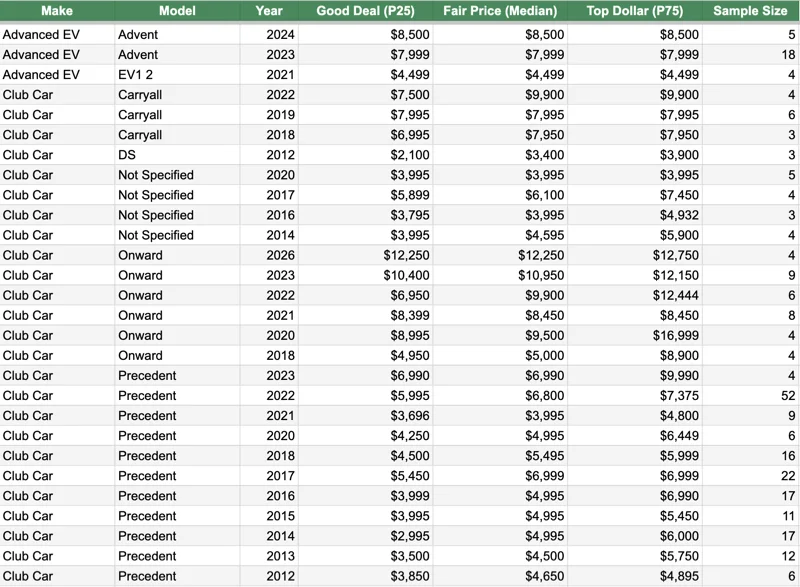
Before you start shopping, you need to know what a used golf cart is actually worth. Prices vary based on age, brand, condition, and your location.
When the listing includes a specific model, check a model-level value page before you negotiate. Start with Club Car Precedent, E-Z-GO RXV, E-Z-GO TXT, Yamaha Drive / Drive2, or browse all used golf cart value guides.
Price Ranges by Age
Golf carts depreciate quickly in the first few years, then level off. Here's what to expect:
| Cart Age | Typical Price Range | % of Original Value | Notes |
|---|---|---|---|
| 1-2 years | $8,000-$12,000 | 70-80% | Still like new, warranty may transfer |
| 3-4 years | $6,000-$9,000 | 55-70% | Great condition, modern features |
| 5-6 years | $4,500-$7,000 | 45-55% | Best value zone |
| 7-8 years | $3,500-$5,500 | 35-45% | Good deals, check batteries carefully |
| 9-10 years | $2,500-$4,000 | 25-35% | Budget option, expect some repairs |
| 10+ years | $1,500-$3,000 | 15-25% | Project carts, parts may be harder to find |
The 5-7 Year Sweet Spot: Carts in this age range have already taken their biggest depreciation hit but still have years of reliable service ahead. You'll pay roughly half of the new price for a cart that's mechanically sound with a known maintenance history.
Price Ranges by Brand
Not all brands hold value the same. Here's how the big three manufacturers compare:
If you want the pricing-only version of this topic before you dig into inspection details, start with our used golf cart prices by brand guide. If resale timeline matters, compare those prices against the golf cart depreciation chart by brand. When you are ready to shop, compare the main used golf cart dealer directory, used electric golf carts, used gas golf carts, used Club Car carts, used Yamaha carts, and used 6 seater carts.
Club Car
Premium pricing due to aluminum frames and reputation. Holds value well. Parts readily available.
EZGO
Good middle-ground pricing. Huge parts availability. Popular with both consumers and fleets.
Yamaha
Strong resale on gas models. Known for reliability. Slightly smaller used market.
Other Brands
Star EV, Tomberlin, Icon -can be good value but verify parts availability first.
Late-model value brands need a different inspection standard than the Big 3. If a used Denago is on your shortlist, read our Denago golf cart review for the current warranty, dealer-support, pricing, and resale evidence before deciding whether the discount is large enough.
If the Club Car you are considering is older, our Club Car DS vs Precedent guide explains when the cheaper DS is a good buy and when the newer Precedent is worth paying extra for.
If you are trying to separate a bargain from a brand trap, our guide to golf cart brands to avoid in 2026 explains which badges and support situations deserve extra caution before you buy used.
Electric vs Gas Pricing
Electric carts typically sell for similar prices to gas carts of the same age, but the cost calculation is different:
| Factor | Electric | Gas |
|---|---|---|
| Purchase price | Similar | Similar |
| Battery replacement | $800-$1,500 every 4-6 years | N/A |
| Fuel/charging cost | $0.02-0.05/mile | $0.08-0.15/mile |
| Major repairs | Less frequent | Can be expensive |
| Resale value | Good | Good (especially Yamaha) |
For a detailed comparison of electric vs gas golf carts, see our complete comparison guide.
What Affects Used Golf Cart Value?
Beyond age and brand, these factors significantly impact price. For a deeper dive into how much your specific cart is worth, see our complete golf cart value guide and plug your cart details into the golf cart value calculator.
Increases value:
- Lithium battery upgrade (+$1,000-2,000)
- Lift kit and larger tires (+$500-1,000)
- Street-legal package with lights (+$300-600)
- Low hours/cycles
- Recent battery replacement
- Custom seats or enclosures
- Garage-kept condition
Decreases value:
- Dead or dying batteries (-$800-1,500)
- Rust on frame (especially coastal areas)
- Missing charger (-$200-400)
- Non-working features
- Unknown history or no maintenance records
- Mismatched or bald tires
- Faded or damaged body panels
Location Matters
Golf cart prices vary by region. According to market data from Golf Cart Resource:
- Florida, Arizona, California: Higher prices due to year-round demand
- Golf communities (The Villages, Sun City): Premium pricing, but more selection
- Northern states: Lower prices, especially in fall/winter
- Rural areas: Often lower prices, but less selection
Timing Tip: Prices typically peak in spring and early summer when demand is highest. You can often find better deals in fall and winter, especially in northern states where carts get less use.
For the full calendar on when to shop new versus used, see our best time to buy a golf cart guide.
Where to Buy a Used Golf Cart
You've got several options for finding a used cart, each with trade-offs:
Option 1: Golf Cart Dealers
Pros:
- Carts often reconditioned before sale
- May include short warranty (30-90 days)
- Financing options available
- Can handle registration/title work
- Accountable if something goes wrong
Cons:
- 15-25% higher prices than private sales
- Limited negotiation room
- May push add-ons and upgrades
Best for: First-time buyers, those wanting peace of mind, buyers needing financing
Find golf cart dealers near you to compare local new and used inventory before you commit.
Before choosing a shop, use our analysis of golf cart dealer red flags from 8,208 reviews to check its warranty, parts, battery, and service process.
Option 2: Private Sellers (Facebook, Craigslist)
Pros:
- Lower prices (no dealer markup)
- More room to negotiate
- Can meet previous owner, learn cart history
- Often motivated sellers
Cons:
- Sold "as-is" with no warranty
- Must do your own inspection
- Potential for scams or misrepresentation
- Title/registration is your responsibility
Best for: Experienced buyers, those comfortable with inspections, budget-focused shoppers
If you are specifically searching owner-listed carts on Facebook Marketplace, Craigslist, OfferUp, or community boards, use our private seller golf cart buying guide to screen listings before you schedule a test drive.
Option 3: Online Marketplaces
Sites like eBay, Facebook Marketplace, and dedicated golf cart listing sites offer wide selection:
Pros:
- Huge selection
- Easy price comparison
- Can find specific models/features
- Reviews of sellers available
Cons:
- Can't inspect before buying (sometimes)
- Shipping costs can be significant ($300-800)
- Photos can hide problems
- Returns may be difficult
Option 4: Golf Course Fleet Sales
Golf courses replace their fleets every 4-6 years, selling off old carts:
Pros:
- Well-maintained to a schedule
- Known history
- Often sold in bulk (discounts available)
- Consistent condition across carts
Cons:
- High hours/usage
- Basic configurations (no upgrades)
- May need cosmetic work
- Limited availability (seasonal)
Best for: Buyers wanting a basic, reliable cart at a good price
Where to Buy: Quick Comparison
| Source | Price | Risk | Convenience |
|---|---|---|---|
| Dealer | Higher | Low | High |
| Private Sale | Lower | Medium | Medium |
| Online | Varies | Higher | High |
| Fleet Sale | Lowest | Low-Medium | Low |
The Complete Used Golf Cart Inspection Checklist
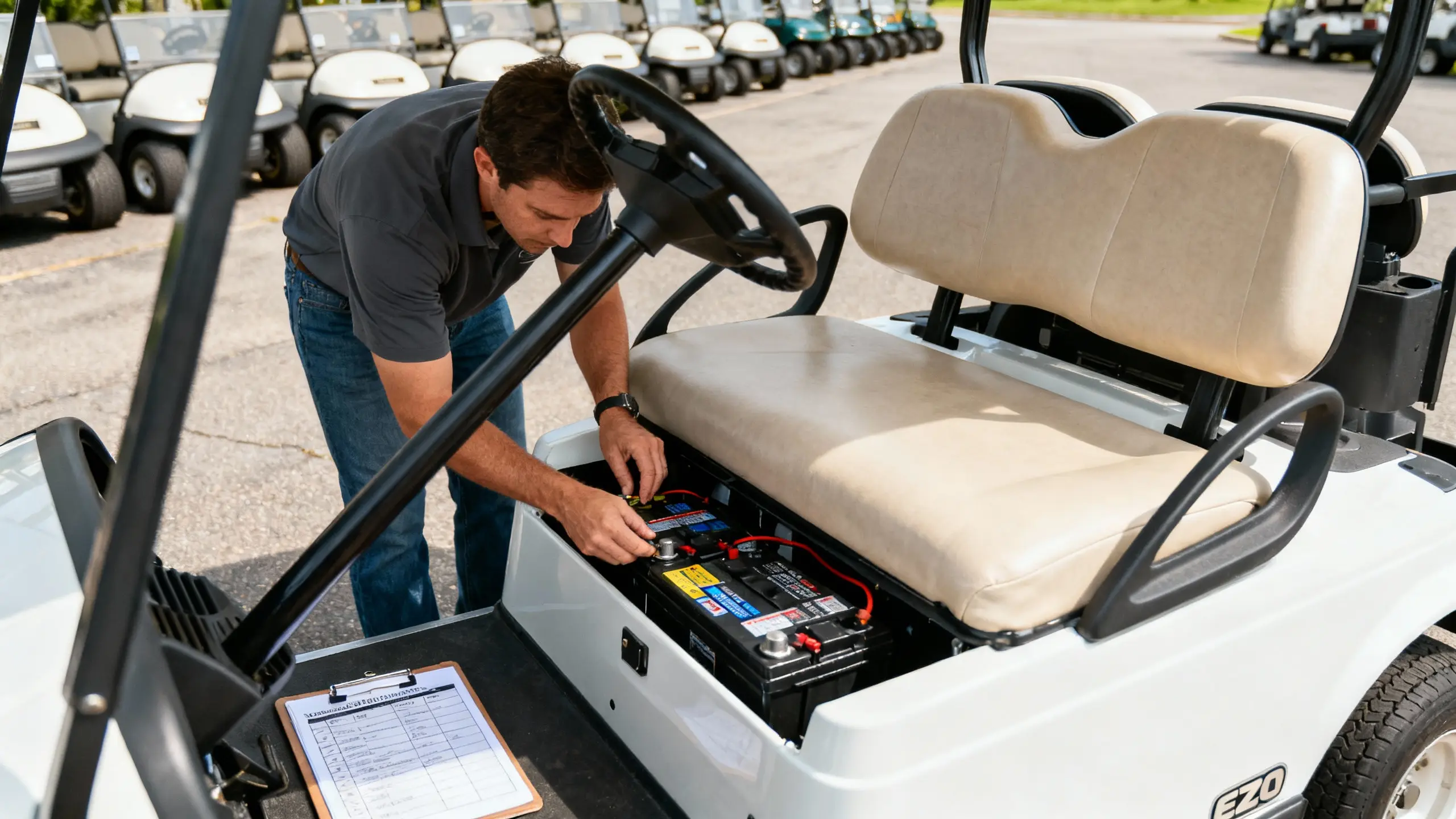
This is the most important part of this guide. Trust me -spending 30 minutes on a good inspection can save you thousands later.
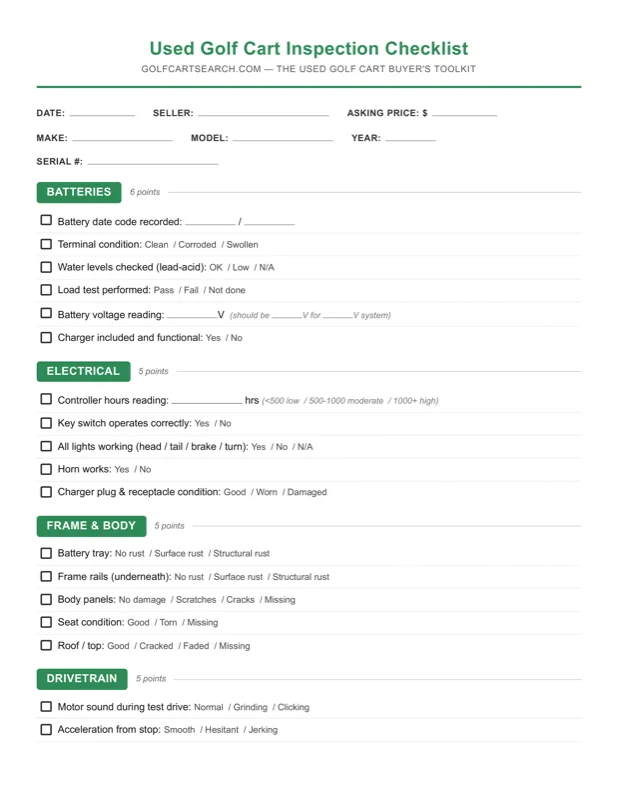
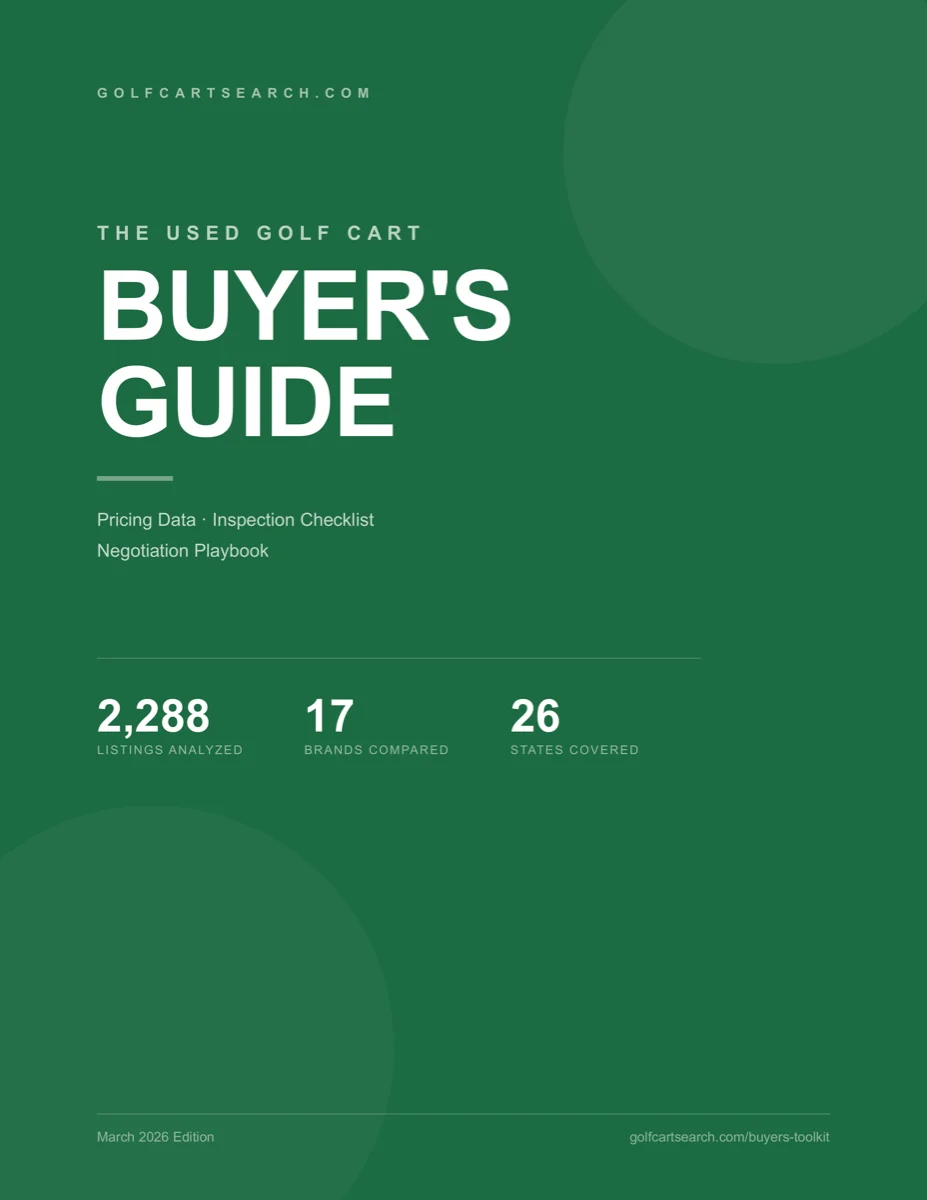
Want a printable version? Our Used Golf Cart Buyer's Toolkit includes a 25-point inspection checklist you can bring to every test drive, plus a scoring system and offer calculator.
If you want a technician to inspect a used cart before you buy, start with a golf cart repair shop near you and ask whether they offer pre-purchase inspections.
Before You Go: Questions to Ask the Seller
Before you even see the cart, get answers to these questions:
- How old is the cart? (Get the serial number and decode it yourself to verify)
- How old are the batteries? (This is critical for electric carts)
- Do you have maintenance records?
- Why are you selling?
- Has the cart been in any accidents or floods?
- Are there any current problems I should know about?
- Is the charger included? (For electric carts)
- Do you have the title? (Most carts are untitled, which is normal. See our golf cart ownership transfer guide for the bill-of-sale vs title-transfer split.)
Red Flag: If a seller can't or won't answer basic questions about the cart's history, that's a warning sign. Legitimate sellers are usually happy to share information about a well-maintained cart.
Battery Inspection (Electric Carts)
Here's the deal: batteries are the priciest part of any electric golf cart. Bad batteries can cost $800-$1,500 to replace. So take your time here. Understanding how long golf carts last by component helps you gauge how many years a used cart has left.
Battery Checklist
- Age: Ask when batteries were installed. Batteries over 4-5 years old may need replacement soon.
- Appearance: Look for bulging, swelling, or cracks in battery cases -signs of damage or wear.
- Terminals: Check for heavy corrosion (white/green buildup) on terminals -indicates poor maintenance.
- Water levels: For lead-acid batteries, water should cover the plates. Low water = neglect.
- Smell: A rotten egg (sulfur) smell indicates overcharging or damaged cells.
- Cables: Look for frayed, cracked, or melted cable insulation.
- Charger: Confirm the charger is included and working. A replacement costs $200-400.
Voltage Test: If you have a multimeter, check each battery one at a time. According to Battery University, these are healthy readings when fully charged:
- 6V battery should read 6.2-6.4V
- 8V battery should read 8.2-8.5V
- 12V battery should read 12.6-12.8V
Readings much lower than these mean weak batteries.
For more details on battery types, costs, and maintenance, see our complete golf cart battery guide.
Engine Inspection (Gas Carts)
Gas carts skip the battery headache, but engine problems can hit your wallet hard. Here's what to check:
Gas Engine Checklist
- Start-up: Engine should start easily without excessive cranking.
- Idle: Should idle smoothly without sputtering or stalling.
- Oil: Check oil level and color. Milky oil = water contamination. Very dark oil = overdue for change.
- Exhaust: Blue smoke = burning oil. Black smoke = running rich. White smoke = possible head gasket issue.
- Leaks: Look under the cart for oil, fuel, or coolant puddles.
- Air filter: Should be clean, not clogged with dirt or debris.
- Belts: Check for cracks, fraying, or excessive wear on drive belts.
If a gas cart squeals, smells like hot rubber, or revs without pulling hard, use our golf cart drive belt size and replacement guide to price the repair before negotiating.
Frame and Body Inspection
The frame is the skeleton of your golf cart. Frame problems are either expensive or impossible to fix -there's no middle ground.
Frame & Body Checklist
- Rust: Check the frame, especially welds and joints. Surface rust is treatable; structural rust is a deal-breaker.
- Undercarriage: Look underneath for rust, damage, or repairs. Coastal carts often have hidden corrosion.
- Alignment: Stand behind the cart and look down the body -it should be straight, not twisted.
- Body panels: Check for cracks, dents, or misaligned panels that might indicate accident damage.
- Floor condition: Lift any existing floor mat and check the floor pan for cracks, acid damage, rust, or soft spots. A damaged floor is expensive to repair but easy to protect going forward with a quality floor mat ($25-$135).
- Seats: Look for tears, sagging, or water damage in seat cushions. Cosmetic cracks can be fixed with seat covers ($30-$100), but sagging foam means a seat replacement or upholstery job ($80-$1,200). Buying a 2-seater? You can add a rear seat kit ($150-$600) to convert it to a 4-passenger cart.
- Roof/canopy: Check for cracks, fading, or loose mounting.
- Windshield: Look for cracks, chips, or yellowing/hazing.
Club Car Advantage: Club Car uses aluminum frames that don't rust, making them especially valuable in humid or coastal areas. EZGO and Yamaha use steel frames that can corrode if not properly maintained.
Tires and Suspension
Bad tires or worn suspension? That's both a safety issue and an uncomfortable ride.
Tires & Suspension Checklist
- Tire condition: Check tread depth and look for cracks, bulges, or uneven wear.
- Matching tires: All four tires should ideally be the same brand and size.
- Uneven wear: Wear on one side indicates alignment problems or bent components.
- Tire pressure: Check that all tires are properly inflated (typically 18-22 PSI).
- Suspension bounce: Push down on each corner -the cart should bounce once and settle, not keep bouncing.
- Wheel bearings: Grab each wheel and try to wiggle it -excessive play indicates worn bearings.
- Lift kit: If lifted, check that all components are properly installed and not damaged.
If you want to tell the difference between a cheap toe correction and a bent-front-end repair bill, read our golf cart wheel alignment guide before you assume uneven wear is minor.
Brakes
No shortcuts here -brake problems are safety problems. Check them carefully.
Brake Checklist
- Pedal feel: Brake pedal should be firm, not spongy or sinking to the floor.
- Stopping power: Cart should stop quickly and straight without pulling to one side.
- Noise: Listen for grinding or squealing -indicates worn pads or damaged rotors.
- Parking brake: Should hold the cart firmly on an incline.
- Brake hardware: Look behind rear wheels for rust or corrosion on brake components.
Electrical System
Electrical gremlins are the worst -hard to find and pricey to fix. Test everything.
Electrical Checklist
- Key switch: Should turn smoothly and start the cart reliably.
- Forward/reverse: Selector should click firmly into each position.
- Headlights: Test high and low beams if equipped.
- Taillights: Should illuminate when lights are on and brighten when braking.
- Turn signals: Test both sides if equipped.
- Horn: Should work clearly.
- Gauges: Battery/fuel gauge should show accurate readings.
- Wiring: Look for frayed wires, electrical tape repairs, or burnt connections.
Need help inspecting a cart? A local golf cart dealer can perform a pre-purchase inspection for $50-100. Worth every penny for peace of mind. Find Golf Cart Dealers Near You →
Brand-Specific Buying Tips
Each brand has its own personality -and its own problem spots. Here's what to know before you buy:
Buying a Used Club Car
Club Car (Precedent, DS, Onward)
Club Car has been making golf carts since 1958. They're known for quality and hold their value well.
Strengths:
- Aluminum frames don't rust (huge plus in humid areas)
- Strong resale value
- Parts widely available
- IQ system allows easy speed changes
Common Issues to Check:
- Speed sensor problems (causes jerky acceleration)
- Front suspension wear on older DS models
- OBC (On-Board Computer) failures on older Precedents
- Motor issues on high-mileage fleet carts
Model Notes:
- DS (1982-present): Long production run means many parts options. Earlier years had steel frames.
- Precedent (2004-present): Modern design, aluminum frame standard. Very reliable.
- Onward (2016-present): Latest model, premium features, commands higher prices.
Best Years: 2008+ Precedent models offer the best value-to-reliability ratio.
Buying a Used EZGO
EZGO (TXT, RXV, Express)
EZGO (now owned by Textron) makes some of the most popular carts on the used market. Parts are easy to find.
Strengths:
- Excellent parts availability
- Strong aftermarket support
- Good value on used market
- RXV models have regenerative braking
Common Issues to Check:
- Solenoid clicking (common on TXT models)
- Controller failures on older carts
- Speed sensor issues
- Rust on steel frames, especially in coastal areas
Model Notes:
- TXT (1994-present): Workhorse model, tons of parts available. Check for rust.
- RXV (2008-present): More modern, AC motor with regenerative braking. More complex electronics.
- Express (2018-present): Budget line, simpler systems, good value.
If your short list is TXT vs RXV, our EZGO TXT vs RXV guide breaks down used prices, charger differences, and the inspection risks that matter most.
Best Years: 2010+ TXT or 2012+ RXV models balance value and reliability well.
Buying a Used Yamaha
Yamaha (Drive, G29, G22)
Yamaha Golf Car brings their engine expertise to golf carts. Their gas models are especially reliable.
Strengths:
- Excellent gas engine reliability
- QuieTech gas models are very quiet
- Strong, durable build
- Good resale value, especially gas models
Common Issues to Check:
- Starter generator issues on older gas models
- Speed controller problems on electric models
- Plastic body panels can crack
- Charger issues on some years
Model Notes:
- G22 (2003-2006): Reliable but older. Check for wear.
- G29/Drive (2007-2016): Very popular, good balance of features and value.
- Drive2 (2017-present): Latest model, EFI gas engine option, premium pricing.
Best Years: 2010-2016 Drive (G29) models offer excellent value.
Other Brands to Consider
Star EV, Icon, Tomberlin, and Others
What to Know:
- Can offer good value, especially Star EV and ICON
- Parts availability varies significantly
- Less resale value than the Big 3
- Quality varies by model year and specific model
Before Buying:
- Verify a local dealer can service the brand
- Check parts availability online
- Research the specific model year for known issues
- Consider resale value if you may sell later
Best Advice: Stick to the Big 3 (Club Car, EZGO, Yamaha) unless you're getting a significant discount or have confirmed local service availability. If you need a commercial-grade utility vehicle, Cushman is worth a look -- see our complete Cushman golf cart review for model details and pricing.
Red Flags: When to Walk Away
Some carts just aren't worth the trouble -no matter how good the price looks. Here's when to say "thanks, but no thanks":
Structural Rust
Light surface rust is fixable. Rust that has eaten through frame members, created holes, or weakened welds is a safety hazard and expensive to repair. Walk away.
Flood Damage
Carts that have been submerged can have hidden electrical damage that shows up later. Look for water lines, rust inside electrical boxes, musty smells, and sediment in unusual places.
Bulging Batteries
Batteries that are swollen, bulging, or have cracked cases are dangerous and need immediate replacement. Budget $800-1,500 for new batteries if you proceed.
No Title or Paperwork
A cart without a title could be stolen, have liens against it, or be impossible to register. Always get proper documentation. Our ownership transfer guide explains when a bill of sale is enough and when a title problem should stop the deal.
Seller Won't Allow Inspection
Legitimate sellers welcome thorough inspections. If a seller is rushing you, won't let you look closely, or discourages a test drive -something is wrong.
Price Too Good to Be True
A cart priced way below market value usually has hidden problems or isn't legitimate. Trust your instincts and investigate why it's so cheap.
Scam Alert: Watch out for sellers who want payment via wire transfer or gift cards, won't meet in person, have vague answers, or pressure you to decide now. These are classic scam signs. The FTC's vehicle buying guide has more tips on avoiding fraud.
The Test Drive: What to Check
Here's a rule I live by: never buy a golf cart without driving it first. Period. Here's what to check:
Before You Start Moving
- Turn key to "on" position - gauges should illuminate, no warning lights
- Check forward/reverse selector - should click firmly
- Test horn - should sound clearly
- Turn on lights - all should work
While Driving
Should be smooth and progressive. Jerky or hesitant acceleration can indicate motor, controller, or throttle issues. Electric carts should have immediate response; gas carts may have a slight delay.
Drive on a flat surface and note the top speed. Stock carts typically reach 12-15 mph (electric) or 15-19 mph (gas). Significantly slower speeds indicate problems. Learn more about golf cart speeds.
Test brakes at various speeds. They should stop the cart promptly without pulling to one side, grinding, or requiring excessive pedal pressure.
Should be responsive with no excessive play (looseness) in the wheel. The cart should track straight without constant correction.
If possible, drive up an incline. The cart shouldn't struggle or slow dramatically. Poor hill performance indicates weak batteries (electric) or engine issues (gas).
Listen for unusual sounds: grinding, clicking, whining, or knocking. Electric carts should be nearly silent. Gas carts should run smoothly without misfiring.
Test reverse operation. Should engage smoothly and operate at appropriate speed (usually slower than forward).
Drive for at least 10-15 minutes. Some problems only appear after the cart warms up or batteries are partially discharged.
After the Test Drive
- Check for new leaks - look under the cart for fresh drips
- Feel the motor - should be warm but not extremely hot
- Note the charge level - how much did it drop during your drive?
- Test the charger - plug it in and verify it begins charging
Negotiation Tips: Getting the Best Deal
Get the full negotiation playbook. Our Buyer's Toolkit ($29) includes word-for-word negotiation scripts, a pricing spreadsheet with data from 1,691 usable listings, and a bill of sale template.
Alright, you've done your inspection and you want the cart. Now let's talk price.
Know Your Leverage
Use what you found during inspection as negotiation points:
| Issue Found | Potential Discount |
|---|---|
| Batteries 4+ years old | $400-800 (partial battery cost) |
| Worn tires | $200-400 |
| Cosmetic damage | $100-300 |
| Missing charger | $200-400 |
| Minor repairs needed | Cost of repair + 10% |
| No maintenance records | 5-10% off asking price |
Negotiation Scripts
If batteries are old:
"The batteries are [X] years old. They'll likely need replacement within a year, which costs around $1,000. Would you consider $[price minus $500-700]?"
If there are cosmetic issues:
"I noticed [specific issues]. I'm fine with them, but they do affect the value. Would you take $[price minus $100-300]?"
General negotiation:
"I've done my research and similar carts are selling for $[lower price]. I can pay $[your offer] today if that works for you."
Tips for Success
- Be respectful - aggressive tactics backfire with private sellers
- Show you're serious - bring cash or be pre-approved for financing
- Be willing to walk away - this is your strongest leverage
- Find common ground - sometimes a quick, easy sale is worth a discount to the seller
- Get it in writing - any verbal promises should be on the bill of sale
Private Seller Tip: Private sellers are often more flexible on price than dealers, especially if the cart has been listed for a while. Check when the listing was posted -a cart listed for 30+ days may have a motivated seller.
After You Buy: First Steps
Congratulations on your purchase! Here's what to do next:
Immediate Tasks
- Get documentation - Bill of sale, title (if applicable), any maintenance records
- Transfer title - Check your state's requirements for golf cart registration, then use our how to transfer golf cart ownership guide if you need the exact untitled-vs-titled paperwork steps
- Arrange insurance - Required in many areas, especially for street use. See our golf cart insurance guide
- Full charge - Plug in and complete a full charge cycle (electric carts)
- Oil check - Verify oil level and condition (gas carts)
- Arrange transportation - If the seller doesn't offer delivery, check our golf cart transport guide for trailer, truck bed, and shipping options
First Week Maintenance
Even if the previous owner maintained the cart well, these items ensure you're starting fresh:
- Clean battery terminals - Remove any corrosion with baking soda and water
- Check tire pressure - Inflate to proper PSI (usually 18-22)
- Lubricate moving parts - Steering, suspension, brake cables
- Test all features - Lights, horn, turn signals, etc.
- Check fluid levels - Oil, brake fluid, coolant (gas carts)
Understand Your State's Requirements
Golf cart laws vary significantly by state. Before driving on public roads, know:
- Whether your cart can legally be on streets
- What safety equipment is required
- Whether registration is needed
- Age requirements for operators
Check our golf cart laws by state guide for specific requirements in your area.
Frequently Asked Questions
How much should I pay for a used golf cart?
Used golf cart prices range from $2,000-$3,000 for basic older models to $7,000-$10,000+ for newer carts with upgrades. The sweet spot for most buyers is $3,500-$6,500, which gets you a 5-8 year old cart in good condition with decent batteries. Always factor in potential battery replacement costs ($800-$1,500) when evaluating price.
What is the best year to buy a used golf cart?
The best value is typically a golf cart that's 4-7 years old. At this age, the steep initial depreciation has passed (carts lose 20-25% in the first two years), but the cart still has plenty of useful life. Avoid carts older than 10 years unless heavily discounted, as parts and battery technology become concerns.
How do I tell if a used golf cart battery is bad?
Signs of bad batteries include: bulging or swollen cases, heavy corrosion on terminals, low water levels in lead-acid cells, the cart losing power quickly or not holding a charge, slow acceleration especially uphill, and a sulfur or rotten egg smell. Ask the seller for battery age -batteries over 4-5 years old will likely need replacement soon.
Is it better to buy from a dealer or private seller?
Dealers typically charge 15-25% more but often include short warranties, reconditioning, and financing options. Private sellers offer lower prices but sell "as-is" with no recourse if problems arise. For first-time buyers or those uncomfortable inspecting carts, dealers are safer. Experienced buyers can find better deals from private sellers.
What brand of used golf cart is most reliable?
Club Car, EZGO, and Yamaha are all reliable when properly maintained. Club Car is known for durable aluminum frames that resist rust. EZGO offers good parts availability and value. Yamaha excels in gas-powered reliability. Avoid obscure brands on the used market due to parts scarcity and unknown longevity.
How many miles can a used golf cart last?
Electric golf carts are measured in cycles rather than miles, but a well-maintained cart can last 20-30 years with proper battery replacements every 4-6 years. Gas carts can run 5,000+ hours with regular maintenance. Most used carts have plenty of life left -the key is battery condition (electric) and engine maintenance history (gas).
Should I buy a used electric or gas golf cart?
Electric carts are quieter, cheaper to operate, and require less maintenance, making them ideal for neighborhoods and golf courses. Gas carts offer more power for hills and hauling, longer range, and quick refueling. For most buyers, used electric carts offer better value since battery costs are predictable while gas engine repairs can be expensive. See our complete comparison for more details.
Do used golf carts come with a warranty?
Private sales are almost always "as-is" with no warranty. Dealer warranties vary -some offer 30-90 day limited warranties covering major components, while others sell as-is at lower prices. Always ask about warranty terms in writing before purchasing. Extended warranties are available from some dealers for additional cost.
Conclusion
Buying a used golf cart doesn't have to be a gamble. With the right knowledge and a solid inspection, you can find a reliable cart and save thousands over buying new.
Remember these key points:
- The 4-7 year sweet spot offers the best balance of price and remaining useful life
- Batteries are everything on electric carts -inspect them carefully and factor replacement costs into your budget
- Stick to the Big 3 (Club Car, EZGO, Yamaha) for the best parts availability and resale value
- Always test drive for at least 10-15 minutes
- Know when to walk away from structural rust, flood damage, or missing paperwork
- Use inspection findings as leverage for negotiation
Take your time, do your homework, and don't let pressure push you into a bad deal. The right used golf cart is out there -and now you know exactly how to find it.
Ready to go look at carts?
Get our printable inspection checklist, pricing data from 1,691 usable listings, and negotiation scripts. Everything in this guide, in a take-it-with-you format.
Get the Buyer's Toolkit ($29)Considering Buying New Instead?
If you've weighed the risks of buying used and prefer the peace of mind of a new cart with a warranty, you can now buy electric golf carts directly on Amazon - often at prices that compete with the used market:
- SDLANCH SDLGC80 - current 4-passenger 60V marketplace listing around $9,800; use it as a price benchmark and verify support before buying
As an Amazon Associate, we earn from qualifying purchases.
Next Steps
Golf Cart Search
Find the Best Golf Carts of 2026
Compare top-rated models, read expert reviews, and find the perfect cart for your needs.