
Do Golf Carts Have Titles? Registration Guide (2026)
Most golf carts do not need titles unless street-legal. State-by-state requirements, title transfer steps, and tips for buying without a title.
Compare the best portable and collapsible golf carts for RV parks and campgrounds. Kandi, Cricket, Mantis specs, prices, and buying advice.

As an Amazon Associate, we earn from qualifying purchases. This helps support our site at no extra cost to you.
Walk around any busy RV park or campground and you will notice the same thing: golf carts everywhere. They haul kids to the pool, carry coolers to the lake, and save you from trekking half a mile to the bathhouse at midnight. The problem? Traditional golf carts are 8 feet long, weigh 900+ pounds, and need a trailer to transport.
That is where portable and collapsible golf carts come in. These compact electric carts fold down to fit in a truck bed, SUV, or even a minivan, then unfold at camp in minutes. In this guide, we compare the best portable golf carts for camping and RV parks in 2026, covering specs, prices, and real-world buying advice so you can pick the right one for your next trip.
Price Range $3,999 - $7,495
Range Per Charge 25 - 70 miles
Folded Length 50 - 66 inches
Charge Time 6 - 8 hours (120V)
If you have spent any time at large campgrounds like Thousand Trails, Jellystone, or KOA resorts, you know the distances involved. Some of these parks stretch across hundreds of acres. Walking back and forth to the activity center, laundry, or general store adds up fast, especially with kids in tow.
A portable golf cart solves this. You drive it around the park, haul gear, and give tired legs a break. And because collapsible models fit in your existing vehicle, you skip the cost and hassle of towing a trailer.
Golf carts are also part of the culture at many golf cart friendly communities and RV resorts. At parks like The Villages in Florida or Hilton Head campgrounds in South Carolina, carts are the primary way people get around.
Not every golf cart works for camping. Here are the features that actually matter when you are shopping for a campground-ready cart.
This is the single most important factor. A collapsible cart should fold small enough to fit your transport method, whether that is a truck bed, SUV cargo area, or RV storage bay. Measure your available space before you buy.
The most compact option on the market (the Cricket ESV) folds down to just 50 x 32 x 28 inches. The Kandi Mini folds to 66 x 35.5 x 33.5 inches. Both fit in a standard full-size truck bed.
Portable golf carts weigh between 350 and 700 pounds depending on the model and battery type. You will need a ramp or loading system to get the cart into a truck bed. Some models include a powered fold mechanism that makes loading easier.
Consider your tow vehicle's payload capacity. If you are already hauling a travel trailer, adding 400-600 lbs of golf cart to your truck bed affects your remaining payload. Check your truck's door sticker and do the math.
Most camping trips involve short drives around the park, typically 2-5 miles per day. Even the shortest-range portable cart (the Kandi Mini at 25 miles) will last several days of normal campground use before you need to recharge.
If you plan to explore beyond the campground or use the cart heavily, look for models with lithium battery upgrades that push range to 50-70 miles. For more on battery technology and range, see our golf cart range guide.
Every portable golf cart on this list charges from a standard 120V household outlet. That is the same power available at any RV electrical hookup (30A and 50A pedestals both include 120V outlets). Plug in at night and wake up to a full charge.
Charge times run 6 to 8 hours for most models. If your campsite only has 20A service, avoid running other high-draw appliances while charging. For a deeper look at charger options, check our golf cart charger guide.
Most campgrounds enforce 10 mph speed limits for golf carts. A portable cart topping out at 9-13 mph is perfectly adequate. You do not need 25 mph at an RV park.
Terrain matters more than speed. Flat, paved campgrounds work with any cart. If your favorite parks have gravel roads, hills, or dirt paths, look for models with independent suspension and larger tires. The Cricket RX5 Plus and Mantis models handle rougher terrain better than basic mini carts.
We evaluated every collapsible and portable golf cart on the market based on folded size, weight, range, price, and real-world campground suitability. Here are our top picks.
The Kandi Collapsible Mini is the most affordable portable golf cart you can buy, and it ships free from Amazon. At $3,999, it costs roughly half of what competitors charge.
Key specs:
The Kandi Mini folds with an electric-assist mechanism and collapses small enough to fit in a full-size truck bed, minivan, or large SUV. Electrek tested it and confirmed it fits inside a Honda Odyssey. The build quality is solid for the price, with hydraulic disc brakes front and rear and a rear-wheel-drive system.
Where it shines: Budget buyers who want campground transportation without spending $6,000+. The 25-mile range covers a full week of typical campground use before you need to recharge.
Where it falls short: The 9 mph top speed is the slowest in this list, though still fine for campgrounds with 10 mph limits. It seats only 2 passengers, so families of four need two trips. The 400 lb weight limit is also the lowest here.
Check Price on AmazonThe Cricket RX5 is the most popular portable golf cart at campgrounds across America, and for good reason. It seats 4 passengers, gets 30 miles per charge, and has a proven track record with the RV community.
Key specs:
The RX5 folds smaller than the Kandi despite seating twice as many people. Its 600 lb weight capacity handles a family of four with room to spare. The optional lithium battery upgrade (roughly $1,500-2,000 extra) pushes the range to 70 miles and shaves significant weight off the cart.
Where it shines: Families who need 4-passenger seating in a package that still fits in a truck bed. The 30-mile standard range is generous for campground use, and the lithium upgrade is worth considering for frequent campers.
Where it falls short: Cricket carts are sold through a dealer network, not available on Amazon, so pricing is less transparent. Expect to pay $5,500-7,000 depending on configuration and dealer. Lead times can stretch during peak season.
If storage space is your biggest constraint, the Cricket ESV is the smallest collapsible golf cart on the market. It folds to just 50 x 32 x 28 inches, roughly the size of a large suitcase on a pallet.
Key specs:
The ESV is designed for boaters, small RV owners, and anyone who cannot sacrifice cargo space for a larger cart. It fits in boat storage compartments, compact truck beds, and the cargo area of most mid-size SUVs.
Where it shines: The smallest folded footprint by a wide margin. If you are working with tight storage on a smaller RV, boat, or short-bed truck, this is your best option.
Where it falls short: Only seats 2 passengers. The compact frame means less legroom than the RX5. Still sold through dealers at $5,000-6,000 depending on battery and options.
Mantis takes a different approach with an integrated solar panel on the roof that charges the battery throughout the day. If you camp at primitive sites without electrical hookups (BLM land, forest service campgrounds, dispersed camping areas), this feature is a real advantage.
Key specs:
The Mantis collapses with the roof staying attached, so you do not have to remove the canopy before folding. The solar panel replenishes the battery slowly throughout the day, adding an estimated 10-20 miles of extra range during sunny conditions.
Where it shines: Campers who boondock or visit sites without reliable electrical hookups. The solar charging extends your range without plugging in. Build quality is premium, with a modern dash display and comfortable seating.
Where it falls short: The heaviest cart on this list at 645-695 lbs, which makes loading more difficult. The price is the highest too. And the solar panel helps extend range but will not fully recharge the battery on its own. Think of it as a supplement, not a replacement for plugging in.
If you already have a way to tow a full-size cart (utility trailer, toy hauler RV, or flatbed truck), the AODES E-TrailCross offers a completely different experience. This is not a mini cart. It is a full-size, 4-passenger electric golf cart with independent suspension, a cargo bed, and UTV-grade build quality.
Key specs:
The AODES fills the gap between a portable mini cart and a traditional golf cart. Its independent A-arm suspension with adjustable coilover shocks handles rough campground roads, gravel, and hills far better than any mini cart. The rear cargo bed converts to a flat loading platform for hauling coolers, firewood, or camping gear.
Where it shines: Campers who want full-size performance and already have the means to transport it. The 40-mile lithium range and 25 mph top speed make it useful beyond the campground too. Street-legal features (headlights, turn signals, mirrors) mean you can make it street legal in many states.
Where it falls short: Not collapsible. You need a trailer or toy hauler to move it. At $7,249 and roughly 800+ lbs, this is a bigger commitment than a portable mini cart.
Check Price on Amazon| Feature | Kandi Mini | Cricket RX5 | Cricket ESV | Mantis MicroLite | AODES TrailCross |
|---|---|---|---|---|---|
| Price | $3,999 | $5,500-7,000 | $5,000-6,000 | $5,995-7,495 | $7,249 |
| Seats | 2 | 4 | 2 | 2-4 | 4 |
| Range | 25 mi | 30-70 mi | 30 mi | 25-35 mi | 40+ mi |
| Top Speed | 9 mph | 10-13 mph | 10-13 mph | 15 mph | 25 mph |
| Folded Size | 66x36x34" | 58x32x30" | 50x32x28" | Varies by model | N/A (not collapsible) |
| Weight | ~375 lbs | 412 lbs | ~350 lbs | 645-695 lbs | ~800 lbs |
| Capacity | 400 lbs | 600 lbs | 600 lbs | 600 lbs | 800+ lbs |
| Collapsible | Yes | Yes | Yes | Yes | No |
| Solar Panel | No | No | No | Yes | No |
| On Amazon | Yes | No | No | No | Yes |
| Best For | Budget buyers | Families | Tight storage | Off-grid camping | Full-size needs |
If you are choosing between electric and gas golf carts, electric wins in every category that matters for campground use.
Most campgrounds only allow electric carts. Many parks explicitly ban gas-powered golf carts, ATVs, and side-by-sides. This is not a suggestion. Show up with a gas cart and you may be asked to leave it parked for your entire stay. Parks ban gas carts for three reasons: noise complaints, exhaust fumes in close quarters, and insurance liability.
Electric carts are also quieter, which matters when you are parked 30 feet from your neighbor. Nobody wants to hear an engine firing up at 6 AM. And electric carts produce zero emissions, keeping the campground air clean.
From a maintenance standpoint, electric carts are simpler. No oil changes, no fuel filters, no spark plugs. Plug it in, charge it up, and ride. For the full breakdown of what electric carts need, see our maintenance guide.
Every campground has its own golf cart policy. Before you load up the cart, call ahead or check the park's website. Here are the most common rules you will encounter:
Getting your cart to the campground is half the challenge. Here are your three options.
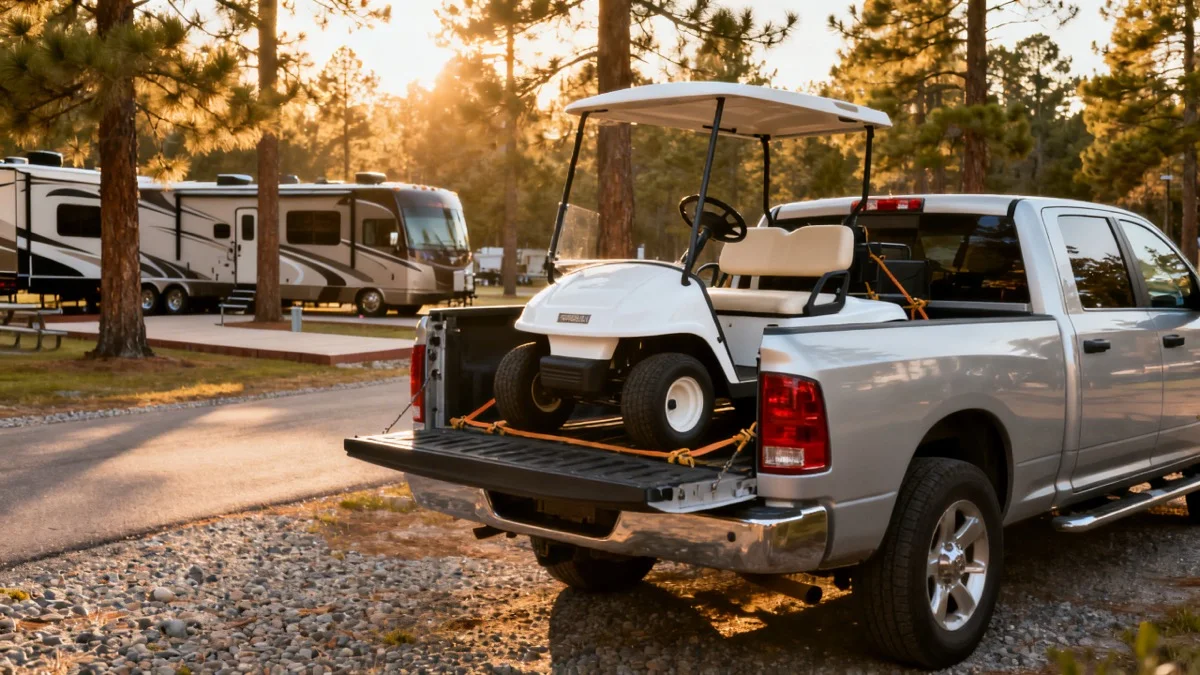
The most popular method for collapsible carts. Most portable golf carts fold to fit a standard 6.5-foot truck bed. You will need a loading ramp rated for the cart's weight, and one person can usually manage loading with the cart's powered fold system.
The Kandi Mini and both Cricket models all fit in a full-size truck bed with the tailgate down. The Mantis is heavier and may require two people to load safely.
The Cricket ESV (50 x 32 x 28 inches folded) fits inside most mid-size and full-size SUVs. The Kandi Mini fits in minivans and larger SUVs. If you drive a toy hauler RV, any of these carts will fit in the garage section with room to spare.
This is the most convenient option because you keep your truck bed free for the rest of your camping gear.
Full-size carts like the AODES E-TrailCross need a utility trailer (4x8 or 5x10 minimum). A basic open trailer costs $800-1,500 and adds roughly 300-500 lbs to your tow load. Factor the trailer cost into your total budget if you go the full-size route.
For more on golf cart weight considerations, see our golf cart weight guide.
One of the biggest advantages of portable electric golf carts is simple charging. Every model on this list plugs into a standard 120V household outlet, the same outlet available at any RV park electrical hookup.
How it works: Plug the charger into your campsite's power pedestal at night. By morning (6-8 hours later), you have a full charge. The charger draws roughly 5-8 amps, so it will not trip your breaker even with other appliances running.
No hookups? If you camp at primitive sites without electricity, the Mantis MicroLite's solar panel provides supplemental charging throughout the day. For other carts, a portable solar panel setup can trickle-charge the battery, though it will not provide a full recharge on its own. See our golf cart solar panel guide for setup details.
Battery care while camping: Lithium batteries handle partial charges and irregular charging schedules much better than lead-acid. If you camp frequently, the lithium battery option (standard on the Kandi Mini and Mantis, optional on Cricket models) is worth the upgrade for longevity alone. For a deep dive into battery types, read our golf cart batteries guide.
A few accessories make your campground golf cart significantly more practical.
Phone mount. You will use your phone for campground maps, GPS, and keeping kids entertained on rides. A universal clamp-style mount attaches to any golf cart frame and keeps your phone secure on bumpy camp roads. The Haxmuti mount is built specifically for golf carts and holds up well on rough terrain.
Haxmuti Universal Golf Cart Phone MountHeated seat cushion. Stock mini cart seats are basic. A heated and ventilated cushion makes early morning and late evening rides much more comfortable, especially during shoulder season camping in spring and fall when temperatures drop after sunset.
NOKINS Heated & Ventilated Seat Cushion →Cart cover. Protect your investment from rain, tree sap, and bird droppings when parked at your campsite. A fitted cover is especially important for multi-day stays or seasonal camping. See our complete golf cart cover guide for top picks by cart size.
LED light kit. If your cart does not come with headlights, an aftermarket LED kit is essential for evening rides back from the campfire. Many campgrounds require lights after dark. Our LED lights guide covers the best options by brand and budget.
GPS tracker. Golf carts get stolen from campgrounds more often than you might expect. A small GPS tracker hidden on the cart provides peace of mind, especially if you leave it unattended during the day. Check our GPS tracker and security guide for recommendations.
For a complete rundown of must-have add-ons, browse our golf cart accessories guide.
These campgrounds and RV parks are known for being golf cart friendly, with wide roads, cart paths, and plenty of fellow cart owners:
Looking for golf cart communities beyond campgrounds? Our guide to the best golf cart communities in America covers retirement communities, beach towns, and planned developments where carts are the primary way to get around.
Still deciding? Here is a quick framework based on how you camp:
Whichever you choose, a portable golf cart turns a good campground stay into a great one. It saves your legs, hauls your gear, and lets you explore more of the park in less time.
For more golf cart shopping advice, browse our pricing guide or check out budget options under $10,000. If you want to rent before you buy, find local rental shops on our rental directory or browse dealers on our dealer directory.
The Cricket RX5 is the best overall, with 4-passenger seating, 30-mile range, and a compact folded size of 58 x 32 x 30 inches. For budget buyers, the Kandi Collapsible Mini at $3,999 offers the lowest entry price with solid specs and Amazon availability.
Collapsible mini golf carts fit inside toy hauler RVs and some larger motorhomes. The Cricket ESV folds to just 50 x 32 x 28 inches, small enough for most toy hauler garages. Standard full-size golf carts (roughly 8 feet long and 4 feet wide) will need a trailer.
Most private campgrounds and RV parks welcome electric golf carts. Many ban gas-powered models. Common rules include 10 mph speed limits, licensed drivers only, and quiet hours restrictions. Always verify with your specific park before arrival.
Prices range from $3,999 (Kandi Collapsible Mini) to $7,495 (Mantis MicroLite Lithium). Cricket models fall in the $5,000-7,000 range depending on battery and configuration. Full-size alternatives like the AODES E-TrailCross cost $7,249 on Amazon.
Yes. Every portable golf cart in this guide charges from a standard 120V outlet, which is available at RV park electrical hookups (both 30A and 50A pedestals include 120V). A full charge typically takes 6-8 hours overnight.
Many campgrounds prohibit gas golf carts due to noise, exhaust fumes, and insurance liability. Electric carts are accepted at virtually every cart-friendly park. If you are buying specifically for campground use, choose electric.
Some parks require proof of liability insurance. Coverage typically costs $100-300 per year and is recommended even when not required by the campground. Your homeowner's or renter's insurance policy may already cover golf cart liability, so check before buying a separate policy.
Yes. The Kandi Collapsible Mini folds to 66 x 35.5 x 33.5 inches, fitting standard 6.5-foot and 8-foot truck beds with the tailgate down. It also fits in minivans (confirmed in a Honda Odyssey by Electrek) and most full-size SUVs.
Golf Cart Search
Compare top-rated models, read expert reviews, and find the perfect cart for your needs.
Most golf carts do not need titles unless street-legal. State-by-state requirements, title transfer steps, and tips for buying without a title.

Step-by-step guide to selling your golf cart. Pricing, timing, prep tips, listing advice, and where to sell for the best price in 2026.

Every new golf cart you can buy under $10,000 in 2026, from $3,999 to $9,995. Compare specs, prices, and our top picks by category.
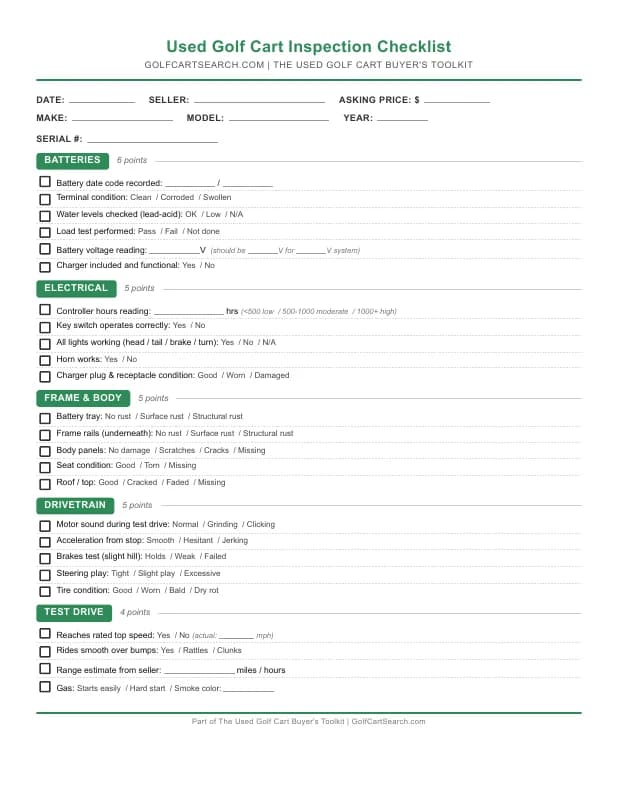
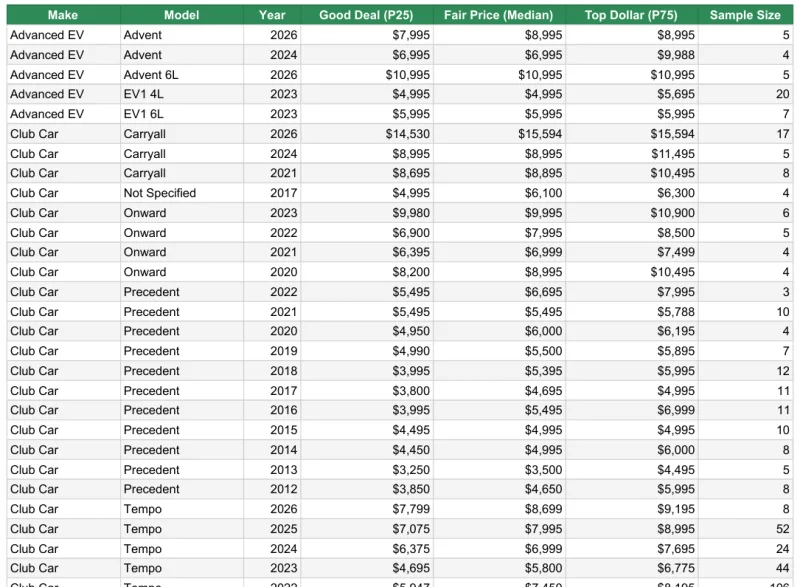
For less than the cost of a tank of gas, you get pricing data from 2,288 listings, a 28-page guide, and a printable inspection checklist. Avoid one bad deal and it pays for itself 100x over.