As an Amazon Associate, we earn from qualifying purchases. This helps support our site at no extra cost to you.
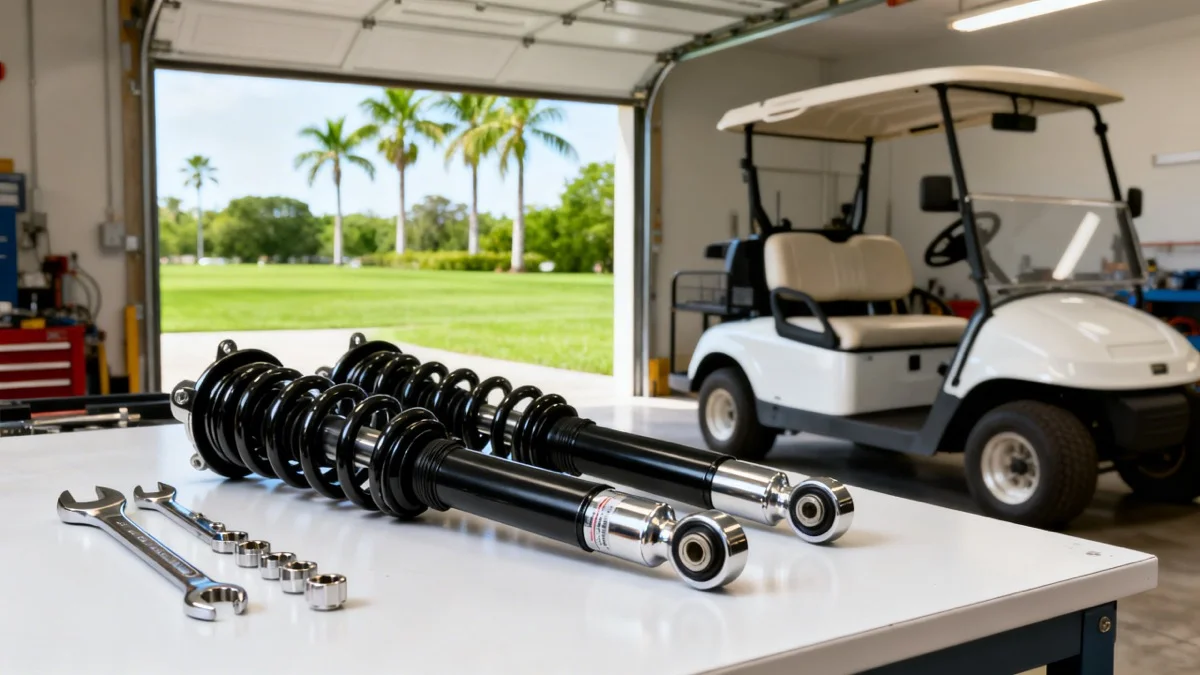
A worn-out set of shocks turns every bump and crack in the pavement into a jarring reminder that something needs fixing. The good news: golf cart shocks are one of the cheapest and easiest upgrades you can do. A full set of four runs $60 to $80 for most carts, and installation takes about an hour with basic hand tools.
This guide covers how golf cart suspension works, how to tell when your shocks are shot, the right replacements for EZGO, Club Car, and Yamaha carts, and a tire pressure trick that can transform your ride quality for free.
How Golf Cart Suspension Works
Before buying replacement shocks, it helps to understand what each part of the suspension actually does. Golf cart suspension has two main components that work together.
Springs vs Shocks: Two Different Jobs
Springs (leaf springs or coil springs) carry the cart's weight and absorb the initial impact of bumps. When you hit a pothole, the springs compress to absorb the force. They're the structural backbone of the suspension.
Shocks (shock absorbers) don't carry weight at all. Their only job is to control how the springs move. Without shocks, the springs would bounce up and down repeatedly after every bump. Shocks use hydraulic fluid and a piston to slow that motion down, converting bounce energy into heat.
This distinction matters because many ride quality problems that people blame on shocks are actually caused by worn or weak springs. If your cart sags under load, that's a spring problem. If it bounces repeatedly after hitting a bump, that's a shock problem.
Front vs Rear Suspension
Front suspension varies by brand. Club Car and Yamaha use A-arm designs with upper and lower control arms. EZGO TXT uses a simpler leaf spring front end, while the EZGO RXV uses integrated strut assemblies.
Rear suspension on most golf carts uses leaf springs paired with shock absorbers on a solid rear axle. Yamaha is the exception: newer Drive2 models have independent rear suspension with coil-over shocks, which is one reason Yamaha carts tend to ride smoother than competitors.
Signs Your Shocks Need Replacing
Not sure if your shocks are worn? Run through this checklist.
The bounce test is the easiest diagnostic. Push down firmly on each corner of the cart and release. A healthy shock lets the cart bounce once and settle. If it bounces two or three times (or more), that shock is worn out.
Other warning signs:
- Excessive bouncing over bumps, especially at speed
- Nose diving when braking (front shocks worn)
- Rear squat when accelerating or carrying passengers (rear shocks worn)
- Clunking or banging noises over uneven surfaces
- Oil leaks visible on the shock body or mounting points
- Uneven tire wear with a cupped or scalloped pattern
- Steering wander or the cart pulling to one side
- Longer stopping distance (worn front shocks can increase braking distance by up to 20%)
If the main symptom is one-sided tire wear or a steady pull on flat pavement, use our golf cart alignment guide before buying shocks. Bad toe, loose tie rods, or worn bearings can mimic a suspension problem.
If your cart also sits lower than normal, you likely need new leaf springs in addition to shocks. See the leaf spring section below.
Shocks vs Springs: Which to Replace First?
This is one of the most common questions on golf cart forums, and the answer is simple.
Replace springs first if the cart sags, sits unevenly, or bottoms out under load. Springs are structural. Without proper spring support, new shocks won't fix the ride.
Replace shocks first if the cart sits at the right height but bounces excessively, dives when braking, or clunks over bumps. The springs are fine, the dampers are worn.
Replace both if the cart is sagging AND bouncing. This is common on carts over 8 to 10 years old, especially those that carry heavy loads or have a rear seat kit installed. Adding passengers puts extra stress on both springs and shocks.
Oil vs Gas Shocks: What's the Difference?
Golf cart shocks come in two main types. Each has trade-offs.
| Feature | Oil (Hydraulic) | Gas-Charged |
|---|---|---|
| How it works | Hydraulic fluid flows through valves in a piston | Nitrogen gas added to hydraulic fluid chamber |
| Ride feel | Softer, smoother | Firmer, more controlled |
| Fade resistance | Can fade under heavy use (fluid foams) | Resists fading (gas prevents foaming) |
| Best for | Flat terrain, comfort priority | Rough terrain, heavy loads, lifted carts |
| Price per shock | $15 - $30 | $20 - $50 |
| Typical lifespan | 4 - 6 years | 5 - 7 years |
For most golf cart owners driving on paved paths and neighborhood streets, oil shocks are perfectly fine. Gas-charged shocks are worth the extra cost if you haul heavy loads, drive on rough off-road terrain, or have a lifted cart.
Suspension Differences by Brand
EZGO, Club Car, and Yamaha use different suspension designs. Knowing yours helps you buy the right parts and understand your cart's ride characteristics.
| Feature | EZGO TXT | Club Car DS/Precedent | Yamaha Drive/Drive2 |
|---|---|---|---|
| Front design | Leaf spring | A-arm with bushings | A-arm with bushings |
| Rear design | Leaf springs + shocks | Leaf springs + shocks | Coil springs + shocks |
| Rear axle | Solid | Solid | Solid (older) / Independent (Drive2) |
| Stock ride quality | Basic, functional | Tuned for comfort | Smoothest of the three |
| Shock count | 4 (front + rear) | 4 (front + rear) | 4 (front + rear) |
| Parts availability | Excellent, most options | Excellent | Good, fewer budget choices |
EZGO has the most standardized parts. TXT shocks from 1994 through current models are largely interchangeable, which means the widest selection of aftermarket options and the lowest prices.
Club Car DS (1981-2011) and Precedent (2004+) use similar shocks. An interesting cost-saver: the Monroe #56000 automotive gas shock fits Club Car rear mounts and costs about $24 each at auto parts stores.
Yamaha uses coil springs instead of leaf springs on the rear, which gives a smoother stock ride but means you can't just swap in heavy-duty leaf springs. Yamaha shocks also tend to cost more than EZGO or Club Car equivalents, running $88 to $106 per pair.
Best Shocks for EZGO Carts
Budget Pick: LEAPGOMAX EZGO TXT Pair
A two-shock coil-spring pair for the front or rear of compatible 1994-up E-Z-GO TXT and Medalist carts. It does not fit Marathon or RXV models, and a full front-and-rear replacement requires two pairs. Lifted carts may need the included rear extenders; confirm the original shock length before ordering.
Check Price on AmazonBest Value: 10L0L EZGO TXT 4-Pack
The 10L0L set at around $80 is the most popular aftermarket option for EZGO. It replaces OEM part numbers 76418-01 and 70928-G01, fits all EZGO TXT models from 1994 to present (gas and electric), and has 4.6 stars across hundreds of reviews. Slightly better build quality than the budget options.
Check Price on AmazonEZGO RXV note: The RXV uses different shocks than the TXT, especially on the front (strut-style assemblies). Make sure you're buying RXV-specific shocks if that's your cart. 3G and CLUBRALLY both make RXV rear shock sets for $50 to $60.
Best Shocks for Club Car
Best Value: 10L0L Club Car Front and Rear Set
This set covers both Club Car DS (1981 to 2011) and Precedent (2004+) models at around $60 to $70 for all four shocks. Replaces OEM part numbers 103351001 and 102588601. Same 4.6-star rating as their EZGO line.
Check Price on AmazonThe Auto Parts Store Trick
Experienced Club Car owners know this one: the Monroe #56000 gas shock from any auto parts store fits Club Car DS and Precedent rear mounting points. At roughly $24 each, you get a name-brand gas-charged shock for less than most golf cart-specific options. Verify the length and bushing diameter match your model year before buying, but this cross-reference is well-documented on forums like Cartaholics and Buggies Gone Wild.
Club Car Onward/Tempo note: These newer models (2018+) share the Precedent platform and use the same shocks as the Precedent.
Best Shocks for Yamaha Carts
Rear Shocks: LEAPGOMAX Heavy Duty with Springs
Yamaha rear shocks are sold separately from fronts, and this heavy-duty set with coil springs is the top pick at around $90. It fits the full range of Yamaha models: G14, G16, G19, G20, G22, and G29/Drive. The 14-inch extended length is purpose-built for Yamaha's rear suspension geometry.
Check Price on AmazonFront Shocks: Yamaha G29/Drive
Front shocks for Yamaha G29 and Drive models run about $88 to $90 per pair. These use a different mounting style than the rears, so you can't mix them. For older Yamaha G2 through G22 models, DTA and 10L0L both offer rear shock pairs in the $80 to $100 range.
Why Yamaha shocks cost more: Yamaha uses coil springs instead of leaf springs on the rear suspension, and its newer Drive2 models have independent rear suspension. The engineering is more sophisticated, which means the parts cost more. The upside: Yamaha carts ride smoother than EZGO or Club Car out of the box.
Best Leaf Spring Upgrades
If your cart sags under load or the ride feels bottomed out, the leaf springs are the fix. Shocks alone won't solve a spring problem.
Club Car Precedent: ProFormX 4-Leaf Heavy Duty Kit
This kit includes two 4-leaf springs, U-bolts, and bushings for around $100 to $130. Fits Club Car Precedent, Tempo, and Onward models from 2004+. The extra leaf (stock is typically 3) adds load capacity without making the ride harsh.
Check Price on AmazonEZGO TXT: ECOTRIC 3-Leaf Spring Kit
A solid rear leaf spring replacement for EZGO TXT models from 1996 to 2013, priced around $53 to $90. Includes bushings and U-bolts for a complete swap. If your TXT sags in the rear with passengers, this is the first thing to replace.
Check Price on AmazonShocks for Lifted Golf Carts
Lifted carts are the number one source of ride quality complaints on golf cart forums. The issue: most lift kits are simple spacer lifts that raise the body but don't improve the suspension at all. Your stock shocks end up stretched beyond their effective range, and the ride turns harsh and bouncy.
Three ways to fix it, from cheapest to best:
Option 1: Shock Extension Rods ($20)
The cheapest fix. Extension rods bolt between your existing shock and the mounting point, adding 2 to 2.5 inches of length so the shock operates in its proper range again. The 10L0L extension rod fits both EZGO and Club Car.
Check Price on AmazonThis works fine for lifts of 2 to 3 inches. For taller lifts, the stock shocks still won't have enough travel.
Option 2: Longer Aftermarket Shocks ($60 to $130/pair)
Purpose-built shocks with the extra length needed for lifted carts. Companies like Jake's, RHOX, and 10L0L make extended-length shocks for popular lift kit heights. A better solution than extension rods because the internal valving is tuned for the longer stroke.
Option 3: Long-Travel Suspension Kit ($1,200 to $1,800)
The real fix for serious builds. Kits from Jake's and GCTS replace the entire front suspension with adjustable coil-over shocks and independent A-arm geometry. The ride quality difference is night and day compared to a spacer lift with stock shocks. Overkill for a neighborhood cruiser, but worth every dollar for a hunting or off-road build.
The Tire Pressure Fix Everyone Overlooks
Before spending any money on suspension parts, check your tire pressure. This single adjustment transforms ride quality more than any shock upgrade, and it's free.
Most golf cart owners inflate their tires to 20 to 22 PSI because that's what a generic tire gauge suggests. For golf carts, that's way too high. Golf carts are light vehicles on small tires, and over-inflated tires transmit every crack and pebble straight to the frame.
The fix: drop to 12 to 15 PSI for street tires, 8 to 12 PSI for off-road tires.
At lower pressure, the tire sidewall flexes and absorbs bumps before the suspension even has to work. The ride gets dramatically softer. This is especially effective on lifted carts with larger tires, where the extra sidewall gives you more cushion.
Won't lower pressure damage the tires? Golf cart tires are designed for low-pressure operation. Most are rated for 15 to 22 PSI. Running 12 PSI is well within the safe range. Just avoid going below 8 PSI, and check pressure monthly since low-pressure tires lose air faster.
For more on tire selection and pressure, see our golf cart tires and wheels finder.
Our golf cart tire pressure chart by size also separates safe everyday PSI from the lower-pressure comfort tuning some owners experiment with on lifted carts.
How to Replace Golf Cart Shocks (DIY)
This is one of the easiest DIY jobs on a golf cart. If you can turn a wrench, you can do it.
Tools needed: Socket wrench set (typically 14mm or 9/16"), penetrating oil (PB Blaster), jack and jack stands, safety glasses.
Time: 30 to 60 minutes for all four shocks.
Step-by-Step
- Park on a flat surface and engage the parking brake
- Jack up the cart and support it on jack stands. You need the wheels off the ground so the suspension hangs freely
- Spray penetrating oil on the top and bottom shock bolts. Let it soak for 5 to 10 minutes. Golf cart hardware corrodes, and this step prevents rounded bolts
- Remove the top bolt first, then the bottom bolt. The shock slides out
- Compare the old and new shock side by side. They should be the same length with matching bushing sizes
- Install the new shock with the bottom bolt first, then the top. Hand-tighten both before final torquing
- Torque to spec (typically 25 to 35 ft-lbs, check your manual)
- Repeat for the remaining three shocks
- Lower the cart and do the bounce test on each corner to verify
If you're not comfortable doing it yourself, any golf cart dealer or repair shop can handle the job. Labor runs $85 to $250 depending on the shop and how many shocks you're replacing. Find a shop near you on our dealer directory.
For more maintenance tasks you can handle at home, see our complete maintenance guide.
When to Upgrade vs Replace Stock
Not everyone needs upgraded shocks. Here's a quick decision guide.
Stick with stock-style replacements if:
- You drive on paved paths, golf courses, or smooth neighborhood streets
- Your cart is at stock ride height
- You carry 2 to 4 passengers at normal weight
- You want the most comfortable, softest ride
Upgrade to heavy-duty or gas shocks if:
- You regularly carry heavy loads (coolers, tools, cargo)
- You added a rear seat and passengers ride in the back often
- You drive on gravel, dirt, or rough terrain
- You've installed a lift kit or larger tires
- You want to improve speed stability at higher speeds
For a complete overview of all the upgrades you can do, our customization guide covers 30+ mods ranked by impact and difficulty.
Frequently Asked Questions
How much should I budget for new shocks?
A full set of four aftermarket shocks costs $60 to $80 for EZGO and Club Car. Yamaha front and rear pairs together run about $175 to $195. Add $85 to $250 for professional installation if you don't want to DIY. Total all-in cost: $60 to $80 DIY, or $150 to $330 with a shop doing the work.
How do I know what size shocks fit my cart?
Match by brand, model, and year. EZGO TXT shocks are interchangeable across 1994 to present. Club Car DS and Precedent use similar but not identical shocks. Yamaha front and rear shocks are different sizes. The product listings in this guide specify exact fitment. When in doubt, measure your old shock's compressed and extended length and bushing inner diameter.
My cart bounces AND sags. Do I need shocks or springs?
Both. Sagging means the leaf springs (or coil springs on Yamaha) have weakened and can't support the cart's weight. Bouncing means the shocks can't control the spring movement. Replace the springs first, then the shocks. Budget about $140 to $200 total for a spring and shock refresh on EZGO or Club Car.
Are more expensive shocks worth it?
For most golf cart owners, no. The $60 to $80 aftermarket sets from 10L0L, LEAPGOMAX, and similar brands perform well for standard driving. Premium shocks ($100+ per pair) make a noticeable difference on lifted carts, rough terrain, or carts that carry heavy loads daily. For flat-ground neighborhood use, budget shocks are perfectly fine.
Can I mix different brand shocks front and rear?
Technically yes, but it's not ideal. Front and rear shocks have different damping rates tuned for their position. Using the same brand and product line for all four ensures consistent ride quality. Always replace in pairs at minimum (both fronts or both rears).
What else improves ride quality besides shocks?
Three things make the biggest difference: tire pressure (drop to 12 to 15 PSI), leaf spring condition (replace if sagging), and tire choice (radial tires ride smoother than bias-ply). After those, seat cushion quality and a smooth-riding top that doesn't rattle also help. Our troubleshooting guide can help diagnose specific ride issues.
Should I check anything else while replacing shocks?
Yes. While you have the cart jacked up, inspect the bushings on your control arms and leaf spring mounts. Cracked or deteriorated rubber bushings cause clunking and loose handling that new shocks won't fix. Also check for cracked or broken leaf spring leaves, loose U-bolts, and worn tie rod ends. Our complete maintenance guide covers the full inspection routine.
Golf Cart Search
Find the Best Golf Carts of 2026
Compare top-rated models, read expert reviews, and find the perfect cart for your needs.