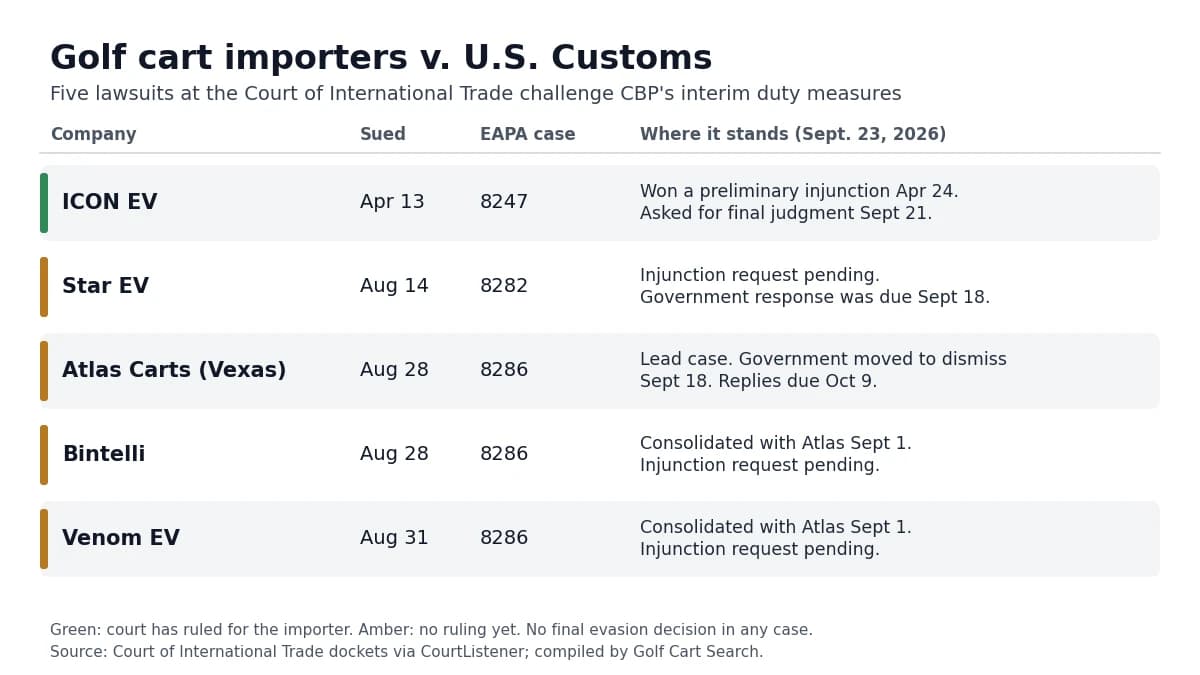
Bintelli, Atlas Carts, and Venom EV are suing U.S. Customs and Border Protection at the Court of International Trade to stop the duty measures CBP placed on their golf cart imports in August. On September 18, the government responded with a motion to dismiss the combined case, filed under seal. The companies' replies are due October 9, and the court has not ruled on their requests for emergency orders.
Golf Cart Search reviewed the public court dockets and read the three complaints that are free to download. With Star EV, which sued separately on August 14, and ICON EV, which sued in April, five golf cart importers are now in court over CBP's interim measures. The complaints include figures that were not in CBP's public notice. Bintelli says the measures could require it to pay more than $150 million in duties, about five times the roughly $30 million in revenue it says it grossed last year.
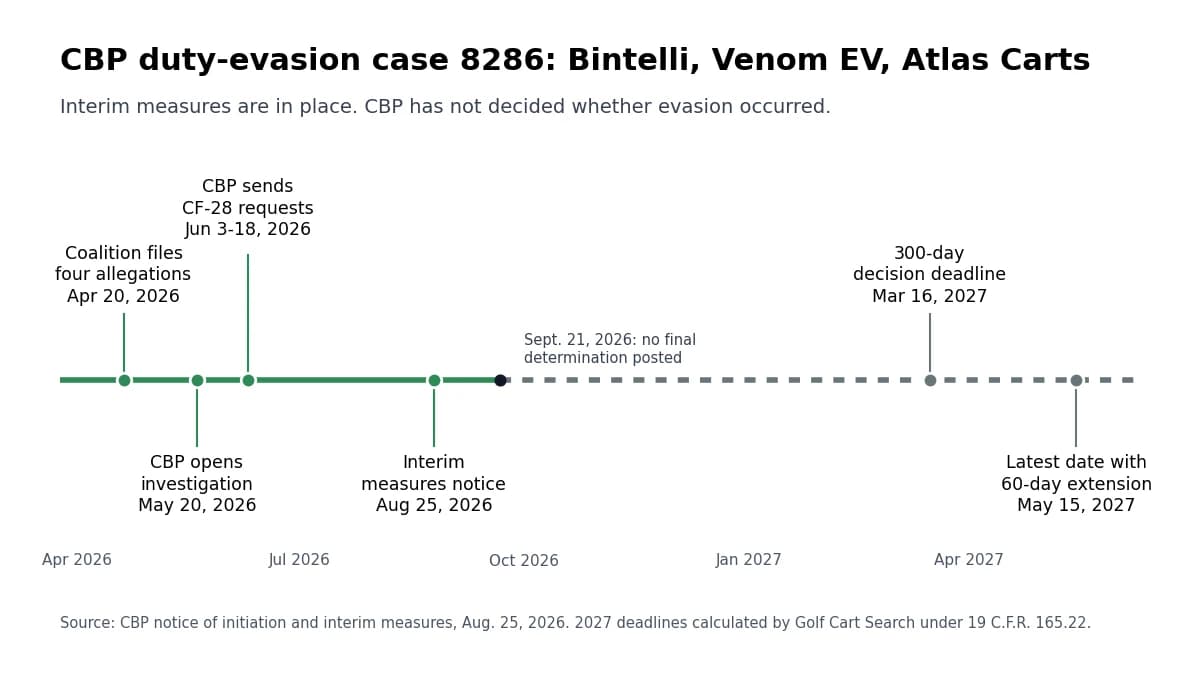
The lawsuits will not decide whether any company evaded duties. CBP's investigations will, and a final CBP decision in the Bintelli, Atlas, and Venom case is not due until 2027.
| Question | What the court record shows |
|---|---|
| Who sued? | Vexas Corp. d/b/a Atlas Carts, Bintelli, and Venom EV over EAPA Case 8286. Star EV over Case 8282. ICON EV over Case 8247. |
| What are they challenging? | CBP's interim measures, which CBP imposed before deciding whether evasion happened |
| Which judges? | Judge Leo M. Gordon has the Atlas, Bintelli, Venom EV, and Star EV cases. Judge Jane A. Restani has ICON's case. |
| What did the government file? | A confidential response and motion to dismiss in the combined Atlas, Bintelli, and Venom case on September 18 |
| Has the court ruled? | Not in the four newer cases, based on docket copies reviewed September 23. In April, the court blocked most of the measures against ICON. |
| What comes next? | Replies are due October 9 in the combined case |
Which golf cart companies are suing Customs?
| Company | Court No. | Customs case | Filed | Status on September 23 |
|---|---|---|---|---|
| ICON EV | 26-02759 | EAPA 8247 | April 13 | Preliminary injunction granted April 24. ICON asked for final judgment September 21. |
| Star EV | 26-03645 | EAPA 8282 | August 14 | Injunction motion filed August 28. Government response ordered by September 18. |
| Vexas Corp. (Atlas Carts) | 26-03809 | EAPA 8286 | August 28 | Lead case. Government moved to dismiss September 18. |
| Bintelli | 26-03812 | EAPA 8286 | August 28 | Combined with the Atlas case September 1 |
| Venom EV | 26-03824 | EAPA 8286 | August 31 | Combined with the Atlas case September 1 |
The three Case 8286 companies sued 10 to 13 days after an August 18 email in which CBP told them it had found a reasonable suspicion of evasion and was imposing interim measures. CBP posted its public notice on August 25. Our report on that notice covers what CBP says it found.
At the government's request, and with no objection from the companies, the court combined the three suits on September 1 under the Atlas case. Arnold & Porter represents Atlas. Faegre Drinker represents both Bintelli and Venom EV. The American Personal Transportation Vehicle Manufacturers Coalition asked on September 1 to join the case as a defendant. Its counsel has named its members as Club Car and Textron Specialized Vehicles, which makes E-Z-GO and Cushman vehicles. The docket copy shows no ruling on that request yet.
Star EV's lawsuit is separate and concerns CBP's earlier case against it. Its complaint is not free to download, so we cannot describe its arguments. Its public docket lists CBP letters dated March 20 and April 10, 2026 as exhibits. Those are the dates CBP opened Case 8282 and announced interim measures.
What do the importers say the duties would cost?
The cost comes from the cash-deposit rate. CBP is applying the China-wide antidumping rate of 478.09% and the all-others countervailing rate of 41.14%, a combined 519.23% of entered value. At that rate, every $10,000 of entered value requires a $51,923 deposit.
The companies told the court this about their finances:
| Company | What the company told the court |
|---|---|
| Bintelli | More than $150 million in possible duties on past entries. About $30 million in revenue last year. 146 employees, 60 of them hired in the past year. More than 200 dealers. A 498,000-square-foot assembly facility in Ladson, S.C. |
| Venom EV | More than $18 million in possible duties on past entries. A net loss of more than $500,000 last year. About 110 dealers. |
| Atlas Carts | "Millions of dollars" on prior imports, with no specific estimate in its public filings. Nearly 50 employees, mostly at its assembly plant in Williston, S.C. |
Working backward at 519.23%, Bintelli's estimate implies more than $28.9 million in entered value under the measures. Venom's implies more than $3.5 million. Those are our calculations, not figures either company reported. Bintelli says it based its estimate on entries from China, Thailand, and Vietnam that CBP's system had flagged as extended. CBP has not published a dollar figure for any importer.
Atlas told the court on August 31 that without an injunction it would default on its financing and stop operating in less than a month. It also filed declarations from two of its dealers. On September 23, the Atlas homepage made no mention of the case.
Why do the lawsuits cite ICON's April ruling?
All three Case 8286 complaints rely on the ICON EV case. On April 24, Judge Restani granted ICON a temporary restraining order and preliminary injunction in Slip Op. 26-42. The order barred CBP from enforcing its interim measures against ICON until the government holds a pre-deprivation hearing, meaning a chance for ICON to respond before the measures take effect. It left two measures in place: extending liquidation of older entries and suspending liquidation of newer ones. The order took effect April 30.
On May 26, the court denied the government's motion to dismiss ICON's case for lack of jurisdiction in Slip Op. 26-55. The coalition appealed the April rulings to the U.S. Court of Appeals for the Federal Circuit as No. 2026-1772. CourtListener's copy of that appeal docket shows no decision.
Atlas's complaint says the measures imposed on it are identical to ICON's and asks for the same preliminary relief. The new cases are before a different judge, Leo M. Gordon, who has not ruled.
ICON's own case has moved to the next stage. On September 21, ICON filed a motion for summary judgment asking the court to block the interim measures permanently and declare that CBP broke the law. The government's response is due October 26. Our ICON tariff case report covers the court's August order limiting the coalition's role in that case.
How do the companies' accounts compare with CBP's?
CBP's August 25 notice and the complaints describe the same imports in conflicting terms. Both public versions are redacted, so specific entries cannot be matched.
| Company | CBP's public notice says | The company's complaint says |
|---|---|---|
| Bintelli | Documents from its Vietnamese supplier include an invoice and quote for materials marked as Chinese origin. The record has no production records showing its Thai chassis were built in Thailand. | Its Thai carts use frames made from Thai steel and its Vietnamese carts use frames made from Vietnamese aluminum. Local material content has been above 50% since July 2025. CBP accepted Bintelli's explanation for disputed parts entries in 2025 and again in February 2026. |
| Venom EV | The first pro forma invoices for its Thai carts came from a Chinese golf cart producer and described complete or nearly complete carts. | CBP reviewed the same Thai-built carts after a September 2025 information request and liquidated them as entered on December 12, 2025. |
| Atlas Carts | Its records include an invoice listing a material marked "China." One manufacturer's affidavit describes production work in China. | Its Vietnamese carts have frames made in Vietnam. Its shipments from China were bare frames without the parts needed to count as a rolling chassis. It accepts that a small number of early shipments were covered and says it reclassified them. |
All three complaints turn on the same scope language. For unfinished carts, the China duty orders cover at a minimum a "rolling chassis": a frame with suspension parts installed and a motor or engine installed or ready to install. The companies argue that frames, motors, and suspension parts shipped separately do not meet that minimum. The orders also say that finishing a covered chassis in another country does not take it out of scope. CBP's notice says the records the companies supplied did not show where their cart frames and chassis came from.
What did the government file on September 18?
On September 9, Judge Gordon ordered that all briefs be filed under seal until CBP files the administrative record. He gave the government until September 18 to respond to the injunction motions and allowed it to include a motion to dismiss.
On September 18, the Justice Department filed a confidential response and motion to dismiss covering the Atlas, Bintelli, and Venom EV motions. The coalition filed its own opposition to Venom EV's amended injunction motion the same day. Neither filing is public, so their arguments are unknown. In the ICON case, the government's first response was also a motion to dismiss for lack of jurisdiction, which the court rejected in May.
In Star EV's case, Judge Gordon ordered CBP to file the administrative record by September 17 and the government to respond to the injunction motion by September 18. CourtListener's copy of that docket, last updated September 14, shows no filings after September 11.
What happens next?
- October 9, 2026: Replies are due on the government's September 18 filings in the combined Atlas, Bintelli, and Venom EV case.
- October 26, 2026: The government's response to ICON's motion for final judgment is due.
- March 16, 2027: The 300-day deadline for CBP's final evasion decision in Case 8286. Bintelli's complaint cites the same date. CBP can extend it to May 15, 2027.
Judge Gordon can rule on the injunction requests at any time. We will update this story when he does.
The lawsuits concern import entries and duty deposits. None of the public filings addresses warranties or carts already sold to owners. For readers shopping these brands, our Atlas, Venom EV, and Star EV model pages list specifications, and our Bintelli review covers pricing and common problems. None of those pages shows which models or entries are involved in the court cases.
How we reported this: Golf Cart Search reviewed CourtListener's copies of the five court dockets on September 23, 2026, and read the public complaints from Atlas, Bintelli, and Venom EV, Atlas's public injunction motion, the April 24 ICON opinion, and ICON's September 21 motion. Sealed filings, confidential exhibits, and docket entries missing from CourtListener are not included. The deposit and entered-value calculations are in scripts/news/golf-cart-importers-sue-cbp-duties-2026-analysis.mjs in the site repository.
Primary reporting source
U.S. Court of International Trade: Vexas Corp. v. United States, No. 26-03809, docket