U.S. Customs and Border Protection has placed interim measures on golf cart imports by Bintelli, Venom EV, and Vexas Corp., which sells as Atlas Carts, in a duty-evasion investigation known as EAPA Consolidated Case 8286. CBP's August 25 notice says it has a reasonable suspicion that the three importers brought Chinese golf carts, rolling chassis, or covered parts into the country without paying antidumping and countervailing duties.
The public coverage so far comes from the law firm representing the coalition that filed the complaints. Golf Cart Search read the full 24-page public notice and separated the coalition's allegations from what CBP says it found on its own. CBP says it had already ruled that specific entries from each company were covered by the China golf cart duty orders, months before this case reached interim measures. It also says each company's written answers left the origin of the cart chassis unresolved.
This is not a final ruling. CBP has not determined that any of the three companies evaded duties, and the companies have told CBP that their carts were properly declared.
| Question | What the public record shows |
|---|---|
| Who is covered? | Bintelli LLC (Ladson, S.C.), Venom EV LLC (Monroe, Wis.), and Vexas Corp. d/b/a Atlas Carts (Williston, S.C.) |
| Which duties? | Antidumping order A-570-176 and countervailing duty order C-570-177 on low-speed personal transportation vehicles from China |
| Who complained? | The American Personal Transportation Vehicle Manufacturers Coalition, in four allegations filed April 20, 2026 |
| When did CBP open the case? | May 20, 2026 |
| What changed in August? | CBP found reasonable suspicion of evasion and imposed interim measures in a notice dated August 25 |
| Which entries are covered? | Entries from September 7, 2024 through the end of the investigation |
| Is there a final decision? | No. None was posted on CBP's EAPA notices page as of September 21, 2026 |
What did CBP find in its own review?
Most of the numbers in the notice come from the coalition's allegations. The notice also describes findings CBP made using its own entry records and the companies' responses. Those findings are the stronger part of the record because they come from CBP rather than from a competitor.
CBP says it had already determined that certain entries by each company were subject to the duty orders, even though the importers had declared them as regular entries with no antidumping or countervailing duties owed:
| Importer | When CBP reviewed the entries | What CBP says it reviewed |
|---|---|---|
| Bintelli | December 2025 | One entry imported in August 2025, containing Chinese-origin golf cart parts and components |
| Venom EV | January 2026 | Certain entries from Chinese suppliers containing golf cart components on the same invoices |
| Vexas (Atlas Carts) | December 2025 | Seven entries classified under the tariff code for golf carts, HTSUS 8703.10.5030 |
CBP also says its official entry data confirms the shift the coalition described. After cash deposits began in September 2024, the importers cut back or stopped bringing in complete carts from China. They moved toward shipments described as parts or components, or toward carts declared as made in Vietnam or Thailand.
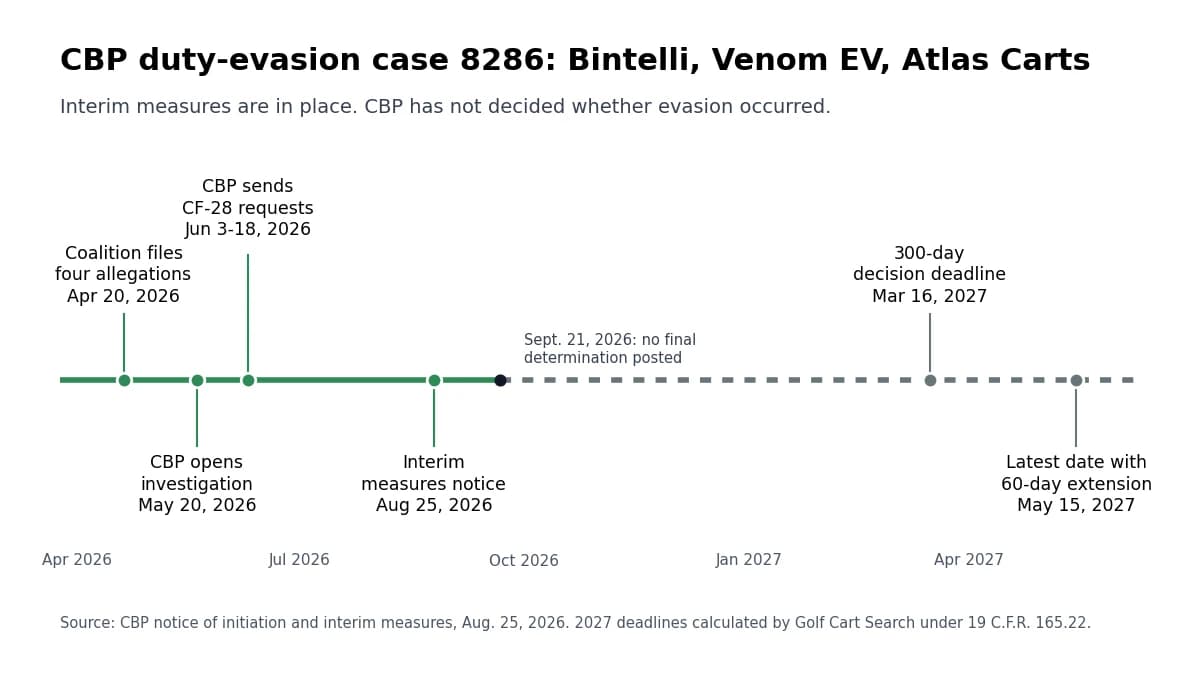
Between June 3 and June 18, 2026, CBP sent the three importers CF-28 requests for information on 20 specific entries: 11 for Bintelli, four for Venom EV, and five for Vexas. The responses arrived between July 23 and August 6. CBP's notice says those responses did not resolve where the cart frames, chassis, and raw materials came from.
What does CBP say about each company?
Bintelli. Bintelli told CBP that its Vietnamese-origin carts were properly declared because critical components were produced in Vietnam and final assembly happened there. CBP says the documents included a Vietnamese supplier's invoice and quotation for materials marked as originating in China, and that the record does not trace the frame or chassis back to Vietnamese materials. For carts declared as Thai-origin, CBP says the bill of materials lists the chassis as Thai but the record has no production or fabrication records showing it was built in Thailand. CBP also says pro forma invoices for those Thai carts listed payment to a company in China.
Venom EV. Venom EV told CBP that its Thai supplier fabricates the chassis in Thailand from Thai inputs and performs final assembly there, so the carts are outside the orders. CBP says the initial pro forma invoices for those carts came from a Chinese golf cart producer and described complete or nearly complete carts. CBP says the record does not show what went into the Thai chassis assembly or where those inputs came from.
Vexas (Atlas Carts). Vexas gave CBP bills of materials, production records, inspection reports, and supplier documents for carts declared as made in Vietnam. CBP says that record still includes an invoice listing a material marked "China" and does not show that mill certificates cover all the relevant inputs. For one entry, CBP also cites a manufacturer's affidavit describing production work done in China.
CBP redacted company names, entry numbers, and product descriptions in the public version, so the notice does not identify which cart models are involved.
What does the coalition allege?
The coalition's allegations, as summarized by CBP, describe four evasion methods: importing slightly disassembled rolling chassis as "parts," entering carts under tariff codes for golf balls and golf equipment, shipping Chinese carts through Vietnam and Thailand, and undervaluing entries. CBP's notice presents these as the coalition's claims and cites the coalition's exhibits for the figures.
The largest numbers in the notice come from those allegations:
- Bintelli: More than 13,300 metric tons of carts imported from China from January 2021 through September 2024, with 0.05% entered as parts. In the 12 months after cash deposits began, 100% of 2,294 metric tons was entered as "golf cart(s) parts."
- Bintelli's Vietnam supplier: Feiteng EV, which the coalition says was set up in Vietnam in March 2025, began U.S. exports in August 2025, and counts Bintelli as its only customer.
- Venom EV: More than 221,000 kilograms entered under the tariff code for "golf equipment except clubs and balls" by October 2025, described as "golf carts."
- Vexas: More than 1.7 million kilograms of carts imported under the golf cart tariff code from 2023 to late 2024, followed by a switch to parts shipments after October 2024.
- Market data: U.S. International Trade Commission statistics cited by the coalition show China shipped 21,955 golf carts under the relevant codes in December 2024. Over the next nine months, China's shipments fell by more than 82% while Vietnam's rose from zero to 6,209 units.
The coalition describes current rates of over 478% for antidumping duties and over 691% for countervailing duties. Its counsel's press release gives ranges of 119% to 478% and 31% to 679%. The rate that applies to any given entry depends on the producer and exporter.
What do the interim measures do?
The notice lists three steps under the EAPA statute:
- Suspend liquidation of unliquidated covered entries made on or after May 20, 2026.
- Extend the liquidation period for unliquidated covered entries made before May 20, 2026.
- Take other steps to protect revenue, such as a single transaction bond, additional security, or cash deposits.
For future entries, CBP will require live entry, which means paperwork and any required deposits must be filed before the cargo is released. CBP may also review whether the importers' continuous bonds are large enough.
The notice does not mention retail prices, dealer inventory, warranties, or carts already sold to owners. It deals with import entries.
When will CBP decide the case?
Golf Cart Search calculated the deadlines using the dates in CBP's notice and the timing rules in 19 C.F.R. Part 165. The notice says the consolidated deadlines run from May 20, 2026. The analysis script is in the site repository at scripts/news/cbp-golf-cart-duty-evasion-case-8286-2026-analysis.mjs.
| Milestone | Date |
|---|---|
| 90-day limit for interim measures | August 18, 2026 |
| Notice to the parties | August 25, 2026, five business days later |
| 300-day limit for a final determination | March 16, 2027 |
| Latest date if CBP takes the full 60-day extension | May 15, 2027 |
The coalition's counsel expects a final determination by May 2027, which matches the extended deadline. CBP can decide sooner. After a final determination, any party can ask CBP for administrative review within 30 business days.
How does this fit with the other golf cart cases?
Case 8286 is the third CBP evasion case involving the China golf cart orders. None has reached a final determination on CBP's EAPA notices page as of September 21, 2026.
| Case | Importers | Opened | Interim measures notice |
|---|---|---|---|
| EAPA Cons. Case 8247 | ICON EV, Denago EV, and others | December 30, 2025 | April 6, 2026 |
| EAPA Case 8282 | Star EV | March 20, 2026 | April 10, 2026 |
| EAPA Cons. Case 8286 | Bintelli, Venom EV, Vexas (Atlas Carts) | May 20, 2026 | August 25, 2026 |
ICON is challenging the interim measures in its case at the Court of International Trade. Our ICON EV tariff case report covers the August ruling on the coalition's role in that lawsuit. The notice for Case 8286 also says the coalition compared a Thai supplier's "Model J" cart with Star EV's J Model, which is part of the separate Star EV case.
What do the companies say publicly?
Beyond their CF-28 answers summarized by CBP, Golf Cart Search found no public statement from the three companies about the case, and no Court of International Trade decision involving Case 8286, as of September 21.
Atlas's website says its carts are "Designed & Assembled in the USA." On September 21, its model pages listed the Atlas PRO from $12,649 MSRP and the Atlas ONE from $14,649 MSRP, both with a 105Ah battery, alongside a $1,000 instant rebate promotion. Bintelli's website, as quoted in the coalition's allegation, calls its Ladson, South Carolina facility "the largest LSV assembly facility in the United States."
For readers comparing these brands, our Atlas and Venom EV model pages list specifications. Our guide to Chinese-built golf carts explains how parts and service support differ across import brands. Neither page shows which models or entries are involved in the CBP case.
Primary reporting source
U.S. Customs and Border Protection: EAPA Cons. Case 8286 notice