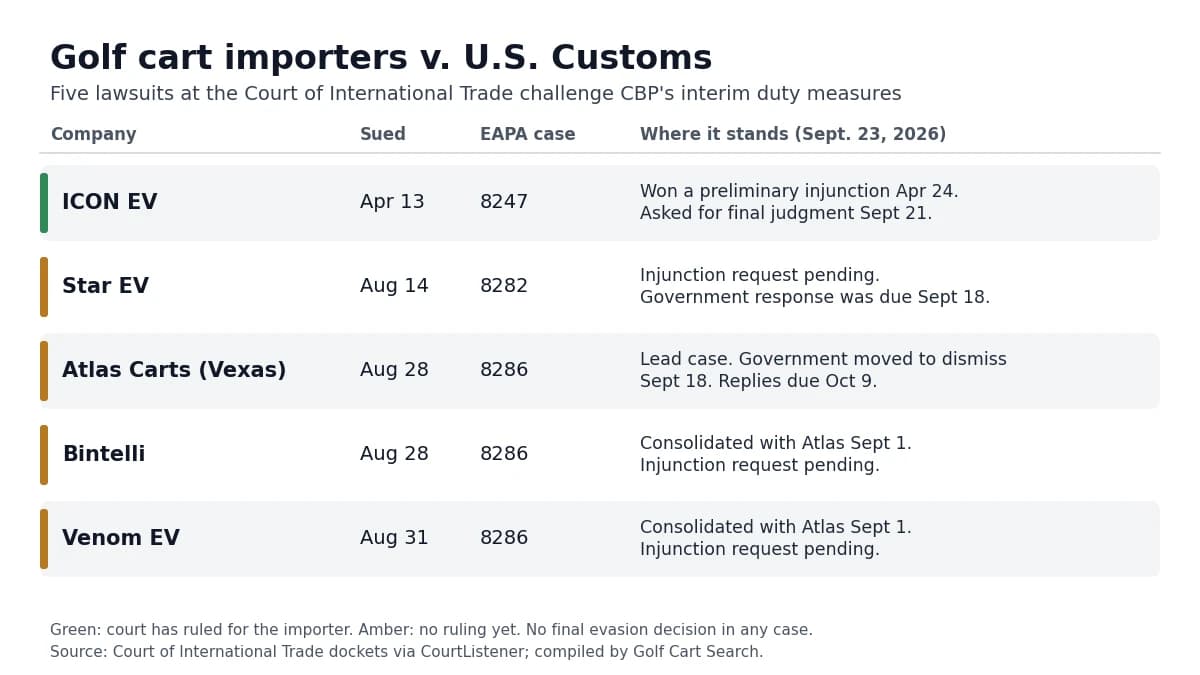
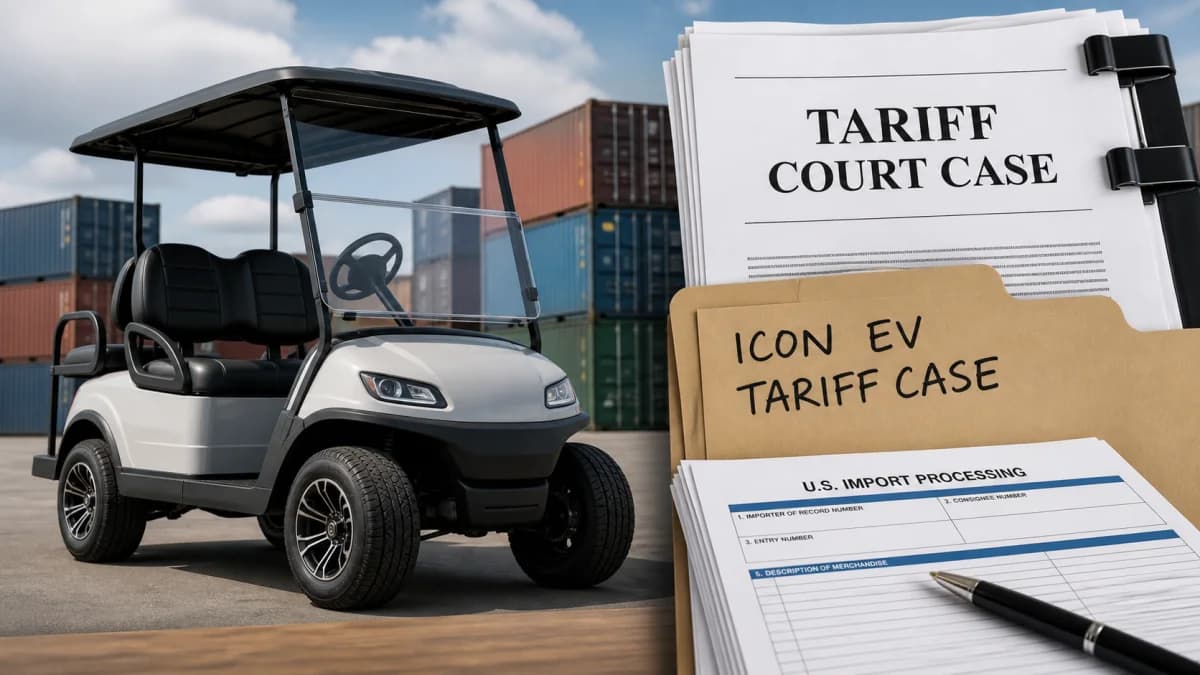
The ICON EV tariff case now has a narrower industry voice in court. On August 10, the U.S. Court of International Trade allowed the American Personal Transportation Vehicle Manufacturers Coalition to intervene, but only on one claim: whether Customs had a reasonable suspicion that ICON EV evaded low-speed personal transportation vehicle tariffs.
The court did not let the coalition join ICON's due-process claims or advance jurisdiction defenses. That distinction matters. The order does not decide whether ICON evaded duties, and it does not end ICON's challenge to the interim measures Customs imposed earlier this year.
Golf Cart Search also analyzed its ICON catalog data current on August 22, 2026. Our file includes 39 ICON model entries: 35 electric models, four gas models, and 34 models listed with a 25 mph maximum speed. That catalog footprint explains why the court fight is relevant to buyers, dealers, and service shops, but it does not show which entries, parts, or vehicles are covered by the trade proceeding.
What is the ICON EV tariff case?
The ICON EV tariff case is a Court of International Trade challenge to Customs' interim measures in an Enforce and Protect Act investigation involving low-speed personal transportation vehicle duties. ICON is challenging both the process Customs used and the reasonable-suspicion basis for the interim measures.
The case sits at the intersection of golf cart imports, LSV tariffs, and due-process claims. For readers outside trade law, the practical question is whether the court will let Customs' interim import restrictions stand while the EAPA investigation continues.
What changed in the ICON EV tariff case?
The August 10 order grants the coalition's renewed motion in part and denies it in part. The coalition may participate only on Count III of ICON's complaint, which challenges Customs' decision to impose interim measures based on a reasonable suspicion of evasion.
The court directed the coalition to file an answer within 14 days of the order. That sets an August 24, 2026 deadline unless the docket changes.
The coalition had asked for a wider role. ICON opposed the renewed intervention motion, arguing in part that the coalition's position duplicated the government's defenses and would complicate a fast-moving case. The court accepted part of that concern.
For Counts I and II, which involve ICON's procedural due-process arguments, the court said the coalition's proposed defenses would not add much beyond the government's position. The court also rejected coalition intervention for jurisdiction defenses, noting that those arguments overlapped with the government's and would involve ICON's confidential financial information.
The one lane left open is the technical trade question. The court said the coalition may assist on whether Customs had a reasonable suspicion of evasion because that issue depends on the scope of the LSPTV orders and the weight of the evidence Customs relied on.
Did the court find ICON EV evaded tariffs?
No. The court did not find that ICON EV evaded tariffs. The August 10 order is not a final evasion ruling. It decides who gets to participate, and on which issues, while ICON challenges Customs' interim measures.
The case background is still important. According to the court's August 10 order, the coalition submitted Enforce and Protect Act allegations to Customs on October 10 and December 8, 2025. The allegations claimed ICON was evading antidumping and countervailing duty orders on certain low-speed personal transportation vehicles from China.
Customs initiated its investigation on December 30, 2025. On March 30, 2026, Customs notified ICON that it had a reasonable suspicion of evasion by misclassification and transshipment through Vietnam. On April 6, Customs imposed interim measures, including extension and suspension of liquidation, an over-500% duty rate on ICON imports, and live-entry cash deposits. The April public opinion identified the combined all-others cash-deposit rate as 519.23% ad valorem.
ICON filed its complaint on April 13. It alleges Customs violated due process by imposing interim measures without prior notice and a meaningful opportunity to be heard. It also challenges whether Customs had reasonable suspicion under the EAPA.
Those are allegations and procedural findings, not final merits findings. The court's earlier April 24 order granted ICON preliminary relief, and its May 26 order denied the government's motion to dismiss. The August 10 order adds a limited intervenor role on the reasonable-suspicion count.
Why this matters to golf cart dealers
For dealers, the practical issue is uncertainty. A tariff case can affect landed cost, inventory timing, cash deposits, and how confidently a dealer quotes future availability. A procedural court order will not tell a dealer what to charge tomorrow, but it does show which arguments are now in the litigation.
The coalition's permitted role is focused on whether Customs had enough to suspect evasion when it imposed interim measures. That is closer to the factual trade-record question than to ICON's due-process claims.
Dealers should be careful with customer-facing language. It is accurate to say ICON is challenging Customs' interim measures and that a manufacturers coalition has been allowed to participate on one count. It is not accurate to tell shoppers that the court found ICON liable for evasion.
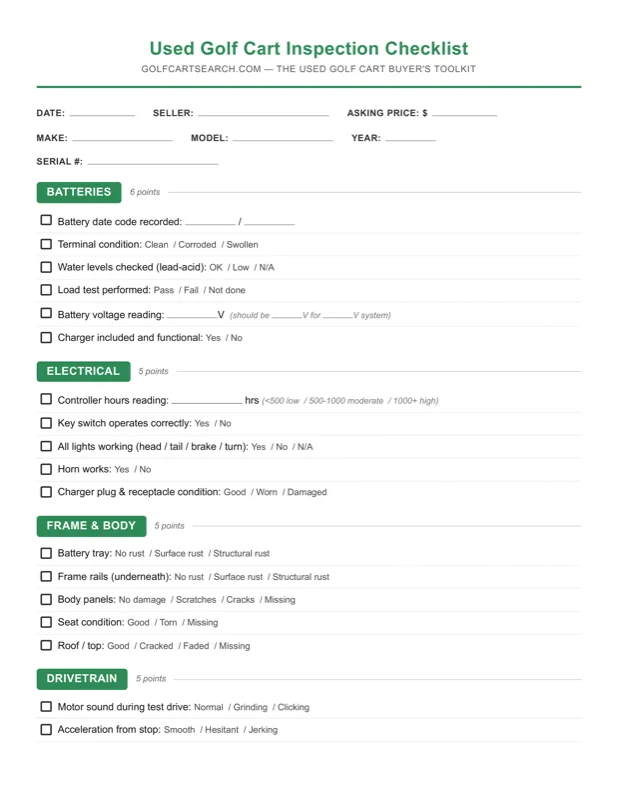
Buyers should make the same distinction. If you are comparing an ICON golf cart with another LSV-style cart, ask the seller for the current delivered price, warranty terms, available inventory, and written title or registration paperwork. Do not assume any tariff story automatically changes every vehicle on a dealer lot.
What the Commerce review window adds
The court case is separate from Commerce's administrative-review process, but both sit inside the same trade-policy backdrop for low-speed personal transportation vehicles.
In an August 4 Federal Register notice, Commerce opened the monthly window for interested parties to request administrative reviews by the last day of August 2026. The notice lists certain low-speed personal transportation vehicles from China under antidumping case A-570-176 for the period November 1, 2024 through July 31, 2026. It also lists the countervailing duty case C-570-177 for the period September 7, 2024 through December 31, 2025.
That notice does not decide the ICON court case. It does show that the LSPTV orders remain active enough for interested parties to request review during the August window. For manufacturers and importers, that means litigation and administrative review timing can overlap.
Where ICON fits in Golf Cart Search data
We ran a reproducible local analysis against src/data/golf-carts/models/icon.json using node scripts/news/analyze-icon-catalog-tariff-context.mjs.
The dataset includes all ICON model entries in Golf Cart Search's catalog file as of August 22, 2026. Separate trims and configurations count as separate model entries because they have separate catalog pages.
| ICON catalog measure | Count |
|---|---|
| Total ICON model entries | 39 |
| Electric model entries | 35 |
| Gas model entries | 4 |
| Models listed at 25 mph | 34 |
| Two-seat entries | 12 |
| Four-seat entries | 14 |
| Six-seat entries | 11 |
| Eight-seat entries | 1 |
| Wheelchair-capable entry | 1 |
Every catalog entry in the file includes a published starting price. The lowest listed starting price is $9,999, the median is $15,999, and the highest is $18,999. These are catalog figures, not transaction prices. They may exclude freight, dealer fees, batteries, accessories, tax, title, registration, and local delivery costs.
The data is useful for reader context, not for legal conclusions. A model page count does not establish which imports, entries, subassemblies, or parts fall inside any LSPTV order or EAPA investigation. That question depends on trade records and the orders' scope.
For shoppers looking beyond the litigation, our used ICON golf carts for sale page and broader Chinese golf cart guide are better tools for comparing local availability, support, and ownership risk.
What happens next in the ICON EV tariff case?
The next case steps will determine how the court handles ICON's due-process claims and the Count III challenge to Customs' reasonable-suspicion determination. The coalition can now participate only in that Count III lane.
Customs' final EAPA determination is a separate milestone. Commerce review requests, if filed by interested parties in August, would move on their own administrative track.
For now, the strongest read is narrow: the trade court has opened the door to an industry coalition on one technical evasion-suspicion issue, while keeping the constitutional and jurisdiction arguments between ICON and the government.
This article summarizes public court and agency records and is not legal advice. Buyers, dealers, and importers should verify current pricing, inventory, customs status, and registration paperwork before making a purchase or shipment decision.
Primary reporting source
U.S. Court of International Trade: Slip Op. 26-88