
As an Amazon Associate, we earn from qualifying purchases. This helps support our site at no extra cost to you.
Quick Answer: The Best Golf Cart for Hills
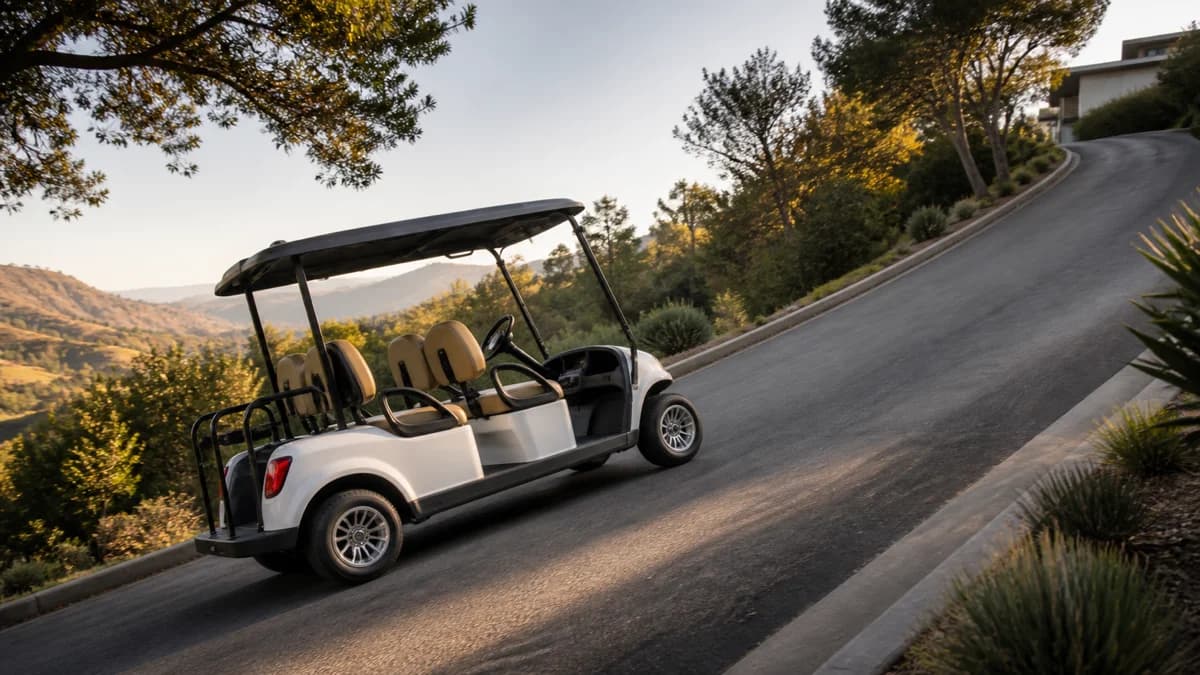
The Yamaha Drive2 PowerTech AC or PowerTech Li is our best overall golf cart for maintained hills. Yamaha markets its AC system for hill climbing, and the Drive2 pairs it with independent rear suspension. The Club Car Onward HP Lithium is our premium neighborhood pick, while the E-Z-GO Freedom RXV ELiTE stands out for controlled downhill braking. Choose Yamaha QuieTech EFI gas when you need long range without dependable charging.
Voltage and tire size alone do not identify the best golf cart for hills. A hill exposes the whole drivetrain. The battery must hold voltage, the controller must deliver current without overheating, the motor or gas engine must pull the load, the tires must grip, and the brakes must control the descent.
That is why an old 48V cart with tired batteries can crawl uphill while a healthy factory-AC cart holds speed. It is also why a lifted cart that looks powerful can perform worse after oversized tires change its effective gearing.
This guide compares gas and electric golf carts for hills, ranks five practical models, explains grade in plain English, and gives you a loaded hill-test checklist. Our picks are based on published manufacturer specifications and system design, not a standardized head-to-head slope test. Most brands do not publish directly comparable maximum-grade results, so you should test the exact cart on your route before buying.
Gas vs Electric Golf Cart for Hills
For most paved neighborhoods and campgrounds, a modern AC electric golf cart is the best hill climber. Electric motors deliver smooth torque from a stop, and many AC systems add regenerative or motor braking on the way down. They are quiet, require little routine drivetrain maintenance, and do not lose time shifting through a belt-driven transmission.
Gas still has a place. A gas cart can refuel quickly, cover long routes, and work on remote property where charging is unreliable. Its performance also stays more predictable over a long workday than an old lead-acid pack that is losing charge. Read our broader gas vs electric golf cart comparison if hills are only one part of your decision.
| Factor | Modern AC electric | Gas EFI | Older DC electric |
|---|---|---|---|
| Starting on a paved hill | Smooth, immediate response | Strong with healthy CVT and engine | Varies widely by batteries and system |
| Repeated short climbs | Excellent when correctly sized | Good, with more noise and heat | Can slow or heat up |
| Downhill control | Often includes regen or motor braking | Relies mainly on mechanical brakes and engine drag | Depends on drive system |
| Long remote routes | Limited by range and charging | Best for quick refueling | Limited by battery condition |
| Maintenance | Low | Oil, filters, belts, fuel system | Batteries, cables, brushes on some motors |
| Quiet neighborhood use | Best | Noisier | Quiet |
| Used-cart risk | Battery and controller condition | Engine, clutch, belt, and compression | Battery age plus old wiring |
Do not assume gas always beats electric uphill. That rule came from the era of basic 36V and early 48V DC carts. A factory-matched AC motor, controller, and healthy lithium or lead-acid pack can be a stronger and more controllable hill setup than a small gas engine.
What Makes a Golf Cart Good on Hills?
A Matched Motor and Controller
Motor horsepower or kilowatts alone do not tell you how a cart will climb. The controller determines how much current reaches the motor, how smoothly it arrives, and when heat or low voltage triggers power reduction. A large motor behind a conservative controller can feel weak. A large controller on stock cables, an undersized solenoid, or an incompatible motor can create dangerous heat.
Factory AC systems are attractive because the motor, controller, software, and braking strategy were engineered together. Our AC vs DC golf cart motor guide explains the differences, while the controller symptoms and upgrade guide covers current limits and thermal cutback.
Battery Voltage Under Load
The number printed on the battery pack is only nominal voltage. Hill climbing creates a high-current load, and a weak battery can sag sharply even when the dash shows a full charge. One failing battery, a corroded terminal, or a loose cable lug can make the whole cart surge, slow down, or shut off.
Lithium is not magic, but a properly sized lithium pack is lighter and usually holds voltage more consistently than an aging flooded lead-acid pack. Its battery management system must still support the controller's peak and continuous current demands. Compare chemistries in our golf cart battery guide and check conversion requirements before buying a lithium golf cart battery.
Gearing and Tire Diameter
Taller tires raise the effective gear ratio. That can increase speed on level ground, but it reduces the torque available at the tire and makes the motor work harder uphill. Heavy wheels also add rotating mass. If hill climbing matters more than appearance, stay close to the factory tire diameter and use only as much tread as your surface needs.
On gravel or wet grass, traction may be the limiting factor rather than power. A moderate all-terrain tread can help, but an extreme mud tire can tear turf, add weight, and make paved handling worse. Use our golf cart tire guide and set pressures using the tire sidewall plus the manufacturer's guidance, not guesswork.
Brakes, Wheelbase, and Center of Gravity
A cart needs predictable downhill speed control and enough mechanical braking reserve if motor braking is reduced or unavailable. Lift kits, roof racks, rear seats, tall tires, and heavy cargo raise or shift the center of gravity. That makes cross-slopes and turns less forgiving.
Before adding power, service the brakes and inspect the steering and suspension. Our golf cart brake maintenance guide covers adjustment, worn shoes, rotors, cables, and warning signs.
Best Golf Carts for Hills in 2026
How we chose: We limited the list to current or recently documented configurations with manufacturer specifications for the drivetrain, brakes, or load-related hardware. We favored factory-matched systems, standard-height stability, dealer support, and controlled descents over unsupported peak-power claims.
| Pick | Powertrain | Published hardware | Best for |
|---|---|---|---|
| Yamaha Drive2 PowerTech AC or Li | 48V AC | Toyota Industries motor controller unit | Best overall on maintained hills |
| Club Car Onward HP Lithium | AC electric | 4.7 hp motor, 375A controller | Premium neighborhoods |
| E-Z-GO Freedom RXV ELiTE | 56.7V AC lithium | 3.3 kW continuous, 235A controller | Downhill control |
| ICON i40 | 51V lithium, AC | 5 kW motor, 450A controller | Feature value |
| Yamaha Drive2 QuieTech EFI | 357cc gas EFI | CVT, independent rear suspension | Long routes without charging |
1. Yamaha Drive2 PowerTech AC or Li: Best Overall
The Yamaha Drive2 PowerTech AC or lithium package is our top hill pick for buyers who want a conventional, dealer-supported golf cart. Yamaha's Drive2 specifications pair the 48V AC drivetrain with a Toyota Industries-built motor controller unit, and Yamaha explicitly promotes the system for hill-climbing ability. The independent rear suspension also helps the tires stay composed on uneven paved or maintained gravel routes.
Choose PowerTech Li if you want lower battery maintenance and more consistent loaded response. PowerTech AC with flooded batteries can still climb well, but only when the pack is healthy and properly maintained. Confirm the actual powertrain label because Yamaha sold DC and AC configurations in overlapping years.
Best for: Hilly golf communities, resorts, paved private roads, and buyers who prioritize proven service support.
Watch for: Mechanical rear drum brakes still need inspection and adjustment. The fleet version's published speed is 15 mph, while personal configurations can differ.
2. Club Car Onward HP Lithium: Best Premium Cart
The Club Car Onward HP Lithium combines an aluminum frame with a factory AC package. Club Car's published Onward specifications list a 4.7 hp motor and 375A controller for the HP AC configuration, and the company describes the system as providing hill-climbing power and acceleration. The corrosion-resistant frame is particularly valuable in wet climates or hilly coastal communities.
This is the cart to shortlist if you want a premium neighborhood build and strong resale support. For a four- or six-passenger setup, test with every seat occupied. Passenger weight changes both climbing and stopping performance, and a rear-facing seat moves weight behind the axle.
Best for: Premium hilly neighborhoods, coastal areas, and long-term ownership.
Watch for: Onward powertrains vary by trim. Verify that the cart is the HP AC or HP Lithium configuration, not a lower-output package with similar bodywork.
3. E-Z-GO Freedom RXV ELiTE: Best Downhill Control
The Freedom RXV ELiTE is our downhill-control pick. E-Z-GO's Freedom RXV specification sheet lists a 56.7V lithium pack, 3.3 kW continuous AC motor, 235A controller, limited-slip differential, and induction-motor service braking. It also includes an automatic electromagnetic parking brake.
Those systems can make low-speed hill driving feel controlled. Programming matters, so do not assume every used RXV has the same speed or braking calibration. Have an E-Z-GO technician inspect faults and verify the motor-brake system on a used RXV.
Best for: Steep paved driveways, hilly communities, and buyers who value automatic parking-brake behavior.
Watch for: A used RXV should be scanned for faults and tested by someone familiar with the model. Do not modify controller or speed settings casually because braking behavior is integrated with the drive system.
4. ICON i40: Best Feature Value
The current ICON i40 brings substantial published hardware for the money: a 5 kW three-phase AC motor, 450A controller, and 51V 105Ah lithium battery. ICON also lists four-wheel disc brakes and an electromagnetic parking brake on its i40 specification sheet. An ICON owner manual publishes a 25 percent climbing capacity, although it does not provide enough test conditions to compare that figure directly with other brands.
The standard-height i40 is the hill choice over a lifted version. It keeps a lower center of gravity and avoids the torque penalty of taller tires. Dealer quality and local parts support vary, so the seller matters nearly as much as the specifications.
Best for: Buyers who want lithium, strong published motor/controller numbers, four seats, and road-oriented equipment.
Watch for: Confirm whether you are looking at the i40 or lower-cost i40-ECO. They use different controller, braking, and wheel packages.
5. Yamaha Drive2 QuieTech EFI: Best Gas Cart for Hills
The gas Drive2 uses a 357cc single-cylinder EFI engine and continuously variable transmission. Yamaha publishes 45 mpg and 60.5 dB for QuieTech, making it one of the quieter gas choices. It shares the Drive2's independent rear suspension, which is useful on rolling property and imperfect private roads.
Gas is the practical choice when a long hilly route exceeds electric range, several users share the cart all day, or there is no reliable charging point. A healthy drive belt, clutch, fuel system, brakes, and engine matter more than peak horsepower on a used cart.
Best for: Large properties, remote campgrounds, and long daily routes without dependable charging.
Watch for: Gas adds oil changes, filters, belt and clutch wear, fuel storage, noise, and exhaust. It is not automatically stronger than a factory AC electric cart on a short climb.
How Steep Is Your Hill?
Hill grade is the vertical rise divided by horizontal distance, multiplied by 100. A road that rises 20 feet over 100 horizontal feet has a 20 percent grade. Degrees measure the angle, so the numbers are not interchangeable.
| Grade | Approximate angle | Practical description |
|---|---|---|
| 5% | 2.9 degrees | Gentle rolling route |
| 10% | 5.7 degrees | Noticeable neighborhood hill |
| 15% | 8.5 degrees | Steep for a loaded older cart |
| 20% | 11.3 degrees | Serious test of power and braking |
| 25% | 14.0 degrees | Severe grade, test before purchase |
| 30% | 16.7 degrees | Extreme for a conventional golf cart route |
You can estimate grade with a phone inclinometer, a digital level, or an elevation map, but measure the steepest sustained section, not the average for the whole road. Surface, turns, loose gravel, bumps, and a stop near the bottom can make a shorter hill harder than the percentage suggests.
The Loaded Hill-Test Checklist
Never buy a cart for hills based on a flat parking-lot drive. Ask the dealer or seller to test it with the same load you expect to carry.
- Charge or fuel it fully. A seller should not use low charge as an excuse for weak performance.
- Add the normal load. Bring the usual adult passengers or equivalent safe ballast within the vehicle rating.
- Start near the lower section. A cart that only climbs with a running start may not suit a driveway with a gate or intersection.
- Use moderate throttle. Watch for surging, severe speed loss, warning lights, controller cutback, belt slip, or engine bogging.
- Repeat the climb. Thermal problems may appear on the second or third run rather than the first.
- Stop safely at the top. Check for hot electrical smells, clicking, belt odor, or unusually hot cable connections. Do not touch bare terminals.
- Descend at low speed. Judge motor braking, brake-pedal travel, steering, and whether the cart tries to gain speed.
- Test the parking brake. Use a controlled slope and keep your foot ready on the service brake.
If a used electric cart slows sharply, test pack voltage under load before replacing parts. A clean resting-voltage reading cannot reveal one weak battery. Our battery voltage chart and test guide explains the process.
36V vs 48V vs 72V for Hills
Higher voltage can deliver the same power with less current, which helps reduce electrical heat and cable loss. That does not mean every 72V cart climbs better than every 48V cart. Battery capacity, controller limits, motor design, gearing, software, tires, and vehicle weight can overwhelm the voltage advantage.
- 36V: Fine for light loads and modest hills when healthy, but most 36V carts are old enough that battery, cable, brake, and motor condition dominate.
- 48V: The practical sweet spot for many conventional carts. There are abundant battery, charger, controller, and service options.
- 51V to 56V lithium: Common on newer factory packages from ICON and E-Z-GO. Judge the complete drive system, not the label.
- 72V: Useful for heavier or higher-output carts, but extra voltage does not correct poor gearing, tall tires, weak brakes, or an undersized battery BMS.
Compare the full system in our 36V vs 48V guide and 48V vs 72V guide.
Upgrading a Golf Cart for Better Hill Climbing
Use this order. It prevents expensive parts from hiding a maintenance problem.
1. Test Batteries, Cables, and Connections
Load-test every lead-acid battery, inspect lithium BMS fault history when available, clean corrosion, torque cable connections to the manufacturer's specification, and replace heat-damaged lugs. Our battery cable size guide explains why cable gauge and crimp quality matter.
For a compatible 48V conversion, these batteries are current options to compare. Confirm dimensions, charger, BMS current rating, controller compatibility, and warranty before ordering.
Compare DC HOUSE 48V 100Ah Battery Compare LOSSIGY 48V 100Ah KitAn E-Z-GO RXV with corroded or undersized pack cables may also benefit from a correctly fitted heavy-gauge replacement set. Match the exact model year and terminal layout.
Check E-Z-GO RXV 2-Gauge Cable Kit2. Restore Brakes and Traction
Service brakes before adding torque or speed. Replace worn tires with a tread suited to the surface, keep diameter close to stock, and verify pressure cold. A tire that grips loose gravel but raises the cart two inches is not an automatic hill upgrade.
3. Match the Motor, Controller, and Gearing
If the stock system is healthy but insufficient, use a matched package from a reputable supplier. The controller, motor, solenoid, cables, throttle type, battery BMS, and rear-axle gearing must work together. Ask the supplier for a recommendation based on grade, tire diameter, total loaded weight, desired top speed, and longest continuous climb.
An AC conversion can be worthwhile on a clean cart with a strong frame and recent battery. On a worn $3,000 cart that also needs brakes, steering, batteries, and tires, buying a newer factory-AC model may cost less overall.
4. Remove Unnecessary Weight
Rear seats, steel cargo boxes, oversized wheels, sound systems, and tool loads all affect a climb. Carry only what you need and stay within the manufacturer's vehicle load rating. For rough acreage and heavy payloads, a utility cart or UTV may be safer than modifying a passenger cart. See our farm and ranch golf cart guide for that decision.
Used Golf Cart Warning Signs on Hills
Walk away or budget for professional diagnosis when you find:
- a full-charge claim but severe voltage sag under load
- melted cable insulation, discolored lugs, or a burnt smell
- controller or motor fault codes that the seller cannot explain
- a speed-focused gear or tire setup on a cart advertised for torque
- brake pedal travel near the floor or a parking brake that will not hold
- steering play, cracked springs, damaged lift-kit brackets, or uneven tire wear
- a lithium swap with no battery model, charger match, BMS rating, or installation paperwork
- a gas cart that slips, shudders, smokes, or smells strongly of fuel on the climb
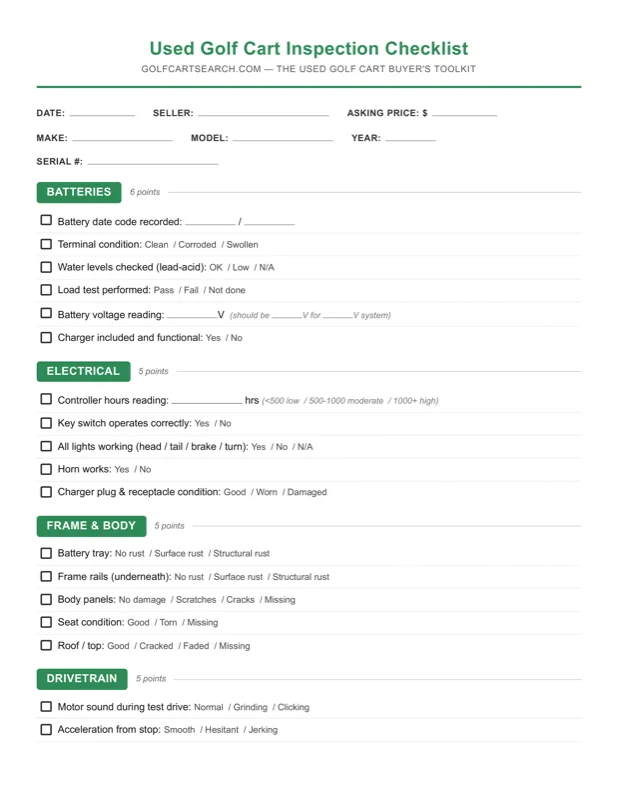
Use our complete used golf cart buying guide, then compare local golf carts for sale. A nearby golf cart repair shop can perform a pre-purchase inspection when the route is steep or the cart has performance modifications.
Final Recommendation
For repeated paved hills, buy a factory AC electric cart in standard-height form and test it with your normal load. Start with the Yamaha Drive2 PowerTech AC or Li, Club Car Onward HP Lithium, or E-Z-GO Freedom RXV ELiTE. Choose the ICON i40 when feature value and four-wheel disc brakes matter, provided a capable local dealer supports it.
Choose Yamaha QuieTech EFI gas when long remote routes or unreliable charging outweigh quiet operation and lower maintenance. Avoid selecting by voltage, horsepower, or tire size alone. The right hill cart is the one that starts from rest, repeats the climb without thermal cutback, and controls the descent safely with your passengers aboard.
Compare golf cart brands, browse our overall best golf carts, or contact a local dealer and ask for a loaded demonstration on a comparable grade.
Frequently Asked Questions
What is the best golf cart for hills?
The Yamaha Drive2 PowerTech AC or PowerTech Li is our best overall pick for maintained hills because Yamaha specifically positions the AC drive for hill climbing and pairs it with independent rear suspension. The Club Car Onward HP Lithium and E-Z-GO Freedom RXV ELiTE are strong alternatives. Test the exact cart with your normal passenger load before buying.
Is a gas or electric golf cart better for steep hills?
A modern AC electric cart is usually better for short, repeated paved hills because it delivers smooth low-speed torque and can provide motor braking downhill. Gas remains practical for long routes, remote property, and users who cannot recharge. Battery condition matters more than the fuel label on older carts.
Can a 48V golf cart climb steep hills?
Yes, a healthy 48V cart can climb many steep hills, but voltage alone does not prove hill capability. Motor type, controller current, battery voltage under load, gearing, tire diameter, passenger weight, traction, temperature, and grade all matter. A weak 48V pack can perform worse than a healthy 36V cart.
Are AC golf carts better on hills than DC carts?
Factory AC golf carts are generally the better hill choice because their matched motor and controller can maintain power smoothly and often provide regenerative or motor braking. Some DC carts have strong starting torque, but older systems are more likely to lose speed, build heat, or lack controlled downhill braking.
What golf cart has the best downhill braking?
The E-Z-GO Freedom RXV ELiTE stands out because its induction motor serves as the service brake and it includes an automatic electromagnetic parking brake. Other AC carts may use regenerative braking plus mechanical brakes. Always verify braking behavior on the exact grade because programming and model configuration vary.
How steep is a 20 percent grade?
A 20 percent grade rises 20 feet for every 100 feet of horizontal distance and equals about 11.3 degrees. Grade and degrees are not the same. A 10 percent grade is about 5.7 degrees, while a 30 percent grade is about 16.7 degrees.
Does lithium make a golf cart climb hills better?
Lithium can improve consistency because it is lighter and usually holds voltage better under load than a tired lead-acid pack. It does not automatically add motor torque. The battery BMS, controller, motor, cables, solenoid, gearing, and software settings still limit performance.
Why does my golf cart slow down uphill?
Common causes include weak batteries, voltage sag, loose or undersized cables, hot terminals, an undersized controller, worn motor components, oversized tires, high-speed gears, dragging brakes, excess passenger weight, or thermal protection. Load-test the batteries and inspect cables before buying performance parts.
Do bigger tires help a golf cart climb hills?
Aggressive tread can improve grip on gravel, dirt, or wet grass, but taller tires usually make hill climbing harder by raising the effective gear ratio. They also add rotating weight and raise the center of gravity. Use only enough tire for the terrain and keep the diameter close to stock when climbing power matters most.
Can I upgrade an old golf cart for steep hills?
Yes, if the frame, steering, brakes, rear axle, and wiring are sound. Start with battery and cable testing, then address brakes and traction. A matched motor-controller kit, suitable gearing, heavy cables, and a compatible solenoid can help, but a complete AC conversion may cost enough that a newer factory-AC cart is the better buy.
How should I test-drive a golf cart for hills?
Test the exact hill with the normal passenger or cargo load, starting from a safe stop near the bottom. Watch for severe speed loss, surging, warning lights, hot smells, cable heat, and controller cutback. Then descend at low speed to judge motor braking, pedal feel, steering, and parking-brake hold.
Golf Cart Search
Find the Best Golf Carts of 2026
Compare top-rated models, read expert reviews, and find the perfect cart for your needs.