
Golf Cart Dimensions by Brand (2026)

Golf cart dimensions by brand for 2026. Compare width, length, and height for Club Car, E-Z-GO, Yamaha, and ICON, plus garage and trailer fit.

Michael
Michael
Apr 17th, 20269 min read
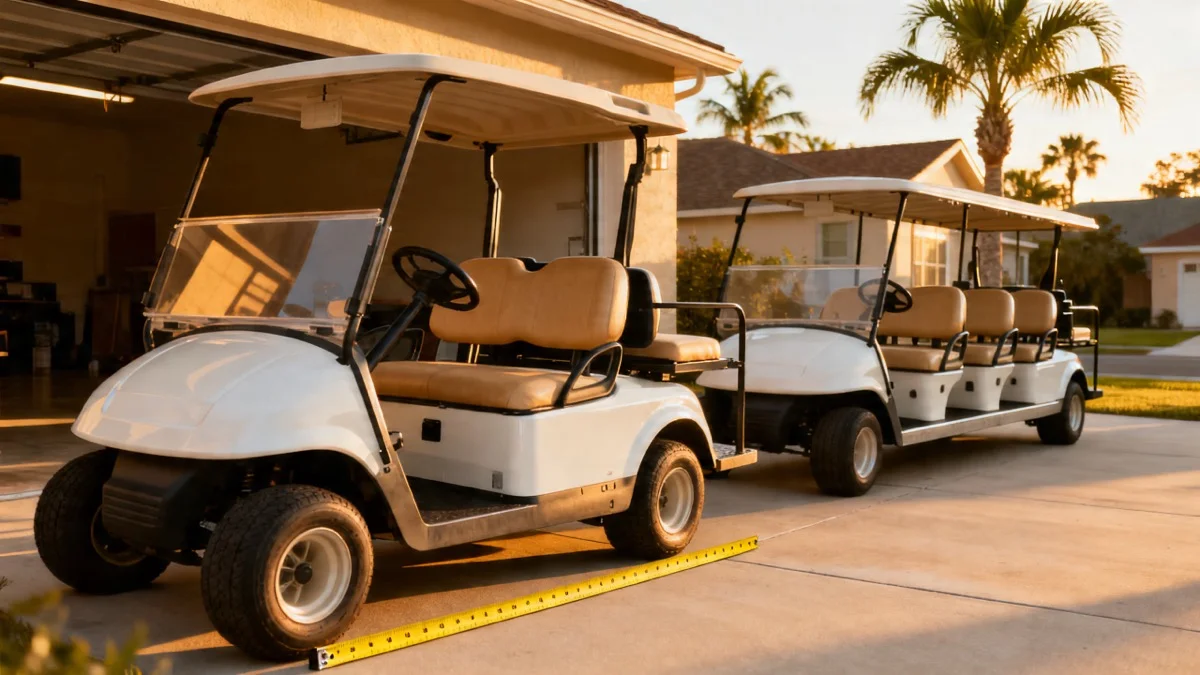
Lineup of golf carts in different sizes parked in a driveway with measuring tape and garage in the background

As an Amazon Associate, we earn from qualifying purchases. This helps support our site at no extra cost to you.

If you search for golf cart dimensions, you usually get a vague answer like "about 4 feet wide and 8 feet long." That is not wrong, but it is not enough if you are trying to fit a cart in a garage, through a gate, onto a trailer, or next to a car in a two-bay setup.

This guide is narrower than our 2 vs 4 vs 6-seater comparison and more exact than our garage setup guide. Here we are focusing on golf cart dimensions by brand, using current published specs from major manufacturers plus real-world fit advice for Club Car, E-Z-GO, Yamaha, and ICON.

The comparison table below is built from current official Club Car Onward spec pages, E-Z-GO spec pages and sell sheets, Yamaha Drive2 model pages, and ICON product spec sheets. Where a current model has meaningful package-to-package variation, I call that out instead of pretending every trim uses one single number.

Most common width 47 to 49 in

Typical 4-seat length 106 to 128 in

Typical 6-seat length 134 to 161 in

Safe garage target 10 x 14 ft or larger

Standard golf cart dimensions at a glance

If you only need the fast answer, this is the baseline:

Golf cart typeTypical lengthTypical widthTypical height with roof
2-passenger stock cart91 to 96 in47 to 49 in70 to 72 in
4-passenger stock cart106 to 128 in46 to 49 in71 to 76 in
6-passenger stock cart134 to 161 in47 to 51 in74.5 to 78 in
Lifted 4- or 6-passenger cart108 to 149 in49 to 53 in80 to 82 in

That means the usual "4 feet wide" rule is still mostly true. Width stays surprisingly consistent across brands until you get into a few E-Z-GO and lifted packages. Length is what changes fast once you move from a 2-seater to a 4- or 6-seater.

If seat count is your real question, read our full 2 vs 4 vs 6-seater guide. If towing or payload is the issue, pair this with our golf cart weight guide and transport guide.

Golf cart dimensions by brand

Here is the part most generic dimension posts skip: actual brand-specific examples.

BrandModelSeatsLengthWidthHeight with roof
Club CarOnward 2 Passenger291.5 in48.75 in71 in
Club CarOnward 4 Passenger4108 in48.75 in71 in
Club CarOnward 6 Passenger6143 in48.8 in75 in
E-Z-GOValor294.5 in47 in70 to 71 in
E-Z-GOLiberty4106 to 106.25 in46 to 48 in75.5 to 76 in
E-Z-GOExpress 66142.8 to 144.5 in49 to 50.6 in74.5 to 76.2 in
YamahaDrive2 PTV293.6 in47.3 in70.2 in
YamahaDrive2 Concierge 44128 in47.2 in75.2 in
YamahaDrive2 Concierge 66161.4 in47.2 in75.2 in
ICONi20296 in49 in72 in
ICONi404108 in49 in72 in
ICONi606134 in49 in75 in

E-Z-GO is the brand with the most package variation in current official specs, so the Liberty and Express 6 rows are shown as ranges where current factory pages and sell sheets differ slightly by trim, powertrain, or wheel package.

Club Car dimensions

Club Car stays close to the industry norm on width, but the 6-passenger Onward is noticeably longer than the 4-passenger model. The other thing to watch is lifted height. Club Car's own spec pages show the Onward 4 jumping from 71 inches tall in standard form to 80.5 inches in lifted form, while the Onward 6 jumps from 75 inches to 82 inches.

That matters for garage doors, trailer ramps, and low carport openings. If you are comparing brands for neighborhood use, our Club Car review and best golf cart brands page give the broader context.

E-Z-GO dimensions

E-Z-GO is usually one of the easiest brands to fit, but it is also the brand where package differences show up the most in the current official literature. The Liberty is still a good example of a 4-seat cart that does not get dramatically longer, even though it gives you four forward-facing seats. Depending on the current package sheet you reference, it lands right around 106 inches long, about 46 to 48 inches wide, and roughly 76 inches tall.

The tradeoff shows up when you step to the Express 6. Current factory pages put it at roughly 143 to 145 inches long, 49 to 50.6 inches wide, and 74.5 to 76.2 inches tall depending on gas versus ELiTE trim. That still places it in the same broad class as a Club Car Onward 6 for trailer planning, but some ELiTE configurations run a little wider than buyers expect.

Yamaha dimensions

Yamaha is where length becomes a bigger story than width. The standard Drive2 PTV is compact at 93.6 inches long, but the hospitality-style Concierge line stretches fast:

  • Concierge 4: 128 inches
  • Concierge 6: 161.4 inches

That makes the Concierge 6 one of the longest mainstream six-passenger carts in the category. If your storage depth is tight, Yamaha can be the brand that turns a comfortable garage fit into a squeeze.

ICON dimensions

ICON tends to run a little bigger and heavier-feeling than the Big 3 in comparable seating classes, even when the raw width number still lands at 49 inches. The ICON i20 comes in at 96 x 49 x 72, the i40 at 108 x 49 x 72, and the i60 at 134 x 49 x 75.

That is useful if you are cross-shopping newer import-heavy brands against Club Car, E-Z-GO, and Yamaha. The carts can still fit the same garage and trailer categories, but they often look bulkier because of wheel, tire, and body treatment.

Width is more standardized than length

One useful takeaway from the official spec pages: width usually moves less than length.

Most personal carts in this guide land between 47 and 49 inches wide. The main exceptions are a few E-Z-GO trims that run slightly narrower or a bit over 50 inches wide. That is why:

  • a standard garage door opening is usually not the problem
  • most carts still work with the same side-clearance assumptions
  • neighborhood path fit is more forgiving than buyers expect

Where owners get in trouble is assuming width is the whole fit question. It is not. The real problems usually come from:

  1. extra rows of seats
  2. lifted suspension and taller roofs
  3. fender flares, mirrors, brush guards, and oversized tires
  4. trailer gate width and ramp track width

If the cart is going to live under a cover or enclosure, roof length and overall height matter just as much as body width.

What changes dimensions the most

Published stock specs are only the starting point. A used cart in the real world can be meaningfully different from the brochure.

Seat count and chassis length

This is the biggest change. Adding seats usually means adding frame length, not width.

  • A 2-seater around 92 to 96 inches long is easy to store.
  • A 4-seater around 106 to 128 inches is still manageable.
  • A 6-seater around 134 to 161 inches changes trailer and garage planning completely.

If you are deciding between a factory 4-seater and a kit cart, compare this with our rear seat kit guide. A bolt-on rear seat changes functional length and accessory fit even if the original chassis started as a 2-seater.

Lift kits and taller tires

A lifted cart may only get slightly longer, but it can get 8 to 11 inches taller depending on tire size and suspension style. That affects:

  • garage door openings
  • top-of-cart clearance under shelves
  • trailer loading angle
  • enclosure and cover sizing

If you are shopping lifted models, use our lift kit guide and tires and wheels guide before you assume the stock numbers still apply.

Street-ready carts often keep the same published body width while becoming harder to fit in practice. Side mirrors, front brush guards, fender flares, and rear grab bars all add real-world clearance needs. That is especially true if you are parking in a tight garage beside a car or squeezing through gates.

Our street-legal guide and safety guide cover those add-ons from the equipment side.

Will it fit in your garage, trailer, or truck bed?

This is the practical reason people search dimensions in the first place.

Garage fit

For most readers, these are the safe targets:

Cart sizeComfortable garage target
2-seater10 x 14 ft
4-seater10 x 16 ft
6-seater10 x 18 ft or larger

A standard 2-seat or 4-seat cart usually fits in a normal garage without drama. A 6-seater often still fits, but you lose working room fast once you account for chargers, shelving, and walking space.

If you want a cleaner parking footprint, a dedicated mat helps you center the cart the same way every time and protects the floor from tire marks and battery mess.

Roykaw Golf Cart Parking Mat

That mat is sized for the common garage-fit problem at about 9.2 x 4.9 feet, which makes it a practical visual guide for a stock 2-seater or compact 4-seater. For the full storage setup, read our garage and storage guide.

Trailer fit

This is where length matters more than almost anything else.

Cart sizePractical trailer size
2-seater5 x 10 ft
4-seater6 x 12 ft
6-seater6 x 14 ft or 7 x 14 ft

If you are loading into a truck bed or taller trailer, ramp length matters too. A short ramp makes a long cart feel worse to load than it should.

WheelX 1,800 lb Folding Ramps

These make sense if the dimensions question is really a loading question. A long, shallow ramp is easier on low ground-clearance carts and lifted carts alike.

Once the cart is on the trailer, proper tie-down gear matters more than another inch of theoretical fit.

Stalwart Ratchet Straps 4-Pack

If transport is your main use case, pair this article with our full transport guide.

Pickup truck fit

Most standard 2-seaters can fit in a full-size long bed. Most 4-seaters and 6-seaters do not belong in a truck bed unless you know exactly what you are doing and have the right ramp and payload setup.

That is one reason compact or folding carts keep getting attention in the camping and RV market. Our portable golf cart guide covers that category in more detail.

How to measure a golf cart correctly

If fitment matters, measure the cart you are actually buying or storing, not the internet description.

Use this sequence:

  1. Measure overall length bumper to bumper.
  2. Measure overall width at the widest installed point, not just the body.
  3. Measure overall height from the ground to the highest fixed point.
  4. Re-measure with mirrors folded out, accessories installed, and tires at normal pressure.

That last step matters a lot on used carts. Owners often add:

If you are shopping remotely, use our dealer directory and ask sellers for three numbers, measured exactly as the cart sits today: length, width, and height.

Which size makes sense for most buyers?

For most households, the sweet spot is still the normal 4-seat category. It gives you passenger flexibility without pushing you into the longest trailer and garage requirements.

Use a 2-seater if:

  • you mostly ride alone or as a couple
  • storage is tight
  • you want the easiest trailer and garage fit

Use a 4-seater if:

  • family flexibility matters
  • you want the best resale mix of utility and size
  • you still want a cart that fits normal residential storage

Use a 6-seater if:

  • you actually carry five or six people often
  • you have already measured garage and trailer depth
  • you accept wider turning circles and a bigger overall footprint

If you are still choosing the cart itself, our best golf carts page, best brands page, pricing guide, and used buying guide are the next reads.

FAQ

What are standard golf cart dimensions?

A stock 2-passenger cart is usually about 91 to 96 inches long, 47 to 49 inches wide, and around 70 to 72 inches tall with the roof on.

How wide is a typical golf cart?

Most mainstream personal carts fall around 47 to 49 inches wide. Utility carts and lifted carts can go beyond that.

How long is a 4-seater golf cart?

Most 4-seat carts are about 106 to 128 inches long depending on the brand and seating layout.

How long is a 6-seater golf cart?

Most 6-seat carts are about 134 to 161 inches long. The Yamaha Concierge 6 is one of the longest common examples.

Will a golf cart fit in a standard garage?

Usually yes for 2- and 4-seaters. Most 6-seaters fit too, but working room gets tighter and lifted height can be the real issue.

What size trailer do I need for a golf cart?

A 2-seater usually works on a 5x10 trailer, a 4-seater on a 6x12, and a 6-seater on a 6x14 or 7x14.

Are lifted golf carts much bigger than stock carts?

They are usually much taller, and sometimes slightly longer and wider depending on the wheels, tires, and suspension setup.

Do mirrors count toward golf cart width?

They should for real-world fit. Published body width often does not reflect the widest installed accessory points.

Which golf cart brand is the smallest?

The mainstream 2-seat Club Car, E-Z-GO, and Yamaha carts are all very close in footprint. They mostly differ by a few inches, not by an entirely different size class.

Which golf cart brand is longest in 6-passenger form?

In this guide, the Yamaha Drive2 Concierge 6 is the longest at 161.4 inches.

How do I measure a golf cart correctly?

Measure bumper-to-bumper length, widest installed width, and tallest installed height. Do it with the actual accessories and tire setup on the cart.

What matters more, seat count or roof length?

For storage and transport, overall length matters most. For covers and enclosures, roof length can matter even more than seat count.

Share this post

Golf Cart Search

Find the Best Golf Carts of 2026

Compare top-rated models, read expert reviews, and find the perfect cart for your needs.
Related posts

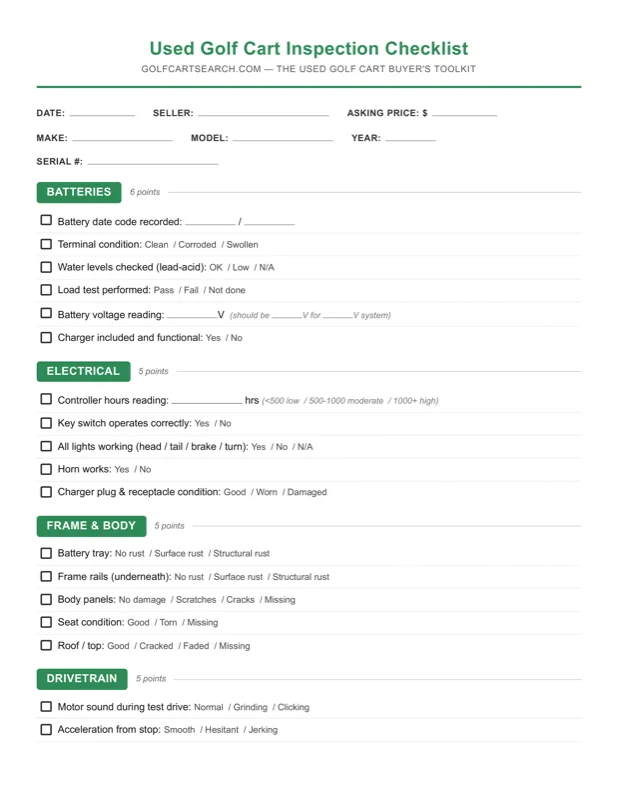
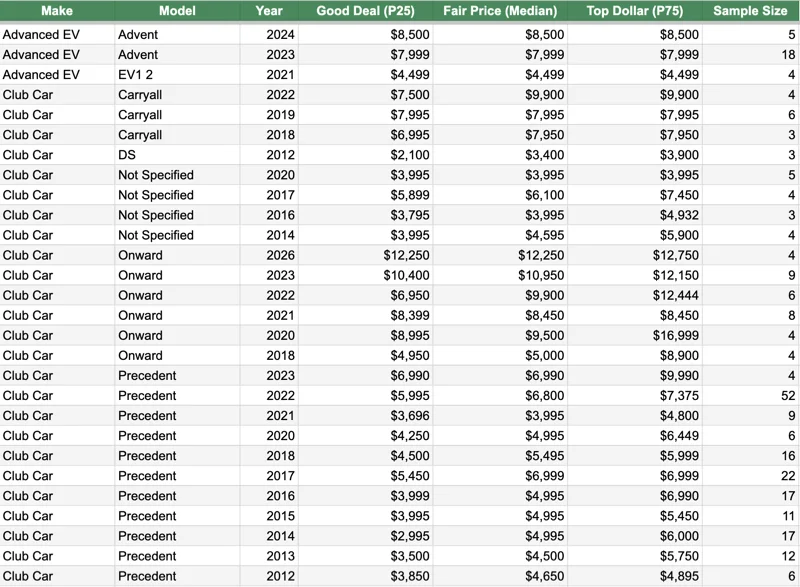
Don't Overpay for a Used Golf Cart

Get pricing data, a printable inspection checklist, and negotiation scripts to help you buy with confidence.

Get the Buyer's Toolkit
Pricing dataInspection checklistNegotiation scripts

Instant download. 30-day guarantee.