As an Amazon Associate, we earn from qualifying purchases. This helps support our site at no extra cost to you.
The practical answer to 48V vs 72V golf cart shopping is simple: buy 48V unless you have a specific reason to pay for 72V. A 48V cart is easier to service, cheaper to repair, common across Club Car, EZGO, Yamaha, ICON, and most modern neighborhood carts, and it has enough speed for normal use.
Choose 72V when the cart works hard: steep hills, six passengers, lifted suspension, big tires, daily resort or rental use, hunting property, long routes, or a serious performance build. Higher voltage can deliver the same power with less current, which means less heat under load. But 72V also narrows your parts choices and turns a simple battery decision into a full drivetrain decision.
This guide breaks down speed, range, cost, safety, conversion mistakes, and real buying examples. If you are still deciding between electric and gas first, start with our electric vs gas golf cart comparison, then come back here for the voltage decision.
Quick Verdict: 48V vs 72V Golf Cart
For most buyers, a 48V lithium golf cart is the best balance of price, range, parts availability, and service support. It will handle flat neighborhoods, golf courses, retirement communities, beach towns, campgrounds, and short errands without making ownership complicated.
A 72V golf cart is a performance or duty-cycle choice. It is the better setup when you need stronger hill climbing, less voltage sag under load, quicker acceleration with passengers, or high-speed tuning. It is not automatically the better cart for a normal subdivision or golf course.
| Buyer situation | Better choice | Why |
|---|---|---|
| Flat neighborhood cruising | 48V | Enough speed, lower cost, easy service |
| Golf course use | 48V | Proven, quiet, widely supported |
| Used cart shopping | 48V | Easier parts and dealer support |
| Street-legal LSV use | 48V or 72V | 48V often reaches the 25 mph cap |
| Steep hills | 72V | Better power delivery under load |
| Lifted cart with big tires | 72V | Less strain on controller and motor |
| Six-passenger family cart | 72V if hilly, 48V if flat | Load and terrain decide |
| Rental fleet or resort | 72V | Better for daily high-use routes |
| Budget lithium conversion | 48V | More kit options and lower cost |
| Performance build | 72V | More speed and torque headroom |
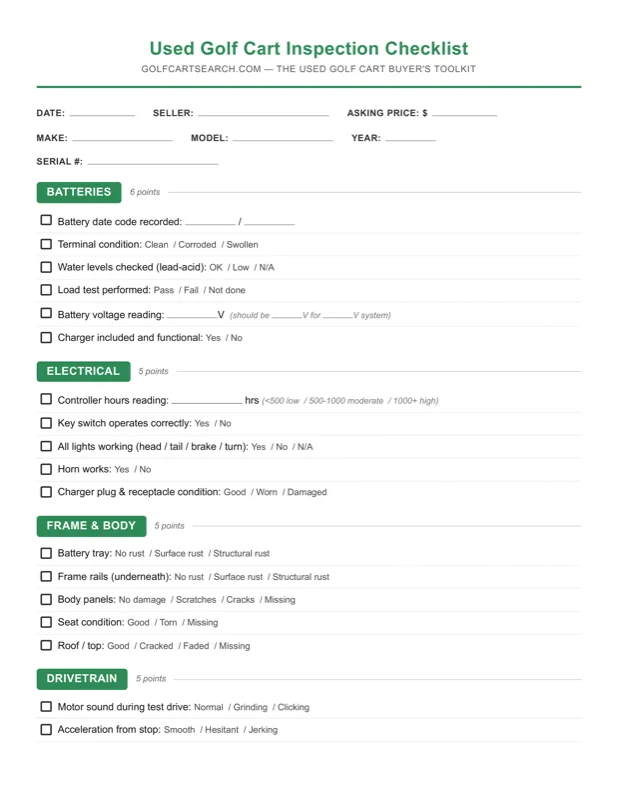
If you are shopping used, do not pay extra for 72V just because it sounds stronger. Pay extra only when the cart has documented parts, clean wiring, a correct charger, a properly rated DC-DC converter, and a local shop willing to work on it.
What Golf Cart Voltage Really Means
Voltage is not range. Voltage is electrical pressure. The basic power formula is:
Watts = volts x amps
That is why voltage matters. A 48V cart pulling 200 amps is delivering about 9,600 watts. A 72V cart delivering the same 9,600 watts needs only about 133 amps. Lower current can mean less heat in cables, controllers, and motor components when everything is correctly matched.
The range formula is different:
Watt-hours = volts x amp-hours
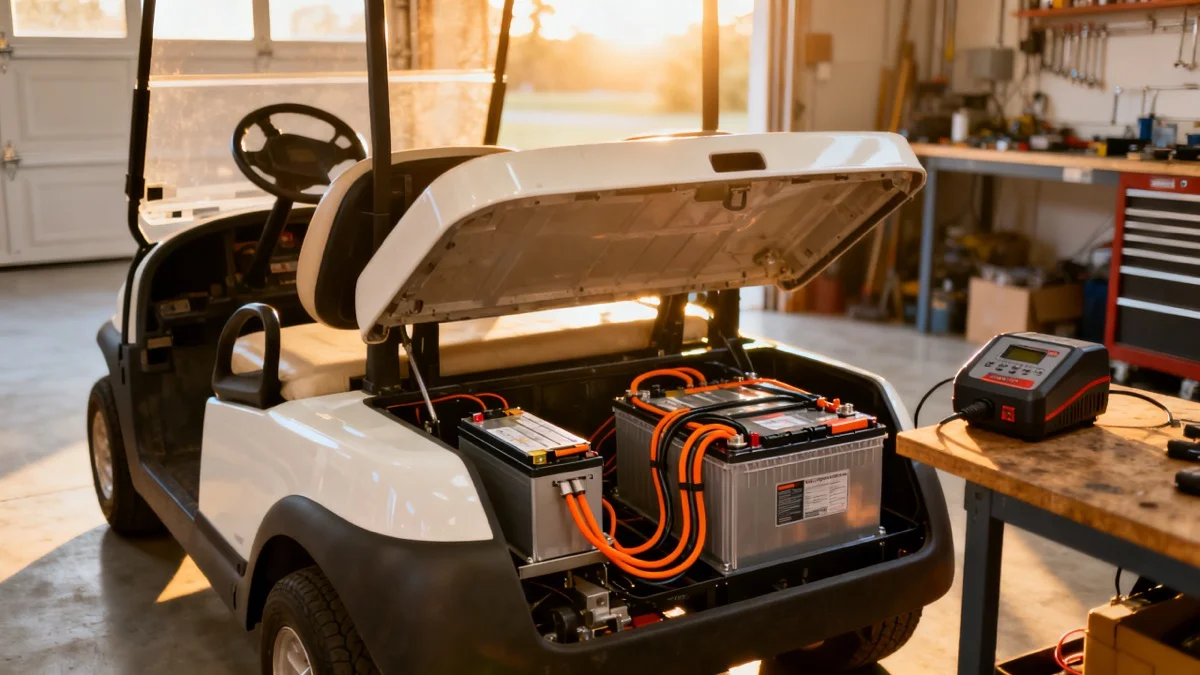
A 51.2V 105Ah lithium battery stores about 5,376 watt-hours, or 5.4 kWh. A 72V 105Ah pack stores much more energy. Trojan's 72V OnePack page lists a 105Ah pack at 7.392 kWh and 141 pounds, which is why a true 72V 105Ah setup can carry more usable energy than a standard 48V 105Ah pack.
That does not mean every 72V cart goes farther. A 72V cart driven faster, loaded heavier, and fitted with all-terrain tires can burn through that extra energy quickly. Range still depends on battery capacity, speed, terrain, tire pressure, passengers, and accessories. Our golf cart range guide covers that math in more detail.
Speed: How Fast 48V and 72V Carts Go
Most stock 48V golf carts run 15 to 20 mph. That includes many traditional carts from Club Car, EZGO, and Yamaha. Many newer lithium neighborhood carts run closer to 20 to 25 mph from the factory.
Most factory 72V carts are tuned for stronger acceleration, hill performance, or street-legal use rather than unlimited speed. Many still run around 20 to 25 mph because low-speed vehicle rules matter. Under federal FMVSS 500 language summarized by NTEA, an LSV is a four-wheeled vehicle with speed capability above 20 mph and not above 25 mph on a paved level surface, with a gross vehicle weight rating under 3,000 pounds.
That 25 mph limit is important. A 72V cart can be built to run faster, but faster is not automatically legal or safe on public roads. Before you chase speed, read our golf cart top speed guide, speed upgrade guide, and street-legal guide.
| Setup | Typical stock speed | Modified potential | Best use |
|---|---|---|---|
| 36V lead-acid | 12-15 mph | 18-20 mph | Flat course or budget use |
| 48V lead-acid | 15-19 mph | 20-24 mph | Standard carts and used buys |
| 48V lithium | 18-25 mph | 25+ mph | Neighborhoods and LSV-style carts |
| 60V lithium | 20-25 mph | 28+ mph | Value carts between 48V and 72V |
| 72V lithium | 20-25 mph | 30+ mph | Hills, loads, performance builds |
If your real goal is a legal 25 mph neighborhood cart, 48V lithium can often do the job. If your real goal is hauling four adults up steep grades without heat soak, 72V starts to make more sense.
Range: Voltage Helps, But kWh Decides
This is the most misunderstood part of the 48V vs 72V golf cart debate. A higher-voltage battery with the same amp-hour rating stores more energy. A higher-voltage cart with a smaller pack may not.
| Battery setup | Approx energy | Realistic range signal | Notes |
|---|---|---|---|
| 36V 200Ah lead-acid | 7.2 kWh nominal | 15-25 miles | Less usable capacity due to lead-acid limits |
| 48V 150Ah lead-acid | 7.2 kWh nominal | 20-35 miles | Common six 8V setup |
| 51.2V 105Ah lithium | 5.4 kWh | 35-55 miles | More usable capacity and less weight |
| 60V 100Ah lithium | 6.0 kWh | 40-50 miles | Used by some online value carts |
| 72V 105Ah lithium | 7.4 kWh | 45-70+ miles | Depends heavily on speed and load |
Lead-acid packs can look strong on paper because the nominal kWh number is high, but you cannot use the whole pack the same way you can use lithium. Lead-acid voltage sags, performance fades as the pack drains, and deep discharges shorten battery life. Lithium holds voltage better and uses more of its rated capacity. Our battery voltage chart shows how resting voltage changes by chemistry and charge state.
If your 48V cart already has weak lead-acid batteries, a good 48V lithium conversion is usually the first move. The DC HOUSE 48V 100Ah LiFePO4 kit is a relevant 48V option because it packages the battery, BMS, charger, display, and app support into one conversion path for many Club Car, EZGO, and Yamaha carts.
Check DC HOUSE 48V 100Ah Lithium Battery PriceCost: Where 72V Gets Expensive
The battery is only one part of the cost. The real cost difference is that 48V parts are everywhere, while 72V parts are more specialized.
| Cost item | 48V path | 72V path |
|---|---|---|
| Replacement lead-acid pack | $900-$1,800 | Less common |
| 48V lithium battery kit | $1,300-$3,000 | Not applicable |
| 72V lithium battery kit | Not applicable | $2,000-$4,500+ |
| Lithium charger | $150-$350 | $250-$600+ |
| Controller upgrade | $500-$1,500 | $700-$2,000+ |
| Solenoid and cables | $100-$400 | $200-$600+ |
| DC-DC converter | $30-$100 | $50-$150 |
| Labor | $200-$700 | $500-$1,500+ |
For a normal owner, a 48V lithium upgrade often costs $1,500 to $3,500 total. A serious 72V conversion can hit $3,000 to $6,000+ once you include the charger, controller, solenoid, accessory converter, wiring, programming, and labor.
That is why the best 72V candidate is usually not a random old cart. It is a cart with a healthy frame, upgraded brakes, good suspension, clean steering, and enough resale value to justify the conversion. If your cart also needs batteries, tires, brakes, suspension, and seats, use our golf cart value guide before pouring money into it.
Who Should Choose a 48V Golf Cart
Choose 48V if you want a golf cart that is easy to own. This is the right answer for most buyers.
Good 48V use cases:
- Golf course driving
- Flat neighborhood loops
- Retirement communities
- Beach towns with short trips
- Campgrounds and RV parks
- Two-passenger and four-passenger carts
- Budget used carts
- Standard lithium conversions
- Buyers who want local shop support
The biggest advantage is parts availability. Chargers, controllers, battery kits, solenoids, speed sensors, voltage reducers, and accessories are easier to find for 48V systems. Local shops are also more familiar with them. If you expect to use a local repair shop, browse our repair directory before you buy a modified 72V cart.
48V also pairs well with common street-legal accessories. Lights, turn signals, horns, USB ports, fans, phone mounts, and stereos all run through a 12V accessory system. Our voltage reducer wiring guide shows how to wire that safely.
If your conversion kit does not include a charger, use a lithium-compatible charger that matches your pack. The FORM 48V lithium charger is a good example for 48V lithium setups, but confirm the charge profile against your battery manual before buying.
Check FORM 48V Lithium Charger PriceWho Should Choose a 72V Golf Cart
Choose 72V when the cart is expected to do more work than a normal golf cart.
Good 72V use cases:
- Steep neighborhood hills
- Mountain communities
- Lifted carts with 22-inch or 23-inch tires
- Four or six adults on regular trips
- Resort shuttle routes
- Rental fleets
- Hunting and off-road builds
- Utility property work
- High-speed private-property builds
The benefit is not only top speed. It is torque stability under load. A 72V setup can deliver power with less current, which can reduce heat when the controller, motor, solenoid, cables, and battery are all designed for it. That matters when a cart is heavy, lifted, fast, or climbing.
The downside is complexity. You should assume a 72V cart needs a properly matched system. Battery, charger, controller, solenoid, motor limits, brake resistor on some regenerative systems, and 12V converter all need to be compatible. If you are not comfortable reading specs and wiring diagrams, pay a specialist.
What About 36V Golf Carts?
Older 36V carts can still make sense when the price is right. Many older EZGO TXT carts and legacy fleet carts run 36V systems. They are simple, cheap, and fine for flat golf course use.
Do not buy 36V if you already know you want a rear seat, larger tires, street-legal equipment, or regular hill driving. By the time you upgrade batteries, controller, cables, charger, and accessories, you may spend more than you would have spent on a clean 48V cart.
If you are trying to identify what you have, count the batteries and check labels:
- Six 6V batteries usually equals 36V.
- Six 8V batteries usually equals 48V.
- Four 12V batteries usually equals 48V.
- One 51.2V lithium battery usually replaces a 48V lead-acid pack.
For a deeper battery replacement path, use our golf cart batteries guide and lithium conversion guide. If the cart you are comparing is older, start with our 36V vs 48V golf cart guide before jumping to 72V.
Converting 48V to 72V: Hidden Parts List
The most expensive 72V mistake is assuming the battery is the upgrade. It is not. The system is the upgrade.
Before converting a 48V cart to 72V, verify these parts:
| Part | Why it matters |
|---|---|
| Battery | Must fit the tray, support your controller current, and include a correct BMS |
| Charger | Must match the battery voltage and chemistry |
| Controller | Must be rated and programmed for 72V |
| Solenoid | Must be rated for pack voltage and current |
| Main cables | Must be sized for current and routed safely |
| Motor | Must tolerate the voltage and RPM target |
| DC-DC converter | Must accept 72V input and output stable 12V |
| Brake system | Must be safe at the new speed and weight |
| Tires and suspension | Must handle speed without wobble or instability |
| Insurance and laws | Must still comply with public-road rules |
If the cart has regenerative braking, be extra careful. Some systems need correct programming or resistor capacity so regen braking does not overcharge or overheat components. This is where a cheap conversion can become unsafe.
If your actual issue is weak acceleration, surging, or poor hill power, diagnose the existing cart before converting. Start with the controller symptoms guide, solenoid symptoms guide, and battery cable replacement guide.
New Cart Examples by Voltage
You do not always need to convert. Sometimes the better move is buying the voltage class that already matches your use.
48V examples: The Kandi GOAT 2P and AODES E-TrailCross show how a 48V lithium cart can be plenty for a value-focused neighborhood or property buyer. Before you buy through a marketplace listing, read the Amazon golf cart guide because the exact product, seller support, paperwork, and repair access matter as much as voltage.
60V middle ground: The current SDLANCH SDLGC80 listing markets a 60V system and up to 45 miles of range, placing its nominal voltage between traditional 48V carts and 72V setups. The listing showed an in-stock offer around $9,800 on August 18, 2026, but it does not state battery capacity, chemistry, motor output, or top speed.
Check SDLANCH SDLGC80 Availability on AmazonPremium 48V lithium examples: The Club Car Onward HP Li-Ion keeps the familiar Club Car ownership ecosystem while adding lithium performance. If resale value and service access matter, premium 48V can be smarter than an unknown 72V build.
For broader shopping, compare our best golf carts, best golf cart brands, and golf carts on Amazon guide. If you want local support, use the dealer directory before buying online.
Legal and Insurance Reality
Voltage does not decide whether a cart is legal on public roads. Equipment, title or registration rules, speed, VIN or serial documentation, insurance, and local law decide that.
A 72V cart that can run 35 mph may still be illegal on local roads. A 48V cart with the right equipment and paperwork may be easier to register as an LSV or neighborhood vehicle. Check your state before buying or modifying. Start with our golf cart laws page, LSV vs golf cart guide, registration guide, and insurance guide.
If you plan to drive around The Villages, Peachtree City, beach towns, or resort communities, also check local city rules. Some communities care less about voltage and more about speed limits, seat belts, lighting, age requirements, and where carts can travel.
Final Decision Checklist
Use this before you buy:
- Choose 48V if your trips are short, your roads are flat, you want easy service, and you care about budget.
- Choose 48V lithium if your current 48V lead-acid cart feels tired but the chassis is worth keeping.
- Choose 72V if hills, load, heat, or duty cycle are the problem.
- Avoid 72V conversions when the cart has unknown wiring, weak brakes, loose steering, old tires, or no local service support.
- Avoid 36V unless the price is low and the use case is light.
- Do not compare voltage alone. Compare total kWh, controller current, motor type, tire size, and weight.
The simplest buying rule: if you cannot clearly explain why you need 72V, buy 48V and spend the savings on lithium, brakes, tires, and maintenance.
FAQ
Is a 72V golf cart better than a 48V golf cart?
A 72V cart is better for hills, heavy loads, commercial use, and performance builds. A 48V cart is better for most normal owners because it is cheaper, easier to service, and powerful enough for flat routes.
How fast does a 48V golf cart go?
Most stock 48V carts run 15 to 20 mph. Many modern lithium carts can reach 20 to 25 mph from the factory, especially street-legal or neighborhood models.
How fast does a 72V golf cart go?
Factory 72V carts often run 20 to 25 mph. Modified 72V carts can exceed 30 mph, but that speed requires better brakes, tires, suspension, steering, and legal awareness.
Does a 72V golf cart have more range than a 48V golf cart?
Only when it has more total energy. A 72V 105Ah pack stores more energy than a 48V 105Ah pack, but a small 72V pack may not beat a larger 48V pack. Compare kWh, not voltage alone.
How much does a 48V to 72V conversion cost?
Plan on $2,500 to $6,000+ for a proper conversion. The bill can include the battery, charger, controller, solenoid, cables, DC converter, programming, brake work, and labor.
Can I use my 48V charger on a 72V battery?
No. The charger must match the battery voltage and chemistry. Using the wrong charger can undercharge, overcharge, damage the BMS, or create a fire risk.
Is 48V enough for a street-legal golf cart?
Usually yes. Many 48V lithium carts can reach the 20 to 25 mph LSV speed range. Street legality depends on equipment, paperwork, state law, local rules, and insurance, not voltage alone.
Should I buy a used 36V golf cart?
Only if it is cheap, clean, and used lightly on flat ground. If you want lithium, rear seats, bigger tires, or neighborhood driving, start with a 48V cart instead.
What is better for a lifted cart, 48V or 72V?
72V is usually better for a lifted cart with larger tires because it handles load and hills with less electrical strain. A mild lift on flat ground can still be fine with 48V lithium.
Does 72V damage a golf cart motor?
It can if the motor is not rated or managed for the voltage and RPM target. A proper 72V setup uses compatible controller programming and keeps heat under control.
What voltage should I choose for a six-passenger golf cart?
Choose 48V lithium for flat communities and short trips. Choose 72V if the cart carries six adults regularly, climbs hills, runs larger tires, or operates in commercial service.
What should I check before buying a used 72V cart?
Check the battery label, charger, controller rating, solenoid rating, DC converter input range, wiring quality, brake condition, tire age, steering play, and whether a local shop will service it.
Golf Cart Search
Find the Best Golf Carts of 2026
Compare top-rated models, read expert reviews, and find the perfect cart for your needs.