
As an Amazon Associate, we earn from qualifying purchases. This helps support our site at no extra cost to you.
The most revealing golf cart dealer red flags usually appear after the sale: a warranty nobody will own, a part nobody can source, a repair nobody can schedule, or a battery nobody can date.
GolfCartSearch analyzed 8,208 stored customer reviews connected to 1,220 golf cart businesses in our directory. The sample was overwhelmingly positive, with 86.4% of reviews carrying five stars. That makes the central finding more useful: a high average rating is common, while the words customers use about warranty, wait times, parts, batteries, and communication are much more diagnostic.
Among the 7,925 reviews with written text, 10.4% were low-rated, meaning one or two stars. But the low-rating share rose to 32.4% for reviews mentioning wait, 30.4% for warranty, 23.1% for parts, and 20.0% for battery. Reviews mentioning price were low-rated only 7.6% of the time.
A cheap quote or high average can distract from the costliest question: what happens when the cart needs help?
8,208 Dealer reviews analyzed
1,220 Shops represented
86.4% Five-star reviews
30.4% Low-rated when warranty was mentioned
8 Golf Cart Dealer Red Flags to Check First
A golf cart dealer deserves extra scrutiny when any of these eight warning signs appears:
- Vague warranty answers: Staff cannot explain who approves claims or who pays labor and transport.
- No parts plan: Nobody can name the source or normal lead time for common model-specific parts.
- Unclear service timing: The shop will not state its current diagnostic wait or who provides updates.
- An incomplete quote: Freight, setup, delivery, accessories, or paperwork appear only after you compare totals.
- Missing battery documentation: The dealer cannot show battery age, make, test results, or remaining coverage.
- Inconsistent communication: Important answers change between the salesperson, manager, and service department.
- Thin review evidence: The rating is high, but recent reviews lack specific sales or repair details.
- Pressure before verification: The dealer wants a deposit before providing the cart identity, paperwork, or test drive.
If a dealer becomes vague when the conversation moves from the vehicle to the support process, slow down. Compare at least three businesses in the golf cart dealer directory, read detailed reviews, and use the questions below before leaving a deposit.
What 8,208 Reviews Reveal About Golf Cart Dealer Red Flags
The following table measures simple, case-insensitive substring matches in the 7,925 reviews containing text. A review can match more than one theme. The low-rated share is the percentage of matching reviews that received one or two stars.
| Review theme | Reviews mentioning theme | Low-rated share | Average rating | Signal |
|---|---|---|---|---|
| Rude | 81 | 92.6% | 1.32 | 75 of 81 were low-rated |
| Refund | 59 | 83.1% | 1.54 | 49 of 59 were low-rated |
| Wait | 250 | 32.4% | 3.70 | 3.1 times the baseline low-rating rate |
| Warranty | 181 | 30.4% | 3.77 | 2.9 times the baseline |
| Parts | 442 | 23.1% | 4.06 | 2.2 times the baseline |
| Battery | 406 | 20.0% | 4.22 | 1.9 times the baseline |
| Repair | 593 | 16.5% | 4.33 | Above the baseline |
| Communication | 262 | 14.9% | 4.40 | Above the baseline |
| Price | 1,178 | 7.6% | 4.67 | Below the baseline |
| Delivery | 528 | 7.0% | 4.71 | Below the baseline |
| Recommend | 2,425 | 4.9% | 4.80 | Strong positive signal |
| Friendly | 953 | 1.9% | 4.89 | Strong positive signal |
| Helpful | 1,026 | 1.6% | 4.91 | Strong positive signal |
| Knowledgeable | 850 | 0.6% | 4.96 | Strongest positive signal |
Source: GolfCartSearch analysis of 7,925 written reviews from 1,220 golf cart businesses, using a directory snapshot analyzed August 26, 2026. Theme matches are not mutually exclusive.
These are associations, not proof that mentioning a word caused a rating. A positive review can mention a warranty because the dealer handled it well. Still, the gap is hard to ignore. Warranty, parts, wait, and battery language appears disproportionately in the low end of the sample.
The positive side is just as useful. Reviews describing staff as knowledgeable, helpful, and friendly were rarely low-rated. Look for detailed examples of those traits, such as a salesperson explaining battery options correctly or a technician resolving a problem, rather than reviews that say only “great place.”
Golf Cart Dealer Reviews: Why Stars Are Not Enough
Across the full directory snapshot, 1,374 businesses account for 102,905 aggregate public review ratings. The deeper text sample contains up to 10 stored reviews per shop, not every review ever written about every business.
Within that text sample, 7,093 of 8,208 reviews were five-star. A dealer with a 4.6 average may be excellent, but the difference between 4.6 and 4.8 does not tell you whether the shop stocks your controller, will transport a disabled cart, or knows how to submit a battery claim.
Use ratings in this order:
- Volume: Ten reviews carry less evidence than hundreds.
- Recency: Recent service experiences matter more than praise for a prior owner or team.
- Specificity: Details about the cart, repair, timing, and resolution are more useful than generic praise.
- Repeated patterns: Three similar accounts deserve more weight than one isolated complaint.
- Dealer answer: Ask about the pattern directly and judge whether the response is clear and verifiable.
Our dealer-market analysis shows that buyers in dealer-rich states have more options. If you are choosing where to shop locally, our best cities to buy a golf cart ranking narrows that same idea to city markets. That advantage matters only if you compare the support behind each quote.
Red Flag 1: The Warranty Answer Changes Depending on Who You Ask
Ask the salesperson to walk through one realistic claim. If the controller fails next month, who diagnoses it, who submits the claim, where does the cart go, and who pays to move it?
Do not settle for “it has a three-year warranty.” Vehicle components, lead-acid batteries, lithium packs, accessories, labor, and transportation can have different terms. The Club Car warranty page says an authorized dealer submits covered repair paperwork on the owner's behalf. E-Z-GO customer care similarly directs owners to authorized E-Z-GO dealers for service. Those processes make the selling dealer's ability and willingness to help part of the product you are buying.
Get these answers in writing:
- warranty administrator and claim phone number
- start date and remaining term
- covered components and battery-specific term
- labor, diagnostic, pickup, and transport charges
- transfer rules for a used cart
- treatment of dealer-installed lifts, seats, lights, stereos, and controllers
- the authorized location that will actually perform the work
Read the full golf cart warranty guide before comparing long coverage headlines.
Red Flag 2: Nobody Can Explain Parts Availability
Parts appeared in 442 written reviews, and 23.1% of those reviews were low-rated. That is more than twice the 10.4% review-text baseline.
Instead of asking only whether the dealer can get parts, choose one likely repair for the exact model. Does the dealer stock brake components, chargers, controllers, switches, body panels, and battery-system parts? If not, what was the typical supplier lead time on the last three orders?
Parts risk is especially important when buying a newer value brand or an uncommon imported model. A compelling touchscreen and low sticker price lose their appeal if a proprietary display, suspension part, or battery-management component sidelines the cart for weeks. Compare the dealer's answer with our best golf cart brands research and the local golf cart repair directory.
Good dealers do not promise that every part is always on a shelf. They explain which parts they stock, which distributor they use, and what happens when an item is backordered.
Red Flag 3: Service Wait Times Have No Owner or Estimate
“Wait” had the highest low-rating share among the larger operational themes: 32.4%. That is roughly 3.1 times the review-text baseline.
Some delay is normal during peak season. The red flag is a process nobody owns. Ask:
- How soon can the shop diagnose a disabled cart today?
- Is there a separate wait for warranty authorization?
- Does the dealer offer pickup, mobile service, or loaner carts?
- Who updates customers when the date changes?
- Is the service department at this location or somewhere else?
A dealer that gives a realistic two-week estimate can be safer than one promising “a few days” without checking the schedule. Search the best golf cart repair shops near your home before buying, even if the new cart includes a factory warranty.
Red Flag 4: The Quote Is Cheap Because It Is Incomplete
Price was the most common commercial theme in the sample, appearing in 1,178 reviews. Yet only 7.6% of price-mentioning reviews were low-rated, below the overall baseline. Transparent, competitive pricing often produces happy customers.
A low price becomes risky when the quote is impossible to compare.
Ask for an itemized out-the-door total that shows:
- cart price and model year
- freight and setup
- battery and charger
- dealer-installed accessories
- delivery
- documentation, title, or registration charges
- sales tax
- financing products and service contracts
- trade-in credit
E-Z-GO's model pages state that configured prices can exclude tax, freight, setup fees, and dealer-added accessories. That is a useful reminder to compare totals, not advertised starting prices. Our golf cart dealer fee guide shows how to normalize quotes line by line.
Red Flag 5: The Dealer Cannot Document the Battery
Battery appeared in 406 reviews, and one in five of those reviews was low-rated. That does not mean every battery mention reflects a bad dealer. It does show why battery documentation deserves its own buying conversation.
For lead-acid carts, record the battery date codes, brand, voltage configuration, water level, corrosion, and test results. For lithium carts, record the pack manufacturer, capacity, installation date, warranty start date, remaining coverage, charger compatibility, and any app or diagnostic report.
A new-looking used cart can still have an old battery pack. A “new battery” claim can mean one replacement battery in an aging lead-acid set. A lithium conversion can be valuable, but only if the installation, charger, battery management system, and support path are clear.
Use our battery voltage chart and test guide and complete golf cart battery guide to verify what the dealer tells you.
Red Flag 6: Communication Is Fast Before the Deposit and Vague After It
Communication appeared in 262 reviews, with a 14.9% low-rating share. That is not as stark as warranty or wait language, but it is still above baseline.
Test the process before buying. Ask a specific question by email or text and look for a specific answer. Request the buyer order, warranty PDF, battery details, and promised delivery date. If the dealer will not document an important promise before payment, assume it will be harder afterward.
Save copies of:
- the listing and advertised equipment
- the serial or VIN photo
- the itemized quote
- every promised repair or accessory
- deposit and refund terms
- estimated completion and delivery dates
- warranty and service documents
For a used purchase, confirm ownership and serial information with the golf cart VIN decoder and our ownership transfer guide.
Red Flag 7: The Reviews Are Glowing but Not Informative
Five-star reviews dominated our sample, so generic praise has limited screening value. “Great people” may be sincere, but it does not tell you whether the reviewer bought a cart, rented one for a weekend, ordered a part, or completed a difficult warranty repair.
Read 10 to 20 recent reviews when the volume allows. Deliberately include one-star, two-star, three-star, and detailed five-star comments. Then separate sales hospitality from operational evidence.
Useful positive reviews describe:
- the exact cart or service performed
- an accurate timeline
- a problem the dealer resolved
- clear battery or warranty advice
- a fair, itemized price
- follow-up after delivery
Useful negative reviews describe dates, work requested, promises made, charges, and the eventual outcome. Treat accusations without details cautiously. Look for patterns, not drama.
Red Flag 8: You Are Pressured to Pay Before You Can Verify the Cart
Walk away from artificial urgency when key facts are still missing. Before final payment, match the buyer order to the actual cart, serial number, battery, charger, seats, tires, accessories, and legal equipment.
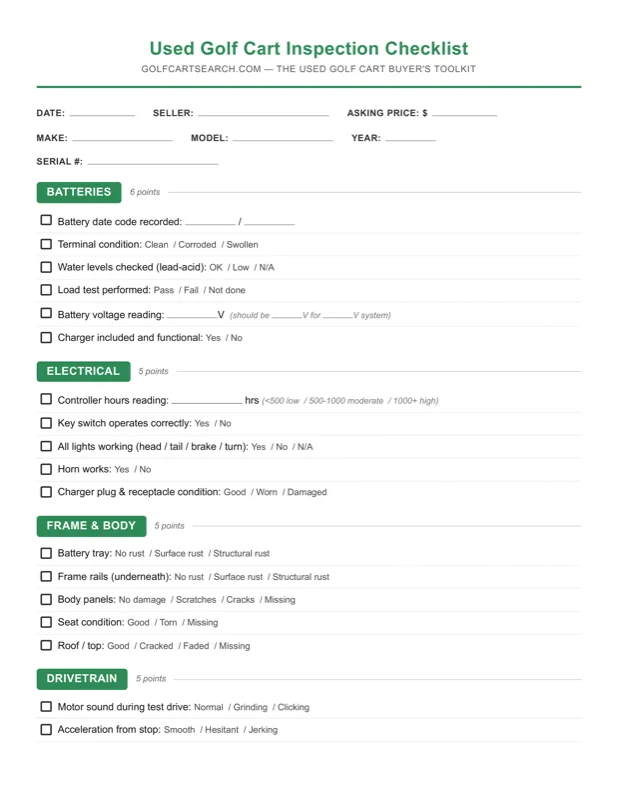
Take a 10 to 15 minute test drive when practical. Check cold acceleration, braking, steering play, suspension noise, hill performance, lights, turn signals, horn, charging, and the range display. If the cart is used, follow the complete used golf cart inspection checklist.
Also confirm whether your intended road use is legal. Equipment promised as “street legal” does not override state or local rules. Start with the golf cart laws directory and compare golf cart insurance requirements before paying for a street package.
How to Choose a Reputable Golf Cart Dealer in 15 Minutes
Use this scorecard during the first serious conversation. Award one point for each clear, verifiable answer.
| Check | One point if the dealer can provide it |
|---|---|
| Cart identity | Model year, serial or VIN, trim, powertrain, and installed equipment |
| Complete price | Itemized out-the-door quote with no unexplained line items |
| Battery proof | Date, make, capacity, test result, and warranty status |
| Warranty path | Written terms plus the location and person handling claims |
| Service capacity | Current diagnostic lead time and pickup options |
| Parts plan | Source and realistic lead times for common model-specific parts |
| Test drive | Enough time to test the cart under normal operating conditions |
| Paper trail | Written deposit, delivery, refund, and promised-work terms |
| Review pattern | Recent detailed reviews without repeated unresolved service issues |
| Legal fit | Accurate answer about title, MSO, registration, and road-use equipment |
Eight to 10 points: Strong process. Continue with the vehicle inspection and price comparison.
Five to seven points: Plausible, but resolve every gap in writing before paying.
Zero to four points: The risk is in the transaction process, even if the cart looks good.
A Small Inspection Kit for the Dealer Visit
You do not need a mechanic's toolbox to verify basic claims. Bring a flashlight, phone camera, paper towels, and three compact tools if you are inspecting a used electric cart. Online prices change, but expect roughly $12 to $20 for the AstroAI meter, $12 to $15 for the hydrometer, and under $15 for a basic low-pressure gauge.
Check the AstroAI Digital Multimeter on AmazonUse a digital multimeter only if you understand safe battery testing and the dealer allows it. Our voltage guide explains what resting voltage can and cannot tell you. For flooded lead-acid batteries, a temperature-compensating hydrometer provides cell-level information that pack voltage can hide.
Check a Golf Cart Battery Hydrometer on Amazon →Tire pressure affects ride quality and can make a short test drive misleading. Many carts use pressures below the range where an automotive gauge is most readable.
Check a Low-Pressure Tire Gauge on Amazon →These tools do not replace a professional inspection. If the cart is expensive, modified, unfamiliar, or sold without meaningful warranty coverage, paying an independent golf cart repair shop for a pre-purchase inspection can be the cheaper decision.
Dealer or Private Seller: Which Is Safer?
A dealer is not automatically safer, and a private seller is not automatically risky. The safer transaction is the one with better evidence.
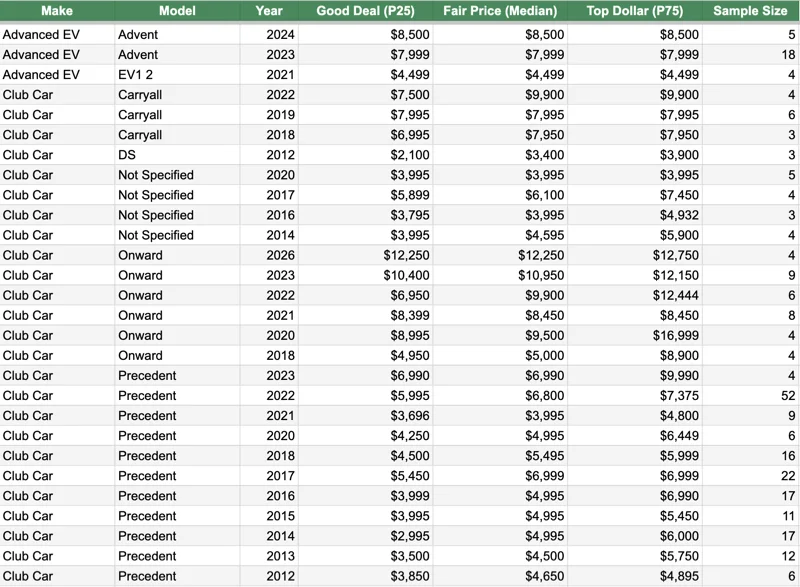
A good dealer can provide reconditioning, financing, delivery, a short warranty, parts access, and a service department. A good private seller may provide years of records, a simpler price, and direct knowledge of the cart. Compare both against current used golf cart prices by brand and understand the trade-off between trade-in value and private-sale value.
Whichever route you choose, verify the exact cart rather than buying the story around it.
Methodology and Limitations
We analyzed a GolfCartSearch directory snapshot on August 26, 2026. It contained 1,374 businesses across sales, repair, and rental categories, with 102,905 aggregate public review ratings shown on the business records.
The text analysis used 8,208 stored review records connected to 1,220 businesses. Of those, 7,925 contained written text. Each business contributed no more than 10 stored reviews, so this is a structured sample of directory reviews, not every review posted online.
We defined low-rated reviews as one or two stars and positive reviews as four or five stars. Theme counts use case-insensitive literal substring matching. Reviews could match multiple themes, and a match does not reveal whether the writer used the term positively or negatively. We read the results as directional signals, not causal proof or a national probability estimate.
Business types also differ. Rental customers, repair customers, and cart buyers may judge different parts of the experience. The strength of the analysis is its consistent comparison across thousands of reviews. Its limitation is that no keyword count can replace reading the actual reviews and checking the specific dealer yourself.
Which Golf Cart Dealer Should You Choose?
Choose a dealer that can identify the exact cart, itemize the full price, document the battery and warranty, and explain where service will happen. If two quotes are close, favor the shop with the clearer parts and repair process.
Our review data points to four questions that deserve disproportionate attention: warranty, wait times, parts, and batteries. Ask about those first. Then verify the price, paperwork, service location, and cart itself.
Use the dealer directory to build a local shortlist, compare each shop with the scorecard above, and keep every important promise in writing.
Frequently Asked Questions
What are the biggest golf cart dealer red flags?
The biggest red flags are vague warranty answers, no written out-the-door quote, uncertain parts support, unexplained repair wait times, missing battery documentation, inconsistent communication, pressure to leave a deposit, and reviews showing repeated service failures.
How can I tell if a golf cart dealer is reputable?
A reputable dealer identifies the exact cart and battery, provides written pricing and warranty terms, explains who performs service, allows a meaningful test drive, documents promised work, and answers specific questions without changing the story.
Should I trust a golf cart dealer with a high star rating?
Use the rating as a starting point, not a verdict. In our sample, 86.4% of reviews were five-star. Detailed comments about warranty, parts, repair delays, batteries, and communication often reveal more than the average alone.
What should I ask about a golf cart warranty?
Ask who backs the warranty, what components and battery are covered, when coverage started, whether it transfers, who approves claims, which shop performs the work, and who pays diagnostics, labor, pickup, and transportation.
Why does parts availability matter when choosing a dealer?
A dealer can sell a cart quickly but leave you waiting if common parts are hard to source. In our sample, reviews mentioning parts were more than twice as likely to be low-rated as the review-text baseline.
How many dealer reviews should I read before buying a golf cart?
Read at least 10 to 20 recent, detailed reviews when available. Include several low-rated reviews, then look for repeated operational problems rather than treating one angry comment as proof that the dealer is bad.
What paperwork should a golf cart dealer provide?
Get an itemized buyer order, serial or VIN details, model year, battery make and age, warranty documents, delivery terms, promised repairs or accessories, title or MSO status when relevant, and a receipt for every deposit.
Is a cheaper golf cart dealer usually riskier?
Not necessarily. Reviews mentioning price were less likely than the overall review-text sample to be low-rated. The bigger risk is a low quote that omits freight, setup, accessories, delivery, paperwork, or future service costs.
Should a golf cart dealer allow a test drive?
Yes, unless there is a clear safety or inventory reason. A serious buyer should be able to test acceleration, braking, steering, hill performance, ride quality, range indications, lights, and accessories before final payment.
How do I verify that a dealer is authorized by a golf cart brand?
Check the manufacturer's dealer locator and ask the shop to identify which location and technicians handle warranty work. Selling a brand, servicing a brand, and being authorized to submit factory claims are not always the same thing.
Are bad golf cart dealer reviews always accurate?
No. Reviews are individual accounts and can omit context. Give more weight to repeated, specific patterns across different customers, especially when the dealer cannot answer direct questions about the same issue.
Is it safer to buy a used golf cart from a dealer or a private seller?
A good dealer may offer inspection, paperwork, short warranty coverage, financing, and service support, but the word dealer is not a guarantee. A knowledgeable private seller can be a better value when the cart, battery, history, and ownership documents check out.
Golf Cart Search
Find the Best Golf Carts of 2026
Compare top-rated models, read expert reviews, and find the perfect cart for your needs.