
As an Amazon Associate, we earn from qualifying purchases. This helps support our site at no extra cost to you.
Golf Cart Dealer Fees & Out-the-Door Cost in 2026
The advertised price is not the real price. If you are shopping for a new golf cart, especially from a dealer or a direct-buy brand, the number that matters is the full out-the-door quote: cart price, freight, prep, paperwork, tax, registration, delivery, and any accessories the dealer is trying to bundle in.
That is where buyers get burned. A cart that looks like a deal at first glance can end up costing $1,000 to $3,000 more once the quote is complete. Your goal is not to win an argument over one line item. Your goal is to know what is normal, what is negotiable, and when the final number stops making sense.
This guide is the quote-analysis companion to our broader golf cart pricing guide and golf cart financing guide. If you are comparing quotes today, start here.
Quick Answer: What Golf Cart Fees Are Normal?
If you just want the fast version, this is the fee map to use when reading a quote.
| Fee Type | Typical Range | Usually Negotiable? | Notes |
|---|---|---|---|
| Freight or logistics | $300-$900 common, sometimes higher | Sometimes | More common on factory-order, online, or specialty carts |
| Dealer prep / PDI / setup | $300-$800 common | Sometimes | Real prep exists, but padding also exists |
| Doc / admin fee | $50-$300 | Rarely by line item | Negotiate the total OTD number instead |
| Delivery | $0-$500 local | Sometimes | Often waived to close deals locally |
| Title / registration / DMV | $40-$175 typical | No | Depends on whether the cart is an LSV or state-registered vehicle |
| Sales tax | State and local rate | No | Usually the largest unavoidable add-on |
| Accessories / protection packages | $200-$2,000+ | Yes | This is where dealers often have the most room |
On a standard local personal cart, a fair non-tax quote usually lands somewhere around $600 to $1,500 above the base selling price before optional accessories. On factory-order, direct-buy, or specialty road-ready carts, higher fee stacks can still be legitimate. The problem is not that fees exist. The problem is when they are vague, duplicated, or used to hide margin.
What Actually Belongs in a Golf Cart OTD Quote?
An out-the-door quote should be simple enough that you can explain it back to someone else in 30 seconds.
- Selling price of the cart
- Freight or logistics
- Dealer prep, PDI, or setup
- Accessories you agreed to buy
- Delivery, if any
- Documentation, title, and registration fees
- Sales tax
That is it. Once a quote starts adding “market adjustment,” vague “dealer services,” mystery protection bundles, or preloaded accessories you did not ask for, slow down.
For context, some dealer pages make these buckets explicit. SCV Carts publicly lists a $695 dealer prep fee. Cart Mart frames quote comparisons around total out-the-door pricing, including PDI, inbound freight, dealer prep, parts prep, white-glove delivery, and title or doc fees. On the online-style side, Matrix EVH discloses models where MSRP excludes separate logistics, freight, and dealer setup charges. That is exactly why headline price alone is not enough.
Which Golf Cart Dealer Fees Are Fair in 2026?
The cleanest way to think about this is by asking whether the dealer is charging for something real and whether the amount is proportionate.
Freight
Freight is real. Golf carts are bulky, often crated, and expensive to move. The fee becomes less convincing when:
- the dealer has large in-stock volume and treats freight like a universal surcharge
- the same dealer advertises “free local delivery” in other contexts
- the freight number is high but the cart is already local and assembled
For a normal in-stock cart at a local dealer, freight should not automatically kill the deal. But if the freight line looks aggressive, push on the total quote. Our best time to buy a golf cart guide explains why slower months often create room here.
Dealer Prep, PDI, or Setup
This fee is often real, but it is also one of the easiest places to hide margin. True prep can include:
- uncrating and assembly
- battery fill, charge, and test
- software or controller setup
- tire pressure and brake checks
- lighting and accessory verification
- paperwork and final detailing
If the dealer prep fee is meaningful, ask what it includes. A dealer who has a real answer is different from a dealer who just repeats “that is our standard fee.”
Doc, Title, and Registration Fees
Some of these are administrative, some are state-driven. Treat them separately.
- Title and registration are usually real if the cart qualifies as an LSV or your local program requires it. See our registration by state guide and titles and registration guide.
- Doc fees are usually less worth fighting one-by-one. Just negotiate the total OTD quote.
- Sales tax is not negotiable, but make sure it is being applied correctly to the actual taxable amount.
If you are buying a road-ready cart, layer in insurance costs too. Those do not show up on the dealer invoice, but they matter to the real ownership math.
Accessories and Protection Packages
This is where buyers should be most skeptical.
Common examples:
- premium wheels and tires
- rear seat kits
- enclosure and windshield packages
- sound bars and screens
- ceramic, paint, or vinyl “protection” upsells
- basic convenience accessories
Factory-integrated options can be worth paying for. But low-dollar convenience gear is often better purchased after the sale. If a dealer is rolling a phone mount, a simple seat cover, or other minor add-ons into a long loan, you are paying interest on convenience items that do not need to be financed.
If you want those kinds of upgrades later, price them separately first. A good example is a simple golf cart phone mount or a seat cover. Those are easy to buy after the fact instead of letting them inflate your financed quote.
What Fees Are Actually Negotiable?
Most buyers focus on the wrong question. They ask whether a specific line can be removed. The better question is whether the total out-the-door number can move.
Usually negotiable, at least indirectly
- freight
- prep or setup
- delivery
- accessories and protection products
- financing markup
- trade-in value
Usually not negotiable
- sales tax
- state title fee
- state registration fee
- mandatory local program fees where applicable
If the dealer insists a fee is “non-negotiable,” that does not mean the quote is non-negotiable. A dealer can hold the line on the fee name and still discount the cart price, waive delivery, cut accessory margin, or improve the trade number.
That is why our financing guide stresses separating purchase price from financing terms. Dealers love turning everything into one monthly payment. Do not let them.
What Is a Fair OTD Adder by Scenario?
These are not legal standards. They are practical buyer benchmarks.
Scenario 1: In-stock local dealer, standard personal cart
This is the cleanest case. For a normal 2-seat or 4-seat personal cart with no huge accessory bundle, a non-tax adder in the rough range of $600 to $1,500 is usually believable.
That can include:
- real prep
- modest freight
- doc handling
- local delivery or small setup items
If you are seeing a much larger spread on a mainstream cart, compare it against a second dealer or a similar Club Car, EZGO, Yamaha, or ICON quote.
Scenario 2: Factory-order, premium LSV, or specialty cart
This is where buyers need more flexibility. Premium carts like the Club Car CRU or upscale LSV-first models like Tomberlin can carry real freight, setup, and paperwork complexity. In those cases, $1,500 to $3,000 before tax may still be real, especially if you are adding road-ready equipment, delivery, or integrated accessories.
The key is itemization. Higher does not automatically mean unfair. Unexplained does.
Scenario 3: Direct-buy or online-first cart
This is where cheap headline pricing fools people most often.
An online-first or direct-buy cart can still be a good move, but you have to add:
- freight
- assembly or PDI
- local service reality
- paperwork path
- return and damage risk
That is why our golf carts on Amazon guide tells buyers to treat online price as a reference, not an automatic win. Sometimes the cheapest online option is still the cheapest after fees. Sometimes it is not.
If you want a direct-buy benchmark, the AODES Trailcross on Amazon is one of the better price-reference examples because it gives you a real full-size cart to compare against dealer-backed value brands. Pair that with our AODES review before you assume the lowest upfront number is the best total deal.
When a Used Cart Beats a New Quote
This is the section many dealers hope you skip.
If a new quote starts with a cart you can afford, then grows with freight, prep, accessories, financing, and registration, compare the final number against the used market before signing. Many buyers end up in a different price tier than they intended.
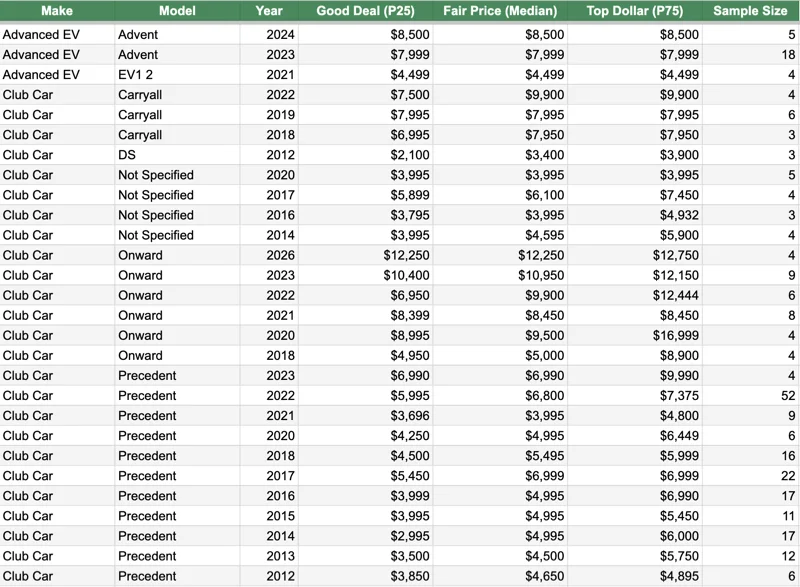
That matters because the used market often gives you access to better brands at the same real spend. A bloated new import or value-brand quote can suddenly sit in the same territory as a cleaner used Club Car, EZGO, or Yamaha.
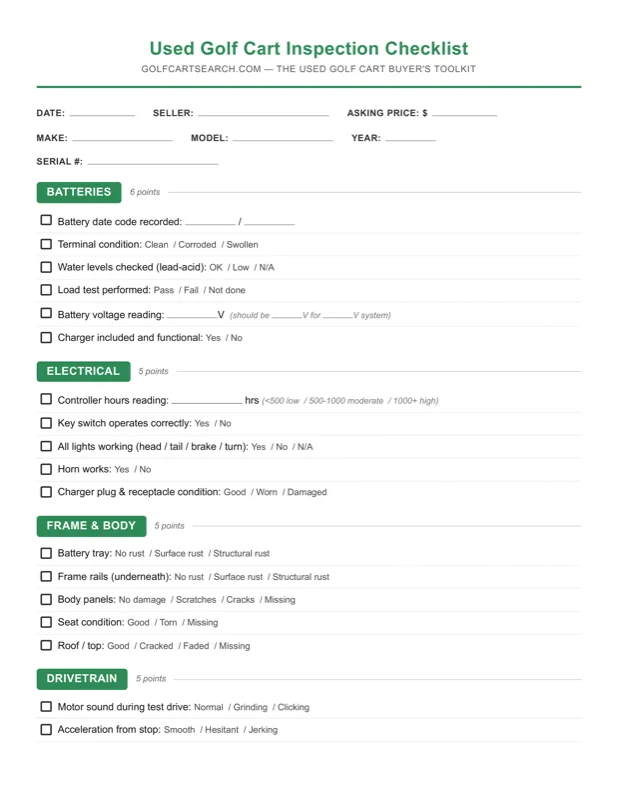
Start with our used golf cart prices by brand guide and used golf cart buying guide before assuming the new quote is still your best move.
How to Compare Two Golf Cart Quotes Correctly
When two dealers are close, use this exact comparison sequence:
- Base cart price: same model, same battery type, same seating, same road-use status.
- Mandatory fees: freight, prep, doc, registration estimate.
- Accessories: remove anything you do not actually need.
- Tax treatment: compare taxable totals, not just subtotal lines.
- Financing: APR, term, total interest, total paid.
- Support reality: local service, parts, dealer reputation, warranty handling.
If one dealer is cheaper by $400 but the stronger dealer is local, responsive, and credible on service, the cheaper deal is not always the better deal. But if the “better dealer” is charging you $1,500 extra in vague fees, that trust premium has gone too far.
For local quote shopping, use the dealer directory to compare nearby stores and the cost calculator to see how the real total changes once fees and financing are included.
6 Questions to Ask Before You Sign
Use these questions exactly, or close to it:
- What is the full out-the-door number today, including every fee?
- Which of these line items are dealer charges versus state charges?
- What does prep or PDI include on this specific cart?
- Which accessories are optional and can be removed right now?
- If I arrange my own financing or delivery, how does the total change?
- If I buy this same month but skip the add-ons, what is your best final number?
That last question matters. Dealers will often defend the fee structure while still moving the real quote.
FAQ
Is a dealer prep fee always a scam?
No. Real prep exists. The question is whether the amount matches the work and whether the dealer can explain what they actually do.
What fee should I push on first?
Do not chase one fee first. Push on the full out-the-door total. That gives the dealer room to move price, freight, delivery, or accessories without wasting time debating labels.
Should I shop dealer quotes in fall and winter?
Usually yes. Slower months often create room on freight, setup, trade value, or accessory discounts. Our best time to buy guide breaks that out month by month.
Are expensive accessory bundles ever worth it?
Sometimes, but mostly when the items are factory-integrated and genuinely useful. Simple convenience accessories usually are not worth rolling into financing.
Does road-legal paperwork change the quote much?
It can. Once a cart crosses into street-legal or LSV territory, title, registration, insurance, and equipment compliance become more relevant to the real number.
What is the biggest dealer pricing mistake buyers make?
Looking only at sticker price or monthly payment. Both hide the real deal.
Final Take
Golf cart dealer fees are not the enemy. Hidden margin is. A real quote should be itemized, understandable, and defensible. A bad quote relies on confusion, financing smoke, and accessories you never intended to buy.
If you remember one rule, make it this: negotiate the total out-the-door number, not the label on a single fee. Then compare that real number against used alternatives, direct-buy options, and at least one competing local dealer before you sign.
Golf Cart Search
Find the Best Golf Carts of 2026
Compare top-rated models, read expert reviews, and find the perfect cart for your needs.