
Best Golf Cart Mirrors: Side & Rear View Buyer's Guide (2026)
Best golf cart mirrors for EZGO, Club Car & Yamaha. Compare rear view, side, and 5-panel mirrors with prices, installation tips, and top picks for 2026.
Best golf cart LED light kits for headlights, underglow, and light bars. Prices, installation tips, and top picks for Club Car, EZGO & Yamaha.

As an Amazon Associate, we earn from qualifying purchases. This helps support our site at no extra cost to you.
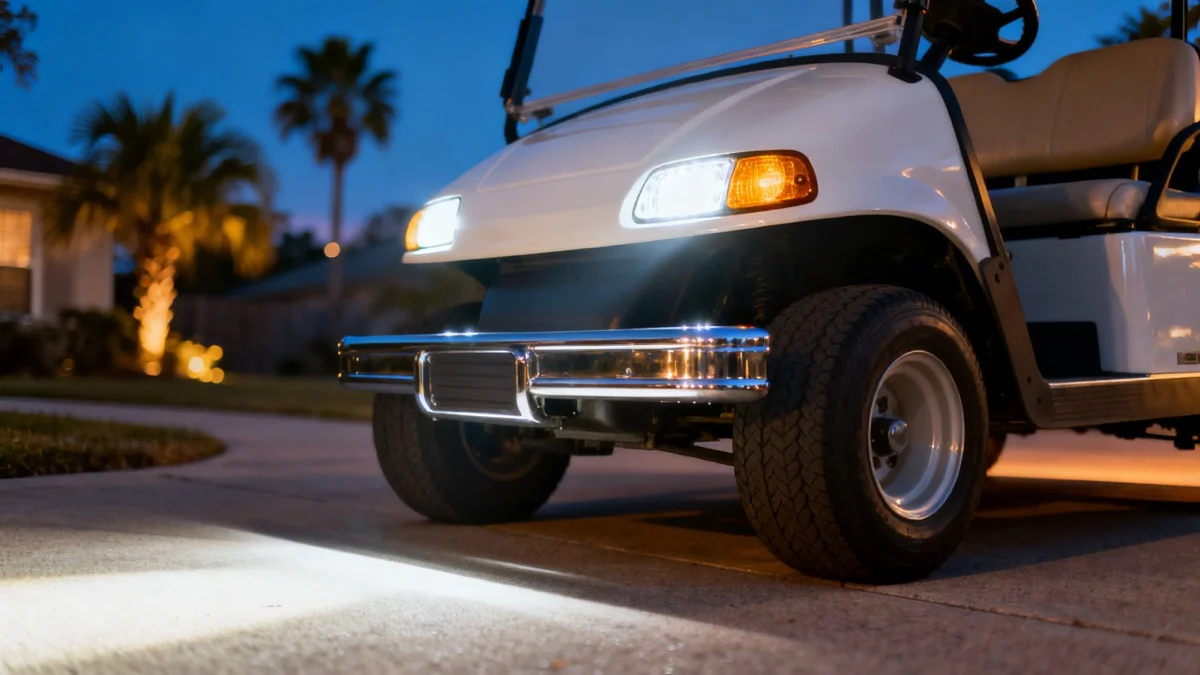
Adding LED lights to your golf cart is one of the most practical upgrades you can make. Whether you need headlights and taillights to meet street-legal requirements, underglow for a custom look, or a light bar for nighttime trail riding, the right lighting setup changes how you use your cart after dark.
This guide covers every type of golf cart LED light, the best kits for Club Car, EZGO, and Yamaha, real pricing, installation basics, and the legal requirements you need to know. We tested and researched dozens of products to bring you clear recommendations at every price point.
Before shopping for lights, it helps to understand what is available. Golf cart LED lights fall into several categories, and each serves a different purpose.
Headlights are the most common upgrade. LED headlights provide bright, white forward-facing light for driving after sunset. They mount in the front cowl or bumper area and are required for street-legal operation in every state. Budget kits start around $30, while premium units with 2,500+ lumens run $80-$150.
Taillights and Brake Lights mount on the rear of the cart. Basic taillights stay on whenever the headlights are on, while brake lights illuminate when you press the brake pedal. Most complete light kits bundle headlights and taillights together. Standalone tail light sets cost $25-$60.
Turn Signals are required for street-legal golf carts in most states. Turn signal kits include a column-mounted lever, a flasher relay, and the signal lights themselves. They often come bundled with a horn and hazard switch. Standalone turn signal kits run $25-$45.
LED Light Bars mount on the roof or front bumper and provide powerful flood or spot lighting. They are popular for off-road use, hunting, and nighttime visibility on trails. Light bars work well alongside lift kits on off-road builds. Expect to pay $25-$200 depending on size and output.
Underglow and Accent Lights are flexible LED strips that mount under the body, along the roof canopy, or inside the footwell. They come in multicolor RGB options with remote controls, music sync modes, and app control. Underglow kits range from $50-$135 and are purely for aesthetics. Check your state's laws before installing colored accent lights.
LED Strip Lights are versatile adhesive-backed strips you can mount almost anywhere: under the dash, along the roof edge, inside cup holder areas, or behind seats. Individual strips cost $10-$30 and are easy to cut to length.
If your golf cart has older halogen lights, switching to LED is one of the best modifications you can make. Here is how the two technologies compare:
| Feature | LED | Halogen |
|---|---|---|
| Brightness | 1,000 - 2,500+ lumens | 700 - 1,200 lumens |
| Power Draw | 2 - 10 watts | 50 - 110 watts |
| Lifespan | 30,000 - 50,000 hours | 1,000 - 2,000 hours |
| Color Temperature | 6,000K (bright white) | 3,200K (warm yellow) |
| Startup Time | Instant on | 1-2 second warm-up |
| Vibration Resistance | Excellent (no filament) | Poor (filament can break) |
| Heat Output | Minimal | Significant |
| Cost per Bulb | $15 - $40 | $5 - $15 |
| Annual Replacement | None needed | 1-2 times per year |
The math is straightforward. LED headlights draw roughly 80% less power, which matters for electric golf carts where every watt affects your driving range. A halogen headlight setup drawing 110 watts cuts into your battery capacity noticeably during evening rides. The same LED setup drawing 6 watts has almost zero impact.
LED lights also handle the vibration of cart paths and rough terrain far better than halogen bulbs. Halogen filaments are fragile and prone to breaking on bumpy rides, especially on lifted carts used off-road. LEDs have no filament to break.
If you drive your golf cart on public roads, proper lighting is not optional. Every state that allows golf carts on streets requires specific lighting equipment. Here is what most states mandate:
Required for street-legal operation:
Also commonly required:
Requirements vary by state, so check the specific rules where you drive:
Or browse all state golf cart laws to find your state.
If you are making your cart street legal, you will also need golf cart insurance and should understand license requirements in your state.
After researching dozens of products and cross-referencing independent reviews, forum comparisons, and customer ratings, here are the top picks in each category.
The PROFX Deluxe LED Light Kit is the top-rated street-legal kit for EZGO TXT and T48 models (2014 and newer). It delivers 1,200-lumen LED headlights with low and high beam, LED taillights, turn signals with hazard flashers, a horn, and a brake pad switch. The entire setup draws just 2.8 watts, which is the lowest power consumption of any kit we found.
The plug-and-play wiring harness means no cutting or splicing. Installation takes about 2 hours, and the injection-molded housings look factory-installed. It includes an in-line fuse for protection.
Price: Around $128 Fits: EZGO TXT/T48 (2014+), gas and electric
Check Price on AmazonThe 10L0L Deluxe Light Kit for Club Car Precedent won first place in an independent head-to-head comparison on the Cartaholics forum. The IP68 waterproof headlights produce up to 2,500 lumens, and the kit includes everything for street-legal compliance: LED headlights with bumper, two tail lamps, horn, turn signal lever, steering column cover, brake pad, control box, and a 9-pin plug wiring harness.
10L0L is the most recognized brand in the golf cart parts space on Amazon, and this kit reflects their quality. Expect 2-3 hours for installation. Cutting templates and mounting hardware are included.
Price: Around $160-$240 Fits: Club Car Precedent (2004+), gas and electric
Check Price on AmazonIf you want street-legal compliance without spending $150+, the Shu-Ran Deluxe LED Kit delivers headlights, taillights, turn signals, hazard lights, horn, and brake lights starting around $30-$100 depending on your cart model. It requires 12V input, so you will need a voltage reducer on electric carts.
Shu-Ran offers kits for nearly every golf cart model: Club Car DS, EZGO TXT, EZGO RXV, and Yamaha G14-G29. Build quality is a step below the PROFX and 10L0L options, but for the price, it is hard to beat as a basic compliance kit.
Price: $30-$100 Fits: Club Car DS, EZGO TXT, EZGO RXV, Yamaha G14-G29
Check Price on AmazonFor extra forward lighting on nighttime rides or off-road trails, the Lightboss 7-Inch Slim LED Light Bar packs 60 watts and 6,000 lumens into a compact package. The 12V-60V wide voltage input means it works directly on any golf cart system without a voltage reducer.
The flood/spot combo beam pattern covers a wide area while still throwing distance. IP67 waterproof rating handles rain and trail splash. Universal mount hardware fits any roof rack or front bumper.
Price: Around $25-$40 Fits: Universal (any golf cart with a mounting point)
Check Price on AmazonLEDGlow has been the go-to brand for golf cart underglow since 2002, and their Million Color kit remains the benchmark. Four flexible tubes (two 28-inch and two 18-inch) with 84 SMD LEDs provide 10 solid colors plus strobe, fade, flashing, and sound-activation modes.
What sets LEDGlow apart is the 12-port expandable junction box. Start with underbody lights, then add canopy lights, interior lights, or wheel well lights later without rewiring anything. They also include two wireless remotes and offer free lifetime tech support, which no other brand matches.
Available in a 12V version for gas carts and a 12V-72V version with a built-in voltage reducer for electric carts.
Price: Around $110-$135 Fits: Universal (EZGO, Club Car, Yamaha, ICON, Star EV, 4-seater carts)
Check Price on AmazonThe 10L0L 6-Piece Underglow Kit stands out because it includes canopy (roof) lights along with the standard underbody strips. Most underglow kits only cover the undercarriage, so the canopy coverage is a bonus. The 12V-80V control box works on any golf cart without a separate voltage reducer.
You get 24 lighting modes: 7 solid colors, 7 color fades, 6 flowing patterns, 3 flash/strobe modes, and 1 music sync mode. Wireless remote included.
Price: Around $50-$70 Fits: Universal (any electric or gas golf cart)
Check Price on AmazonAlready have basic headlights and taillights but need turn signals for street-legal compliance? The 10L0L Universal Turn Signal Kit adds a column-mounted turn signal lever, horn button, hazard switch, controller, brake pad, and column cover. It uses a universal 9-pin plug that connects to most existing light kit wiring harnesses.
This is the smart buy if you already installed a basic headlight/taillight kit and realized later that your state requires turn signals. Much cheaper than replacing your entire light kit.
Price: Around $25-$45 Fits: Universal (EZGO, Club Car, Yamaha with 9-pin harness)
Check Price on AmazonHere is what to budget for different lighting levels. Prices include the light kit, any required hardware, and tools you might need.
| Lighting Level | Components | Estimated Cost |
|---|---|---|
| Basic Headlights Only | LED headlight kit + voltage reducer (electric carts) | $50 - $120 |
| Street-Legal Package | Complete kit (headlights, taillights, turn signals, horn, brake lights) | $100 - $250 |
| Street-Legal + Underglow | Street-legal kit + underglow accent kit | $180 - $400 |
| Full Custom Lighting | Street-legal kit + underglow + light bar + interior strips | $250 - $550 |
| Professional Installation | Labor only (parts not included) | $75 - $200 |
For context on overall ownership costs, check our golf cart pricing guide.
Most LED light kits are designed for DIY installation with basic hand tools. Here is what to expect.
This is the most important distinction. Gas golf carts have a 12V electrical system (similar to a car), so LED lights wire directly to the battery. No additional hardware needed.
Electric golf carts run on 36V or 48V battery systems. LED lights require 12V, so you need a voltage reducer between the battery bank and the light kit. A voltage reducer taps into your battery pack and steps the voltage down to a safe 12V output.
Some newer kits (like the Lightboss light bar and 10L0L underglow kit mentioned above) include built-in voltage converters that accept the full 12V-72V range. These eliminate the need for a separate reducer.
Step 1: Disconnect the battery. Safety first. On electric carts, disconnect the main positive terminal. On gas carts, disconnect the 12V battery.
Step 2: Mount the lights. Use the included templates and hardware to mount headlights in the front cowl and taillights on the rear body. Most kits require drilling 2-4 holes.
Step 3: Install the voltage reducer (electric carts only). Mount the reducer in a dry, accessible location. Connect the input wires to the appropriate batteries in your pack. Connect the output wires to the light kit wiring harness.
Step 4: Run the wiring harness. Route wires along existing wire paths, tucking them behind body panels and under the seat. Use zip ties every 12-18 inches to secure the wiring.
Step 5: Connect the light kit. Plug the harness into each light assembly. If your kit uses a 9-pin connector, it is truly plug-and-play. If not, match wire colors and use crimp connectors.
Step 6: Install the switch and turn signal lever. Mount the headlight switch within easy reach of the driver. If your kit includes a column-mounted turn signal lever, attach it to the steering column using the included cover.
Step 7: Reconnect the battery and test. Turn on headlights (low and high beam), taillights, turn signals, brake lights, and horn. Check that all functions work before driving.
For complex electrical work or if you are not comfortable with wiring, find a golf cart repair shop near you or check our best repair services by state.
Underglow lights are legal in most states, but there are restrictions worth knowing before you install them.
Generally allowed:
Generally restricted or prohibited:
The safest approach: use white or amber for road driving, and save the multicolor modes for when you are parked at events or driving on private property. Most underglow kits let you lock in a single color, which is the practical setting for street use.
Check your state's golf cart laws for specific lighting regulations. States like Florida and Texas have detailed rules about auxiliary lighting.
Lights stop working for a handful of predictable reasons. Here is how to diagnose and fix the most common issues, or reference our full golf cart troubleshooting guide for more detail.
Check the fuse first. Most light kits include an inline fuse in the wiring harness. A blown fuse is the single most common cause of total lighting failure. Replace it with the same amperage rating.
Test the voltage reducer. Use a multimeter to check the output side of your voltage reducer. You should see 11.5V-13V. If the output is zero or very low, the reducer has failed and needs replacement.
Inspect battery terminals. Corroded or loose battery terminals can cut power to the entire lighting circuit. Clean terminals with a wire brush and tighten connections.
Check ground connections. A poor ground wire connection is the most common cause of dim or flickering lights. Make sure the ground wire has clean, tight metal-to-metal contact with the cart's frame.
Verify wire gauge. If someone used wire that is too thin for the circuit, voltage drop over long runs can cause dimming. Most light kits use 18-gauge wire, which is adequate for LED loads. If you extended the wiring, match the original gauge.
Test battery voltage. Low battery charge can cause dim lights, especially on systems without a voltage reducer. Charge your batteries fully and retest.
Swap the LED module. If a single headlight or taillight is dead, swap it with the working one on the opposite side. If the problem follows the module, the LED is bad and needs replacement. If the problem stays on the same side, the issue is in the wiring to that socket.
Check the connector. Unplug and replug the connector for the dead light. Look for bent pins, corrosion, or moisture inside the connector.
One of the biggest advantages of LED over halogen is the minimal impact on your golf cart's range.
A typical halogen headlight setup draws 50-110 watts. On a 48V cart with 150Ah batteries (7,200 watt-hours total), running halogen headlights for 4 hours consumes 200-440 watt-hours, which is 3-6% of your total battery capacity.
The same LED headlight setup draws 2-10 watts. Four hours of LED headlights uses 8-40 watt-hours, which is less than 0.5% of total battery capacity. The difference is negligible for all practical purposes.
Underglow lights add another 10-30 watts depending on the kit and mode. Even with headlights and underglow running together, the total LED power draw stays under 40 watts, which is still less than a single halogen headlight bulb.
Bottom line: LED lights will not meaningfully reduce your driving range. If you are concerned about battery performance, upgrading to a lithium battery will have a far bigger impact than any lighting choice.
Club Car carts are divided into three main platforms for lighting compatibility:
EZGO has two primary platforms:
Yamaha golf carts span several generations:
Brands like ICON, Star EV, Evolution, Advanced EV, and Denago are growing fast but have limited aftermarket light kit availability. Most come with factory LED lighting in their standard trim. If you need to add or upgrade lights on these newer carts, universal underglow kits and light bars work well since they mount independently of the cart's body style.
Check our best golf cart brands comparison or browse all brands and models for more details.
Not every golf cart owner needs the same lighting setup. Here is a quick guide based on how you use your cart:
Neighborhood and community driving: A complete street-legal kit is the priority. Headlights, taillights, turn signals, and brake lights keep you legal and visible. Check if your golf cart community has specific lighting rules. Budget $100-$250.
Golf course use only: Basic headlights and taillights are enough for early morning and late afternoon rounds. You do not need turn signals or brake lights for course-only use. Budget $30-$80.
Off-road and hunting: A roof-mounted light bar provides the best visibility on trails and unlit terrain. Pair it with standard headlights for a complete setup. Check our best golf carts list for models built for off-road use. Budget $60-$150.
Custom show builds: Underglow, interior LED strips, canopy lights, and color-matched accent lighting. The LEDGlow expandable system is ideal for builds where you want to add lighting over time. Review our customization guide for more mod ideas. Budget $100-$300+ for lighting alone.
Used cart upgrades: If you bought a used cart without lights, a complete street-legal kit is the best first purchase. It adds both safety and resale value. Use our golf cart value calculator to see how upgrades affect your cart's worth.
Most base-model golf carts built for course use do not include lights. Street-legal models (LSVs) from Club Car, EZGO, and Yamaha usually include factory headlights and taillights, but turn signals and brake lights are sometimes optional. Always check the trim level before assuming your new cart has full lighting.
Most golf cart repair shops charge $75-$200 for light kit installation, depending on the complexity. A basic headlight/taillight install runs on the lower end, while a full street-legal kit with turn signals and a horn takes longer. Find a repair shop near you for a quote.
Yes. Complete light kits include the entire wiring harness from scratch. You do not need any pre-existing wiring. You will need a voltage reducer (for electric carts) and basic tools for drilling mounting holes and running wires.
Yes. Several newer products accept wide voltage input (12V-72V or 12V-80V) with built-in converters. The Lightboss light bar (12V-60V) and the 10L0L underglow kit (12V-80V) both work without a separate voltage reducer. Complete headlight kits still typically require one, though this is changing as manufacturers adopt wide-input designs.
Adding lights generally does not increase golf cart insurance costs. In fact, making your cart street legal with proper lighting may be required for some insurance policies. Contact your insurer to confirm coverage, especially if you are adding lights to drive on public roads.
Both 36V and 48V electric carts need a voltage reducer to power 12V light kits. The reducer connects to the battery bank's full voltage on the input side and outputs 12V on the other. The wiring process is identical for both voltages. The only difference is selecting a voltage reducer rated for your specific system (36V-to-12V or 48V-to-12V). Many reducers accept both ranges.
If you need help understanding your cart's electrical system, our guide on golf cart motor power draw explains how the electrical load works.
Golf Cart Search
Compare top-rated models, read expert reviews, and find the perfect cart for your needs.
Browse Top-Rated Carts
Best golf cart mirrors for EZGO, Club Car & Yamaha. Compare rear view, side, and 5-panel mirrors with prices, installation tips, and top picks for 2026.

Best golf cart lift kits for EZGO, Club Car, and Yamaha. Compare spindle, A-arm, and drop axle types with pricing, installation tips, and top picks.

Compare acrylic, polycarbonate, and impact-modified golf cart windshields. Covers fold-down vs fixed, tinted vs clear, brand compatibility, and top picks.
Get the latest updates on golf cart services, tips, and exclusive offers delivered to your inbox.