As an Amazon Associate, we earn from qualifying purchases. This helps support our site at no extra cost to you.
Most standard golf carts do not have titles. For private-property use, golf-course use, and most ordinary cart ownership, the normal proof of ownership is a bill of sale plus the serial number, not a state title.
A title usually becomes relevant once the vehicle is being treated as a road-going LSV or NEV. That is when you start seeing a 17-digit VIN, MCO/MSO paperwork, DMV registration, and in many states an actual title or title-application path.
That distinction is what trips buyers up. One seller says the cart does not need a title. Another says it comes with an MCO. Your DMV asks for a VIN. Your insurer wants proof of ownership. Those are related questions, but they are not the same document.
This guide answers the title-and-paperwork side of the problem first: when no title is normal, when a title becomes relevant, how to buy an untitled cart safely, and which documents matter most. If you need the actual state-by-state registration rules, use our golf cart registration by state guide. If you want the fee side of the question, including Arizona and California cost examples and when a golf cart title is issued, use our golf cart registration cost by state guide. If you already know you are in transfer mode, use our how to transfer golf cart ownership guide.
Do Golf Carts Come With Titles? Quick Answer
Most regular golf carts do not come with titles. If the cart is a standard private-property or golf-course cart, expect a bill of sale, receipt, and serial number. If the cart is a factory LSV/NEV or has been converted and inspected for road use, expect a VIN, MCO/MSO or title path, registration, and insurance.
| Buyer question | Short answer |
|---|---|
| Do golf carts have titles? | Usually no for standard carts |
| Does a golf cart have a title? | Only if it was titled as an LSV/NEV or road vehicle |
| Do golf carts come with titles? | Standard carts usually do not; road-ready carts may have MCO/MSO |
| Is a title issued for a golf cart? | Usually only through an LSV/NEV title path |
| Do you need a title for a golf cart? | Not for many private-property carts; often yes for road registration |
| Can you buy without a title? | Yes, if the ownership trail and serial number check out |
| What should you get instead? | Detailed bill of sale, serial number, receipt, and any prior paperwork |
| Biggest red flag | Seller says a titled/registered cart has a lost title |
Most standard carts Bill of sale, not title
Road-ready LSVs VIN plus title path
Key dealer document MCO or MSO
Biggest buying risk Missing ownership trail
Golf Cart vs Low-Speed Vehicle: The Title Difference
The single biggest factor is vehicle classification.
For most standard golf carts, the normal paperwork bundle is:
- a bill of sale
- the serial number
- any old receipt, invoice, or prior bill of sale the seller can produce
For a road-ready LSV or NEV, the paperwork gets much heavier:
- a 17-digit VIN
- a bill of sale
- an MCO/MSO if it has not been titled yet
- or an actual title if it already went through DMV
- insurance and registration paperwork once plated
The most useful mental model is this:
- ownership proof is not always the same as a title
- manufacturer paperwork is not always the same as a state title
- road-use paperwork is much stricter than private-property paperwork
If you already know you want a road-ready cart, our best street legal golf carts guide is the best companion to this page.
Golf Cart Title vs Bill of Sale vs MCO/MSO
These terms get mixed together constantly. Keep them separate.
Title
A title is the state-issued ownership document for a road-going vehicle. If your cart already went through DMV as an LSV or NEV, it may have a title just like a car or motorcycle.
For ordinary golf carts that stay on private property, there often is no title at all.
Bill of Sale
A bill of sale is the most common ownership document in golf-cart transactions. It is the paper trail showing who sold the cart, who bought it, when the sale happened, how much changed hands, and which specific cart was involved.
For many standard golf carts, this is the most important document in the file.
MCO or MSO
An MCO or MSO is the manufacturer's origin document. Different dealers and states use different names:
- MCO = Manufacturer's Certificate of Origin
- MSO = Manufacturer's Statement of Origin
They serve the same core purpose. This is the factory-origin document used to create the first title. A new dealer-sold road-ready cart may come with an MCO or MSO instead of an existing title because nobody has titled it yet.
That is why buyers should not panic if a new cart does not already have a title in the seller's hand. What matters is whether the dealer has the proper origin paperwork and whether your state recognizes that path. Our registration-by-state guide covers the state side.
Do Standard Golf Carts Usually Have Titles?
Usually, no.
Standard golf carts used on private property, golf courses, campgrounds, farms, resorts, or inside some gated communities usually operate more like off-road equipment than road vehicles. In that world, ownership is normally proven with:
- a receipt
- a bill of sale
- the serial number plate
- sometimes an old dealer invoice
That is also why it is normal to buy a used golf cart without a title. The lack of a title is not automatically suspicious. What matters is whether the seller can show a believable ownership trail and whether the cart's serial number is intact.
If you need help finding that plate, use our free golf cart VIN decoder or the longer serial number and VIN decoder guide.
When Does a Golf Cart Need a Title?
This is where the answer changes.
Under the federal low-speed-vehicle standard, a low-speed vehicle is designed to travel at more than 20 mph but not more than 25 mph and is regulated as a motor vehicle class with specific safety requirements. That is the threshold where title, registration, VIN, and insurance questions start getting real. This comes from the federal standard at 49 CFR 571.500.
In practice, a golf cart usually needs title-path paperwork once it is being treated as a public-road LSV or NEV, whether factory-built that way or converted and inspected into that category.
That is why these carts often come with or require:
- a 17-digit VIN
- road-use equipment
- insurance
- registration paperwork
- an MCO/MSO or an actual title
If your cart is staying under 20 mph and never entering that public-road vehicle lane, title questions usually stay much simpler.
Serial Number vs VIN
This distinction matters because sellers and buyers use the wrong word all the time.
Serial Number
A serial number is the manufacturer identifier for an ordinary golf cart. Every major brand uses its own format. It is what you use for:
- confirming year and model
- ordering parts
- checking old receipts
- proving basic ownership
VIN
A VIN is a standardized 17-character vehicle identification number. NHTSA's VIN system is built around that 17-character format, and you can decode a valid VIN at the official NHTSA decoder.
That is why the VIN question is so useful:
- a normal golf cart usually has a serial number
- a road-going LSV or NEV usually has a VIN
If a seller claims a cart is fully street legal but cannot show either a VIN plate or a clean path to one, treat that as a warning sign.
What Should Be on a Golf Cart Bill of Sale?
Even when a title does not exist, the bill of sale should be detailed enough to stand up later if there is a dispute.
Include:
- seller full name and address
- buyer full name and address
- make and model
- year, if known
- serial number or VIN
- sale price
- sale date
- accessories included in the sale
- known condition issues or modifications
- signatures from both buyer and seller
The key is not making it fancy. The key is making it specific. A one-line note that says "sold golf cart for $4,000" is weak. A proper bill of sale that ties the sale to one exact serial number is much stronger. If you need a starting point, use our free golf cart bill of sale form.
If the cart is being sold for road use, also capture:
- MCO/MSO number, if available
- title number, if available
- odometer reading, if the vehicle has one
- plate number, if the cart was already registered
How to Buy a Golf Cart Without a Title Safely
Buying without a title is normal. Buying without any believable paper trail is not.
Use this checklist:
1. Verify the seller actually owns it
Ask for:
- old bill of sale
- original dealer invoice
- maintenance receipts
- community permit paperwork
- any registration records if it was ever plated
One document alone is not magic. You are looking for a story that hangs together.
2. Confirm the serial number plate is present
If the serial number plate is missing, ask why. A missing plate does not prove theft, but it does increase the burden on the seller to explain the ownership trail. Our golf cart VIN decoder and serial and VIN guide show where to look by brand.
3. Match the paperwork to the cart
Make sure the serial number or VIN on the paperwork matches the actual cart. That sounds obvious, but buyers skip it constantly.
4. Get a signed bill of sale
No matter how trustworthy the seller seems, get signatures on paper.
5. Be more cautious if the seller claims it was once titled
An untitled golf cart is normal. A cart that should have a title but somehow does not is more dangerous. That usually means you should ask the seller to get the duplicate title before you pay.
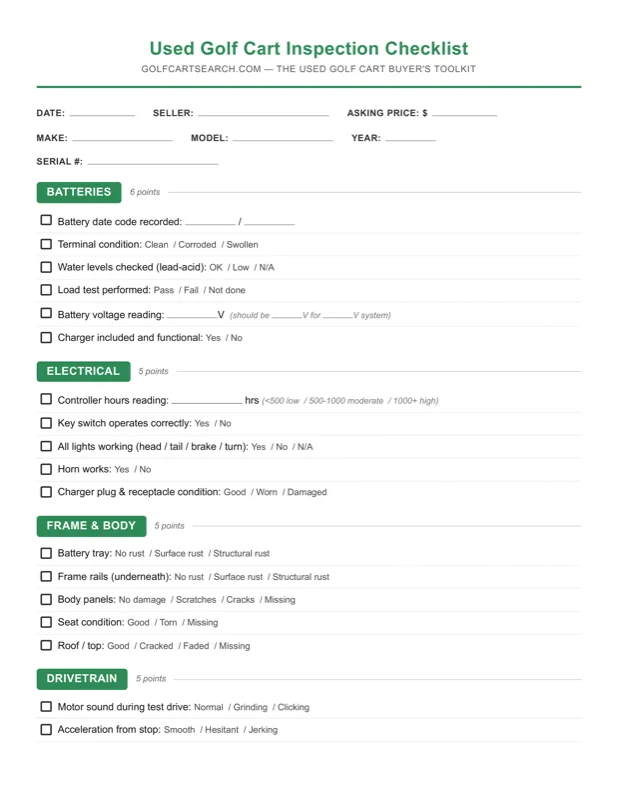
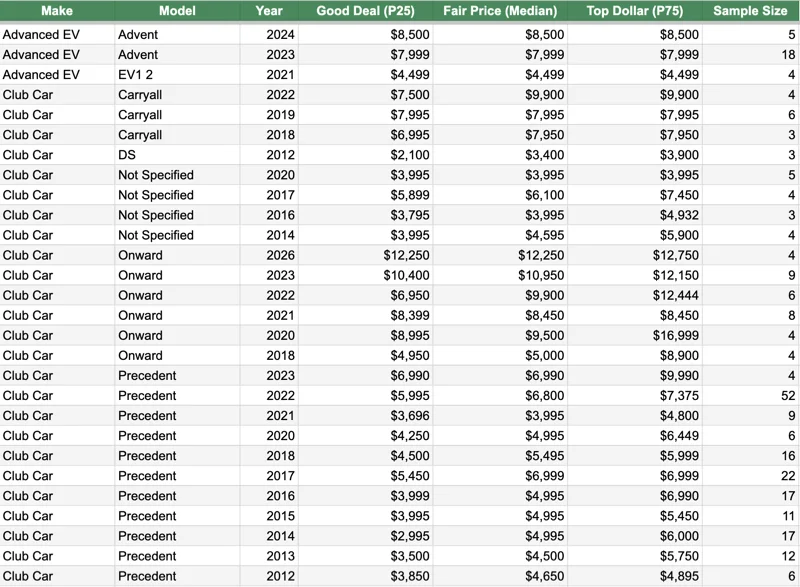
If you are actively shopping, pair this with our used golf cart buying guide and current pricing guide.
Lost Title vs No Title: Why the Difference Matters
This is one of the most important distinctions in the whole article.
No title because the cart was never titled
This is normal for standard golf carts.
No title because the seller lost it
This is much riskier if the vehicle is supposed to have one.
If a seller says:
- "It is street legal"
- "It used to be registered"
- "I had the title somewhere"
then the next step is usually not for you to figure it out later. The next step is for the seller to request a duplicate title first.
That is especially true if the price is high enough that you are effectively buying a road-going LSV. A missing title on a road-use vehicle can turn a good deal into a DMV headache fast.
Buying New From a Dealer: What You Should Receive
Dealer sales are cleaner, but you still need to know what to expect.
For a standard private-property golf cart, you should still get:
- purchase invoice
- serial number
- warranty paperwork
For a road-ready LSV or NEV, you should expect some combination of:
- purchase invoice
- VIN
- MCO/MSO
- temporary registration or dealer registration help
- warranty paperwork
This is one reason factory road-ready carts are easier to live with. The paperwork path is more organized from the start. If you know you want public-road use, compare our best street legal golf carts guide before you buy a cart that still needs to be converted.
If you want a lower-cost direct-buy example, the AODES Trailcross is one of the few online-first carts where the road-use conversation is at least worth taking seriously.
How Ownership Transfer Works
The transfer path depends on what kind of cart you are dealing with.
For the step-by-step handoff, use the golf cart ownership transfer guide. This page explains titles and registration concepts; the transfer guide walks through the buyer/seller checklist, bill of sale, DMV timing, and lost-title red flags.
Untitled standard cart
Use the bill of sale and keep copies permanently.
New road-ready cart with MCO/MSO
Use the origin paperwork to create the first title and registration through your state, if your state allows that vehicle on the road.
Already titled LSV or NEV
Transfer it like any other titled vehicle. That usually means signing the title over, paying transfer fees, and updating registration and insurance.
This is exactly why our registration-by-state guide exists. The document path is only half the story. Your state still decides what to do with it.
What Ownership Problems Actually Kill Deals
The most common paperwork mistakes are predictable:
- seller does not know the serial number
- bill of sale is vague or incomplete
- "street legal" claim does not come with VIN paperwork
- seller says title is lost but never requested a duplicate
- buyer assumes a local permit is the same thing as full registration
- buyer confuses MCO/MSO with an actual title
Most of these are avoidable if you slow down for ten minutes and collect the right documents before money changes hands.
Where the State Rules Start to Matter
This page is about paperwork, not a 50-state legal chart. But this is the point where state differences really do matter.
Do Golf Carts Have Titles in Florida, Michigan, Ohio, or South Carolina?
State rules change the answer once you move from a standard cart to road use, registration, or LSV status.
| State | Title answer | Official source |
|---|---|---|
| Florida | Standard golf carts are distinct from LSVs. FLHSMV says LSVs must be registered, titled, and insured, and converted golf carts need inspection, VIN assignment, title, and registration paperwork before LSV road use. | FLHSMV low-speed vehicles |
| Michigan | Michigan says golf carts cannot be registered as on-road vehicles. If the MCO shows the vehicle meets federal on-road requirements, it may be titled as a low-speed vehicle and registered with a passenger plate. | Michigan SOS titles |
| Ohio | Ohio separates most golf carts from low-speed vehicles and utility vehicles for registration purposes. Check BMV rules before assuming a golf cart can be titled like a car. | Ohio BMV registration |
| South Carolina | South Carolina has a golf cart permit registration process for qualifying golf carts, separate from normal vehicle titling. LSVs follow a different title/registration path. | SCDMV golf carts |
The practical takeaway: a generic "do golf carts have titles?" answer is useful for buying paperwork, but your state decides whether a particular cart can be titled, registered, plated, or used on public roads.
Use these pages next:
- golf cart registration by state
- state golf cart laws map
- golf cart insurance guide
- golf cart license guide
- street-legal conversion guide
Those pages answer the legal-use side. This page answers the ownership-document side.
Golf Cart Title FAQ
Do golf carts have titles?
Most standard golf carts do not. The usual ownership proof is a bill of sale plus the serial number. Titles usually matter once the vehicle is being treated as a road-going LSV or NEV.
What is the difference between an MCO/MSO and a title?
An MCO or MSO is the manufacturer origin document used before the first title exists. A title is the state-issued ownership document created after DMV processing.
Can I buy a golf cart without a title?
Yes. That is normal for many standard golf carts. What matters is whether you get a strong bill of sale and a believable ownership trail.
What if the seller lost the title?
If the cart should have a title, ask the seller to get the duplicate title before the sale. Do not rely on a promise that you can solve it later.
Do golf carts have VIN numbers?
Ordinary golf carts usually have serial numbers. Road-going LSVs and NEVs usually have a 17-digit VIN.
Is a bill of sale enough?
For many standard golf carts, yes, as basic proof of ownership. For road registration, often no. The state may also want a VIN, origin paperwork, inspection results, and insurance. Use a detailed golf cart bill of sale PDF instead of a vague receipt, then follow the ownership transfer checklist before payment.
Do golf carts have titles in Florida?
Florida distinguishes golf carts from LSVs. FLHSMV says LSVs must be registered, titled, and insured, while standard golf carts are treated differently. Converted golf carts need inspection, VIN assignment, title, and registration paperwork before road use as an LSV.
Do golf carts have titles in Michigan?
Michigan says golf carts cannot be registered as on-road vehicles, but if the manufacturer certificate of origin shows the vehicle meets federal on-road requirements, it may be titled as a low-speed vehicle and registered with a passenger plate.
Golf Cart Search
Find the Best Golf Carts of 2026
Compare top-rated models, read expert reviews, and find the perfect cart for your needs.