USCG Base Guam is seeking two gasoline-powered low-speed vehicles for post-typhoon recovery, saying the island's vulnerable electrical grid makes battery-electric alternatives unacceptable. The August 19 solicitation calls for a truck and passenger van to support debris clearance, structural inspections, and emergency personnel movement after storms.
Golf Cart Search found that 14 days separate the vehicle request and a Department of Energy emergency order intended to reduce Guam's blackout risk while a major generating unit was offline. The solicitation does not cite the DOE order. DOE's action confirms Guam was managing an active generation constraint when the request opened.
The procurement remains open. It does not show that the Coast Guard has selected a supplier, spent money, or taken delivery of either vehicle.
Why does USCG Base Guam require gas low-speed vehicles?
USCG Base Guam requires gasoline because the statement of work says Guam's vulnerable grid and unreliable power system make battery-electric alternatives unacceptable for this post-typhoon role.
The Coast Guard plans to use the vehicles as primary contingency platforms after typhoons. Listed assignments include clearing debris, inspecting structures, and moving emergency personnel. Both units must arrive fully assembled and operational at Base Guam in Santa Rita, with delivery estimated within 90 days after an award.
The file does not compare gasoline availability with charging availability after a storm. It also provides no charging study, fuel-cost analysis, emissions estimate, or lifecycle-cost calculation. For these two contingency vehicles, Base Guam made post-storm electricity access a deciding specification.
How vulnerable is Guam's power grid?
Guam was under an active federal grid-reliability order when the Coast Guard solicitation opened. On August 5, the Department of Energy issued an emergency order intended to reduce blackout risk. DOE said the Guam Power Authority had limited options for meeting demand because the Ukudu steam turbine was offline for emergency repairs. The order took effect August 6 and runs through November 4, 2026.
The NREL Guam 2023 Energy Baseline Report, published in May 2024, says Typhoon Mawar caused 98% of Guam Power Authority customers to lose electricity in May 2023. The report also records rotating outages during generator repairs. Those figures describe the 2023 grid, not current outage conditions in August 2026.
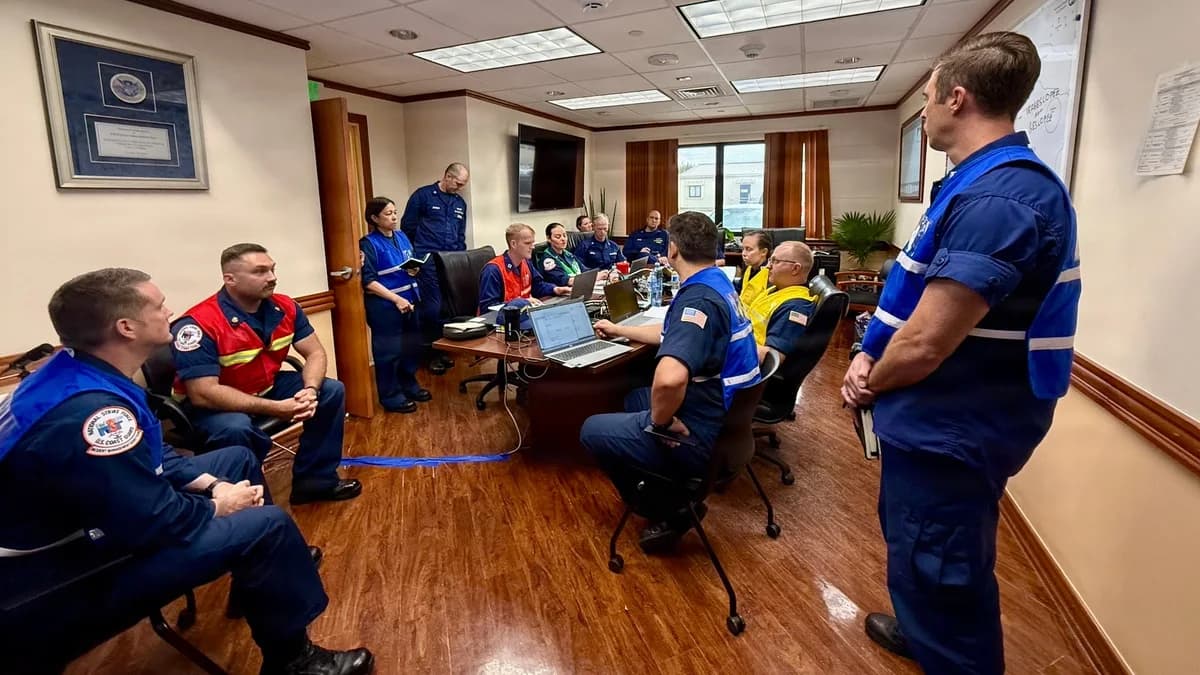
The Coast Guard's own storm records show how quickly recovery work begins. Before Typhoon Bavi in July 2026, Coast Guard Forces Micronesia said crews were securing Base Guam, moving small boats ashore, and preparing cutters to leave port so they could return for post-storm response. The public-domain image with this article shows an incident management team coordinating port recovery after that typhoon.
Are the requested vehicles street-legal LSVs?
No public-road use is specified. The solicitation title calls them low-speed vehicles, but the statement of work requests off-road configurations for closed-facility operations and requires off-road operational labeling. Nothing in the posted requirement says the Coast Guard intends to title, register, or operate them on Guam public roads.
The federal procurement label should not be read as a street-legal certification. Under the federal low-speed vehicle standard, a road-going low-speed vehicle must meet a defined speed range and federal safety-equipment requirements, followed by any applicable state or territorial title and registration rules. Our LSV vs. golf cart guide explains how that differs from a cart or utility vehicle restricted to private property.
Which low-speed vehicles did USCG Base Guam specify?
The Coast Guard names two new, current-production Vantage Primo models:
| Requested vehicle | Model in the statement of work | Intended role |
|---|---|---|
| Standard truck | Vantage V2XS-AT | Debris and facility-response work |
| Passenger van | Vantage V2XP-AT | Emergency personnel logistics |
Both must use electronic fuel-injected gasoline engines, automatic transmissions, rear-wheel drive, and electronic power steering. The specification also calls for factory air conditioning, power windows, power door locks, and radios.
Both are enclosed fleet vehicles rather than conventional open golf carts. The procurement belongs in the same neighborhood-mobility market because federal buyers use overlapping low-speed vehicle and utility-vehicle terminology. Readers comparing recreational powertrains can use our separate electric vs. gas golf cart guide; its range and ownership comparisons should not be treated as a substitute for emergency fleet planning.
When are responses due for the Guam vehicle request?
Responses are due August 28, 2026. The notice lists no award date or contract value, and the published document does not identify a winning vendor.
An award would still leave an estimated 90-day delivery period. Until SAM.gov posts an award or update, the accurate status is that the Coast Guard is requesting offers for two gas-powered vehicles. The choice reflects the contingency requirements in this solicitation and should not be presented as a Coast Guard-wide finding about electric fleets.
Primary reporting source
SAM.gov: Solicitation 31200PR260000054