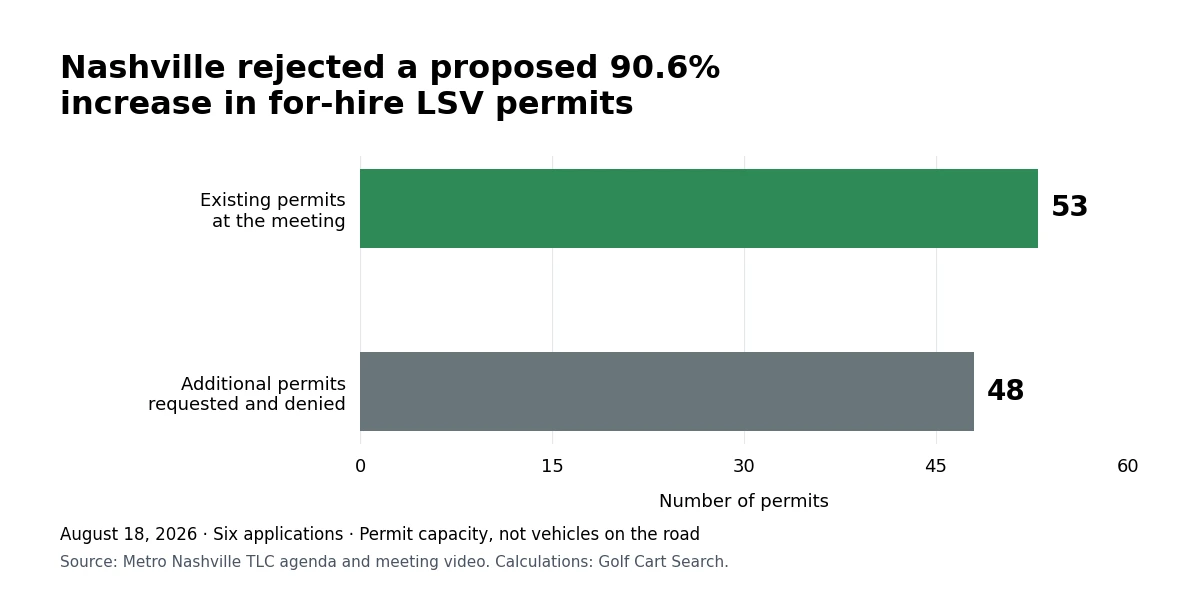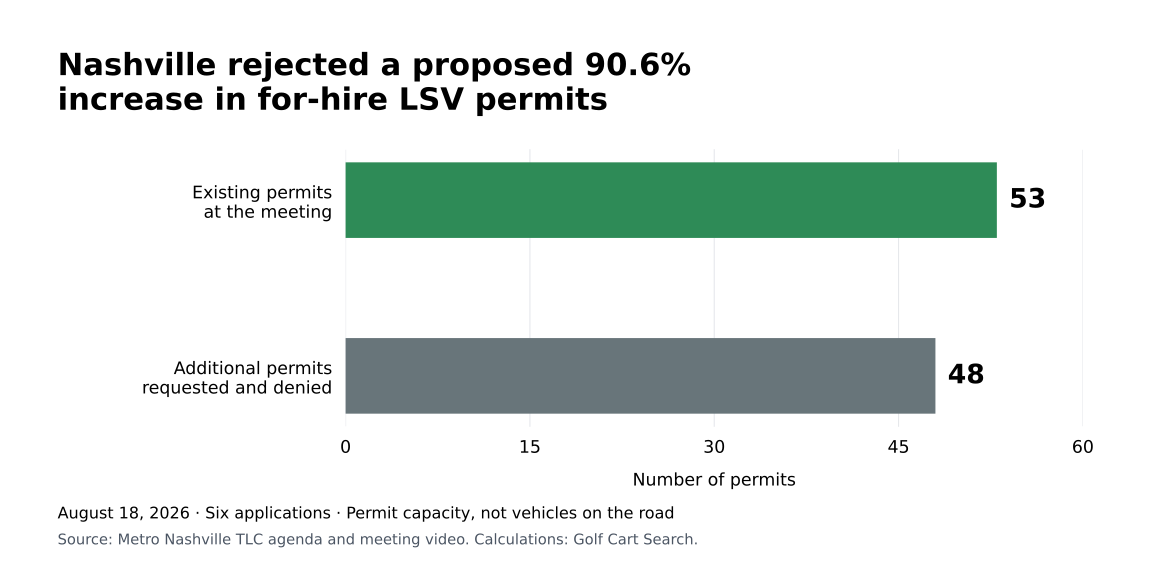
Nashville's Transportation Licensing Commission rejected six applications covering 48 new or additional low-speed vehicle permits on August 18, 2026. Before denying the applications, commissioners voted 3-1 that the applicants had not demonstrated a public convenience and necessity for more LSVs.
Transportation staff told the commission that four companies currently hold 53 permits. Golf Cart Search's review of the official agenda found that granting all six applications would have raised the total to 101 permits, a 90.6% increase. Four prospective new operators sought 29 permits, and two existing companies sought another 19.
The calculation compares the 48 requests listed on the agenda with the 53-permit baseline stated during the official meeting video. Permit totals do not show how many vehicles operate at one time, how often they are used, or passenger demand.
Why did Nashville reject the LSV permit applications?
Commissioners said they had not heard enough quantified evidence that Nashville needed more low-speed vehicles. During deliberations, they looked for signs that current operators were turning away riders or fully using their fleets. The meeting record did not establish either point citywide.
Transportation staff recommended against adding permits under the current rules. Staff cited downtown congestion and said applicants could not be restricted from entering the downtown core, even when their business plans focused on trips elsewhere.
The commission first voted on the required public-convenience-and-necessity finding. Three commissioners supported a finding that the need for additional LSVs had not been demonstrated, while one voted against it. The commission then approved a separate motion denying all the applications.
The decision applied to the new and additional permits on the agenda. It did not revoke the 53 permits that staff said were already held by four companies, and the commission did not adopt a permanent fleet cap.
Who requested the 48 Nashville LSV permits?
The commission agenda listed four new-company applications and two applications from current operators.
| Applicant | Application type | Permits requested |
|---|---|---|
| L & J LLC | New company | 10 |
| TN Transport Holding LLC dba Cruzzin | New company | 15 |
| Thungy Brush LLC | New company | 2 |
| Docor Luxury Cruz LLC | New company | 2 |
| Vintage Nashville Tour | Existing company | 15 additional |
| L=L Transport Services LLC | Existing company | 4 additional |
| Total | 48 |
The four new-company applicants accounted for 29 requested permits. Vintage Nashville Tour and L=L Transport Services accounted for the other 19.
How large would the Nashville LSV fleet increase have been?
Approving every application would have taken the permit count from 53 to 101. The requested permits equaled 90.6% of the existing total, so the maximum approved fleet would have been just short of twice its current permitted size.
| Nashville LSV permit measure | Count |
|---|---|
| Existing companies | 4 |
| Existing permits | 53 |
| Applications considered | 6 |
| New or additional permits requested | 48 |
| Possible total if every request had been approved | 101 |
This is a permit-capacity comparison, not an estimate of active vehicles or market demand. The calculation uses the commission's August 18 baseline and counts each requested permit once.
Are Nashville low-speed vehicles the same as golf carts?
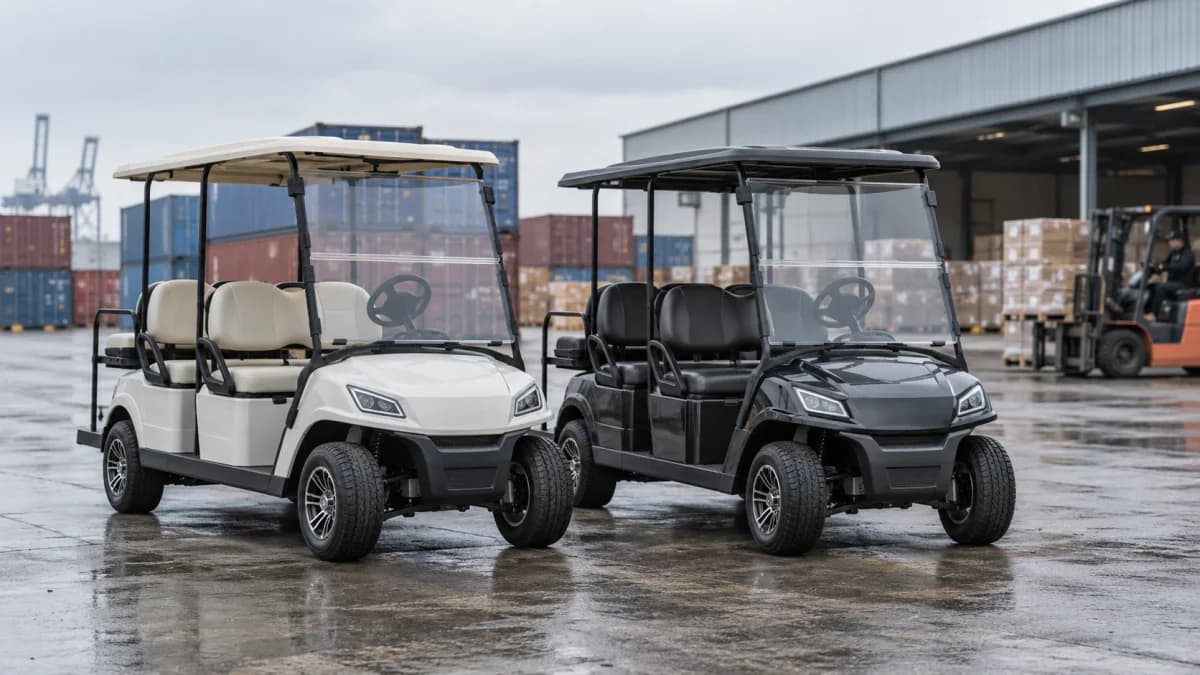
No. Tennessee defines a low-speed vehicle as a four-wheeled electric or gasoline vehicle capable of more than 20 mph but no more than 25 mph, and the definition expressly excludes golf carts. An LSV must also meet the federal safety standard in 49 CFR 571.500, according to the Tennessee Department of Revenue.
Metro Nashville uses the same distinction in its application for additional LSV permits. The form says vehicles meeting Tennessee's golf-cart definition are not included as LSVs for the city permit process.
The Nashville applications concerned for-hire LSV companies regulated by the Transportation Licensing Commission. They were not applications to register ordinary personal golf carts. Our LSV vs. golf cart guide explains the certification, equipment, title, and road-use differences.
Tennessee generally permits registered LSVs on roads posted at 35 mph or less, subject to state and local restrictions. The Tennessee golf cart law page covers that statewide framework, while Nashville separately controls for-hire companies and their vehicle permits.
Can companies apply for Nashville LSV permits again?
The August 18 vote denied the six applications in that annual review. It did not create a permanent prohibition on future applications. Metro Nashville's transportation permit page sets a yearly filing deadline for new LSV applications, and any later requests would go through a future commission process.
Download the permit data and chart
The six-application CSV includes each applicant, requested permits, decision, and agenda reference. The calculation file contains the totals, source timestamps, and limitations.
Download the permit comparison chart, its editable SVG, and the methodology. The comparison describes the August 18 decision; 101 permits is the hypothetical total if every application had been approved.
Updated September 6, 2026: Added downloadable data, a chart, and source timestamps after rechecking the agenda and meeting captions. The reported decision is unchanged.
Primary reporting source
Metro Nashville Network: August 18 commission meeting