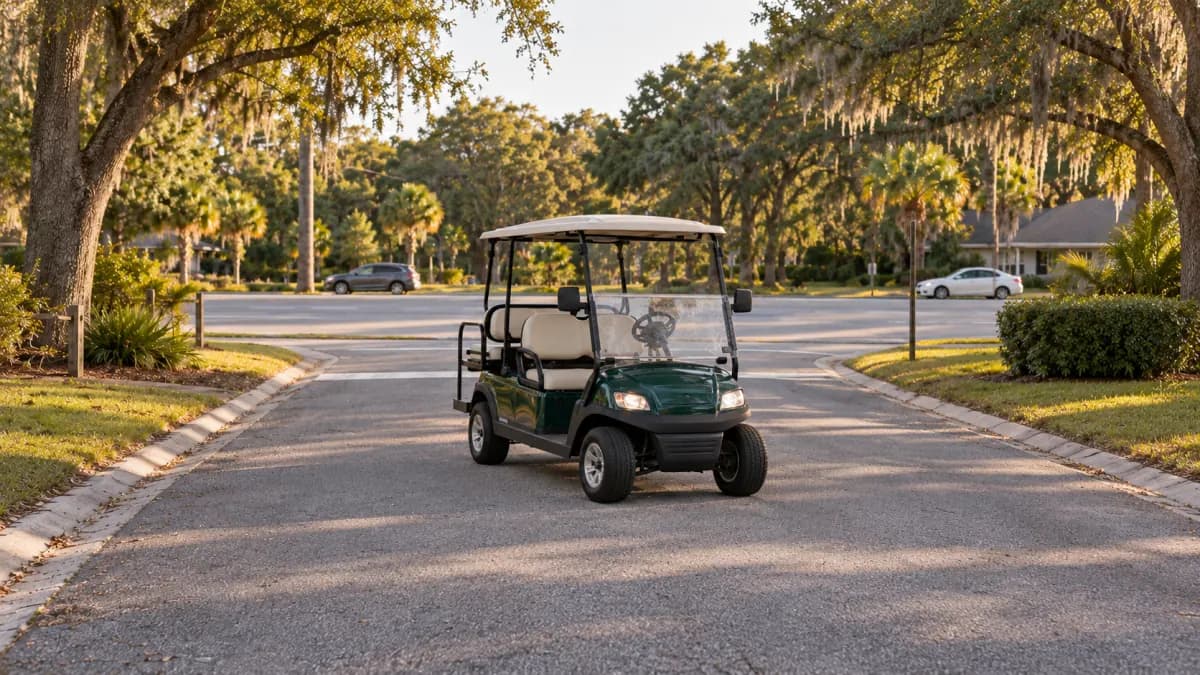
The TEKO golf cart recall for missing pedestrian-alert equipment lists 1,934 potentially affected 2026 vehicles in NHTSA campaign 26V420000. The recall covers the 2026 TEKO Triumph, Trophy, Trophy Plus, TurboLite, and Turbo.
Golf Cart Search compared the current NHTSA TEKO campaign record, a public recall-change register, and NHTSA's separate Denago AVAS recall. The TEKO campaign is smaller than the Denago case, but the defect category is similar: electric low-speed vehicles that may not make the pedestrian warning sounds required under FMVSS 141.
A CarsMultiverse change register says the TEKO campaign count changed on August 28 from 5,469 to 1,934. NHTSA's live API now shows the lower 1,934-unit count. Because NHTSA overwrites current campaign records, the earlier 5,469 figure should be treated as an archived third-party comparison, not the current official count.
| Recall campaign | Manufacturer | Current potentially affected units | Affected rows in NHTSA API | Issue |
|---|---|---|---|---|
| 26V420000 | TEKO, INC. | 1,934 | 5 | AVAS may not have been installed |
| 26V381000 | Denago EV Corporation | 34,136 | 16 | Vehicles may fail to make pedestrian warning sounds when in motion |
The comparison uses NHTSA campaign rows as of August 30, 2026. NHTSA rows identify model-year and model combinations, not distinct VINs. The Denago campaign's current unit count is 17.7 times larger than TEKO's current unit count.
Which TEKO models are recalled?
NHTSA's current campaign data lists five affected TEKO model rows, all from model year 2026:
| Model year | Make | Model |
|---|---|---|
| 2026 | TEKO | Triumph |
| 2026 | TEKO | Trophy |
| 2026 | TEKO | Trophy Plus |
| 2026 | TEKO | TurboLite |
| 2026 | TEKO | Turbo |
TEKO's own product navigation lists the same five model families: TurboLite, Turbo, Trophy, Trophy Plus, and Triumph. The recall record does not say that every vehicle with those names is affected. Owners need a VIN-level recall check or dealer confirmation for their specific cart.
What is the TEKO AVAS recall issue?
NHTSA says the acoustic vehicle alerting system, or AVAS, may not have been installed on the recalled vehicles. Without that system, the vehicle may fail to make pedestrian warning sounds.
NHTSA lists the component as back-over prevention, external pedestrian alert warning. The agency's consequence field says a vehicle that does not make a sound may fail to alert pedestrians that a vehicle is approaching, increasing crash or injury risk.
The remedy field says Teko will provide an AVAS kit free of charge. It also says owner notification letters were expected to be mailed August 17, 2026, and lists Teko Customer Care as the owner contact.
Why does AVAS matter for low-speed vehicles?
FMVSS 141 is the federal minimum sound standard for hybrid and electric vehicles. The current eCFR text says the standard exists to reduce injuries from electric and hybrid vehicle crashes with pedestrians by requiring sound levels and sound characteristics that make those vehicles detectable and recognizable.
This is especially relevant for quiet neighborhood vehicles. Many street-legal golf-cart-style vehicles are marketed around 25 mph road use. Once a vehicle is sold as a compliant low-speed vehicle, buyers are no longer just comparing seats, screens, lithium batteries, and price. They also need the required safety equipment and paperwork to match the vehicle category.
The separate FMVSS 500 low-speed vehicle standard covers the LSV category and equipment list for vehicles in the 20 mph to 25 mph range. Our street-legal golf cart guide explains how that federal equipment layer fits with state registration, title, insurance, and road-speed rules.
How does this compare with the Denago AVAS recall?
NHTSA's Denago campaign 26V381000 lists 34,136 potentially affected vehicles. It covers 2024 to 2026 Denago EV rows across Nomad, Nomad XL, Scout 2, Scout 4, Rover XL, Rover XXL, and Rover XL6.
The Denago wording is not identical to TEKO's. NHTSA says the Denago vehicles may fail to make pedestrian warning sounds when in motion, while the TEKO record says AVAS may not have been installed. Both campaigns cite noncompliance with FMVSS 141 and both describe a pedestrian-warning sound problem.
| Manufacturer | Current unit count | Unique model names in NHTSA campaign rows | Owner remedy described by NHTSA |
|---|---|---|---|
| TEKO, INC. | 1,934 | 5 | Teko will provide an AVAS kit free of charge |
| Denago EV Corporation | 34,136 | 7 | Dealers will provide an acoustic vehicle alerting system remedy kit free of charge |
Golf Cart Search has current Denago model pages for several of the Denago model families named in the NHTSA campaign, including the Nomad, Nomad XL, Rover XL, and Rover XXL. TEKO does not currently have a model page in the Golf Cart Search catalog.
How to check a TEKO golf cart recall
To check a TEKO golf cart recall, start with the vehicle's VIN or recall paperwork, then compare it with NHTSA campaign 26V420000 or ask a TEKO dealer to confirm whether the AVAS kit applies. A model name alone is not enough because recall eligibility depends on the specific vehicle population identified by the manufacturer.
- Find the VIN or manufacturer serial information on the cart paperwork or vehicle label.
- Search the VIN through NHTSA or ask the selling dealer to check campaign 26V420000.
- Confirm whether the AVAS kit is required and keep the completed repair record.
- If the cart is registered for road use, keep the recall record with the title, registration, insurance, and LSV documents.
For a street-use cart, the paper trail is part of the safety check. Owners should keep the recall notice, dealer repair record, VIN or serial information, and any LSV registration documents together. The golf cart VIN decoder can help owners separate a 17-character road-vehicle VIN from a shorter manufacturer serial number.
Buyers considering a used TEKO, Denago, or other electric LSV should ask the seller for proof that any open recall has been handled. Equipment such as lights, mirrors, seat belts, and screens does not prove that the vehicle satisfies the sound standard or the state registration path. Start with the street-legal golf cart checker if the cart will be used on public roads.
What changed on August 28?
The August 28 development is the unit-count revision captured by the public recall-change register. The register lists TEKO campaign 26V420 as a United States recall where the units changed from 5,469 to 1,934.
NHTSA's live record now shows 1,934 potentially affected units. Golf Cart Search could not verify the old 5,469 number from NHTSA's current record because the agency's current public API returns the revised count. RecallCheck, retrieved on August 24 according to its provenance section, still displays 5,469 as published in the campaign file, which supports the same before-and-after discrepancy but does not replace NHTSA's current record.
For owners and dealers, the current official count is the number that should be used unless NHTSA revises the campaign again. The safer action is unchanged: check the specific vehicle, confirm whether the AVAS kit applies, and keep the completed recall record with the cart's road-use paperwork.
Primary reporting source
NHTSA recall campaign 26V420000