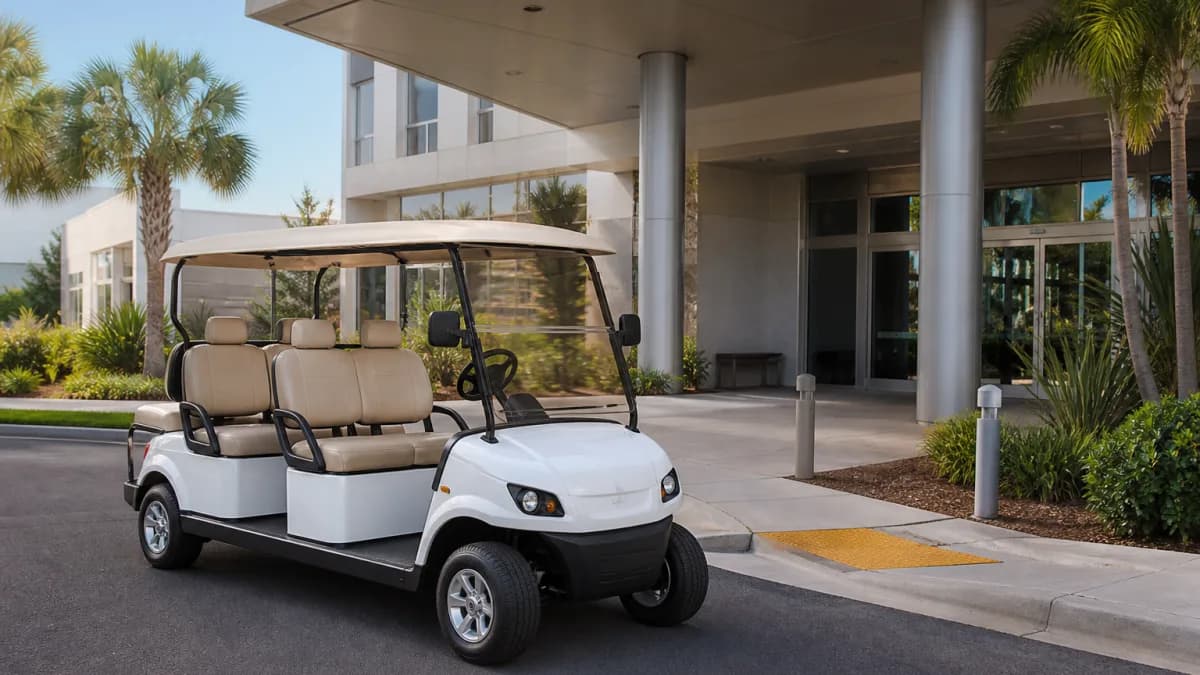
The Department of Veterans Affairs is seeking 10 electric four-passenger golf carts to move elderly or mobility-limited veterans between parking areas and entrances at its Lake Baldwin facility in Orlando. Solicitation 36C24826Q1107 closes August 27 at 1 p.m. EDT.
An August 21 amendment clarified the eligible vehicle configurations. The VA will accept four forward-facing seats or a 2+2 layout, and the carts do not have to be federally classified low-speed vehicles. A non-LSV model capped at 19 mph is acceptable if it has the specified safety equipment.
Golf Cart Search screened 225 current model records against four requirements that can be checked consistently in our catalog: four-seat availability, an electric powertrain, a listed maximum speed of 19 mph or less, and no lifted, elevated-chassis, or off-road label. Eleven records passed that initial screen, but none of their catalog entries documents every item needed to establish full compliance with the solicitation.
What are the Lake Baldwin VA golf cart requirements?
The original 34-page request specifies electric carts with four seats, 110-volt charging, a state-of-charge meter, weather protection, and a standard manufacturer warranty. Required safety equipment includes:
- front LED headlights;
- rear LED tail and brake lights;
- front and rear turn signals;
- side and rear mirrors;
- and a horn.
The amendment says each cart must operate for at least six to eight hours before recharging. It also clarifies that the vehicles must be model year 2026 or newer, cannot be lifted, and must arrive fully assembled, unloaded, inspected, and ready to operate.
The original specification paired its equipment list with a statement that the carts should meet federal and state low-speed-vehicle safety standards. A vendor asked whether that meant every cart had to be an LSV requiring title and DMV registration. The published response says no: a non-LSV cart with a maximum speed of 19 mph is acceptable if it has the listed safety features.
The response also resolves an ambiguous weight line. The VA says the 800-pound figure refers to a minimum gross vehicle weight rating, not a maximum passenger or payload allowance.
Which golf carts passed the initial catalog screen?
Our August 26 catalog screen found 11 records across four brands. These models are starting points for comparison, not confirmed bids or VA-approved products.
| Catalog model | Listed seating | Electric option | First listed speed |
|---|---|---|---|
| Club Car Onward 4 Forward | 4, all forward-facing | Yes | 19 mph |
| Club Car Onward 4 Passenger | 4 | Yes | 19 mph |
| Club Car Onward HP Li-Ion | 2 or 4 | Yes | 19 mph |
| Club Car Tempo | 2 or 4 | Yes | 15 mph |
| Cushman Shuttle 2+2 | 4 | Yes | 19 mph |
| Cushman Shuttle 4 | 4, forward-facing | Yes | 19 mph |
| Evolution Classic 4 Plus | 4 | Yes | 19 mph base configuration |
| Evolution D5-Ranger 2+2 | 4 | Yes | 19 mph base configuration |
| Evolution D5-Ranger 2+2 Plus | 4 | Yes | 19 mph base configuration |
| Yamaha Drive2 Concierge 4 | 4 | Yes | 19 mph |
| Yamaha UMAX Rally 2+2 | 4 | Yes | 19 mph |
The filter uses the first numeric speed in each catalog record. For Evolution models that also list a 25 mph LSV package, the 19 mph base configuration is the value counted. Models identified in our data as lifted, elevated-chassis, or off-road were excluded because the amended request says a non-lifted cart is required for safety.
Do any models meet every VA requirement?
The catalog screen cannot verify model year, minimum GVWR, six-to-eight-hour operation, warranty coverage, VIN and serial-number documentation, exact option packages, or delivery readiness. Those items require current manufacturer and vendor documents for the specific configuration quoted.
Equipment fields are also incomplete across the catalog. None of the 11 records explicitly documents every light, signal, mirror, horn, and canopy item in the VA request. Missing catalog details leave availability unresolved, so a vendor would need a line-by-line compliance sheet for the quoted configuration.
The amendment gives vendors some flexibility. Manufacturer-approved, dealer-installed equipment is acceptable, and the VA is open to color combinations beyond the white body and tan seats listed in the original request. The carts can use a 2+2 layout, but lifted configurations are out.
Do the VA carts have to be street-legal LSVs?
No. The August 21 response allows a non-LSV capped at 19 mph if it carries the VA's specified safety equipment. Federal low-speed vehicle rules apply to four-wheeled vehicles that can reach more than 20 mph but no more than 25 mph within one mile and have a gross vehicle weight rating under 3,000 pounds. The standard also specifies required equipment and certification.
The procurement therefore covers two possible paths: a 19 mph golf cart equipped to the VA's stated safety specification, or an LSV configuration meeting the applicable standards. Our low-speed vehicle guide explains why the labels affect certification, title, registration, and road use even when the vehicles look similar.
The solicitation does not identify a preferred manufacturer, an award value, or a selected vendor. It requires delivery within 90 days after an order. The procurement remains an open request for quotations until the VA publishes an award.
Primary reporting source
SAM.gov: Solicitation 36C24826Q1107