

2 vs 4 vs 6 Seater Golf Carts: How to Choose (2026)

Compare 2, 4, and 6 seater golf carts side by side. Real prices, dimensions, range data, and a decision guide to pick the right size for your needs.

Michael
Michael
Mar 9th, 202611 min read
Three golf carts of different sizes parked side by side on a suburban driveway at golden hour

As an Amazon Associate, we earn from qualifying purchases. This helps support our site at no extra cost to you.

Choosing the right number of seats is one of the first decisions you'll make when buying a golf cart. Get it wrong and you'll either pay for space you don't use, or find yourself turning people away every time you head out.

This guide compares 2, 4, and 6-seater golf carts with real specs, prices, and dimensions from every major brand. We'll cover exactly how size affects performance, what fits in your garage, and which configuration makes the most sense for how you actually use your cart.

4-seater Most popular (48% of all listings)

$1,500-$3,000 Price premium per additional row of seats

$2,500/seat Cost per seat on a 6-seater vs $5,000/seat on a 2-seater

10-20% Range reduction when fully loaded

Side-by-Side Size Comparison

Here's how 2, 4, and 6-seater golf carts compare across the specs that matter most.

Spec2-Seater4-Seater6-Seater
Length7.5-8 ft (91-97")9-10.5 ft (108-128")11-13.5 ft (134-161")
Width4 ft (47-49")4 ft (47-49")4 ft (47-51")
Weight570-730 lbs795-1,430 lbs980-1,550 lbs
New price range$5,000-$15,000$7,000-$18,000$10,000-$20,000+
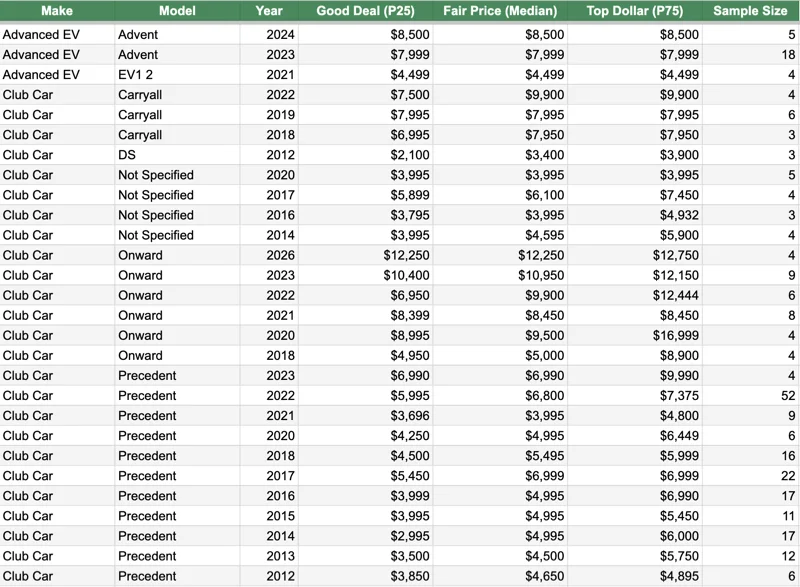
Used price (median)$5,450$6,995$8,595
Top speed19-25 mph19-25 mph17-25 mph
Range (electric)25-45 miles20-40 miles20-35 miles
Load capacity500-800 lbs800-1,000 lbs1,000-1,200 lbs
Turning radius9-11 ft10-15 ft12.6-28.8 ft
Fits single-car garage?EasilyYesTight but possible

Used prices above are median values from 2,288 dealer listings gathered in early 2026.

2-Seater Golf Carts: Best for Solo Riders and Couples

The standard 2-seater is what most people picture when they think "golf cart." It's compact, affordable, and purpose-built for two people.

Best for: Golf course use, couples, solo riders, tight storage situations, and anyone who prioritizes maneuverability over passenger space.

Dimensions and handling: At under 8 feet long and 4 feet wide, a 2-seater fits anywhere. You'll park it in a single-car garage with room to spare, make U-turns on narrow paths, and trailer it on a basic 5x10-foot flatbed. The tight turning radius of 9-11 feet means you can navigate golf course paths and narrow neighborhood streets with ease.

Popular 2-seat models by brand:

BrandModelStarting PriceKey Feature
Club CarOnward 2 Passenger~$10,700Aluminum frame, no rust
EZGOFreedom RXV~$10,299AC motor, regenerative braking
YamahaDrive2 PTV~$9,590QuieTech EFI gas or PowerTech electric
ICONi20$11,999Lithium standard, 25 mph LSV
Star EVSirius 2$11,999Trojan batteries, 40-60 mile range

If you're shopping on a tighter budget, full-size electric 2-seaters are also available on Amazon starting around $7,000-$8,000.

Check Kandi GOAT 2-Seater on Amazon ($7,999)

The case for a 2-seater: You get the lowest purchase price, the most maneuverability, and the easiest storage. If you only carry one passenger and primarily use your cart on the golf course or for solo neighborhood trips, a 2-seater is all you need.

When to size up: If you regularly carry kids, grandchildren, or guests, you'll outgrow a 2-seater fast. Adding a rear seat kit later is an option, but it only adds rear-facing seats.

The 4-seater is the bestselling golf cart configuration, and for good reason. It handles families, guests, and cargo while keeping dimensions manageable.

Best for: Families of 2-4, neighborhood use, golf cart communities, anyone who occasionally carries passengers, and buyers who want flexibility.

Why it's the top seller: Based on 2,288 dealer listings we analyzed, 4-seaters account for 48% of all used golf carts on the market, compared to 29% for 2-seaters and just 4% for 6-seaters. The demand is strong because a 4-seater covers the widest range of use cases.

Dimensions: At 9-10.5 feet long, a 4-seater fits comfortably in a standard garage and maneuvers well in most neighborhoods. The turning radius of 10-15 feet is still manageable, though noticeably wider than a 2-seater.

Popular 4-seat models by brand:

BrandModelStarting PriceKey Feature
Club CarOnward 4 Forward~$13,800All forward-facing seats
EZGOExpress S4~$11,500Lithium ELiTE option
EZGOLiberty~$12,699First standard-chassis all-forward design
YamahaConcierge 4~$12,4554-year warranty (longest in industry)
ICONi40$12,999Lithium standard, 25 mph, best value
Star EVSirius 2+2$12,499Rear flip seat doubles as cargo bed

For buyers shopping online, the AODES Trailcross at $7,249 is one of the most affordable new 4-seaters available with a street-legal package included.

Check AODES Trailcross 4-Seater on Amazon ($7,249)

The cost-per-seat advantage: A 4-seater costs roughly $1,500-$3,000 more than a comparable 2-seater from the same brand. That works out to about $3,250 per seat on a $13,000 cart, compared to $5,000 per seat on a $10,000 2-seater. You're getting 100% more seating for only 15-30% more money.

Forward-facing vs rear-facing seats: Many 4-seaters use a rear flip seat that faces backward. Newer models like the EZGO Liberty and Club Car Onward 4 Forward offer all forward-facing seats, which are safer and more comfortable, especially for families with children. See the section below on rear seat orientation for more detail.

6-Seater Golf Carts: Room for the Whole Crew

A 6-seater handles large families, frequent guests, and commercial use. It's the practical choice when four seats aren't enough, but it comes with real tradeoffs in size and maneuverability.

Best for: Families of 5+, resort and commercial shuttles, golf cart communities where you regularly carry groups, and buyers who value capacity over compactness.

Dimensions: 6-seaters range from 11 to 13.5 feet long. That's a significant jump from a 4-seater. The Yamaha Concierge 6 at 161 inches (13.5 feet) is the longest mainstream option, while the ICON i60 at 134 inches (11.2 feet) is the most compact. Width stays the same at 4 feet, so lane width isn't a concern.

Turning radius is the biggest tradeoff. The Club Car Onward 6 manages a respectable 12.6-foot turning radius, but the EZGO Express S6 Gas stretches to 28.8 feet. In tight neighborhoods and parking areas, that difference is dramatic. Always test-drive a 6-seater in your actual neighborhood before buying.

Popular 6-seat models by brand:

BrandModelStarting PriceKey Feature
Club CarOnward 6 Passenger~$16,500Tightest turning radius (12.6 ft)
EZGOExpress S6~$14,999ELiTE lithium option
YamahaConcierge 6~$13,330Only $875 more than Concierge 4
ICONi60$14,999Most compact 6-seater (134")
Star EVSirius 4+2$15,998Rear flip seat converts to cargo

The Yamaha value play: The Concierge 6 at $13,330 is only $875 more than the Concierge 4 at $12,455. That's the cheapest per-seat upgrade in the industry. If you're considering Yamaha and think you might ever want 6 seats, the price difference barely registers.

What About 8-Seater Golf Carts?

Eight-seat golf carts exist for commercial use, large families, and resort operations. Models like the Cushman Shuttle 8, ICON i80, and Star EV Classic XPR-6+2 range from $17,000-$20,000+ new.

At 14-16 feet long and 1,500-1,800 lbs, these are serious vehicles. They barely fit in a standard garage, require a 7x16-foot trailer, and the turning radius makes tight streets a challenge. Unless you're running a shuttle service, organizing events, or have a family of 7+, a 6-seater with better maneuverability will serve you better.

Price Comparison by Seating Capacity

New Cart Prices

ConfigurationBudgetMid-RangePremium
2-Seater$5,000-$8,000$9,500-$12,000$12,000-$15,000
4-Seater$7,000-$10,000$11,000-$14,000$14,000-$18,000+
6-Seater$10,000-$13,000$13,000-$16,000$16,000-$20,000+
8-Seater$15,000-$17,000$17,000-$19,000$19,000-$25,000+

For detailed pricing by brand and model, see our complete golf cart pricing guide.

Used Cart Prices (from 2,288 Dealer Listings)

ConfigurationMedian PriceListings Analyzed
2-Seater$5,450658
4-Seater$6,9951,093
6-Seater$8,59597
8-Seater$12,9956

The 4-seater premium over a 2-seater is just $1,545 on the used market. That's roughly $770 per extra seat. Browse used golf carts near you to see current pricing in your area.

Cost Per Seat

ConfigurationAvg New PriceCost Per SeatPremium vs 2-Seater
2-Seater$10,000$5,000/seatBaseline
4-Seater$13,000$3,250/seat35% cheaper per seat
6-Seater$15,000$2,500/seat50% cheaper per seat

Each additional row of seats adds about $1,500-$3,000 to the price, but the cost per seat drops sharply. If you need the capacity, bigger carts offer better value per passenger.

How Extra Passengers Affect Performance

Top speed stays the same. Motor and controller programming determine top speed, not passenger count. A 2-seater and 6-seater from the same brand typically share the same 19 mph (PTV) or 25 mph (LSV) top speed rating. The one exception: the EZGO Express S6 Gas tops out at 17 mph compared to 19 mph for the S4 Gas.

Range drops 10-20% when fully loaded. An electric 4-seater rated for 40 miles of range will deliver closer to 32-36 miles with four adults aboard. Six-seaters carrying a full load on hilly terrain can see range drop to 25-30 miles even on carts rated for 40+. The impact depends on terrain and battery type: lithium batteries maintain more consistent power under load than lead-acid.

Acceleration is slightly slower. A 6-seater weighing 1,400+ lbs with six passengers takes longer to get up to speed than a 600 lb 2-seater. On flat ground you'll barely notice, but on hills the difference is real.

Gas carts handle extra weight better than electric carts because the engine adjusts to load dynamically. If you'll frequently carry a full 6-seater load on hilly terrain, gas models have a slight edge. See our electric vs gas comparison for the full breakdown.

Will It Fit in Your Garage?

Standard garage dimensions are 10-12 feet wide and 20-24 feet deep for a single car, or 18-24 feet wide for a double. All golf carts are under 4.5 feet wide, so width is never the issue. Length is what matters.

Cart SizeTypical LengthFits Single-Car Garage?Fits Next to a Car in 2-Car Garage?
2-Seater8 ftYes, 12-16 ft remainingYes, with room to spare
4-Seater9-10.5 ftYes, 10-15 ft remainingYes, comfortably
6-Seater11-13.5 ftYes, 7-13 ft remainingYes, but tight
8-Seater14-16 ftVery tight or won't fitPossible but tight

Trailer sizing: A 2-seater fits on a 5x10 trailer. A 4-seater needs a 6x12. A 6-seater requires a 7x14 or larger. Always pick a trailer at least 2 feet longer than your cart.

Rear-Facing vs Forward-Facing Rear Seats

Most 4-seater and 6-seater golf carts put the rear row in one of two configurations: rear-facing (flip seats) or forward-facing. This decision affects comfort, safety, and cargo flexibility.

Rear-facing flip seats (traditional):

  • Rear passengers sit facing backward, looking at where you've been
  • The seat flips down to create a flat cargo bed, doubling as a utility platform
  • Available on a shorter chassis since the rear overhang handles the weight
  • Less comfortable on longer rides, and passengers face road dust and debris
  • Safety concern: weight behind the rear axle can lift the front wheels during acceleration on hills

Forward-facing seats (growing trend):

  • All passengers face forward, like a car
  • Safer weight distribution and more comfortable for families with children
  • No cargo bed conversion, so you lose that utility
  • Requires a longer chassis or sacrifices interior space
  • Notable models: EZGO Liberty, Club Car Onward 4 Forward, ICON i40F

Our take: If you're a family with children who will ride in back regularly, forward-facing seats are worth the premium. If you value the flip-down cargo bed for hauling coolers, groceries, or equipment, the traditional rear-facing layout is more versatile.

Adding a Rear Seat Kit vs Buying a Factory 4-Seater

Already own a 2-seater? A rear seat kit is the budget way to add passengers.

FactorRear Seat KitFactory 4-Seater
Cost$250-$750 (kit + install)$1,500-$3,000 more than a 2-seater
Seat directionRear-facing onlyForward-facing options available
Cargo bedYes (flips down)Only on flip-seat models
ComfortAdequate for short tripsBetter for daily use
Weight capacity250-400 lbs (standard kits)Matched to vehicle rating
Installation1-2 hours, bolt-onFactory integrated
Impact on range10-20% reduction when loaded10-20% reduction when loaded

Choose a kit if: You already have a 2-seater, carry passengers occasionally, want cargo bed flexibility, and budget is a priority.

Buy a factory 4-seater if: You're purchasing new, carry passengers daily, want forward-facing rear seats, or plan to make the cart street legal (factory-integrated seats meet compliance requirements more easily).

Which Size Is Right for You?

Use this decision guide based on your primary use case.

Your SituationRecommended SizeWhy
Solo golfer or couple2-seaterCompact, affordable, fits any garage
Family of 3-44-seaterMost popular for a reason: covers 90% of family needs
Family of 5+6-seaterOnly legal option for 5+ passengers
Occasional guests4-seater + rear seat kitSave money, add seats when needed
Golf course only2-seaterMost courses prohibit larger carts on fairways
Neighborhood cruising4-seaterSweet spot of size and maneuverability
Golf cart community4 or 6-seaterDepends on family size and social habits
Resort or commercial6 or 8-seaterMaximize passenger throughput
Hunting and trails2 or 4-seaterManeuverability in tight trails; lifted preferred
RV park or campground4-seaterVersatile and fits on a standard trailer

The general rule: Buy one size up from what you think you need. The $1,500-$3,000 premium for an extra row of seats is small compared to the cost of upgrading later. A 4-seater buyer who later wants 6 seats has to sell and buy again, while someone who bought the 6-seater upfront saved the hassle and transaction costs.

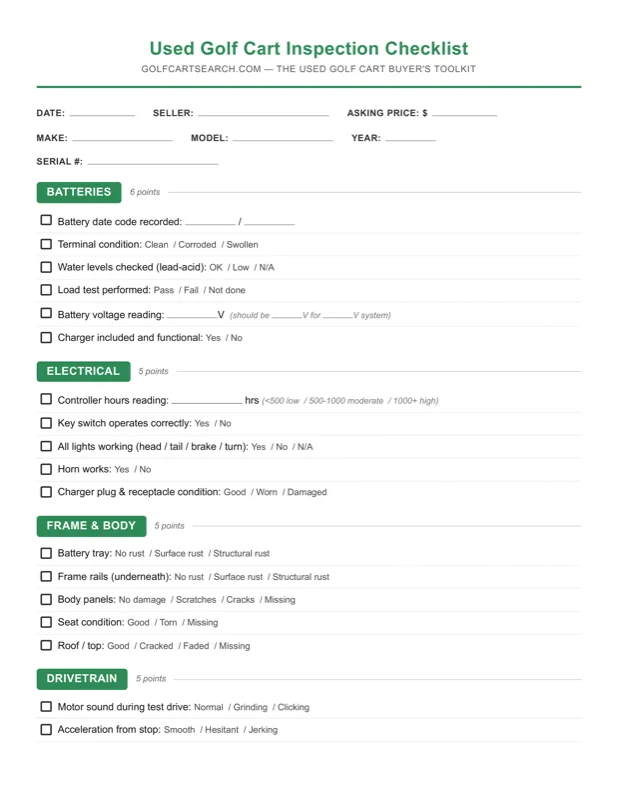
For help comparing specific brands within your chosen size, check our best golf cart brands ranking or browse the full dealer directory to see what's available near you. And if you're deciding between new and used, our used cart buying guide walks through exactly what to inspect.

Frequently Asked Questions

How many seats does a standard golf cart have?

A standard golf cart has 2 seats. This has been the default configuration since golf carts were first built for course use. Manufacturers now offer 4 and 6-seat versions of most models, and aftermarket rear seat kits can convert any 2-seater to a 4-seater for $250-$750.

Can you convert a 2-seater to a 4-seater?

Yes. Rear seat kits bolt onto the rear cargo area and add a bench seat for two passengers. The seat typically flips down to create a flat cargo bed when not in use. Premium kits from brands like GTW and ProFormX cost $400-$750 and rival factory quality. Budget kits start around $150-$250 but may not hold up as well over time.

Which golf cart size has the best resale value?

4-seater golf carts sell fastest and maintain strong resale value because they're the most in-demand configuration. Among the 2,288 dealer listings we analyzed, 4-seaters outnumbered 6-seaters by more than 10 to 1. However, brand and battery condition matter far more than seat count. A well-maintained 2-seater from Club Car will hold its value better than a neglected 6-seater from a lesser-known brand.

Do I need a different driver's license for a 6-seater?

No. Golf carts and Low Speed Vehicles (LSVs) do not require a special license in most states, regardless of passenger count. However, LSVs must be registered and insured, and the driver typically must have a valid driver's license. Check your state's requirements for specific rules on licensing, registration, and where you can drive.

How much does it cost to insure a 6-seater vs a 2-seater?

Insurance premiums for golf carts are generally low ($100-$300 per year) and don't vary dramatically by seating capacity. The bigger factors are whether it's classified as a PTV or LSV, your state, and your coverage level. See our golf cart insurance guide for a complete breakdown of costs and coverage options.

Share this post

Golf Cart Search

Find the Best Golf Carts of 2026

Compare top-rated models, read expert reviews, and find the perfect cart for your needs.
Related posts

Stay in the loop

Stay Updated with Golf Cart News

Get the latest updates on golf cart services, tips, and exclusive offers delivered to your inbox.