
Best Golf Cart Floor Mats & Liners: Buyer's Guide (2026)
Best golf cart floor mats for EZGO, Club Car, Yamaha & ICON. Compare rubber, TPE, and silica gel liners with prices, fitment charts, and top picks for 2026.
Find the best golf cart rear seat kit for Club Car, EZGO, or Yamaha. Compare flip seats by price, weight capacity, and quality with install tips.

As an Amazon Associate, we earn from qualifying purchases. This helps support our site at no extra cost to you.
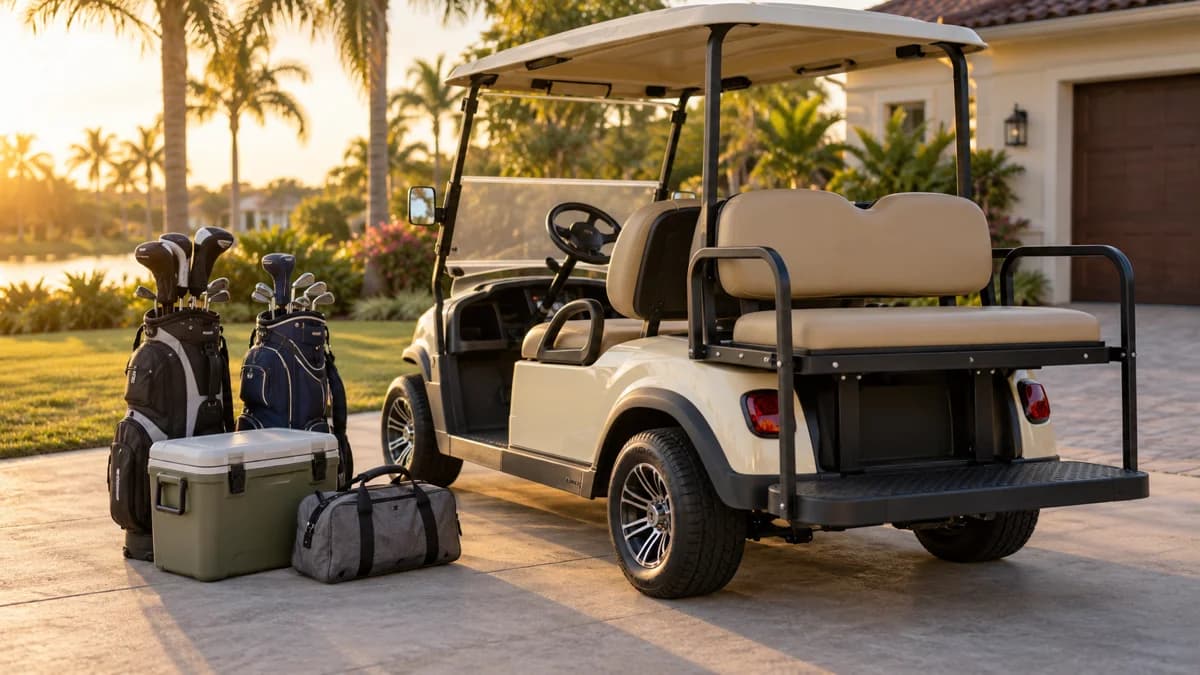
Adding a rear seat kit is one of the most popular golf cart upgrades for a reason: it turns a basic 2-passenger cart into a 4-seater that can carry your family, friends, or gear. Whether you own a Club Car, EZGO, or Yamaha, there is a bolt-on kit that fits your cart and budget.
The problem? There are dozens of options across multiple brands, and quality varies wildly. A cheap kit might sag after six months, while spending $750 on a premium kit could be overkill for weekend neighborhood cruising.
This guide breaks down the best rear seat kits by brand, budget tier, and cart model so you can find the right fit without overspending. If you are still deciding on a cart, check our golf cart pricing guide and used buying guide first.
Price Range $150 to $750+
Install Time 1 to 3 hours (DIY)
Weight Capacity 250 to 1,100 lbs
Most Popular Type Flip-flop (convertible)
| Cart Brand | Top Pick | Best For | Price Range |
|---|---|---|---|
| Club Car Precedent/Tempo/Onward | GTW MACH3 (Steel) | Best overall value | $400 to $500 |
| Club Car DS (2000.5+) | GTW MACH3 (Steel) | Reliable mid-range | $400 to $500 |
| Club Car DS (1982 to 2000) | KUAFU Heavy Duty | Budget with high capacity | $150 to $250 |
| EZGO TXT | GTW MACH3 (Steel) | Best overall value | $400 to $500 |
| EZGO TXT (Premium) | ProFormX Challenger HD | Best warranty and quality | $400 to $530 |
| Yamaha Drive G29 | ProFormX Challenger HD | Best build quality | $400 to $530 |
| Yamaha Drive2 (2017+) | GTW MACH3 (Steel) | Reliable option | $400 to $500 |
Before shopping, understand the two main categories and their trade-offs.
The flip-flop design is the gold standard for aftermarket rear seats. It serves double duty: fold it one way for a rear-facing passenger bench, flip it the other way for a flat cargo bed. About 90% of aftermarket kits use this design, and for good reason.
Pros: Versatile (passengers or cargo), easy to switch modes, widely available, fits most carts Cons: Passengers face backward, slightly less legroom than forward-facing options
Some manufacturers offer fixed rear seats or forward-facing configurations. These are more comfortable for passengers but eliminate the cargo bed function.
Pros: Forward-facing is more comfortable for passengers, no need to flip anything Cons: No cargo mode, heavier, more expensive, fewer options available
For most buyers, a flip-flop seat is the right call. You get a 4-passenger cart when you need it and a cargo hauler when you do not. A rear seat pairs well with other popular golf cart accessories and customization mods.
Not all kits are built the same. Here are the factors that separate a kit you will love from one you will regret.
Steel frames (powder-coated) are the standard. They are strong, affordable, and hold up well if the coating is thick enough to prevent rust. Look for frames described as "heavy-duty" with a UV-resistant powder coat.
Aluminum frames weigh 15 to 20 lbs less and resist corrosion better, making them ideal for coastal or humid environments. They cost $100 to $200 more. The GTW MACH3 Aluminum and MadJax Genesis 250 are popular aluminum options.
Marine-grade vinyl is the minimum standard. It resists UV fading, mildew, and water penetration. Avoid kits with generic vinyl or cloth, as they will crack and fade within a season.
Some premium kits use molded cushions (no stitching), which eliminates rotting threads entirely. The GTW MACH3 uses this approach, and it holds up well over time.
Most kits handle 250 to 400 lbs in passenger mode. That is fine for two average-sized adults. If you plan to haul heavier loads in cargo mode, look for kits rated at 400 lbs or more. The KUAFU for older Club Car DS models stands out with a 1,100 lb rating.
Better kits include everything you need: mounting brackets, hardware, footrest, grab bar, and detailed instructions. Check whether a grab bar is included or sold separately, as that is a $40 to $80 add-on.
Warranties range from zero (many budget kits) to two years (ProFormX Challenger HD). A 1-year warranty is standard for mid-range and premium kits.
Club Car is the most popular golf cart brand, so the aftermarket selection is excellent. Here are the best options by model.
The GTW MACH3 is the most widely recommended rear seat kit across golf cart forums and dealer reviews. The steel frame version offers the best balance of quality, price, and ease of installation.
Key specs: Powder-coated steel frame, marine vinyl molded cushions (no stitching), polyethylene cargo bed with diamond-plate texture, one-size wrench installation, integrated seat belt mounting tabs, injection-molded footrest.
Fits: Club Car Precedent (2004+), Tempo (2018+), Onward (2017+)
The molded cushion design is a standout feature. Without stitched seams, there are no threads to rot or water to penetrate. The diamond-plate cargo bed also resists warping better than smooth polyethylene.
Check Price on AmazonIf the GTW MACH3 is above your budget, the ECOTRIC is a solid mid-range alternative. It uses a steel frame with powder coating and marine-grade vinyl cushions. The 400 lb cargo bed rating matches more expensive kits.
Key specs: Steel frame, marine vinyl cushions, 400 lb cargo capacity, bolt-on installation
Fits: Club Car Precedent/Tempo/Onward (2004+)
The trade-off compared to the MACH3 is in fit and finish. The instructions are less detailed, and you may need to finesse the alignment during installation. But once installed, it looks and functions nearly as well at a lower price point.
Check Price on AmazonFor older Club Car DS carts (1982 to 2000.5), the KUAFU stands out with an impressive 1,100 lb weight capacity rating. That heavy-duty steel frame handles serious loads, making it a favorite for utility use.
Key specs: Heavy-duty steel frame, 1,100 lb weight capacity, flip-flop design with grab bar, powder-coated finish
Fits: Club Car DS (1982 to 2000.5)
Fair warning: the installation instructions are not great. Multiple reviewers note that "the directions were awful, but after figuring it out, it looks great." Plan for extra alignment time on older DS models where the frame may have slight variances. That said, the build quality at this price is hard to beat.
Check Price on AmazonEZGO TXT is the second-most common cart on the market, and the rear seat kit options reflect that.
Just like the Club Car version, the MACH3 for EZGO TXT delivers consistent quality. The steel frame and molded cushion design translate directly from the Club Car model, so you get the same durability and easy one-wrench installation.
Key specs: Powder-coated steel frame, molded marine vinyl cushions, polyethylene cargo bed, integrated seatbelt mounting tabs
Fits: EZGO TXT (1995+), Valor, Freedom TXT, T48
Reviewers consistently describe it as "well-made, easy to install with good instructions" and "priced way lower than factory items." If you want a reliable rear seat without overthinking it, this is the one to get.
Check Price on AmazonThe ProFormX Challenger HD is the premium option with the best warranty in the category: two years, which is industry-leading. The 1.25-inch square steel frame is heavier-gauge than most competitors, and the OEM-pattern cushions are designed to match your factory front seats.
Key specs: Heavy-duty 1.25-inch steel frame, UV-protected powder coat, OEM-pattern marine vinyl cushions, polyethylene cushion base (rot-proof), no-drill bolt-on install, 2-year warranty
Fits: EZGO TXT (1995.5+), Freedom T48, Valor
Pay attention to the cushion base material. ProFormX uses polyethylene instead of wood, which matters because wood bases (common in cheaper kits) are prone to rot in humid climates like Florida and the Gulf Coast. This small detail saves headaches down the road.
Check Price on AmazonThe KUAFU budget option for EZGO TXT includes roof support and a grab bar, which many similarly priced kits charge extra for. The build quality is decent for the price, though expect to spend more time on installation.
Fits: EZGO TXT (1995+)
Check KUAFU EZGO TXT Price on Amazon →Yamaha has fewer aftermarket options than Club Car or EZGO, but the kits that do exist are solid.
The Challenger HD is the standout for Yamaha Drive G29 (2007 to 2016). With a 4.7-star rating across reviews and that industry-leading 2-year warranty, it is the safest bet for Yamaha owners.
Key specs: Heavy-duty 1.25-inch steel frame, UV-protected finish, OEM-pattern marine vinyl cushions, molded polyethylene back caps, no-drill bolt-on install, color-coded step-by-step instructions
Fits: Yamaha Drive G29 (2007 to 2016), gas and electric
The full-color installation instructions are a nice touch. Most competitors include black-and-white diagrams that leave you guessing. ProFormX walks you through each step with photos.
Check Price on AmazonIf you have a 2017 or newer Yamaha Drive2, the GTW MACH3 is your best option. It uses the same proven design as the Club Car and EZGO versions, adapted for the Drive2 mounting points.
Fits: Yamaha Drive2 (2017+)
Check GTW MACH3 Yamaha Drive2 Price on Amazon →| Kit | Cart Compatibility | Frame | Weight Capacity | Warranty | Price Tier |
|---|---|---|---|---|---|
| GTW MACH3 (Steel) | Club Car, EZGO, Yamaha | Powder-coated steel | 400+ lbs | 1 year | Mid-Premium |
| GTW MACH3 (Aluminum) | Club Car Precedent | Aluminum | 400+ lbs | 1 year | Premium |
| ProFormX Challenger HD | EZGO TXT, Yamaha G29 | 1.25" steel | 400+ lbs | 2 years | Premium |
| ECOTRIC | Club Car, EZGO | Steel | 400 lbs | Limited | Mid-Range |
| KUAFU (DS) | Club Car DS (pre-2000.5) | Heavy steel | 1,100 lbs | Limited | Budget |
| KUAFU (Standard) | EZGO TXT, Club Car, Yamaha | Steel | 400 lbs | Limited | Budget |
The kit price is only part of the story. Here is what a complete rear seat conversion actually costs:
| Item | Budget Build | Mid-Range Build | Premium Build |
|---|---|---|---|
| Rear seat kit | $150 to $250 | $300 to $450 | $450 to $750 |
| Heavy-duty leaf springs | $30 to $50 | $30 to $50 | $40 to $60 |
| Seat belt kit (pair) | $25 to $40 | $25 to $40 | $25 to $40 |
| Grab bar (if not included) | $0 to $60 | $0 (usually included) | $0 (included) |
| Professional installation | $0 (DIY) | $0 to $150 | $100 to $200 |
| Total | $205 to $400 | $355 to $690 | $615 to $1,050 |
Most owners land in the $350 to $600 range: a quality mid-range kit, upgraded springs, and a DIY install.
A rear seat kit is one of the more beginner-friendly golf cart projects. Most kits are bolt-on with no welding, cutting, or permanent modifications required.
What you will need: Socket wrench set (1/2" and 9/16" are the most common sizes), adjustable wrench, and possibly a drill for older models. The GTW MACH3 uses standardized hardware that requires just one wrench size.
Time estimates by model:
If DIY is not your thing, most golf cart dealers and repair shops will install a rear seat kit for $100 to $200. The job typically takes a professional under an hour. Bring your own kit to save money, as dealer-supplied kits often carry a markup.
Short answer: probably yes.
Adding two passengers (300 to 400 lbs) to the rear of your cart puts significant stress on the stock leaf springs. The most common complaints after a rear seat installation are rear-end sagging, a bouncy ride, and tires rubbing the fenders.
Heavy-duty rear leaf springs solve this. They are thicker than stock (about 15% on average), stiffer, and designed for the added weight. 10L0L and MODZ make well-reviewed options for most cart models, typically in the $30 to $60 range.
Check 10L0L Heavy Duty Leaf Springs on AmazonIf you plan to carry rear passengers regularly, install the upgraded springs at the same time as the seat kit. It takes an extra 30 minutes and makes a noticeable difference in ride quality.
A rear seat changes how you use your cart, and some of those changes have legal implications.
Seatbelts: Many states require seatbelts for golf cart passengers, particularly on public roads. Florida, South Carolina, and several other states have specific rules. Check your state's golf cart laws before assuming you are covered. Even where not legally required, adding a rear seat belt kit ($25 to $40 per pair) is smart, especially if kids ride in the back. You will also want adequate golf cart insurance coverage if you carry passengers regularly.
Weight distribution: A loaded rear seat shifts your cart's center of gravity backward. Take turns more slowly and avoid steep inclines with a full load, particularly on lifted carts. Read our golf cart weight guide for more on how added weight affects performance.
Street-legal carts: If your golf cart is registered as a street-legal LSV, adding passengers may trigger additional safety requirements like rearview mirrors, windshields, and turn signals. Verify your local requirements.
Kids in the back: Children under a certain age may be restricted from riding in golf carts in some states. The rear-facing orientation of flip seats means younger kids should always have adult supervision. See our guide on legal age requirements for state-specific details.
Even with a quality kit, these issues crop up. Here is what to watch for and how to handle it. For broader cart issues, see our troubleshooting guide and maintenance guide.
Rear-end sag or bounce: The most common complaint. Your stock leaf springs were not designed for the extra weight. Install heavy-duty rear leaf springs and consider adding a rear shock kit if available for your model.
Seat does not align properly: Older carts, especially Club Car DS models from the 1990s, may have slight frame variations from years of use. Loosen all bolts, align the seat frame carefully, and tighten in a star pattern. Do not force any connections.
Cushions shifting or rattling: Some budget kits have looser cushion retention. Adding adhesive-backed foam strips between the cushion and frame eliminates rattling and keeps everything snug.
Cargo bed warping: Cheap polyethylene beds can warp in extreme heat. Quality kits (GTW, ProFormX) use thicker polyethylene with diamond-plate texturing that resists this. If warping occurs on a budget kit, placing a rubber mat on the cargo surface helps.
Roof instability after conversion: Some carts, particularly the Club Car Tempo, can experience slight roof flex after adding a rear seat with a roof support bar. Make sure all roof mounting points are properly torqued and consider adding reinforcement brackets if your kit includes them.
Budget rear seat kits start around $150 to $250, mid-range kits run $250 to $400, and premium kits with aluminum frames or OEM-matching cushions cost $400 to $750. Add roughly $100 to $200 for professional installation if you prefer not to do it yourself.
Yes. Most bolt-on kits require only basic hand tools (socket wrench set and adjustable wrench) and take 1 to 3 hours. No welding or cutting is needed for the vast majority of kits. Club Car Precedent kits are generally the easiest to install.
Most aftermarket rear seat kits support 250 to 400 lbs in both passenger and cargo mode. Heavy-duty models for older carts can handle over 1,000 lbs. Always verify the manufacturer's rating for your specific kit.
In most cases, yes. Adding 300 to 400 lbs of passengers causes the rear end to sag on stock springs. Heavy-duty leaf springs cost $30 to $60 and make a significant difference in ride quality. We recommend installing them at the same time as your rear seat kit.
This varies by state. Some states require seatbelts for all golf cart passengers on public roads, while others have no requirements. Check your state's golf cart laws for specifics. Regardless of legal requirements, seat belts are a smart safety addition, especially for children.
Steel frames are heavier, stronger, and more affordable. Aluminum frames save 15 to 20 lbs, resist corrosion better (great for coastal areas), and cost $100 to $200 more. For most owners, a well-built powder-coated steel frame is the best value.
Most standard Club Car, EZGO, and Yamaha 2-seater carts can accept a rear seat kit. The kit replaces the rear cargo area. Make sure your cart has a rear support structure for mounting. Some very old or non-standard models may have limited options.
If you already own a 2-seater, adding a rear seat kit ($200 to $600) is far cheaper than buying a new 4-passenger cart ($8,000 to $15,000+). The trade-off is that aftermarket rear seats face backward and have slightly less comfort than factory setups. For occasional use, the kit is a no-brainer. For daily family use, test both options.
Factory seats typically match the cart's interior perfectly and may face forward. Aftermarket flip-flop seats are rear-facing but add the cargo bed function that factory seats lack. Build quality on premium aftermarket kits (GTW MACH3, ProFormX) rivals factory seats at a fraction of the cost.
Adding 200 to 400 lbs of extra weight will reduce range by roughly 10 to 20% on electric carts and decrease acceleration slightly. Top speed is generally unaffected on flat ground. If you are deciding between electric and gas, gas carts handle the extra weight with less impact on performance.
The most common companion upgrades are heavy-duty leaf springs (to handle the added weight), seat covers (to protect the new cushions), mirrors (for better visibility with rear passengers), and a golf cart cover sized for the longer 4-passenger configuration.
Most golf cart dealerships and repair shops offer seat kit installation. Browse our dealer directory or repair shop listings to find a service provider in your area. Call ahead to confirm they install customer-supplied kits.
Golf Cart Search
Compare top-rated models, read expert reviews, and find the perfect cart for your needs.
Browse Top-Rated Carts
Best golf cart floor mats for EZGO, Club Car, Yamaha & ICON. Compare rubber, TPE, and silica gel liners with prices, fitment charts, and top picks for 2026.

Find the best golf cart heater for your setup. Compare propane vs electric by brand, voltage, and price with BTU ratings and compatibility charts.

Best golf cart speakers and sound bars for 2026. Compare mounted sound bars vs portable Bluetooth speakers with prices, waterproof ratings, and top picks.
Get the latest updates on golf cart services, tips, and exclusive offers delivered to your inbox.