
Best Golf Carts for Hunting & Off-Road (2026)

Top hunting golf carts for 2026 with real prices from $7,249. Electric vs gas, must-have accessories, and how to build your own hunting rig.

Michael
Michael
Mar 11th, 202613 min read
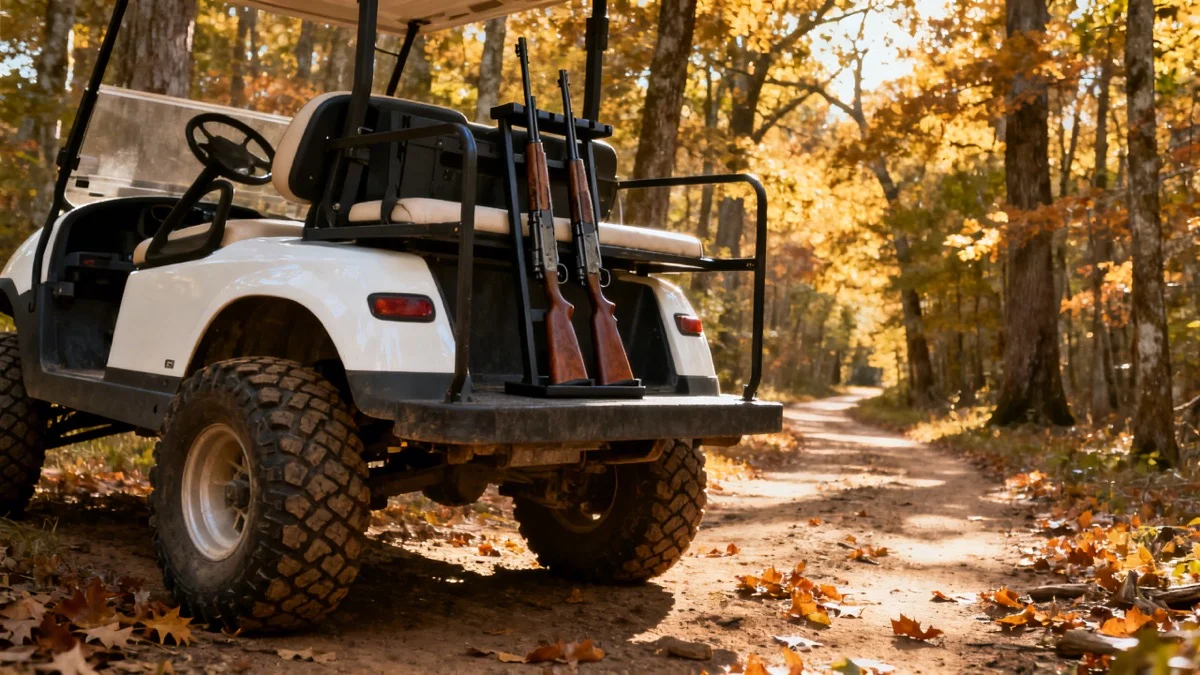
Lifted golf cart with all-terrain tires on a wooded trail, ready for hunting

As an Amazon Associate, we earn from qualifying purchases. This helps support our site at no extra cost to you.

Hunters have been repurposing golf carts for decades, but 2026 is the first year you can buy a cart built specifically for the trail. Modern lithium batteries deliver 40+ mile range, lifted suspensions handle rough terrain, and electric motors run quiet enough to sneak past a whitetail at 30 yards.

Whether you want a ready-to-hunt cart off the lot or plan to build your own rig from a used platform, this guide covers the best hunting golf carts for 2026 with real prices, honest recommendations, and the accessories that actually matter.

Price Range $7,249 to $15,000+

Best Electric Range 40 to 45 miles

Best Gas Range 100 to 120 miles

DIY Build Cost $3,000 to $6,000

Why Golf Carts Make Great Hunting Vehicles

Golf carts sit in a sweet spot between ATVs and walking. They carry more gear than you can shoulder, move quietly through the woods (especially electric models), and cost a fraction of a side-by-side UTV.

Here is why more hunters are choosing them:

Near-silent operation. Electric golf carts produce almost no noise at low speeds. Hunters on forums like Archery Talk and Shotgun World consistently report that electric carts let them approach food plots and stand locations without spooking game. Gas carts are louder, but still quieter than most UTVs.

Lower cost than UTVs. A capable hunting golf cart runs $7,000 to $15,000 new. A comparable Polaris Ranger or Can-Am Defender starts at $12,000 and climbs past $25,000 quickly. For moderate trails on private land, the golf cart does the job at half the price. See our full pricing guide for detailed cost breakdowns.

Trail-friendly size. Golf carts are about 4 feet wide and 8 feet long, narrow enough to fit on ATV trails and between trees. A full-size UTV is typically 5 to 6 feet wide.

Easy gear hauling. Most 4-seat carts have a rear bench that folds flat into a cargo bed. Combined with a front basket and floor-mount gun racks, you can carry rifles, tree stands, decoys, and a full day's worth of gear.

Simple maintenance. Electric carts have fewer moving parts than a lawnmower. No oil changes, no spark plugs, no belts. Gas carts need basic engine maintenance, but far less than a UTV. Our maintenance guide covers everything you need to know.

Electric vs Gas: Which Is Better for Hunting?

This is the biggest decision you will make. Both have legitimate advantages for hunting, and the right choice depends on how and where you hunt.

FactorElectricGas
NoiseNear-silentModerate (quieter than UTV)
Range25 to 45 miles100 to 120 miles
Refuel/recharge4 to 8 hours (lithium)2 minutes at the pump
Hill performanceGood with 48V+ lithiumExcellent
MaintenanceMinimalOil, filters, spark plugs
Fuel cost$0.02 per mile$0.08 to $0.12 per mile
Cold weatherReduced range (10 to 20%)Unaffected
Price range$7,000 to $15,000$8,000 to $13,000

When Electric Wins

Stalking and stand hunting. If you park near a food plot or approach a stand, electric is the clear winner. You can creep along at 3 to 5 mph with barely a whisper. Several hunters on Archery Talk specifically switched from gas to electric for this reason.

Small to mid-size properties. If your hunting land is under 500 acres, a lithium electric cart with 35 to 45 miles of range will cover a full day's worth of trips without running out. For a deeper dive into battery range, see our range guide.

Budget-conscious hunters. Electric carts cost less to fuel and maintain over time. Charging a 48V lithium battery costs about $0.50 to $1.00. No oil changes, no fuel filters, no carburetor rebuilds.

When Gas Wins

Large properties and all-day hunts. If you are covering 1,000+ acres, checking multiple stands, and hauling gear all day, gas range (100 to 120 miles per tank) eliminates range anxiety. You can refill a gas tank in the field in two minutes.

Steep, hilly terrain. Gas engines deliver consistent torque on long climbs. Electric carts handle hills fine, but lithium batteries drain faster on sustained grades. A gas cart does not care how steep the hill is.

Remote properties without power. If your hunting cabin does not have electricity, charging an electric cart becomes a challenge. Gas is simpler when you are off the grid.

For a complete side-by-side comparison, check out our electric vs gas golf cart guide.

What to Look for in a Hunting Golf Cart

Not every golf cart can handle a deer trail. Here are the features that separate a hunting cart from a golf course cruiser.

Ground Clearance and Suspension

Stock golf carts have about 3 to 4 inches of ground clearance, enough for paved paths and nothing more. For hunting trails, you need 6 to 8 inches minimum. That means a lift kit: either a spindle lift ($150 to $300) for 3 to 5 inches, or an A-arm lift ($400 to $800) for 5 to 6 inches with better ride quality.

Independent front suspension makes a noticeable difference on rough terrain. Models like the Denago Rover XL and Evolution Forester 4 Plus come standard with independent suspension, while most Club Car and EZGO models use solid axles.

All-Terrain Tires

Stock golf cart tires are designed for smooth turf. For hunting, you need all-terrain tires with aggressive tread patterns. The sweet spot is 22 to 23 inch tires on 12 or 14 inch wheels. They provide grip in mud, dirt, gravel, and loose sand without making the cart too tall to fit under tree branches.

DOT-rated tires are worth the extra cost if you will drive on any public roads to access your hunting land.

Battery and Range

For electric carts, lithium batteries are the standard for hunting. They weigh 60 to 70% less than lead-acid, charge in 4 to 8 hours vs 8 to 12, and deliver consistent power until they are nearly empty (lead-acid fades gradually). A 48V 105Ah lithium pack gives you 35 to 45 miles on flat ground. Our battery guide has the full breakdown, and our lithium conversion guide covers upgrading an older cart.

Cold weather matters for hunters. Lithium batteries lose 10 to 20% of range in temperatures below 40 degrees F. Plan your routes with that in mind during late season.

Cargo and Hauling Capacity

Look for a fold-down rear seat that converts to a flat cargo bed. This gives you a dedicated space for coolers, tree stands, and harvested game. Some utility models like the Yamaha UMAX have a fixed cargo bed with 800 lb capacity and 1,500 lb towing capability.

Towing Capacity

Most golf carts can tow 500 to 1,000 lbs with a standard hitch. That is enough for a small trailer with a deer, a load of feed corn, or a portable blind. Utility-class models tow up to 1,500 lbs.

Best Golf Carts for Hunting in 2026

These are the top picks based on off-road capability, range, cargo space, and value. Prices reflect current dealer listings.

Best Overall: Evolution Forester 4 Plus

The Forester 4 Plus was designed from the ground up for off-road use. It comes with a lifted chassis, 23-inch all-terrain tires, independent suspension, and a 48V lithium battery that delivers up to 40 miles per charge.

  • Price: $10,000 to $13,000
  • Motor: 48V AC
  • Range: Up to 40 miles
  • Top speed: 25 mph
  • Standout features: 9-inch touchscreen, backup camera, Bluetooth audio, DOT-rated tires
  • Why hunters pick it: Purpose-built off-road platform with factory-installed features that you would otherwise add aftermarket. The lifted stance and silent tires handle trails that would bottom out a standard cart.

Best Value: AODES Trailcross

The AODES Trailcross delivers rugged styling and a street-legal package at a price that undercuts the competition by thousands.

  • Price: $7,249
  • Motor: 48V
  • Range: Up to 40 miles
  • Top speed: 25 mph
  • Standout features: 4-passenger seating, street-legal package, aggressive styling
  • Why hunters pick it: At $7,249, you get a lifted, trail-capable cart for less than a bare-bones Club Car. The savings leave room in the budget for accessories like gun racks and a windshield.
Check Price on Amazon

Best Electric Range: Denago Rover XL

The Denago Rover XL pairs a 5kW motor with a 105Ah lithium battery for consistent power across long distances. Its lifted suspension and 23-inch all-terrain tires come standard.

  • Price: $9,995
  • Motor: 5kW AC (350A controller)
  • Range: Up to 40 miles
  • Top speed: 25 mph
  • Standout features: Independent suspension, lifetime frame warranty, 8-year battery warranty, Bluetooth audio, backup camera
  • Why hunters pick it: The 8-year battery warranty is the best in the business for lithium carts. Independent suspension smooths out rough trails, and the all-forward seating means no one is riding backwards on bumpy terrain.

Best from a Major Brand: Club Car Onward Lifted

The Club Car Onward is the most trusted name in golf carts, and the lifted version handles off-road duty well. Club Car's rust-proof aluminum frame holds up in rain, mud, and creek crossings.

  • Price: $12,000 to $16,000 (lithium)
  • Motor: 3.3kW to 5kW (depending on configuration)
  • Range: 25 to 35 miles
  • Top speed: 19 to 25 mph
  • Standout features: Aluminum frame (no rust), extensive dealer network, industry-leading resale value
  • Why hunters pick it: If you want a cart that will last 15 to 20 years with minimal maintenance and hold its value when you sell, Club Car is the safe bet. The dealer network means parts and service are always accessible.

Best Utility: Yamaha UMAX Rally

The Yamaha UMAX Rally is built for work. Its 800 lb cargo bed capacity and 1,500 lb towing capability make it the most capable hauler on this list.

  • Price: $14,000 to $21,000
  • Motor: Gas EFI or electric
  • Range: 100+ miles (gas), 30+ miles (electric)
  • Top speed: 19.5 mph
  • Standout features: Factory brush guard, deFender fender flares, 23-inch tires, cargo bed with 800 lb capacity
  • Why hunters pick it: This is the pick for hunters who need to haul heavy loads: feed, stands, equipment, and harvested game. The gas version offers all-day range on large properties, and Yamaha reliability is well-documented.

Best Amazon Option: Kandi GOAT 2P

The Kandi GOAT 2P is one of the few full-size electric golf carts you can buy directly on Amazon with free shipping. Its 5,000W motor and yoke steering give it a more aggressive, off-road feel.

  • Price: $7,999
  • Motor: 5,000W
  • Range: 40 miles
  • Top speed: 25 mph
  • Standout features: Yoke steering, off-road capable, ships direct to your door
  • Why hunters pick it: Convenience. No dealer negotiation, no waiting list. Order it, have it delivered, and start adding accessories. The 5kW motor handles hills and trails with authority.
Check Price on Amazon

Hunting Golf Cart Comparison Table

ModelPricePowerRangeSeatsBest For
Evolution Forester 4 Plus$10,000 to $13,00048V AC40 mi4Overall off-road
AODES Trailcross$7,24948V40 mi4Budget hunters
Denago Rover XL$9,9955kW AC40 mi4Long range + warranty
Club Car Onward Lifted$12,000 to $16,0003.3 to 5kW25 to 35 mi4Reliability + resale
Yamaha UMAX Rally$14,000 to $21,000Gas/electric100+ mi (gas)2+2Heavy hauling
Kandi GOAT 2P$7,9995kW40 mi2Buy on Amazon

Must-Have Hunting Golf Cart Accessories

A stock golf cart gets you to the trail. These accessories turn it into a proper hunting rig. For the full roundup, check our complete accessories guide.

Gun Racks and Holders

A floor-mount gun rack is the first accessory most hunters add. Universal models fit EZGO, Club Car, Yamaha, and most aftermarket brands. Look for adjustable angles, quick-release straps, and non-slip rubber pads that protect your firearm's finish.

The 10L0L Universal Gun Holder holds two rifles or shotguns vertically, mounts to any flat floorboard, and includes Velcro straps for extra security. It runs about $50 to $70.

Check Price on Amazon

Windshields for Branch Protection

If you are driving through wooded trails, a windshield keeps branches, brush, and bugs out of your face. A fold-down acrylic windshield ($100 to $200) is the most popular option because you can fold it flat when you do not need it.

For EZGO TXT owners, the ENEKERP windshield is a solid pick with easy bolt-on installation and scratch-resistant acrylic.

Check Price on Amazon

LED Light Bars for Early Morning and Late Hunts

Dawn and dusk are prime hunting hours, and stock golf cart headlights are not built for unlit trails. An LED light bar mounted to the roof or front bumper puts out serious light. A 7-inch bar ($25 to $50) is enough for trail navigation without being overkill.

Check Price on Amazon

Heated Seat Cushion for Cold-Weather Hunts

Late-season hunting means cold mornings. The NOKINS heated, ventilated, and vibrating seat cushion plugs into a 48V system and keeps you warm on the ride to your stand. It also has a cooling mode for early-season hunts in warmer climates.

Check Price on Amazon

Other Accessories Worth Adding

  • Camo seat covers: Protect your seats from mud, blood, and gear scuffs while blending in. Budget $40 to $80.
  • GPS tracker: Protect your investment if you leave the cart on remote property. Real-time tracking runs $50 to $150 plus a monthly subscription.
  • Enclosure or cover: A rain enclosure keeps you and your gear dry. Full enclosures run $150 to $400 depending on cart model.
  • Side mirrors: Required for street-legal use and helpful when towing a trailer on trails.
  • Storage cover: Protect your cart from the elements when parked at a hunting cabin.

How to Build a Hunting Cart from a Used Golf Cart

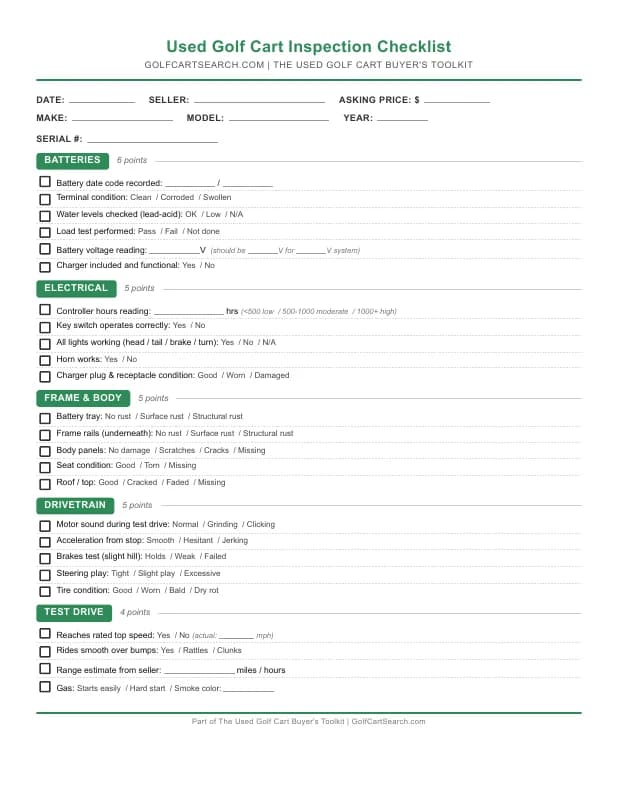
Not everyone needs a $10,000+ purpose-built hunting cart. With a $2,000 to $4,000 used golf cart and $1,000 to $2,000 in upgrades, you can build a capable hunting rig for roughly half the cost. Our used golf cart buying guide explains what to look for when shopping.

Step 1: Start with the Right Platform

The best platforms for a hunting build are the Club Car Precedent/Onward, EZGO TXT, or Yamaha Drive2. These three have the most aftermarket support by a wide margin. A 5 to 10 year old model in decent condition runs $2,000 to $4,000 at a dealer or on the used market.

Electric or gas? For a DIY build, gas is simpler (no battery upgrades needed) and gives you better range on remote property. Electric is worth it if stealth is a priority and you have access to a power outlet.

Step 2: Add a Lift Kit

A 4 to 6 inch lift kit is the foundation of any hunting build. It adds ground clearance and allows you to fit larger tires.

  • Spindle lift (3 to 5 inches): $150 to $300, easiest to install
  • A-arm lift (5 to 6 inches): $400 to $800, better ride quality
  • Drop axle (3 to 5 inches): $200 to $400, good middle ground

Most lifts can be installed in a garage with basic hand tools in 2 to 4 hours.

Step 3: Upgrade to All-Terrain Tires

Swap the stock turf tires for 22 to 23 inch all-terrain tires on 12 or 14 inch wheels. A set of four tires and wheels runs $300 to $600. Look for deep tread patterns designed for mud and loose terrain.

Step 4: Install Hunting Accessories

Add a gun rack ($50 to $70), windshield ($100 to $200), LED light bar ($25 to $50), and any other accessories from the list above. A rear-view mirror ($15 to $30) and front brush guard ($50 to $100) round out the build.

Budget Breakdown: DIY Hunting Cart Build

ItemCost Range
Used golf cart (5 to 10 years old)$2,000 to $4,000
Lift kit (4 to 6 inch)$200 to $600
All-terrain tires and wheels (set of 4)$300 to $600
Gun rack$50 to $70
Windshield$100 to $200
LED light bar$25 to $50
Misc. accessories (mirror, brush guard)$65 to $130
Total$2,740 to $5,650

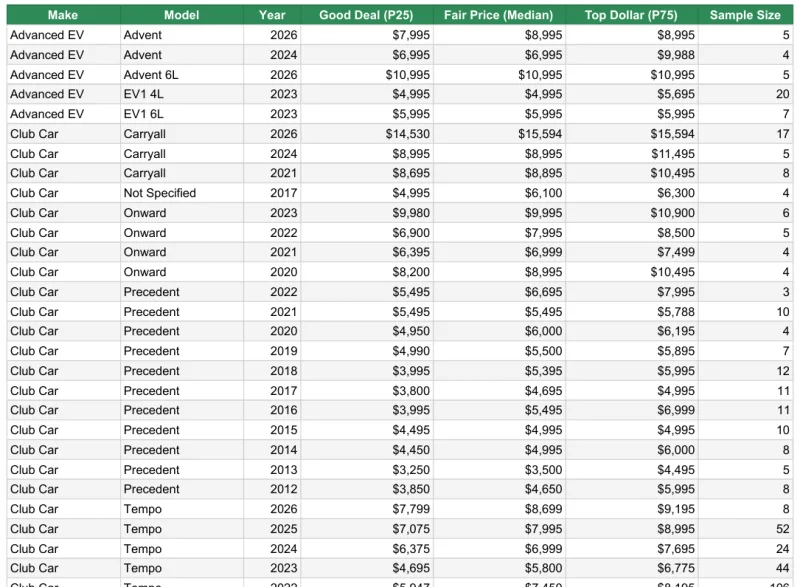
For tips on getting the best deal, check our golf cart value guide to make sure you are not overpaying for the base cart.

Trail Riding Tips and Safety

A hunting golf cart is only useful if you can get it to and from the field safely. Here are practical tips from experienced hunting cart owners.

Know Your Terrain Before You Go

Walk a trail before you drive it. Look for washouts, stumps, low-hanging branches, and soft spots that could swallow a tire. Mark problem areas with flagging tape so you can avoid them at dawn when visibility is low.

Manage Battery Range on Long Hunts

If you are running an electric cart on a full-day hunt, plan your route to stay within 60% of your total range. Hills, mud, and heavy loads drain batteries faster than flat pavement. Carry a portable battery meter so you can check charge levels in the field.

For speed-related upgrades and their effect on range, see our speed upgrade guide. Keep in mind that higher top speeds reduce range significantly.

Check Local Laws and Regulations

Golf cart regulations vary by state and even by county. On private land, you can generally operate any golf cart without registration or insurance. On public roads, most states require street-legal equipment including headlights, taillights, turn signals, mirrors, and a windshield.

Public hunting land has its own rules. Some state wildlife management areas allow golf carts on designated roads; others restrict motorized vehicles to trucks only. Check with your state wildlife agency before your first trip. Our state-by-state golf cart laws page is a good starting point.

If you plan to drive on public roads to access hunting land, you will likely need golf cart insurance. Coverage runs $100 to $300 per year. More details in our insurance guide.

Transporting Your Cart

Most hunters trailer their golf carts to the property. A standard golf cart weighs 800 to 1,100 lbs, so any half-ton truck can tow one on a basic flatbed or tilt trailer ($800 to $2,000). Make sure to strap the cart down with ratchet straps to all four corners and disconnect the battery before trailering.

Basic Safety Practices

Golf cart safety applies on the trail just as much as in a neighborhood. Keep speeds under 10 mph on rough terrain, avoid steep side-slopes that could cause a rollover, and make sure firearms are unloaded and secured in the gun rack while the cart is moving. Our golf cart safety guide covers additional precautions.

How Hunting Golf Carts Compare to Other Brands

The hunting cart market pulls from both specialized brands and the established Big Three. Here is a quick overview of where each brand fits.

Club Car and EZGO offer the strongest dealer networks and aftermarket support. If you want maximum customization options and easy access to parts, these are the safest picks. Both offer lifted models from the factory.

Yamaha stands out with the UMAX utility line, which has the highest cargo and towing capacity of any standard golf cart. The gas-powered UMAX Rally is a favorite among farmers and hunters with large properties.

Evolution, ICON, and Denago are newer brands that ship purpose-built off-road models with features like touchscreens, backup cameras, and independent suspension included in the base price. They offer more features per dollar than the established brands.

Star EV offers solid utility models at competitive prices, and their Capella and Sirius lines have gained traction in the hunting community. See our Star EV review for details.

For a broader comparison of every major brand, check our best golf cart brands ranking and our best golf carts page.

Frequently Asked Questions

Can you legally drive a golf cart on public hunting land?

Rules depend on the state and the specific tract of land. Many state wildlife management areas allow golf carts on established roads. National forests generally permit them on roads open to motorized traffic. Contact your local wildlife agency or check their website for specific regulations.

Are golf carts safe for hunting dogs?

Yes, with some precautions. Use a leash attachment or kennel secured to the rear cargo area. Avoid letting dogs ride loose on the seat, as sudden stops or rough terrain can throw them. Some hunters add a raised platform on the rear with non-slip matting.

Can a golf cart handle deep mud?

Standard golf carts get stuck quickly in deep mud. A lifted cart with aggressive all-terrain tires can handle moderate mud (2 to 4 inches) at slow speeds. For consistently muddy conditions, consider a gas cart with higher torque or add a winch ($100 to $200) as a recovery option.

What modifications void a golf cart warranty?

Lift kits, aftermarket controllers, and motor swaps typically void the drivetrain warranty from the manufacturer. Battery upgrades may void the battery warranty. Bolt-on accessories like gun racks, light bars, and windshields generally do not affect warranty coverage. Check with your specific manufacturer before modifying.

How long do hunting golf cart batteries last?

Lithium batteries last 2,000 to 5,000 charge cycles (8 to 15 years of typical use). Lead-acid batteries last 300 to 500 cycles (3 to 5 years). Hunting use puts more strain on batteries than golf course use due to rough terrain and heavier loads, so expect to be on the lower end of these ranges.

Find a dealer near you to test drive any of these models on our dealer directory, or browse our full golf cart customization guide for more ideas on building the perfect hunting rig.

Share this post

Golf Cart Search

Find the Best Golf Carts of 2026

Compare top-rated models, read expert reviews, and find the perfect cart for your needs.
Related posts

Stay in the loop

Stay Updated with Golf Cart News

Get the latest updates on golf cart services, tips, and exclusive offers delivered to your inbox.