
As an Amazon Associate, we earn from qualifying purchases. This helps support our site at no extra cost to you.
When a golf cart lithium battery is not charging, record the battery model and BMS fault before resetting anything. A protected output, incorrect charging profile, connection problem and internal failure can produce similar symptoms; a blank display does not choose between them.
We checked the sources on October 10, 2026. The named LiTime example below shows why battery temperature, recovery conditions and current-rating definitions matter. Its instructions do not apply automatically to a factory lithium Club Car, E-Z-GO or another aftermarket pack.
What to check first
- Stop use for damage. Swelling, smoke, leakage, melted connections or a hot charge plug require isolation and qualified inspection, not another reset.
- Identify the system. Record battery/charger labels, chemistry, configuration, controller and any conversion wiring.
- Capture the fault. Save app/display alarms, charge permission, cell/battery temperature and the time the problem appeared.
- Confirm charging approval. Check voltage, current, profile, connector and any communications against the exact battery instructions.
- Follow the relevant branch. Use the model's temperature recovery, approved wake procedure or connection diagnosis.
A connector that fits does not prove approval. Do not copy a generic cable-disconnect duration or repeatedly switch charge/discharge permissions to defeat a protection condition.
Cold charging: trip and recovery are different temperatures
The checked LiTime 48V/51.2V 100Ah Bluetooth battery stops charging below 0°C / 32°F, but lists automatic charging recovery at 5°C / 41°F. Its linked manual specifies battery temperature for recovery; the accompanying note says warming above that threshold.
That is a 5°C / 9°F gap between trip and recovery. A garage air reading just above freezing does not demonstrate that the battery's sensor has met the recovery condition. Use the reported battery temperature and applicable instructions, and allow the pack to stabilize. Do not use a heat gun or bypass the BMS.
The checked model does not list self-heating in its specifications. A different heated pack can have another approved cold-charge procedure; the presence of a heater is not permission to improvise an external heating method.
Use the winter storage guide for planning. Storage temperature, permitted discharge temperature and charging recovery are different limits.
BMS wake and reset: use the installed model's procedure
For the named LiTime pack, the manufacturer's page says connecting the charger is needed for initial use or after manual power-off. Its manual's recovery section describes a 30-minute isolated rest, then an activation-capable charger if recovery does not occur.
Follow this model’s complete procedure; another pack may require a different recovery method. Have a qualified installer follow the complete isolation, charging and reconnection instructions for the actual battery/cart combination. Do not use a jump pack, force current into cells or open the case.
Record the reason for protection before attempting recovery. If the same alarm returns, contact battery support with the captured evidence. A wake-up that restores output does not establish why the system shut down or whether its current demand is suitable.
A real owner report does not authorize a reset method
In a public lithium-upgrade discussion checked on October 10, MirSpaceStation described an E-Z-GO TXT with a Lipro 36V 60Ah replacement battery that stopped after a curb impact or sudden load. The owner reported disconnecting/reconnecting a negative connection to recover operation.
Another participant, hiroler2, described trouble at low charge and suggested app charge/discharge toggles. The discussion does not identify that participant's exact battery or provide a verified BMS log, current trace, temperature record or confirmed repair for MirSpaceStation's cart.
The case illustrates the missing information: load-related shutdown and failure to charge are separate complaints. Do not adopt someone else's cable or app workaround as a manufacturer-approved procedure, or conclude from this report that every shutdown means an undersized BMS.
Confirm the exact charger
A nominal “48V lithium” label does not identify the approved charging limit. For the named LiTime 51.2V pack, the manual lists 57.6V ± 0.8V. That upper bound is 58.4V, matching the checked charger output; it does not approve 58.4V for every 48V-class system.
The battery page also contains an inconsistent 53.25–54.75V FAQ recommendation alongside its specification and charger links. Use the exact installed manual and obtain written clarification if the supplied instructions conflict, rather than selecting a setting from mixed page text.
These manufacturer prices were displayed on October 10, 2026, before any applicable tax or other order charges:
| Exact LiTime charger | Output | Displayed price | Relevant distinction |
|---|---|---|---|
| 48V 10A | 58.4V, 10A | $142.99 | Indoor-use recommendation; excludes its 15-cell server-rack batteries |
| 48V 18A waterproof | 58.4V, 18A | $155.99 | Manufacturer lists IP65 and lithium activation |
The price difference is $13, about 9.1% of the 10A price, while rated output current differs by 8A. These are two dated products, not a market-wide best-value ranking or proof of fitment to your cart. Both pages advertise activation; battery approval and the complete procedure still govern its use.
The charger-plug guide covers physical connections. The light-code guide explains why LED colors cannot validate battery compatibility.
Separate terminal voltage from internal cell condition
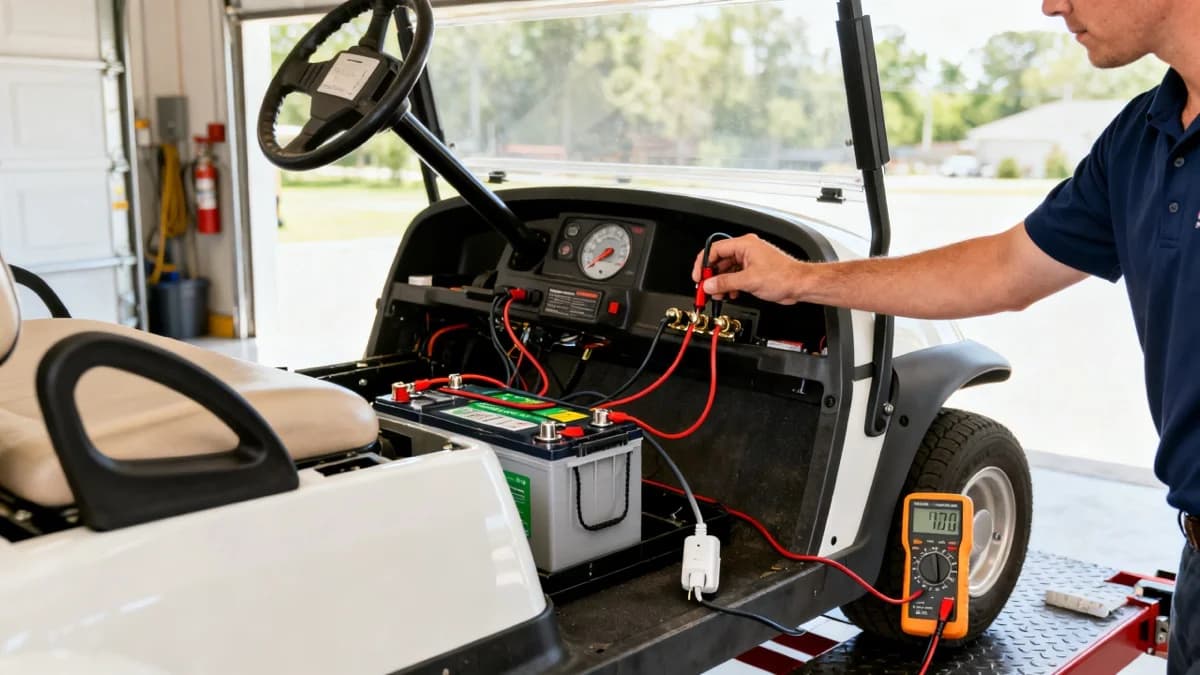
Measure only at safe, approved points using the instrument's DC-voltage setup and correct sockets. Never connect a current-mode meter across the pack. A zero or low external reading can reflect a protected output or open circuit; it does not expose the internal cells' voltage.
The named LiTime manual's resting-voltage reference uses three hours with charger and loads disconnected and zero current. It describes the lookup as approximate and affected by instrument and temperature. Do not substitute a generic “50–56V is normal” band or use a resting reading as a capacity test.
Ask support which measurements are appropriate for the installed pack, including any BMS cell-voltage and temperature data. Use the battery test guide for meter limitations; its flooded lookup table is not a lithium chart.
For those approved external voltage checks, the Klein MM420 offers DC-voltage measurement. Use its own range, accuracy table and socket instructions. The Amazon listing was checked October 16, 2026. This is a voltage-testing tool, not a BMS reset device or a meter to put in series with the traction circuit; it cannot prove internal cell condition or usable capacity.
See price on AmazonCheck wiring and current demand separately
A damaged receptacle or cable can interrupt charging. Isolate before inspecting, and use the exact terminal torque and installation instructions. If charging depends on moving the plug, stop and repair the connection rather than holding it in place.
For load-related shutdown, obtain the actual controller settings and battery-current trace using the approved diagnostic method. A controller's motor/phase-current number is not necessarily battery current. The motor-current guide explains that distinction.
The checked LiTime manual identifies a 200A BMS board, but specifies 100A maximum continuous discharge and 600A for one second. Therefore the “200A BMS” heading is not a promise of 200A sustained output. That distinction matters when comparing the demand of a modified cart with a battery's permissible duty.
An installer must also verify controller, regenerative behavior, accessory wiring, fusing and mounting. A cart badge appearing on a battery's marketing page does not approve every model or controller modification.
If the complaint starts after parking rather than acceleration, our battery-drain guide for carts with the key off covers standby measurements, storage-state checks and monitor thresholds.
Series batteries need explicit permission
Do not build a 48V bank from four arbitrary 12V lithium batteries. Each exact model must explicitly support the proposed series count, charging/balancing method and golf-cart motor duty. Similar capacity, brand or age does not establish that approval.
The named 51.2V LiTime 100Ah pack explicitly does not support series connection; its manual instead describes a conditional parallel arrangement. Do not extrapolate permission from one product to another.
A single pack and multiple series packs have different monitoring and installation requirements. This guide does not claim one is universally more reliable without comparative service evidence. Use the conversion guide and the battery manufacturer's system approval before changing the arrangement.
What to send the battery maker or repair shop
Provide battery and charger labels, purchase/warranty records, BMS alarms and sensor temperatures, safe measured outputs, controller information, charging history and when the symptom occurs. Include photographs of external wiring and damage without opening the pack.
Request a diagnosis and an itemized approved repair/replacement quote. Repeated shutdown, water exposure or no output requires investigation; none alone proves the entire pack must be replaced. A confirmed internal failure, warranty determination and the system's condition should guide the decision.
For repair support, use the electric golf cart repair directory. Keep the fault capture and manufacturer's response with the cart's service record.
Frequently asked questions
Why is my lithium golf cart battery not charging?
Possible branches include charging incompatibility, BMS protection, temperature, connections or internal failure. Record the exact model and fault; this guide does not rank their frequency.
How do I reset a golf cart lithium BMS?
Use the exact battery’s approved recovery procedure. There is no universal cable-disconnect duration or app-toggle sequence; capture the alarm and obtain support if it returns.
Does warming above 32°F clear cold protection?
Not necessarily. The checked LiTime model trips below 32°F but lists recovery at 41°F battery temperature. Garage air or case warmth does not establish the sensor condition.
Does every 48V lithium battery need 58.4V?
No. Charging voltage depends on the exact battery system. The named LiTime manual’s 57.6V ± 0.8V range includes 58.4V, but that does not approve it for every nominal 48V pack.
Does no terminal voltage prove the cells are dead?
No. A protected output or open circuit can change the external reading. Use the manufacturer’s diagnostics without opening the case or forcing charge into cells.
Is a 200A BMS a 200A continuous-output rating?
Do not assume so. The named LiTime manual distinguishes a 200A board from 100A maximum continuous discharge and a one-second 600A surge.
Can four 12V lithium batteries power a golf cart?
Only if the exact batteries and complete arrangement are approved for the proposed series count, charging/balancing method and motor duty. Do not infer permission from matching brand or capacity.
Should I replace the battery or charger first?
Diagnose before replacing either. Capture BMS data, verify charging approval and inspect external connections; request an itemized approved repair or warranty decision.
Golf Cart Search
Find the Best Golf Carts of 2026
Compare top-rated models, read expert reviews, and find the perfect cart for your needs.