
Set golf cart tire pressure from the vehicle label or exact manual, with the approved tires fitted. Tire size alone is not enough: Yamaha's 2025 QuieTech and PowerTech AC IRS manuals specify different pressures for the same nominal 18x8.50-8 size.
The chart below identifies the source model, manual or assembly number. Documents were checked on October 10, 2026. It is a manufacturer-document comparison, not a measured ride or tire test.
If one tire repeatedly loses air, use our golf cart flat-tire guide to distinguish a tread, valve or bead leak before choosing a repair.
Golf cart tire pressure chart by model and tire package
Match the actual cart and its approved package before using a row. The chart covers these documented examples; 16–26 PSI is not a universal safe range for every vehicle or aftermarket tire.
| Vehicle or approved assembly | Tire package | Published pressure | Exact source |
|---|---|---|---|
| E-Z-GO Express 2 / Express 4 ELiTE, MY2025 onward in this edition | Original approved model package | 18–22 PSI | 10082881-B, printed pages 3 and 30 |
| E-Z-GO Express 6 ELiTE, same edition | Original approved model package | 22–26 PSI | 10082881-B, printed pages 3 and 30 |
| Yamaha MY2025 DR2 PTV QuieTech | 18x8.50-8, 4-ply / 205/65-10, 4-ply | 16 / 22 PSI, respectively, front and rear | LIT-19626-A3-81, pressure label, PDF page 12 / printed page 5 |
| Yamaha MY2025 DR2 PTV PowerTech AC IRS | 18x8.50-8, 4-ply / 205/65-10, 4-ply | 20 / 22 PSI, respectively, front and rear | LIT-19626-A3-84, pressure label, PDF page 12 / printed page 5 |
| Club Car assembly 47561646001, Loadstar / Mercury wheel | 205/55-10 | 18 PSI | Approved Tire Matrix, PDF page 1 |
| Club Car assembly 47561650001, driver-side C254 / Mercury wheel | 215/40-12 | 18 PSI | Approved Tire Matrix, PDF page 1 |
| Club Car assembly 47561644001, Kraken / Mercury wheel | 22x10-10 | 20 PSI | Approved Tire Matrix, PDF page 1; lift/vehicle approval must also match |
| Club Car assembly 47561648001, Kraken / Mercury wheel | 23x10-12 | 20 PSI | Approved Tire Matrix, PDF page 1; lift/vehicle approval must also match |
| E-Z-GO RXV EX1 EFI Fleet, Freedom, Freedom 2+2, Valor 2 / 4, MY2024 onward in this edition | Original approved model package | 18–22 PSI | 10036460-E, printed page 5 |
The Club Car rows identify assemblies, not permission to fit them to every DS, Precedent, Tempo or Onward. The matrix has a separate vehicle-prefix approval grid and a lift-kit requirement for starred entries. Have the dealer match both axes of that grid; a matching tire size alone is insufficient.
For the cited RXV EX1 EFI manual, hard surfaces use the higher part of its approved range and soft terrain or turf the lower part. Do not carry that instruction to a different cart with a single specified pressure. RXV tire-pressure section.
Worked lookup: the same tire size gives two answers
Follow the lookup in these two manufacturer manuals:
- Read the manual cover. LIT-19626-A3-81 identifies MY2025 DR2 PTV QuieTech. LIT-19626-A3-84 identifies MY2025 DR2 PTV PowerTech AC IRS. Neither is a generic Yamaha tire guide.
- Open PDF page 12, printed page 5. Both show the operating-pressure label with tire size and separate front/rear columns.
- Match the complete tire line. For 18x8.50-8, 4-ply, the QuieTech label says 16 PSI on both axles; the AC IRS label says 20 PSI on both.
- Check the cart in front of you. Confirm its serial/model identity, fitted tire and pressure label. If it has a conversion or a different package, resolve the approved specification before using either value.
The difference is 4 PSI, or 25% of the QuieTech's 16 PSI specification: (20 − 16) ÷ 16 = 0.25. That shows the size-only lookup error; it does not quantify ride comfort, traction or tire life. The documents do not establish a single cause for the different vehicle specifications. QuieTech label, AC IRS label.
For an older Yamaha G8, G14, G16 or G29, locate its own model/year manual in Yamaha's official library. These MY2025 rows do not establish those older models' pressures.
Cold pressure, sidewall limits and the gauge
Check before driving, after the tires have cooled to ambient conditions. NHTSA's general tire guidance defines a cold reading as at least three hours without driving and distinguishes the vehicle pressure from the tire's sidewall figure. Its passenger-vehicle guidance supports that measurement principle; the golf cart's manual supplies the actual PSI. NHTSA TireWise.
The sidewall identifies tire limits and ratings; it is not automatically the recommended operating pressure for the installed vehicle. The cited Express manual also prohibits exceeding the tire inflation rating and using an inadequately rated tire. Do not solve a conflict by guessing a compromise pressure. Confirm the correct tire/package. Express tire section, printed pages 29–30.
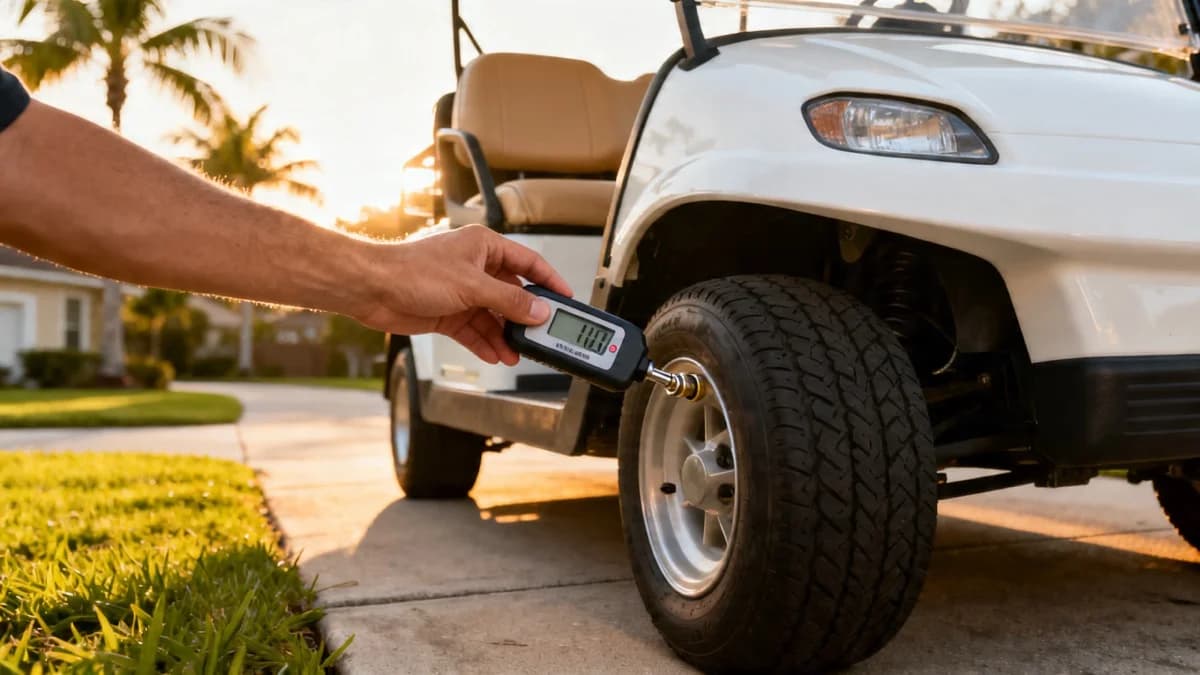
Use a gauge whose measurement range and documented accuracy cover the target pressure. “Digital” does not establish accuracy. A gauge limited to 1–20 PSI cannot measure a 26 PSI specification; display resolution is not the same as measurement accuracy.
If two gauges disagree enough to change the setting, have the reading checked against a suitable reference before setting the tires.
How to check and set pressure
- Park on a level surface and secure the cart. Let the tires cool before establishing the cold setting.
- Inspect the tread, sidewalls, valve stems and fitted tire markings. Resolve damage or incompatible ratings before driving.
- Find the matching vehicle label, manual and approved package. Record separate front/rear values if given.
- Measure each tire using the same suitable gauge. Seat it squarely on the valve to avoid losing air during the reading.
- Add small amounts of air or release air as needed, then measure again. Small tires can change pressure quickly.
- Refit valve caps and record readings. Recheck a tire that repeatedly loses pressure; investigate its valve, bead, rim or tire rather than continually topping it up.
Follow the vehicle schedule. The cited Express manual lists tire condition and pressure as pre-ride checks on printed page 26. A general monthly habit does not replace that more frequent requirement. Express maintenance schedule.
Rear seats, lifts and aftermarket wheels
Before changing pressure to address rear squat or a harsh ride, check rated payload and load distribution. Include people, cargo and accessories. A rear-seat kit or heavier battery pack does not automatically create additional capacity or authorize an extra 1–2 PSI.
The cited RXV manual's load table distinguishes its two-passenger versions from Freedom 2+2 and Valor 4, and tells owners to count occupants, cargo and accessories. Those capacities apply to the named vehicles, not every cart with a rear seat. RXV load-capacity section.
For a modified cart, confirm the approved seat kit, springs, lift, wheel offset, tire load rating and operating pressure together. If the documentation is missing, send the manufacturer or dealer the cart identification, assembly part number, tire markings and intended load.
Persistent tire rubbing is a fitment problem to investigate. Excess inflation is not an approved clearance adjustment. Persistent squat may involve overload, an unsuitable conversion, incorrect springs or worn components. Check capacity before replacing shocks based on appearance.
The tire-size reference, wheel and tire guide and suspension guide help organize those checks. Exact package approval still comes from its manufacturer.
When the cart still handles badly
Measure pressure before diagnosing from tread wear or ride feel. Uneven wear, pulling, vibration or a harsh ride can involve pressure, load, alignment, tire damage, wheel fitment and suspension. None is a reliable one-symptom diagnosis.
If the pressures match the approved specification, move to alignment and steering checks and a qualified inspection. Do not keep lowering pressure until the ride feels soft, and do not lower it for sand unless the actual vehicle and tire documentation permits that use.
Recheck cold pressure after a sharp weather change. Set the current reading to the specified value; do not calculate an alternative operating target from the weather.
Find a local specialist in the repair directory if the package specification is unclear or handling remains unpredictable.
Frequently asked questions
What PSI should golf cart tires be?
Use the pressure label or exact owner manual for the vehicle and approved tire package. The examples in this guide span 16–26 PSI; they do not establish a universal range for every golf cart.
What pressure should 205/50-10 golf cart tires be?
Tire size alone does not establish operating pressure. Match the exact vehicle and approved wheel-and-tire package. Do not copy a 205/55-10 value for a different tire.
Can front and rear pressures be different?
Yes, where the manufacturer specifies different values. Do not add rear pressure based only on a rear seat or heavier batteries. Follow the exact axle specifications.
Should I use the maximum PSI on the tire sidewall?
The tire limit does not replace the vehicle operating specification. Follow the approved vehicle/package pressure while staying within the installed tire rating. If the requirements conflict, have the manufacturer or a qualified dealer resolve the fitment.
How often should I check tire pressure?
Follow the vehicle maintenance schedule. The E-Z-GO Express manual cited here requires a pre-ride tire condition and pressure check; a monthly routine is not a substitute for that instruction.
Does a harsh ride prove the tire pressure is too high?
No. Measure pressure first, then check approved payload, tire and wheel fitment, suspension condition and alignment. Ride feel alone does not identify the cause.
Golf Cart Search
Find the Best Golf Carts of 2026
Compare top-rated models, read expert reviews, and find the perfect cart for your needs.