As an Amazon Associate, we earn from qualifying purchases. This helps support our site at no extra cost to you.
Quick Answer: Gas Golf Cart Battery Size
Most gas golf carts use one 12V starting battery. A Group 70 is common on many gas Club Cars, a Group 26, 26R, or 26UT is common on many gas EZGOs, and a Group 24 or 24F is common on many gas Yamahas. These are starting points, not universal fitments. Match the old battery and manual for case dimensions, positive-post location, top or side terminals, hold-down, cold cranking amps, and reserve capacity before buying.
The correct gas golf cart battery size is a 12V starting-battery fitment, not an electric-cart traction-pack voltage. In a gas cart, one battery cranks the small gasoline engine and supports 12V accessories. An electric cart's battery pack powers the drive motor for the entire trip.
That difference is why a stock gas cart usually needs a 12V starting battery, not a 36V or 48V set of deep-cycle batteries. If you are still deciding between powertrains, our electric vs gas golf cart comparison explains the ownership differences. For electric-cart battery chemistry, voltage, and pack replacement, use the complete golf cart battery guide instead.
Use the chart below as a first lookup for Club Car, EZGO, and Yamaha, then verify the model, year, tray, terminals, and electrical ratings.
System Voltage 12V
Battery Count One
Common Club Car Size Group 70
Common EZGO Size Group 26 family
Common Yamaha Size Group 24 family
Typical Battery Cost $100 to $230
Gas Golf Cart Battery Size Chart
Use this chart to narrow the search, then verify every item in the final column.
| Gas golf cart brand | Common 12V starting point | Common performance reference | Verify before purchase |
|---|---|---|---|
| Club Car | Group 70, often side-post on older applications | Legacy Club Car guidance: 460 CCA, 85-minute reserve; newer commercial examples: 500 CCA, 105-minute reserve | Model/year, top vs side posts, cable ends, tray, hold-down, hood or seat clearance |
| E-Z-GO | Group 26, 26R, or 26UT | Current Express gas example: 525 CCA, 85-minute reserve | Standard or reversed polarity, utility terminals, case height, hold-down, manual rating |
| Yamaha | Group 24 or 24F | Match the original battery and exact Yamaha manual | 24 vs 24F length, positive-post side, top clearance, CCA, reserve, hold-down |
The group number is not a power rating. Battery Council International explains that a BCI group identifies physical size, terminal arrangement, and fit-related features. CCA and reserve capacity are separate specifications.
Model generations, utility variants, previous-owner modifications, replacement cable ends, and accessory installations can all change what fits. Use the golf cart serial number and VIN guide or the free golf cart VIN decoder if you do not know the exact cart.
Group 70 vs 26 vs 24 Battery Dimensions
BCI publishes maximum overall dimensions and terminal layouts. These are the standardized references that explain why a battery with the right voltage can still be the wrong fit.
| BCI group | Maximum length | Maximum width | Maximum height | Main fitment difference |
|---|---|---|---|---|
| Group 70 | 8 3/16 in | 7 1/16 in | 7 5/16 in | Compact side-terminal format in the BCI chart |
| Group 26 | 8 3/16 in | 6 13/16 in | 7 3/4 in | Compact top-post format |
| Group 26R | 8 3/16 in | 6 13/16 in | 7 3/4 in | Same case envelope as 26, reversed terminal layout |
| Group 24 | 10 1/4 in | 6 13/16 in | 8 7/8 in | Longer top-post case than Group 26 |
| Group 24F | 10 3/4 in | 6 13/16 in | 9 in | Slightly longer/taller with a different terminal layout |
Those dimensions come from the BCI group-size specification chart. A specific retail battery may list a slightly different housing dimension within the allowed envelope, and a 26UT utility-terminal battery may add hardware that affects clearance. Measure the actual tray and available height.
Do not focus on length alone. A battery can sit in the tray yet still be wrong because:
- the positive post ends up beside the negative cable
- the old cables cannot reach without tension
- the hold-down crosses a vent cap or terminal
- a top post touches the seat base or metal body panel
- a side-terminal cable has been converted poorly
- the case lip does not engage the stock hold-down
Club Car Gas Golf Cart Battery Size
Group 70 is the most useful first lookup for many gas Club Car carts. Club Car's FAQ confirms that its gas vehicles require a 12V battery. An archived Club Car gasoline service manual specifies a Group 70 side-post battery with 460 CCA and 85 minutes of reserve. It also emphasizes using the proper case size so the stock hold-down can secure the battery.
That legacy specification is not universal for every Club Car model. A Club Car Precedent brochure identifies a 12V battery without naming the group, while Club Car commercial specifications show 500 CCA and 105 minutes of reserve for multiple gas vehicles. Match the exact cart's fit and electrical rating instead of applying one legacy specification to every model year.
For a gas Club Car Onward, Precedent, DS, Carryall, or Tempo:
- Record the serial number and model year.
- Photograph the current posts and every connected cable.
- Check whether the cart uses side or top terminals.
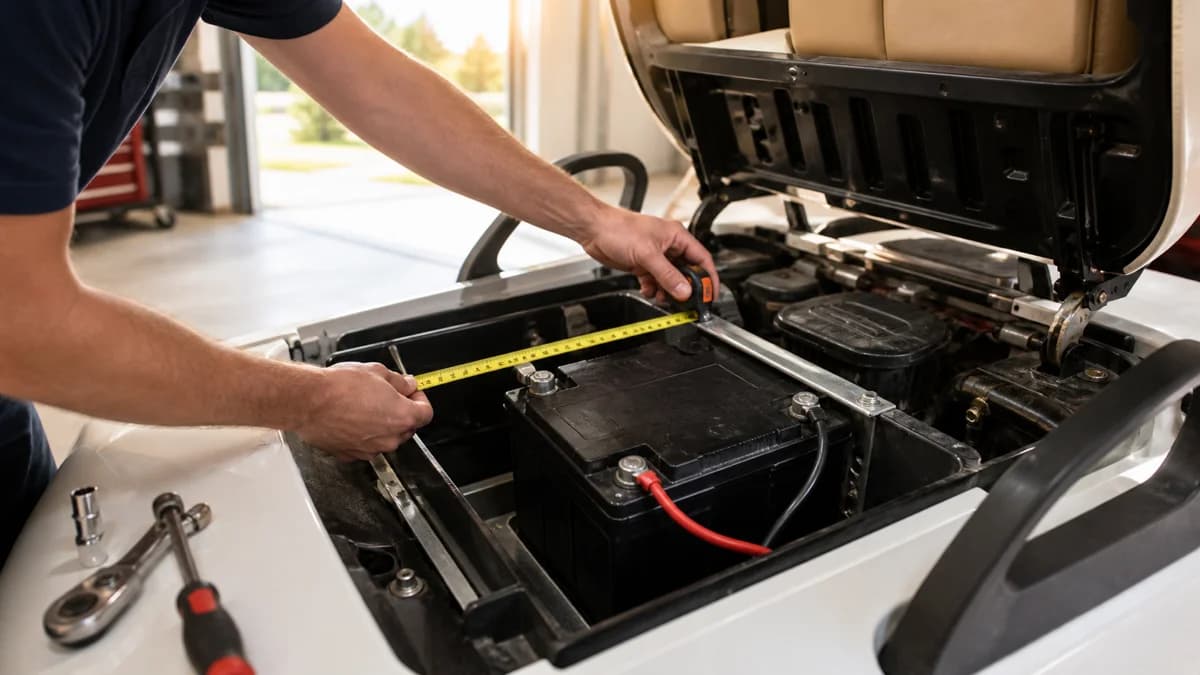
- Measure the tray, hold-down, and overhead clearance.
- Match or exceed the manual's CCA and reserve rating without changing fit.
A Group 70 battery with the wrong terminal style can create more work than it solves. If a previous owner changed the cable ends, compare the wiring against the manual before copying the modification. The Club Car parts page can help narrow brand-specific replacement categories after you confirm the cart.
EZGO Gas Golf Cart Battery Size
Group 26, 26R, or 26UT is the common battery family to investigate for many gas EZGO carts. The suffix matters. A Group 26R reverses the terminal arrangement, while a 26UT may use utility-style terminals. Choosing by “Group 26” alone can put the positive post on the wrong side or leave the cable lugs without a proper connection.
Current E-Z-GO specifications provide a better performance target than a generic aftermarket chart. The gas E-Z-GO Express 4 lists one 12V maintenance-free battery with 525 CCA and an 85-minute reserve. That does not mean every TXT, RXV, Valor, Workhorse, or Express uses the identical case and posts. It shows why the rating on the old battery matters alongside group size.
E-Z-GO's TXT EX1 gas owner manual also settles the starting-versus-deep-cycle question. The cart uses a starting battery. Repeatedly draining it deeply shortens its life, and accessories can consume more current than the charging system replaces.
Check the EZGO parts page after identifying the exact vehicle. If the battery stays discharged after replacement, move to the starter generator test and cost guide instead of buying another battery.
Yamaha Gas Golf Cart Battery Size
Group 24 or 24F is the common starting point for many gas Yamaha golf carts. Do not treat those labels as interchangeable. BCI lists Group 24 at 10 1/4 inches long and Group 24F at 10 3/4 inches, with different terminal layouts. Half an inch and a reversed positive post can decide whether the factory cables and hold-down fit.
Yamaha's current gas owner manual confirms the use of a 12V starting battery but does not give one universal group number for every generation. The Yamaha lineup spans G-series carts, the Drive/G29, current Drive2 PTV, fleet vehicles, and UMAX utility models, so check the model-specific manual and the old battery.
For a Yamaha, copy these details from the existing battery before shopping:
- group number, including any F or R suffix
- positive terminal position when viewed from the post side
- SAE top posts, threaded studs, or other terminal hardware
- CCA and reserve capacity
- case length, width, and total height
- hold-down contact points
If the label is unreadable or the battery has been improvised, identify the model code and year through Yamaha's manual library or a dealer. The Yamaha parts page is useful after fitment is known, not as a substitute for that check.
Starting vs Deep-Cycle Batteries for Gas Golf Carts
A stock gas golf cart normally needs a starting battery, not a traction deep-cycle battery.
| Battery type | Best use | Gas golf cart verdict |
|---|---|---|
| Starting battery | Brief, high-current engine cranking | Correct default for a stock gas cart |
| Deep-cycle battery | Repeated long, deep discharge | Correct for electric traction packs, usually wrong as the default gas-cart starter |
| Dual-purpose marine battery | Starting plus moderate accessory reserve | Possible option when fit and OEM ratings match, but not automatically better |
| AGM starting battery | Starting with sealed, spill-resistant construction | Good premium option when the exact group, posts, CCA, charging profile, and hold-down match |
A deep-cycle battery may have plenty of amp-hours and still be a poor starter choice. A starting battery uses plate construction designed to deliver a strong burst of current. The stock gas-cart charging system is also designed around the expected starting battery.
If the cart has a large stereo, light bars, a winch, or accessories used while parked, solve the accessory load correctly. Repeatedly deep-cycling the starter battery will kill it early. Depending on the build, the right answer may be a fused auxiliary battery and isolator installed by a technician, reduced accessory load, or longer charging time. It is not automatically the largest battery that can be forced into the tray.
How Much CCA Does a Gas Golf Cart Battery Need?
Match the published specification or the original battery, and do not go lower. Published Club Car and E-Z-GO examples fall between 460 and 525 CCA:
- legacy Club Car guidance: 460 CCA and 85-minute reserve
- current Club Car commercial examples: 500 CCA and 105-minute reserve
- current E-Z-GO Express gas example: 525 CCA and 85-minute reserve
CCA measures how much current a battery can deliver at 0°F for a specified test. Higher CCA helps cold starting, but the number does not fix wrong posts, poor hold-down fit, or a case that is too tall. Reserve capacity tells you how long a charged battery can support a 25-amp load before reaching its test cutoff. It matters more when accessories run with little or no charging output.
If you live in a cold climate, match or modestly exceed the OEM CCA within the correct group and terminal layout. In a warm climate, do not use a lower rating simply because the weather is mild. The starter generator, engine condition, cable resistance, and battery age still affect cranking demand.
How to Verify the Right Battery in Five Steps
1. Identify the exact cart
Write down the brand, model, year, serial number, and engine type. Body panels and seats are often swapped. A serial-number lookup is more reliable than visual guessing. If the tag is missing or unreadable, find a local golf cart dealer that can cross-reference the chassis and engine details.
2. Read the old battery label
Record voltage, full group designation, CCA, reserve capacity, chemistry, part number, and terminal type. Take a photo before disconnecting anything.
3. Measure the battery compartment
Measure tray length and width, then the vertical distance to the nearest seat base, body panel, or bracket. Check where the hold-down grips the battery. Allow room for terminal boots and cable bends.
4. Map the terminals and cables
Stand at the same side used by the battery maker's diagram and note where positive and negative sit. Confirm the cables reach naturally without pulling across the case. Check accessory ring terminals for fuses, corrosion, and unsafe stacks. The battery cable size and terminal guide covers damaged or modified cables.
5. Match performance and warranty
Use a 12V starting battery with at least the required CCA and reserve capacity. Compare warranty terms, local service, core return, and manufacturing date. A fresh battery with local warranty support is often a better buy than an old shelf battery with a famous label.
Gas Golf Cart Battery Cost in 2026
A conventional flooded starting battery in a common gas-cart size usually costs $100 to $230. Premium AGM products can run roughly $250 to $420, especially in larger Group 24 variants.
Current examples checked in August 2026 show the spread. Interstate lists a Group 70 starting battery at $129.95. Battery Wholesale lists Group 26, 26R, and 70 gas-cart starting batteries at $134.99 and a Group 24 at $144.99. A Batteries Plus Group 24 automotive starting battery is $194.99, while an official Odyssey Group 24 AGM starting battery is $389.99. Prices vary by location, warranty, stock, and chemistry.
| Cost item | Typical 2026 range |
|---|---|
| Flooded 12V starting battery | $100 to $230 |
| Premium AGM starting battery | $250 to $420 |
| Refundable core deposit | $15 to $30 |
| Shop installation and cable cleanup | $40 to $120 |
| Battery plus charging-system diagnosis | $100 to $250 |
Buying locally is often practical because lead-acid batteries are heavy, shipping options can be limited, and the old battery can be returned for the core refund. The golf cart battery parts finder groups tools and replacement categories, while a local golf cart repair shop can test the battery and charging system together.
Test the Battery Before Replacing It
A resting voltage check is fast, but it does not prove the battery is healthy.
- Turn off accessories and let the battery rest.
- Measure directly across the battery posts with a digital multimeter.
- A fully charged flooded 12V battery is commonly around 12.6 to 12.8V at rest.
- Watch voltage while the starter generator cranks.
- Use a rated battery load tester or ask a battery store to test it.
- Check whether running voltage rises according to the cart service manual.
A cheap meter is enough for basic DC-voltage screening. It cannot measure usable starting capacity by itself. A weak battery may show 12.6V with no load and collapse as soon as the cart tries to crank.
Check Price: Schumacher BT-100 Load TesterThe BT-100 applies a 100-amp load to 12V batteries and supports testing up to 1,000 CCA. Follow its timing and temperature instructions because a load tester creates heat. If you are uncomfortable around high-current battery terminals, get a free or low-cost test at a battery store.
For a broader voltage workflow, see the golf cart battery voltage chart. If the cart still will not crank with a proven battery, follow the golf cart will not start guide and check the main fuse through the golf cart fuse-box guide.
How to Replace a Gas Golf Cart Battery Safely
Lead-acid batteries contain acid, release flammable gas, and can deliver enough current to melt a tool. Wear eye protection and gloves, remove jewelry, keep flames and sparks away, and use insulated tools.
- Park on a level surface, engage the parking brake, turn the key off, and remove it.
- Photograph cable routing and label accessory wires.
- Disconnect the negative cable first, then the positive cable.
- Remove the hold-down without placing a metal tool across both terminals.
- Lift the battery upright with a proper strap or safe two-hand grip.
- Clean and inspect the tray, hold-down, cables, and terminal ends.
- Set the new battery in the same orientation and secure the hold-down.
- Connect positive first, then negative.
- Protect clean connections and confirm no cable can rub a belt or hot engine part.
- Test the cart and charging voltage before reinstalling the seat fully.
Never leave the battery loose. A gas cart vibrates, crosses bumps, and may operate on slopes. A loose case can crack, a post can contact metal, and cable movement can create intermittent starting or heat.
How to Charge and Maintain the Battery
Use a smart charger that supports the battery chemistry. E-Z-GO's TXT EX1 manual specifies a 12V charger rated at 10 amps or less for a discharged battery. A 5-amp charger stays below that limit and can handle routine charging and maintenance on many gas-cart starting batteries, subject to the exact battery and cart manuals.
Check Price: NOCO GENIUS5 Smart ChargerThe NOCO GENIUS5 supports 6V and 12V flooded, maintenance-free, and AGM lead-acid batteries with separate modes. Select the correct chemistry. Do not use a lithium mode on a lead-acid battery or an AGM mode unless the battery maker calls for it.
Monthly maintenance is simple:
- keep the case and terminals clean and dry
- make sure the hold-down stays secure
- inspect cable insulation and ground connections
- check electrolyte only if the battery has removable caps
- use distilled water only and follow the battery maker's fill procedure
- charge monthly during storage or use a compatible maintainer
- turn off lights, USB outlets, stereos, and other accessories when parked
The E-Z-GO manual notes that its gas engine does not idle, so the battery does not charge while the cart is stopped. It also warns that accessories can drain the battery even while the generator operates. That is why long periods with lights or audio on can matter more on a pedal-start gas cart than owners expect.
Our complete maintenance guide, gas golf cart tune-up guide, and winter storage guide cover the rest of the seasonal routine.
Why a New Battery Keeps Going Dead
If a fresh battery repeatedly needs charging, stop treating the battery as the only suspect.
| Symptom | Likely next check |
|---|---|
| Battery dies only after accessories are used while parked | Accessory draw, switch wiring, auxiliary power plan |
| Battery starts charged but weakens after several drives | Starter generator, regulator, belt, charging wiring |
| Battery dies while parked with everything off | Parasitic draw, stuck relay, accessory controller, damaged wiring |
| Cart cranks slowly with a charged battery | Corroded cables, ground strap, starter-generator belt, engine drag |
| Battery post or cable gets hot | Loose connection, corrosion, damaged cable, wrong terminal hardware |
| Fuse blows after battery work | Reversed accessory lead, pinched wire, wrong cable routing |
Check voltage at rest, during cranking, and while running. Inspect the starter-generator belt and ground path. If charging voltage never rises or changes erratically, test the starter generator and regulator. If the battery drains only while parked, measure key-off current draw or have a technician trace the accessory circuits.
Do not keep exchanging batteries until the charging and draw problem is fixed. That gets expensive and can hide a hot cable or short-circuit risk.
Which Gas Golf Cart Battery Should You Buy?
Use the brand as a first lookup, then confirm these fit and electrical checks before buying:
- Club Car: investigate Group 70 first
- EZGO: investigate Group 26, 26R, or 26UT first
- Yamaha: investigate Group 24 or 24F first
- Voltage: one 12V starting battery
- Performance: meet or exceed the exact CCA and reserve requirement
- Fit: match dimensions, polarity, terminals, hold-down, cable reach, and overhead clearance
For most stock carts, a fresh flooded starting battery is the best value. Choose AGM when the exact fit is available and the lower-maintenance, spill-resistant design is worth the higher cost. If the cart has heavy accessories or keeps killing batteries, fix the load or charging problem instead of buying a larger battery blindly.
Gas Golf Cart Battery FAQs
What size battery does a gas golf cart use?
Most gas golf carts use one 12V starting battery. Group 70 is common for many Club Car gas carts, Group 26/26R/26UT for many gas EZGOs, and Group 24/24F for many gas Yamahas. Verify the model, year, group suffix, posts, tray, hold-down, CCA, and reserve rating.
What size battery does a gas Club Car use?
Many gas Club Cars use a Group 70-style starting battery. Legacy Club Car guidance specified a side-post Group 70 with 460 CCA and 85-minute reserve, while newer commercial specifications show 500 CCA and 105-minute reserve. Check the exact cart before purchasing.
What size battery does a gas EZGO use?
Many gas EZGO carts use a Group 26-family battery. Group 26, 26R, and 26UT can differ in polarity or terminal hardware. A current E-Z-GO Express gas specification uses 525 CCA and 85 minutes of reserve, but case fit still depends on the exact model.
What size battery does a gas Yamaha golf cart use?
Group 24 or 24F is common on many gas Yamaha carts. They differ in length and terminal layout, so copy the full group code from the old battery and verify the Yamaha manual, tray, cable reach, and hold-down.
Can I put a regular car battery in a gas golf cart?
Yes, when it is a 12V starting battery that matches the required group size, terminal layout, CCA, reserve capacity, and hold-down. “Car battery” describes a broad category, not a guaranteed fit.
Does a gas golf cart take one battery or several?
A typical gas golf cart takes one 12V battery. Electric carts usually use a 36V or 48V traction pack made from several batteries or one lithium pack.
Should a gas golf cart use a starting or deep-cycle battery?
Use a starting battery unless the manufacturer specifies otherwise. It is designed for the short, high-current burst needed by the starter generator. A dual-purpose battery may work in a compatible accessory-heavy application, but fit and starting performance still come first.
How much CCA does a gas golf cart battery need?
Use the manual or original-battery rating. Many published Club Car and E-Z-GO examples are between 460 and 525 CCA. Do not go below the specified CCA just because the battery fits the tray.
How much does a gas golf cart battery cost?
A conventional flooded starting battery usually costs about $100 to $230 in 2026. Premium AGM options can reach roughly $250 to $420. Return the old battery to recover the core deposit.
How long does a gas golf cart battery last?
Three to five years is a practical planning range for many lead-acid starter batteries. Extreme heat, storage without charging, accessory drain, deep discharges, corrosion, and charging-system faults can shorten that life.
Can I jump-start a gas golf cart?
Do not assume car-style jump-starting is approved. The E-Z-GO TXT EX1 manual says jump-starting is dangerous and impractical because the cart can move when the engine starts. Use the model manual and a compatible low-amp 12V charger instead.
Why does my gas golf cart battery keep dying?
The likely causes are normal self-discharge over long storage, a key-off accessory draw, a stuck relay, corroded wiring, or an old battery. Disconnect or test accessory circuits, charge the battery monthly during storage, and measure parasitic draw if it goes flat quickly.
Golf Cart Search
Find the Best Golf Carts of 2026
Compare top-rated models, read expert reviews, and find the perfect cart for your needs.