As an Amazon Associate, we earn from qualifying purchases. This helps support our site at no extra cost to you.
Golf Cart Won't Start But Lights Work? Fix Guide
If your golf cart won't start but the lights work, the cart is not completely dead. The 12V accessory circuit or dashboard circuit has power, but the drive circuit, start circuit, or safety interlock is not letting the cart move. That usually points to weak batteries under load, a solenoid problem, tow/run switch, forward/reverse switch, brake or pedal micro switch, controller fault, or a main fuse.
You press the pedal and nothing happens. Or maybe you hear a click, but the cart just sits there. Either way, your golf cart won't start and you need it fixed.
If you are learning the controls on a working cart, use the normal electric and gas starting sequence first. Continue here only when the cart fails after that sequence.
Good news: most golf cart starting problems are straightforward to diagnose and many are easy to fix yourself. This guide walks you through every common cause for both electric and gas golf carts, organized by what you see and hear when you try to start. We cover brand-specific tips for EZGO, Club Car, and Yamaha, repair costs, DIY difficulty ratings, and when to call a professional.
If you already have a general sense of what might be wrong, check our broader golf cart troubleshooting guide. Otherwise, start with the flowchart below to narrow things down fast.
If you want a cost range before calling a shop, run the free golf cart troubleshooter after you answer the first few checks below.
Quick Diagnostic Flowchart
Before pulling out tools, answer this question: What happens when you turn the key and press the accelerator?
Lights work but cart won't start or move:
- Battery pack may have enough power for lights but not enough under motor load
- Tow/run switch may be in tow
- Solenoid may click but not pass current
- Forward/reverse switch or pedal micro switch may be open
- Controller may have a fault code
- Gas carts: starter solenoid, starter/generator, fuel, spark, or ignition issue
Nothing at all (completely dead):
- Dead batteries (electric) or dead starter battery (gas)
- Blown fuse or tripped circuit breaker
- Bad key switch / ignition switch
- Tow/run switch in wrong position
Clicking sound but no movement:
- Bad solenoid (most likely)
- Weak batteries (enough to click, not enough to move)
- Corroded battery terminals
- Faulty brake interlock micro switch
Buzzing but no movement:
- Controller issue (electric carts)
- Motor problem (seized, worn brushes)
- Electromagnetic brake not releasing
Engine cranks but won't fire (gas carts only):
- No fuel (empty tank, clogged filter, bad fuel pump)
- No spark (fouled plug, bad ignition coil)
- No air (clogged air filter)
- Stale fuel or gummed-up carburetor
Cart starts then dies:
- Fuel delivery problem (gas)
- Weak batteries dropping under load (electric)
- Loose wiring connection
- Intermittent solenoid or controller failure
Now that you have a direction, find your cart type below and work through the specific causes.
Golf Cart Won't Start But Lights Work: First 7 Checks
Do these before ordering a solenoid, controller, charger, or battery pack.
| Check | What it tells you | Fast fix |
|---|---|---|
| Battery pack voltage | Lights can run on weak voltage, but the motor cannot | Charge and load-test batteries |
| Battery cable tightness | Loose cables can pass small current but fail under load | Clean and tighten terminals |
| Tow/run switch | Cart will not drive in tow mode | Switch to run, then cycle key |
| Solenoid click | Click means the control side is trying; no output means bad contacts | Test both large terminals |
| Forward/reverse switch | Open contacts stop movement in one or both directions | Test continuity and connections |
| Brake/pedal micro switch | Safety interlock can prevent activation | Test continuity while pressing pedal |
| Main fuse/fuse block | Some circuits can work while drive/control feed is dead | Inspect and continuity-test fuses |
If the cart is gas, treat "lights work" as proof that the 12V battery is not completely dead, not proof that it is healthy. A weak 12V battery can light bulbs and still fail to crank the starter/generator. Test voltage before chasing fuel or spark.
Electric Golf Cart: 11 Reasons It Won't Start
Electric carts account for about 70% of the golf cart market. The electrical system is simpler than a gas engine in many ways, but diagnosing issues does require a multimeter. If you do not own one yet, a basic digital multimeter like the AstroAI 2000 Counts ($13) is the single most important diagnostic tool you can buy.
Check Price: AstroAI MultimeterFor a full list of recommended diagnostic tools, see our essential golf cart tool kit guide.
1. Dead or Weak Batteries
The #1 cause of electric golf carts not starting.
Symptoms: No response at all when turning the key. Dashboard dim or completely off. Cart was sluggish before dying. Charger won't activate when plugged in.
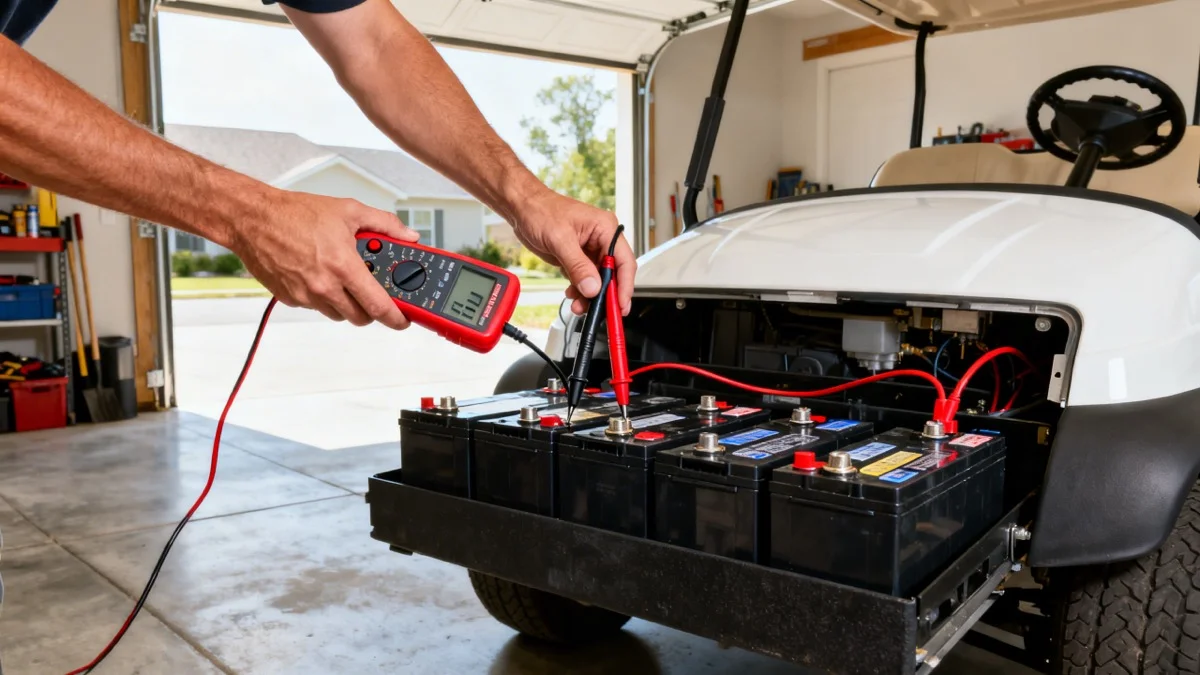
How to diagnose: Set your multimeter to DC voltage and test each battery individually. Here is what a healthy, fully charged battery should read:
| Battery Voltage | Healthy Reading | Needs Charging | Replace Soon |
|---|---|---|---|
| 6V battery | 6.2 - 6.4V | 5.8 - 6.1V | Below 5.8V |
| 8V battery | 8.4 - 8.6V | 7.8 - 8.3V | Below 7.8V |
| 12V battery | 12.6 - 12.8V | 12.0 - 12.5V | Below 12.0V |
Also check total pack voltage. A 36V system should read 37-39V when fully charged. A 48V system should read 49-52V.
The fix: If batteries are simply discharged, charge them. If individual batteries read significantly lower than the rest, that battery has a bad cell and needs replacement. When replacing batteries, replace the entire set rather than mixing old and new.
Cost: $0 if charging resolves it. $800-$1,500 for a full lead-acid set. $1,500-$3,000+ for lithium.
DIY difficulty: Easy (testing), Medium (replacement)
2. Corroded or Loose Battery Terminals
Symptoms: Intermittent starting. Cart dies when hitting bumps. Lights flicker. Reduced power that comes and goes.
How to diagnose: Open the battery compartment and look for white, green, or blue crusty buildup on the terminals and cable ends. Wiggle each cable connection while watching your multimeter. Any voltage fluctuation means a bad connection.
The fix: Disconnect cables (negative first), scrub terminals and cable ends with a battery terminal brush and a paste of baking soda and water, rinse with clean water, dry thoroughly, apply anti-corrosion spray or a thin layer of dielectric grease, then reconnect (positive first). This is part of routine golf cart maintenance that prevents most starting issues.
Battery Terminal Cleaner Kit →Cost: $5-$15 for a terminal cleaning brush and anti-corrosion spray.
DIY difficulty: Easy
3. Low Battery Water Level
Symptoms: Batteries not holding charge. Reduced range before the cart stops. Batteries getting hot during charging. Sulfur smell.
How to diagnose: Open the battery caps (lead-acid batteries only; lithium batteries are sealed) and look inside. The water level should cover the lead plates by about 1/4 to 1/2 inch. If you can see exposed plates, that is the problem.
The fix: Add distilled water only (never tap water) until the plates are covered by 1/4 to 1/2 inch. Do not overfill. Charge the batteries fully after adding water. For convenience, a battery watering system lets you fill all batteries at once without opening individual caps.
Cost: $1-$3 per gallon of distilled water. $70-$120 for a Flow-Rite Pro-Fill watering system.
DIY difficulty: Easy
4. Solenoid Problems (Clicking But Not Moving)
Symptoms: Audible click when pressing the accelerator but the cart does not move. Rapid clicking or buzzing. Intermittent operation. No click at all despite good batteries.
The solenoid is an electromagnetic switch that connects your battery pack to the motor. When it fails, you get the click (the coil trying to engage) but no current flow to the motor. This is one of the most common golf cart repairs.
If you want the dedicated breakdown of solenoid symptoms, fitment mistakes, and replacement costs, use our golf cart solenoid symptoms and replacement guide.
How to diagnose:
- Turn the key on, press the accelerator, and listen for a click
- If you hear a click, set your multimeter to DC voltage and touch the probes to the two large terminals on the solenoid
- Have someone press the accelerator while you watch the meter
- You should see battery pack voltage on both large terminals
- If voltage appears on the input terminal but not the output terminal, the solenoid contacts are burned or stuck and it needs replacement
- You can also test the coil by measuring resistance across the two small terminals: 0 to 0.4 ohms is normal
The fix: Replace the solenoid. Make sure to match voltage (36V vs 48V) and terminal configuration (most are 4-terminal).
Cost: $20-$100 for the part. $100-$250 if professionally installed.
DIY difficulty: Medium
5. Controller / Speed Controller Failure
Symptoms: No response to the accelerator at all. Jerky or erratic acceleration. Cart cuts out at random. Reduced top speed. Error codes blinking on the controller LED (some models).
The controller is the brain of an electric golf cart. It takes the signal from your accelerator pedal and regulates power delivery to the motor. When it fails, the cart either does nothing or behaves erratically.
How to diagnose: Check for error code blink patterns on the controller LED. EZGO PDS/DCS systems and Club Car IQ/Excel systems both use LED codes. Verify input voltage to the controller. Test the throttle sensor output with a multimeter. If the cart is an older electric Club Car and the pedal response is inconsistent rather than fully dead, read our Club Car MCOR symptoms and replacement guide before ordering controller parts.
The fix: Controller replacement is typically a dealer job. Some experienced DIYers handle it, but incorrect installation can damage the new controller or the motor.
Cost: $300-$1,000 for replacement.
DIY difficulty: Hard (diagnosis) / Dealer recommended (replacement)
6. Key Switch / Ignition Switch Failure
Symptoms: No response when turning the key. Dashboard completely dead. Intermittent operation: sometimes works, sometimes does not. Key feels loose or wiggly.
How to diagnose: Test for continuity across the key switch terminals with your multimeter. When the key is in the "on" position, you should see continuity (near 0 ohms). No continuity means the switch has failed internally.
The fix: Replace the key switch. Universal switches work on many carts, but brand-specific replacements ensure proper fit. Club Car uses a specific 2- or 3-pin switch. EZGO switches vary by model year. Yamaha typically uses a 2-wire switch.
Cost: $15-$50 for the part. $50-$100 professionally installed.
DIY difficulty: Easy to Medium
7. Forward/Reverse Switch Problems
Symptoms: Cart won't move in one direction. No response in either direction. Switch physically broken, stuck, or loose. Intermittent operation.
The forward/reverse (F/R) switch is a surprisingly common failure point, especially on Yamaha carts. The internal contacts wear over time and lose their connection.
How to diagnose: Inspect the switch for visible damage. Check for loose or corroded wiring connections at the switch. Use a multimeter to test continuity in each switch position. If the switch has no continuity in one or both positions, it needs replacement.
The fix: Replace the F/R switch. This is a straightforward swap on most carts.
Cost: $50-$150 for the switch. $100-$250 professionally installed.
DIY difficulty: Medium
8. Motor Problems
Symptoms: Buzzing sound without movement. Grinding noise. Burnt smell from under the cart. Very slow speed even with fully charged batteries.
How to diagnose: Check for a motor reset button (some models, particularly EZGO, have one). Try rotating the rear wheels by hand with the tow/run switch in "tow" mode. If the wheels won't turn, the motor may be seized or the electromagnetic brake is stuck. Inspect the motor brushes for wear if accessible.
The fix: Minor issues like worn brushes can be a DIY repair ($20-$50 for brushes). Seized motors or internal damage require professional rebuild or replacement.
Cost: $20-$50 for brushes. $500-$2,000 for motor replacement.
DIY difficulty: Hard / Dealer recommended
9. Charger Won't Activate (Batteries Too Dead)
Symptoms: Plug in the charger and nothing happens. No lights on the charger. Cart has been sitting for weeks or months without being charged.
This is extremely common after winter storage or long periods of inactivity. Golf cart chargers have a minimum voltage threshold. If the batteries self-discharge below that threshold, the charger will not turn on.
How to diagnose: Measure total pack voltage. A 36V charger typically needs at least 25-30V to activate. A 48V charger needs at least 35-40V.
The fix: Use a standard 12V automotive charger or trickle charger to individually boost each battery for 15-30 minutes. For 36V systems with 6V batteries, you can pair-charge (connect two 6V batteries in series to create 12V, matching a car charger). Once the total pack voltage rises above the charger's threshold, plug in your golf cart charger and let it complete a full charge cycle.
If your charger has failed, our charger buying guide covers the best replacements. The EPOWREY 48V charger is our top pick for Club Car, and FORM offers great value for 36V EZGO systems.
For TXT-specific plug and voltage matching, use our EZGO TXT charger guide before you order a replacement.
Check Price: EPOWREY 48V Charger (Club Car) Check Price: FORM 36V Charger (EZGO TXT)Cost: $0 if you already own a 12V charger. $30-$50 for a basic trickle charger. $150-$300 for a new golf cart charger if yours has failed.
DIY difficulty: Medium
10. Brake / Pedal Interlock Issues
Symptoms: Solenoid does not click at all. No response when pressing the accelerator despite good batteries. Brake pedal feels different than usual.
Most golf carts have a safety interlock: the brake must be released (or pressed, depending on model) before the cart will activate. A misadjusted or failed micro switch in this circuit will prevent the cart from starting.
How to diagnose: Locate the micro switch under the brake pedal or near the accelerator. Test it for continuity with a multimeter while actuating the pedal. Clean the switch contacts with electronic contact cleaner. Also check the tow/run switch, typically found under the seat. If it is in "tow" mode, the cart will not drive.
CRC QD Electronic Contact Cleaner →The fix: Clean the micro switch contacts with contact cleaner. If that does not help, replace the micro switch ($5-$30). Verify the tow/run switch is set to "run."
Cost: $5-$30 for a micro switch. $5-$10 for contact cleaner.
DIY difficulty: Easy to Medium
11. Blown Fuse or Tripped Circuit Breaker
Symptoms: Totally dead: no lights, no dashboard, no click. Or partially dead: some systems work but cart won't move.
How to diagnose: Locate the fuse box (location varies by brand and model year). Inspect fuses visually for a broken internal wire or discoloration. Test each fuse for continuity with a multimeter. Check the main circuit breaker (usually under the seat) and push the reset button if it has tripped.
If you cannot find the holder or the same fuse keeps blowing, use our golf cart fuse box location guide before replacing more parts.
The fix: Replace blown fuses with the same amperage rating. If the circuit breaker keeps tripping, there is an underlying short circuit that needs professional diagnosis.
Cost: $1-$5 per fuse. $20-$50 for a circuit breaker.
DIY difficulty: Easy
Gas Golf Cart: 10 Reasons It Won't Start
Gas golf carts follow the same diagnostic logic as any small engine: you need fuel, spark, air, and compression. If any one of those is missing, the engine won't fire. See our electric vs gas comparison for a deeper look at how these powertrains differ.
1. Empty Tank or Stale Fuel
Symptoms: Engine cranks but won't fire. No fuel smell at the exhaust. Engine sputters and dies if it starts at all.
How to diagnose: Check the fuel gauge or open the gas cap and look. If the cart has been sitting for more than 3 months, the fuel may have gone stale. Old gas turns gummy and clogs the fuel system.
The fix: Drain old fuel completely. Fill with fresh gas. Add a fuel stabilizer to prevent future issues. If the cart will be stored for more than a month, always add stabilizer before parking it. Our winterization guide covers proper seasonal fuel storage.
Cost: $5-$15 for fresh gas and fuel stabilizer.
DIY difficulty: Easy
2. Clogged Fuel Filter
Symptoms: Engine sputters, loses power under load, stalls frequently, or won't start at all.
How to diagnose: Locate the inline fuel filter (between the tank and carburetor). If the filter looks discolored or you can see debris inside, it is restricted. If the cart has been sitting with old fuel, the filter is almost certainly clogged.
The fix: Replace the fuel filter. This is a $5-$15 part and takes about 10 minutes. Replace it every season as part of your regular maintenance.
Cost: $5-$15.
DIY difficulty: Easy
3. Bad Fuel Pump
Symptoms: Engine cranks but won't start. No fuel reaching the carburetor.
How to diagnose: Disconnect the fuel line from the carburetor side. Hold the open end over a container and crank the engine briefly. Fuel should pulse out of the line. No flow means the fuel pump has failed. On EZGO and Club Car 4-cycle engines, the fuel pump is vacuum-pulse operated, so also check the vacuum line from the engine to the pump for cracks or disconnection.
For a fuller pump-specific test path and 2026 replacement pricing, use the golf cart fuel pump symptoms guide.
The fix: Replace the fuel pump. Match the pump to your specific engine model.
Cost: $15-$60 for a replacement pump.
DIY difficulty: Medium
4. Carburetor Issues
Symptoms: Engine cranks but won't start, or runs very rough. Backfires. Black smoke from exhaust. Hard starting, especially after sitting.
Stale fuel leaves varnish deposits that clog the tiny jets inside the carburetor. This is the most common gas cart issue after extended storage.
How to diagnose: Remove the air filter and look into the carburetor throat. Spray a short burst of carburetor cleaner directly into the throat and try to start the engine. If it fires briefly and dies, fuel is not reaching the combustion chamber through the carburetor, confirming the carb is clogged.
The fix: For mild clogging, spray carburetor cleaner through all accessible passages and jets. For severe cases, remove and rebuild the carburetor ($25-$50 for a rebuild kit) or replace it entirely ($50-$100 for an aftermarket carb). Brand-specific carburetors vary: EZGO 295cc and 350cc engines use different units, as do Club Car FE290 and FE350.
For a deeper step-by-step cleaning path and 2026 rebuild pricing, see the golf cart carburetor guide.
Cost: $10-$20 for carb cleaner spray. $25-$50 for rebuild kit. $50-$100 for a new aftermarket carburetor.
DIY difficulty: Medium (cleaning) / Hard (rebuild)
5. Fouled or Worn Spark Plug
Symptoms: Engine cranks but won't fire. Misfires or runs rough. Hard cold starting.
How to diagnose: Remove the spark plug and inspect it. A healthy plug has a light tan or gray color on the electrode. Black, oily deposits mean the plug is fouled. Check the electrode gap with a gap gauge. To test for spark, hold the plug against the engine block (grounding it) and have someone crank the engine. You should see a bright blue spark. Weak orange spark or no spark means the plug or ignition system needs attention.
The fix: Clean or replace the spark plug. This is one of the cheapest and easiest fixes for a gas cart. Common plugs: EZGO 4-cycle uses NGK BPR4ES or BPR2ES depending on the engine. Club Car uses NGK BPR2ES (FE290) or BPR4ES (FE350). Yamaha models typically use BPR4ES. Replace the plug every season as part of your spring checklist.
EZGO Golf Cart Spark Plug (4-Cycle 295cc/350cc) →Cost: $3-$8 per plug.
DIY difficulty: Easy
6. Ignition Coil Failure
Symptoms: No spark at the plug. Engine cranks but never fires. Intermittent spark that causes random stalling.
How to diagnose: If you tested the spark plug (see above) and got no spark with a known-good plug, the ignition coil is the next suspect. Test coil resistance with a multimeter: primary winding should read 0.5-2 ohms, secondary winding should read 5,000-15,000 ohms (varies by model).
The fix: Replace the ignition coil. Each brand uses different coils, so match the part to your specific model.
Cost: $30-$80 for a replacement coil.
DIY difficulty: Medium
7. Dead Starter Battery
Symptoms: No crank at all when pressing the pedal. Clicking from the starter solenoid but the engine does not turn. Dim lights.
Gas golf carts normally use one 12V starter battery to crank the engine, separate from an electric cart's traction pack. This battery charges while the engine runs through the starter generator, but it can die if the cart sits unused. Use the gas golf cart battery size guide to compare common Club Car Group 70, EZGO Group 26, and Yamaha Group 24 fitments before buying.
How to diagnose: Test the 12V battery with a multimeter. It should read 12.6V or higher when fully charged. Below 12.0V, it likely cannot crank the engine.
The fix: Charge the battery with a smart 12V charger that meets the cart and battery manuals. Do not assume car-style jump-starting is approved. If the battery will not hold a charge, replace it and test the charging system.
Cost: About $100-$230 for many conventional 12V starting batteries in 2026. Charging may resolve the problem if the battery is still healthy.
DIY difficulty: Easy
8. Starter / Starter Solenoid Issues
Symptoms: Clicking sound but engine won't crank. Starter engages but turns the engine too slowly. Grinding noise from the starter area.
How to diagnose: Listen for the solenoid click. If it clicks but the engine does not crank, carefully bridge the two large solenoid terminals with an insulated screwdriver (while the cart is in neutral on a flat surface). If the engine cranks, the solenoid is bad. If it still does not crank, the starter itself may be faulty.
The fix: Replace the solenoid ($20-$50) or test and replace the starter/generator if it fails. EZGO and Club Car gas carts use a combined starter/generator unit that both starts the engine and charges the battery.
For the full no-crank versus no-charge diagnostic path, see our golf cart starter generator symptoms and cost guide.
Cost: $20-$50 for solenoid. Common starter/generator replacements are usually $250-$400 for many aftermarket units and higher for OEM or specialty fitments.
DIY difficulty: Medium to Hard
9. Worn or Broken Drive Belt
Symptoms: Engine runs normally but the cart does not move. Squealing noise under load. Visible belt damage.
How to diagnose: With the engine off, visually inspect the drive belt and starter belt. Look for cracks, fraying, missing chunks, or excessive slack. Club Car DS models have two belts (drive and starter/generator).
The fix: Replace the worn belt. Match belt size to your specific model and year.
For model-specific size references and replacement steps, see our golf cart drive belt size and replacement guide.
Cost: $15-$50 for the belt. $50-$150 professionally installed.
DIY difficulty: Medium
10. Air Filter Clogged
Symptoms: Engine won't start or runs very rough. Black smoke. Poor acceleration even when it does run.
How to diagnose: Remove the air filter and hold it up to a light. If you cannot see light through it, the filter is too dirty. Try starting the engine with the filter removed (briefly, for testing only). If it starts without the filter, a clogged filter was the problem.
The fix: Replace the air filter. Check and replace every season.
Cost: $8-$20 for a replacement filter.
DIY difficulty: Easy
Brand-Specific Quick Reference
Each major brand has its own quirks. Here are the model-specific tips that will save you the most time.
EZGO
- 36V vs 48V: Know your system. EZGO TXT models come in both 36V (six 6V batteries) and 48V (six 8V batteries or four 12V batteries) configurations. Solenoids, chargers, and controllers are voltage-specific.
- PDS vs DCS: EZGO's electronic speed control systems have different diagnostic procedures. PDS (Precision Drive System) uses a throttle sensor; DCS (Drive Control System) uses a resistor-type throttle. The PDS controller has diagnostic LED codes.
- Micro switch location: The accelerator micro switch on EZGO carts sits near the pedal, underneath the cart. It is a common failure point and cheap to replace ($5-$20).
- RXV motor brake: The EZGO RXV has an electromagnetic motor brake that can fail to release, preventing the cart from moving even with good batteries and a working solenoid.
For full EZGO specs and common issues, see our EZGO golf cart review.
Club Car
- OBC (On-Board Computer): Club Car Precedent and newer models use an OBC that controls charging. A malfunctioning OBC can prevent the charger from activating even when batteries have sufficient voltage. To reset: disconnect the charger, turn the key off, disconnect the main negative battery cable for 5 minutes, reconnect, and try charging again.
- IQ system LED codes: Club Car's IQ controller uses an LED blink pattern to report errors. Count the blinks and look up the code in the service manual. Common codes: 4 blinks = low battery, 8 blinks = speed sensor, 16 blinks = controller fault.
- Battery location: On Club Car DS models, batteries are under the front seat. On Precedent models, they are under the front cowl/dash area.
- FE290/FE350 gas engines: These engines use specific carburetors and ignition coils. The FE290 is the smaller engine found in older DS models; the FE350 is in newer ones.
For full Club Car specs, see our Club Car golf cart review.
Yamaha
- F/R switch failures: Yamaha carts are particularly prone to forward/reverse switch problems. If the cart won't move in one or both directions but everything else checks out, the F/R switch is the top suspect.
- G29/Drive models: The Yamaha G29 (also marketed as "The Drive") uses a 48V system with six 8V batteries. The starter battery on gas models is located under the seat.
- QuieTech EFI: Newer Yamaha gas models use electronic fuel injection instead of a carburetor. These are more reliable but require dealer-level diagnostics when they do fail.
- Fuse accessibility: Yamaha fuses are generally the easiest to access among the three major brands.
For full Yamaha specs, see our Yamaha golf cart review.
When to DIY vs. Call a Professional
Not every repair needs a mechanic, but some absolutely do. Here is a clear breakdown:
Safe DIY Repairs (Basic Tools Required)
- Cleaning corroded battery terminals
- Replacing fuses
- Adding distilled water to batteries
- Replacing spark plugs (gas)
- Replacing the air filter (gas)
- Boosting dead batteries with a 12V charger
- Checking and replacing the key switch
- Replacing micro switches
- Cleaning contacts with electronic cleaner
- Replacing fuel filter (gas)
Intermediate DIY (Multimeter + Some Experience)
- Testing and replacing the solenoid
- Diagnosing charger activation issues
- Replacing the F/R switch
- Testing the controller for error codes
- Replacing the fuel pump (gas)
- Cleaning the carburetor (gas)
- Replacing battery cables
- Testing ignition coil (gas)
Call a Professional
- Controller replacement (risk of damaging expensive components)
- Motor rebuild or replacement (specialized tools required)
- OBC diagnosis and replacement on Club Car
- Compression testing on gas engines (special equipment)
- Carburetor rebuild (gas, if you are not experienced with small engines)
- Any repair where you are uncomfortable working with high-amperage electrical systems
Find qualified technicians through our golf cart repair shops near you directory, or use the mobile golf cart repair directory if the cart will not move and you need on-site diagnosis. You can also compare ranked golf cart repair shops by state if you want a review-based shortlist, or find dealers in your state who offer service departments.
Repair Cost Summary
| Problem | Part Cost | Installed Cost | DIY Difficulty |
|---|---|---|---|
| Corroded terminals | $5 - $15 | N/A (DIY) | Easy |
| Blown fuse | $1 - $5 | N/A (DIY) | Easy |
| Key switch | $15 - $50 | $50 - $100 | Easy-Med |
| Micro switch | $5 - $30 | $30 - $60 | Easy-Med |
| Spark plug | $3 - $8 | $15 - $30 | Easy |
| Air filter | $8 - $20 | $20 - $40 | Easy |
| Fuel filter | $5 - $15 | $20 - $40 | Easy |
| Solenoid | $20 - $100 | $100 - $250 | Medium |
| Fuel pump | $15 - $60 | $60 - $150 | Medium |
| F/R switch | $50 - $150 | $100 - $250 | Medium |
| Ignition coil | $30 - $80 | $80 - $150 | Medium |
| Drive belt | $15 - $50 | $50 - $150 | Medium |
| Carburetor rebuild | $25 - $50 | $100 - $200 | Medium-Hard |
| Battery set (lead-acid) | $800 - $1,500 | $900 - $1,800 | Medium |
| Charger replacement | $150 - $300 | $200 - $400 | Medium |
| Controller | $300 - $1,000 | $500 - $1,200 | Hard |
| Motor | $500 - $2,000 | $800 - $2,500 | Hard |
For a broader look at golf cart pricing and ownership costs, see our pricing and buyer's guide.
Preventing Future Starting Problems
Most no-start conditions are preventable with basic upkeep. Here is what to do:
Monthly:
- Check battery water levels (lead-acid only) and top off with distilled water
- Inspect terminals for early signs of corrosion
- Keep batteries fully charged, even when the cart is not in daily use
Seasonally:
- Follow our spring maintenance checklist when bringing the cart out of storage
- Replace spark plugs and air filter on gas carts each spring
- Add fuel stabilizer before any storage period longer than 30 days
- Clean all electrical connections with contact cleaner
Annually:
- Have a professional inspect the controller and motor brushes
- Test battery capacity under load (not just resting voltage)
- Inspect all wiring for heat damage, rodent chewing, or loose connectors
- Gas carts: check drive belt condition and carburetor gaskets
For a full year-round schedule, see our complete maintenance guide. If you are preparing for winter specifically, follow our winterization guide to avoid the dead-battery problem entirely.
Frequently Asked Questions
What is the most common reason a golf cart won't start?
Dead or weak batteries cause more no-start conditions than everything else combined. On electric carts, test each battery individually with a multimeter. On gas carts, check the 12V starter battery first, then move to fuel and spark.
My golf cart clicks but won't move. What does that mean?
The clicking is your solenoid trying to engage but failing to pass current. Test by measuring voltage on both large solenoid terminals while someone presses the accelerator. Voltage on the input but not the output means the solenoid needs replacement ($20-$100).
My golf cart has been sitting for months and won't charge. What do I do?
The batteries have self-discharged below your charger's activation threshold. Individually boost each battery with a 12V automotive charger for 15-30 minutes. Once total pack voltage rises above the minimum (25-30V for 36V systems, 35-40V for 48V), your golf cart charger should activate.
Is it safe to work on golf cart electrical systems?
Golf cart battery packs run at 36V or 48V with very high amperage capacity (hundreds of amps). While the voltage is not typically lethal, short circuits can cause severe burns, battery explosions, or fires. Always remove jewelry, use insulated tools, and disconnect the main negative cable before working on electrical components. If you are not comfortable, find a professional near you.
How do I know if my golf cart batteries need replacing?
Batteries over 5 years old that repeatedly fail to hold a charge, show a voltage reading more than 0.5V below spec on any individual battery, or have visible swelling, cracked cases, or heavy sulfation buildup should be replaced. Our battery guide covers replacement options and costs in detail.
Why does my gas golf cart backfire and won't start?
Backfiring typically indicates a timing issue, a lean fuel mixture (clogged carburetor jets), or a sticking exhaust valve. Start by checking for stale fuel and cleaning the carburetor. If backfiring continues after a carb clean with fresh fuel, have a technician check valve adjustment and ignition timing.
Golf Cart Search
Find the Best Golf Carts of 2026
Compare top-rated models, read expert reviews, and find the perfect cart for your needs.