As an Amazon Associate, we earn from qualifying purchases. This helps support our site at no extra cost to you.
Golf Cart Starter Generator: How It Works, Test & Cost
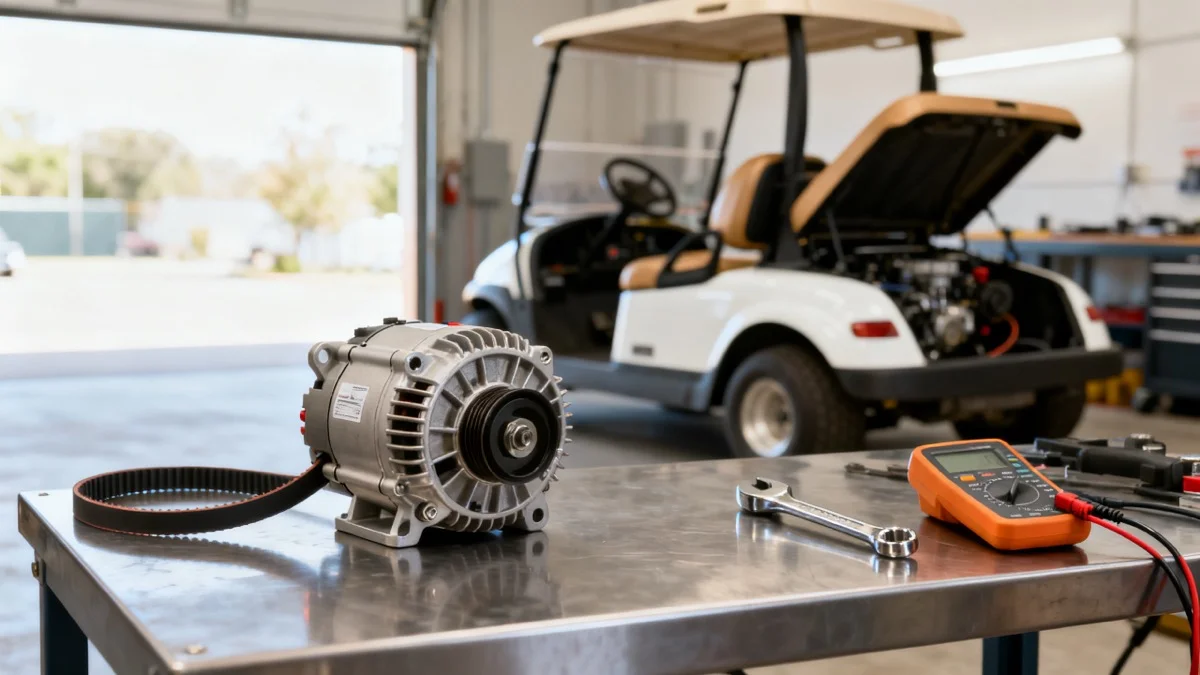
A golf cart starter generator is one of those parts that gets blamed early and replaced too fast. If you are asking how does a golf cart starter generator work, the short answer is that a gas cart uses one belt-driven unit to spin the engine at startup and help recharge the 12V battery after the engine runs. If either job gets weak, the cart can feel dead, slow, noisy, or unreliable.
This guide covers the practical version of golf cart starter generator symptoms: what actually points to the starter generator, what usually gets misdiagnosed, how to test a starter generator on a golf cart before buying parts, what replacement costs look like in 2026, and what changes by EZGO, Club Car, and Yamaha.
If your cart is electric, start with the golf cart solenoid symptoms guide, controller symptoms guide, or golf cart won't start guide instead.
For a gas cart with uncertain age or model details, use the free golf cart VIN decoder and the golf cart serial number and VIN guide before buying a starter generator by fitment chart.
Applies To Gas golf carts
Common Part Cost $290 to $450
OEM or High Output $500 to $650+
Brush Set Cost $30 to $110
Installed Range $400 to $950
First Tool Digital multimeter
Golf Cart Starter Generator Symptoms: Quick Answer
The most common bad golf cart starter generator symptoms are:
- slow cranking when you press the accelerator
- no crank even though the 12V battery is charged
- the cart starts after charging the 12V battery, then dies again after a few rides
- squealing from the narrow starter-generator belt during cranking
- hot ground cables, smoking insulation, or a burnt electrical smell
- grinding, bearing noise, or rattling from the starter-generator body
- intermittent starting that gets worse when the cart is hot
- dim lights or a weak horn on a gas cart after driving
Those symptoms make the starter generator worth testing. They do not prove it is bad. A weak 12V battery, loose belt, bad ground, failed starter solenoid, pedal switch, corroded wiring, or voltage regulator can create the same complaint. If the cart also has fuel, spark, or clutch symptoms, use the broader gas golf cart no-start section and the golf cart clutch guide before ordering an expensive electrical part.
| If you searched for... | Direct answer |
|---|---|
| how does a golf cart starter generator work | The 12V battery powers the starter-generator as a motor first; once the engine runs, the same unit helps recharge the 12V battery through the regulator and wiring path. |
| how to test a starter generator on a golf cart | Test the 12V battery, belt, grounds, solenoid, running battery voltage, regulator path, and starter-generator output in that order. |
| golf cart starter generator not charging | Do not replace the unit first. A bad voltage regulator, corroded wire, slipping belt, weak battery, or poor ground can create the same no-charge symptom. |
| golf cart starter generator replacement cost | Budget roughly $290-$450 for many aftermarket units and $400-$950 installed after diagnosis and belt/cable cleanup. |
How Does a Golf Cart Starter Generator Work?
A gas golf cart does not usually use a car-style starter and alternator as two separate pieces. It uses a starter generator. When you press the accelerator, battery power spins the starter generator through a belt. That belt turns the engine over. Once the engine is running, the same unit works with the voltage regulator to help recharge the 12V battery.
Golf Cart King describes EZGO starter generators as parts that turn the engine over and also charge the battery, with fitment across Marathon, TXT, Medalist, Shuttle, Workhorse, and RXV gas models. Its Club Car starter generator page makes the same basic point for Club Car: the unit turns the engine over and provides charge to the battery.
That dual role is why diagnosis can be confusing. A starter generator can crank but not charge, charge weakly but still spin, fail only when hot, or look bad because the belt is slipping.
Motor City Reman's starter-generator troubleshooting note is useful here because it warns that the starter generator itself may not be the root problem when the charging voltage is not reaching the battery. Corroded wiring, solenoids, regulators, and intermediate connections can all interrupt the path.
Symptoms That Point to the Starter Generator
Use the table first, then read the symptom details below.
| Symptom | Starter-generator likelihood | Also check before ordering |
|---|---|---|
| Slow crank or weak rollover | Medium to high | 12V battery, belt tension, grounds |
| Starts after charging, then 12V battery dies again | Medium | Voltage regulator, wiring, battery age |
| Squeal only while cranking | Medium | Starter-generator belt condition and adjustment |
| No crank, no spin from starter generator | Medium | Solenoid, pedal switch, key switch, cables |
| Hot ground cable or burnt smell | High risk | Cable routing, grounds, shorted wiring |
| Grinding or bearing noise from unit | High | Pulley, bearings, belt alignment |
| Cranks cold but fails hot | Medium to high | Brushes, armature, cable resistance |
Slow Crank From the Gas Engine
A weak starter generator often sounds like the engine is dragging. You press the pedal, the belt turns, but the engine rolls over slowly or unevenly. If the 12V battery is healthy and the belt is tight enough, the starter-generator brushes, armature, or bearings move higher on the suspect list.
Do not skip the battery test. A tired 12V battery can make a good starter generator look bad. A charged 12V battery should usually rest around 12.6V or a little higher. If it is near 12.0V or lower, charge and load-test the battery before blaming the starter generator.
If you do not own a meter, buy one before buying parts.
Check Price: AstroAI MultimeterBattery Dies After a Few Rides
This is the symptom owners describe as "my gas golf cart is not charging the battery." The cart starts after you put the 12V battery on a charger, but a few rides later it cranks slowly or does nothing.
That can be a bad starter generator, but it can also be:
- failed voltage regulator
- loose or corroded regulator wiring
- broken or corroded ground path
- worn starter-generator brushes
- slipping belt
- old 12V battery that will not hold charge
- shorted accessory wiring, lights, stereo, or USB outlet
Golf Cart King notes that a voltage regulator works with the EZGO starter generator to regulate output and provide a safe battery charge. A no-charge diagnosis has to include the regulator, not only the starter generator.
Squeal During Cranking
A squeal during startup is often the starter-generator belt, not the starter generator itself. The starter-generator belt is the narrow belt that connects the engine to the starter generator. It is different from the wider CVT drive belt that moves the cart.
If the squeal happens only while the engine is being turned over, inspect the starter-generator belt first. Look for glazing, cracking, looseness, oil contamination, pulley misalignment, or a belt that is bottoming in the pulley. Our golf cart drive belt replacement guide explains the difference between the wide drive belt and the narrow starter-generator belt in more detail.
For Yamaha owners doing seasonal service, a kit with belts, filters, and spark plug can be more efficient.
10L0L Yamaha tune-up kit with beltsHot Cables or Burnt Electrical Smell
Hot cables are not normal. If the ground cable, starter-generator cable, or nearby insulation gets hot quickly when the pedal is pressed, stop testing and inspect the wiring path. That is the kind of symptom where guessing gets expensive.
Heat can mean:
- high resistance at a loose or corroded lug
- wrong cable routing
- bad ground strap
- internal starter-generator issue
- undersized replacement cable
- shorted wire
- stuck solenoid or switch problem
Clean connections help, but do not keep pressing the pedal on a smoking circuit. If a cable gets hot fast, use a golf cart repair shop.
CRC QD Electronic Contact CleanerGrinding or Bearing Noise
Grinding from the starter-generator area usually means something mechanical is wrong: worn bearings, pulley damage, belt misalignment, or an internal failure. A brush kit will not fix a bearing that is noisy enough to hear from the seat.
This is where you inspect the belt off the pulley if you know how to do it safely. Spin the starter generator by hand with the belt removed. It should feel smooth, not gritty. If the pulley wobbles or the shaft feels rough, replacement or professional rebuild is more likely than a simple brush job.
Intermittent Starting After Heat Builds Up
Intermittent starting is frustrating because the cart can test fine cold. Heat raises electrical resistance and can expose weak brushes, poor grounds, tired cables, or a bad armature spot.
Golf Cart Report's troubleshooting article notes that low voltage at certain starter-generator terminals can point to an armature dead spot, and an armature problem often means replacement of the generator or armature rather than a simple external fix. Treat that as a reason to test carefully, not as a reason to throw parts at the cart.
What Gets Mistaken for Starter Generator Failure
The starter generator is not cheap, so rule out the simple failures first.
Weak 12V Battery
Gas carts still depend on a 12V battery. If the battery is weak, the starter generator cannot crank strongly and the charging system may never recover because the battery itself is no longer healthy.
Test at rest, during cranking, and after the engine is running. If the battery falls hard under load, replace or load-test it before condemning the starter generator. Our gas golf cart battery size guide covers Group 70, 26, and 24 fitment, CCA, terminal layout, and hold-down checks.
Loose Starter-Generator Belt
The belt may be the entire problem. If it is loose, glazed, oily, cracked, or riding incorrectly in the pulley, the starter generator cannot spin the engine properly and may not charge consistently.
If your gas cart also feels weak once the engine is running, separate starter-belt noise from clutch-belt slip with the drive belt size guide and clutch symptoms guide.
Bad Starter Solenoid
The starter solenoid is the switch that sends current into the start circuit. A bad solenoid can create a click with no crank, no click, intermittent crank, or heat at the terminals. That overlaps heavily with starter-generator complaints.
Use our golf cart solenoid symptoms guide if the symptom is clicking or no electrical response before you assume the starter generator is bad.
Failed Voltage Regulator
The voltage regulator controls charging output. A gas cart can start fine but fail to charge the 12V battery if the regulator or its wiring is bad.
Bad Grounds and Battery Cables
Corroded grounds make a good starter generator look weak. Replace obviously damaged cables, clean lugs, and confirm the engine ground strap is intact. If you are dealing with old battery cables or hacked accessory wiring, our golf cart battery cable guide is the right next step.
Use dielectric grease after cleaning, not as a substitute for cleaning.
Pedal Switch, Key Switch, or Wiring Fault
Gas carts start from the pedal circuit. If the pedal micro switch, key switch, reverse buzzer circuit, or wiring is not sending the correct command, the starter generator may never receive power.
The golf cart won't start guide covers the broader flowchart for key switch, pedal switch, fuel, spark, and battery checks.
Golf Cart Starter Generator Replacement Cost in 2026
The realistic cost depends on whether you need brushes, a rebuild, an aftermarket unit, or an OEM-style replacement.
| Repair path | Typical 2026 parts cost | Best for |
|---|---|---|
| Brush set only | $30 to $110 | Unit spins, bearings are quiet, armature is healthy |
| Pulley, bracket, cable, or hardware repair | $25 to $140 | External damage or loose fitment |
| Common aftermarket replacement | $290 to $450 | Most older EZGO, Club Car, and Yamaha gas carts |
| OEM, high-output, or specialty unit | $500 to $650+ | Fleet carts, Subaru Club Car units, Yamaha G1, specific fitments |
| Professional diagnosis and labor | $100 to $300 | Wiring, regulator, or fitment uncertainty |
| Installed starter-generator replacement | $400 to $950 | Parts plus testing, labor, belt adjustment, and cable cleanup |
Current parts listings checked on May 21, 2026 support those ranges. Pete's Golf Carts lists a Club Car gas 1984-up DS and Precedent starter generator at about $290. Golf Cart Tire Supply lists a RHOX EZGO TXT 2010+ Kawasaki unit at about $289. Golf Cart Garage shows Reliance units around $351-$420 for several Club Car, Yamaha, and EZGO applications, with Yamaha G1 closer to $560. Golf Cart King lists a Club Car high-output starter generator around $519 and a Club Car 1984-up unit around $615.
Those are parts-only examples. A shop bill will be higher because a good technician should test the 12V battery, belt, regulator, solenoid, grounds, and output before replacing the unit.
Check Starter Generator Prices on AmazonHow to Test a Starter Generator on a Golf Cart
This is the order I would use on a stock gas cart.
Step 1: Confirm the 12V Battery First
Set your multimeter to DC volts. Test across the 12V battery posts, not the cable ends.
- 12.6V or higher usually means fully charged
- 12.4V is partly charged
- 12.0V or lower is weak enough to distort diagnosis
- below 10V while cranking usually means the battery or cable path needs attention
If you want a deeper explanation of voltage readings, use the golf cart battery voltage chart. That page focuses more on electric packs, but the principle is the same: voltage under load tells you more than resting voltage alone.
Step 2: Inspect the Starter-Generator Belt
Look for cracks, glazing, looseness, frayed edges, oil, or obvious misalignment. A slipping starter-generator belt can cause weak cranking and weak charging at the same time.
If the belt is old and the cart is already apart, replacement is usually cheap compared with the labor of opening the same area twice.
Step 3: Clean and Test Grounds
Follow the large cables from the battery, solenoid, engine, and starter generator. Look for green corrosion, loose lugs, burnt insulation, or cables that have been replaced with undersized wire.
A mixed SAE and metric socket set is helpful because Club Car, EZGO, and Yamaha do not all use the same fastener sizes.
DEWALT mixed socket setStep 4: Rule Out the Starter Solenoid
If you hear a click but the engine does not crank, test the solenoid before removing the starter generator. A failed solenoid can block current from reaching the unit.
If there is no click, check the key switch, pedal micro switch, fuse, and wiring path. No click does not automatically mean the starter generator is dead.
Step 5: Check Charging Voltage at the Battery
With the cart running, voltage at the 12V battery should usually rise from resting voltage toward a charging range around 13.5V to 14.5V. If it stays around resting voltage or drops as accessories run, the battery is not being recharged.
That still leaves multiple suspects:
- starter generator output
- voltage regulator
- regulator ground
- broken wire between generator, regulator, and battery
- old 12V battery
- belt slip
Motor City Reman's note is a good reminder that measuring at one stud does not tell the whole story. The output has to reach the battery through the wiring and regulator path.
Step 6: Decide Whether to Rebuild or Replace
If the unit spins smoothly and the issue is worn brushes, a brush set can be worth trying.
Roykaw starter-generator brush setReplace the full unit or use a rebuild shop if:
- the armature has dead spots
- bearings grind or bind
- the shaft or pulley wobbles
- the case is cracked
- the unit repeatedly damages brushes
- output is inconsistent after wiring and regulator checks
- the cart is used commercially and downtime matters
Brand Notes by Cart Family
Fitment matters more than the generic phrase "golf cart starter generator." Use the cart serial number, model year, engine type, rotation, pulley, and OEM reference before ordering.
EZGO Gas Starter Generator Notes
EZGO gas carts can vary by year and engine. Common families include Marathon, Medalist, TXT, Workhorse, Shuttle, and RXV gas models. Golf Cart King's EZGO page lists starter generators for older 2-cycle carts, 1991-up 4-cycle carts, Marathon and TXT models, and 2010-newer RXV/TXT Kawasaki-engine carts.
The important buying warning: do not order only by "EZGO TXT." Verify whether your cart has the older Robin engine, newer Kawasaki engine, EX1 setup, or another configuration. The starter generator, pulley, brush set, and belt can differ.
Brush wear is still a real EZGO failure mode. Treat it as an inspection clue if the cart cranks inconsistently and the basic battery, belt, and solenoid checks are clean.
For broader EZGO ownership issues, see our EZGO golf cart review and EZGO TXT vs RXV guide.
Club Car Gas Starter Generator Notes
Club Car DS, Precedent, Tempo, and Onward gas carts require careful year and engine verification. Pete's Club Car listing calls out gas DS and Precedent fitment from 1984-up in its product copy, while Golf Cart King separates older Club Car units, 1997-2013 units, high-output options, and Subaru EX40 engine starter generators.
For many owners, the big question is not "Club Car or EZGO?" It is "which Club Car engine and year?" A 1990s DS, a 2008 Precedent, and a 2016 Subaru-engine Precedent may not use the same starter-generator setup.
If your symptom is throttle dropout, pedal response, or intermittent drive command rather than cranking, compare it with our Club Car MCOR symptoms guide. MCOR problems can feel electrical, but they are not the starter generator.
For broader model context, use the Club Car golf cart review.
Yamaha Gas Starter Generator Notes
Yamaha has several gas-cart generations, including G1, G2, G8, G9, G11, G14, G16, G22, G29 Drive, and Drive2. Golf Cart Garage lists Yamaha G16-G22, G29, and Drive 4-cycle starter generators around $351, Yamaha G2-G14 4-cycle units around $420, and older Yamaha G1 units around $560.
Yamaha owners should be especially careful with model identification because older G-series carts, early Drive models, and Drive2 carts can use different belts and starter-generator references. If the cart is from a golf course fleet, check the serial number and engine family before trusting a marketplace listing.
For broader Yamaha issues, see our Yamaha golf cart review. If the symptom is hard starting plus sputtering, stale fuel, or choke dependence, it may belong in the fuel system, not the starter generator.
Rebuild, Replace, or Use a Repair Shop?
Here is the practical decision.
Rebuild With Brushes When the Unit Is Mechanically Healthy
A brush set makes sense when:
- the starter generator spins smoothly
- bearings are quiet
- the pulley is straight
- the case is not cracked
- cable studs are not burned
- the cart mostly has weak cranking or weak charging
- you can verify the brush kit fits your starter-generator model
This is the cheapest repair path, but it is not always the best one. If you install brushes into a damaged armature, the problem comes back.
Replace the Starter Generator When Damage Is Internal
Replacement is usually better when:
- there is grinding or rough bearing feel
- the armature has a dead spot
- the pulley wobbles
- the unit smells burnt
- the case or mounting ear is damaged
- the cart needs to be reliable for daily neighborhood or campground use
- a prior brush repair failed quickly
This is also where you decide whether a cheaper aftermarket unit is good enough. For a personal neighborhood cart used a few times per week, a reputable aftermarket unit can make sense. For a rental fleet, golf course, or work cart, downtime can cost more than the part.
Use a Shop When Wiring or Fitment Is Unclear
Use a repair shop if wires get hot while testing, the cart has hacked accessory wiring, you cannot identify the year or engine, the starter generator was already replaced once, or the regulator, solenoid, and ground path all need testing.
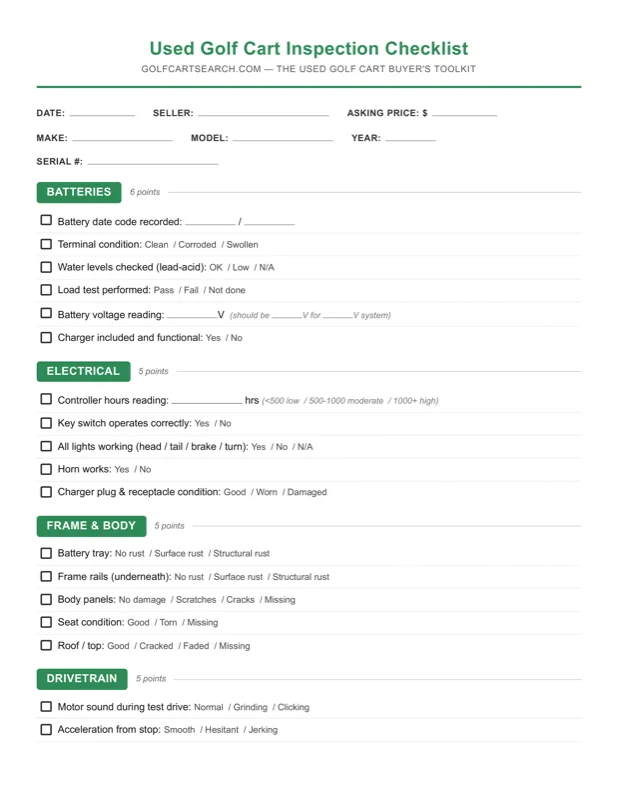
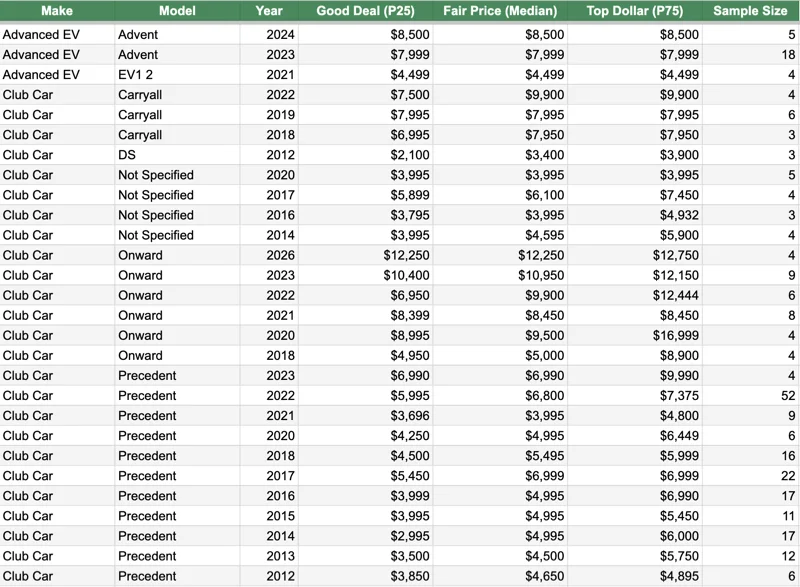
Local shops can also confirm whether the cart is worth repairing. If you are deciding between fixing a tired gas cart and buying another one, compare repair costs against current listings on our dealer directory and read the used golf cart buying guide.
Starter Generator Checklist Before You Buy Parts
Use this checklist before ordering a replacement:
- Confirm the cart is gas, not electric
- Identify brand, model, year, engine, and serial number
- Charge and test the 12V battery
- Inspect starter-generator belt condition and tension
- Clean posts, cable lugs, engine grounds, and starter-generator connections
- Test the starter solenoid and pedal micro switch if there is no crank
- Check voltage at the 12V battery while running
- Test or inspect the voltage regulator and its ground
- Photograph cable routing before removing anything
- Match rotation, pulley, mounting ears, and OEM references before ordering
If the cart is a long-term keeper, fix the root cause, not only the failed part. A weak battery, loose belt, or corroded ground can damage the next starter generator too.
FAQ
What are the symptoms of a bad golf cart starter generator?
The main symptoms are slow cranking, no crank, a 12V battery that keeps dying, squeal during cranking, hot cables, burnt smell, grinding noise, and intermittent starting after warm-up.
How does a golf cart starter generator work?
On a gas cart, the 12V battery powers the starter generator like a motor when you press the pedal. The belt turns the engine over. After the engine starts, the same unit works with the voltage regulator and wiring path to help recharge the 12V battery.
How do you test a starter generator on a golf cart?
Start with the 12V battery, then inspect the starter-generator belt, grounds, cables, solenoid, and running battery voltage. If battery voltage does not rise while the engine runs, test the regulator, regulator ground, wiring path, and starter-generator output before replacing the unit.
How much does it cost to replace a golf cart starter generator?
Expect about $290 to $450 for many aftermarket units and about $500 to $650 or more for OEM, high-output, or harder-to-find units. Installed repairs commonly land around $400 to $950.
Can a starter generator crank but not charge?
Yes. Worn brushes, a weak armature, failed voltage regulator, poor ground, bad wiring, or a slipping belt can let it crank but fail to recharge the 12V battery.
How do I know if the voltage regulator is bad instead?
If the starter generator cranks normally but battery voltage does not rise while the engine runs, test the regulator, regulator ground, and wiring path.
Do electric golf carts use starter generators?
No. Electric carts do not have gas engines, so electric no-start symptoms usually involve batteries, cables, solenoids, controllers, throttle inputs, or motor issues.
Can I replace only the brushes?
Yes, if the starter generator is mechanically healthy and the brushes are the actual wear item. Brushes will not fix armature damage, rough bearings, pulley wobble, or burnt windings.
Why does my gas golf cart squeal when starting?
The starter-generator belt is the first suspect. It may be loose, glazed, cracked, oily, misaligned, or worn.
Is a hot starter-generator cable dangerous?
Yes. Heat means resistance, overload, bad contact, wrong routing, or a short. Stop testing if a cable gets hot or smokes.
Should I buy the cheapest starter generator online?
Only if fitment is confirmed and the seller lists the correct model, year, rotation, pulley, and OEM cross-reference. A cheap wrong-fit unit wastes more time than it saves.
What should I test first on a gas golf cart that will not crank?
Start with the 12V battery, cable condition, grounds, starter-generator belt, solenoid, key switch, and pedal micro switch.
Golf Cart Search
Find the Best Golf Carts of 2026
Compare top-rated models, read expert reviews, and find the perfect cart for your needs.