As an Amazon Associate, we earn from qualifying purchases. This helps support our site at no extra cost to you.
If you use a golf cart for business, you may be able to deduct the full purchase price on your taxes this year. Whether you run a farm, manage rental properties, operate a resort, or use a cart at your warehouse, the IRS allows several deduction methods that can save you thousands.
This guide covers who qualifies, which deduction method saves you the most, real dollar examples, documentation requirements, and the mistakes that trigger audits. We will focus on the three main approaches: Section 179, bonus depreciation, and MACRS depreciation.
Who Can Deduct a Golf Cart on Their Taxes?
Not everyone qualifies. The key factor is business use. You must use the golf cart more than 50% of the time for legitimate business purposes.
You CAN deduct a golf cart if you are:
- A sole proprietor or self-employed individual
- A business owner (LLC, S-Corp, C-Corp, partnership)
- A farmer or rancher (Schedule F filer)
- A rental property owner using it for property operations
- A business that uses carts for on-site transportation
You CANNOT deduct a golf cart if you are:
- A W-2 employee (the Tax Cuts and Jobs Act of 2017 eliminated unreimbursed employee expense deductions)
- Using the cart exclusively for personal recreation
- Using it primarily for playing golf (entertainment expenses are not deductible under current tax law)
This is the most common misconception. Buying a golf cart and occasionally driving it at your business does not qualify. The IRS requires that business use exceeds 50% of total use, and you need records to prove it.
Qualifying Business Uses for Golf Carts
Golf carts are deductible across many industries. Here are the most common qualifying scenarios:
Farms and Ranches
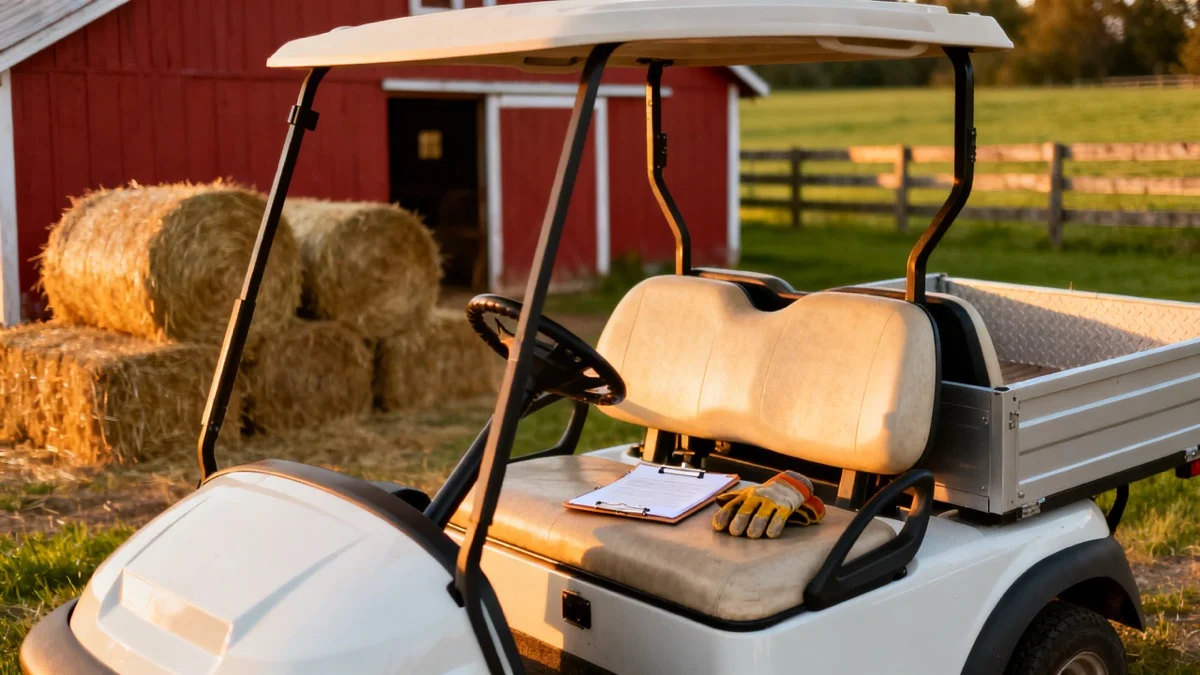
Farmers are some of the biggest beneficiaries of golf cart tax deductions. Using a cart to inspect crops, transport feed, check on livestock, haul tools between buildings, or move equipment around the property all counts as farm business use. If you are shopping for a farm cart, hunting and off-road models tend to handle rough terrain better.
Resorts, Hotels, and Campgrounds
Hospitality businesses use golf carts for guest transportation, luggage hauling, property maintenance, and staff movement. A resort with a fleet of 10 carts at $7,000-$15,000 each could deduct $70,000-$150,000 in the first year using Section 179.
Rental Properties and Airbnbs
Vacation rental owners who use golf carts for guest transportation, property maintenance, and supply runs can deduct the cost on Schedule E. This works especially well in golf cart-friendly communities where guests expect a cart.
Warehouses and Manufacturing Facilities
Carts used for transporting materials, moving between buildings, or facility maintenance on large industrial sites qualify as business equipment. Brands like Club Car and EZGO offer commercial-grade utility models designed for industrial use.
Property Management and HOAs
Property managers who use carts to tour properties, show units, or perform maintenance across multi-unit complexes can claim the deduction.
Construction and Landscaping
Contractors who use carts on job sites for moving tools, materials, or personnel between work areas have a legitimate business use case.
Universities and Corporate Campuses
Large facilities that provide cart transportation for staff, visitors, or equipment qualify for the deduction as standard business equipment.
Section 179: Deduct the Full Price in Year One
Section 179 is the most popular deduction method for golf cart purchases. It lets you deduct the entire purchase price in the year you buy the cart, instead of spreading the deduction over multiple years.
2026 Section 179 Limits
| Detail | 2026 Amount |
|---|---|
| Maximum deduction | $1,250,000 |
| Spending cap (phase-out begins) | $3,130,000 |
| Phase-out complete | $4,380,000 |
For a single golf cart purchase (typically $5,000-$15,000), you are well within these limits. Even a fleet purchase of 20 carts at $10,000 each ($200,000 total) qualifies without hitting the phase-out.
How Section 179 Works for Golf Carts
- Buy the cart and place it in service during the 2026 tax year
- Track business use from day one (must exceed 50%)
- File Form 4562 with your tax return to claim the deduction
- Deduct the business-use percentage of the purchase price
The deduction amount equals the purchase price multiplied by your business-use percentage. If you buy a $10,000 cart and use it 80% for business, your Section 179 deduction is $8,000.
Section 179 Requirements
- The cart must be purchased (not leased) and placed in service during the tax year
- Business use must exceed 50% of total use
- The deduction cannot exceed your business income for the year
- Both new and used carts qualify (you do not need to buy new)
Bonus Depreciation in 2026
Bonus depreciation is a separate deduction method that works alongside or instead of Section 179. Under the Tax Cuts and Jobs Act, bonus depreciation has been phasing down:
| Tax Year | Bonus Depreciation Rate |
|---|---|
| 2022 | 100% |
| 2023 | 80% |
| 2024 | 60% |
| 2025 | 40% |
| 2026 | 20% |
| 2027+ | 0% (unless Congress extends it) |
For 2026, bonus depreciation allows you to deduct 20% of the purchase price upfront, with the remaining 80% depreciated over the MACRS recovery period.
When Bonus Depreciation Makes More Sense Than Section 179
- Your business has a net loss this year. Section 179 cannot create or increase a net operating loss, but bonus depreciation can.
- You have exceeded the Section 179 spending cap. Large businesses with over $3,130,000 in equipment purchases may benefit from bonus depreciation on the excess.
For most golf cart buyers, Section 179 is the better choice in 2026 since it allows 100% first-year deduction while bonus depreciation only covers 20%.
MACRS Depreciation: The Multi-Year Approach
If you prefer to spread the deduction across multiple years, or if you do not qualify for Section 179 or bonus depreciation, MACRS (Modified Accelerated Cost Recovery System) depreciation is the default method.
Recovery Period: 5 Years or 7 Years?
This is a debated topic among tax professionals. The classification depends on how you use the cart:
- 5-year property (MACRS class "Other Transportation Equipment"): Most applicable when the cart is used primarily for transporting people or materials. This applies to most business golf carts on farms, resorts, and commercial properties.
- 7-year property (default for unclassified property): May apply when the cart serves a specialized function that does not fit standard transportation categories.
Most tax professionals default to the 5-year classification for business golf carts. Consult your CPA for your specific situation.
5-Year MACRS Depreciation Schedule
Using the 200% declining balance method with the half-year convention:
| Year | Depreciation Rate | Deduction on $10,000 Cart |
|---|---|---|
| 1 | 20.00% | $2,000 |
| 2 | 32.00% | $3,200 |
| 3 | 19.20% | $1,920 |
| 4 | 11.52% | $1,152 |
| 5 | 11.52% | $1,152 |
| 6 | 5.76% | $576 |
| Total | 100% | $10,000 |
Note: The schedule spans 6 calendar years because of the half-year convention (the IRS assumes you placed the cart in service at the midpoint of year one).
Real Dollar Tax Savings Examples
Here is what the deduction looks like for real business scenarios. These examples assume 100% business use and the 2026 federal tax brackets.
Example 1: Farmer Buying a Utility Cart
A farmer in the 22% tax bracket buys a $9,800 electric golf cart to use around the property for daily operations.
| Method | Year 1 Deduction | Federal Tax Savings |
|---|---|---|
| Section 179 | $9,800 | $2,156 |
| Bonus Depreciation (20%) | $1,960 | $431 |
| MACRS (Year 1 only) | $1,960 | $431 |
Section 179 saves $1,725 more in year one compared to the alternatives. The farmer also saves on self-employment tax, adding roughly $1,385 in additional savings.
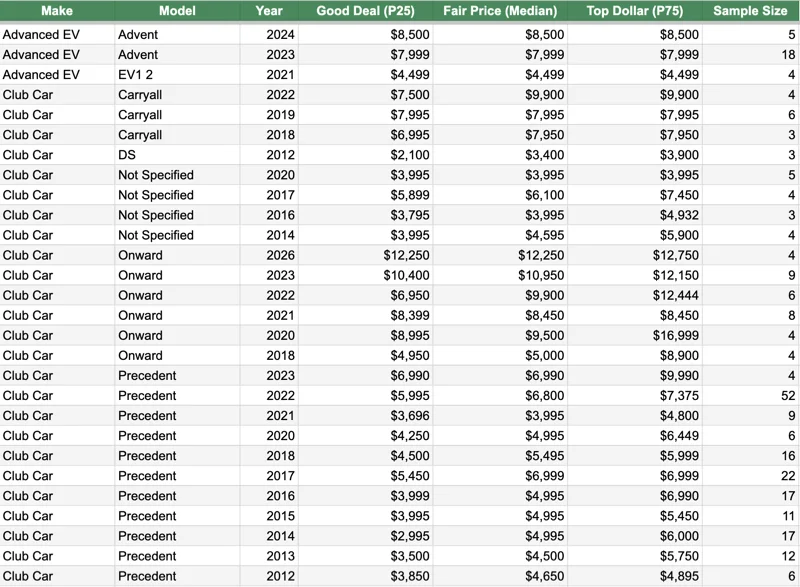
The deduction depends on the documented business purchase price, not an old marketplace price. Keep the invoice, proof of payment, placed-in-service date, and business-use records with the tax file.
Example 2: Resort Purchasing a Fleet
A resort in the 32% bracket buys 5 golf carts at $7,249 each for a total of $36,245 to transport guests and maintain the property.
| Method | Year 1 Deduction | Federal Tax Savings |
|---|---|---|
| Section 179 | $36,245 | $11,598 |
| Bonus Depreciation (20%) | $7,249 | $2,320 |
Using Section 179, the resort saves $11,598 in federal taxes in the first year. That is equivalent to getting one cart nearly for free.
Example 3: Rental Property Owner
A vacation rental owner in the 24% bracket buys a $7,999 golf cart. The cart is used 75% for the rental business (guest transportation, property upkeep) and 25% for personal use.
| Detail | Amount |
|---|---|
| Purchase price | $7,999 |
| Business-use percentage | 75% |
| Section 179 deduction | $5,999 |
| Federal tax savings | $1,440 |
The 25% personal use reduces the deduction, but the owner still saves $1,440 on a cart that also serves personal needs.
Electric vs Gas: Tax Implications
Both electric and gas golf carts qualify for the same Section 179 and depreciation deductions. The IRS does not differentiate based on power source for equipment depreciation purposes.
However, electric carts offer additional tax-relevant advantages:
- Lower operating costs that count as deductible business expenses (electricity is cheaper than gas)
- Less maintenance means fewer deductible repair expenses, but also lower total cost of ownership
- Longer lifespan typically means better depreciation value over time
Do Golf Carts Qualify for the EV Tax Credit?
No. The federal Clean Vehicle Credit under IRC Section 30D requires:
- A minimum battery capacity of 7 kWh (most golf cart batteries are 3-6 kWh)
- A gross vehicle weight rating under 14,000 lbs (golf carts qualify here, but fail other tests)
- The vehicle must be designed primarily for highway use
- The vehicle must meet federal motor vehicle safety standards
Standard golf carts do not meet these requirements. Low-speed vehicles (LSVs) that are street-legal also fall short because they are limited to 25 MPH and not designed for highway use.
A few states offer their own EV incentives that may include golf carts, but these are rare and typically small (under $500). Check your state's golf cart laws for current incentives.
Deductible Business Expenses Beyond the Cart Itself
The cart purchase is just the starting deduction. These ongoing costs are also deductible as business expenses:
- Insurance premiums for business-use carts
- Maintenance and repairs including battery replacement, tire changes, and tune-ups
- Accessories and modifications like mirrors, lights, enclosures, and windshields added for business purposes
- Registration and title fees
- Charging costs (electricity for electric carts, fuel for gas carts)
- Financing interest on loans used to purchase the cart
- Storage costs if you pay for off-site storage
Each of these is deducted proportionally based on your business-use percentage. If your cart is used 80% for business, 80% of every maintenance bill, insurance premium, and accessory purchase is deductible.
Documentation the IRS Requires
Golf carts can be classified as listed property under IRC Section 280F, which means the IRS imposes stricter record-keeping requirements. Failing to maintain proper records can result in losing your deduction entirely during an audit.
What to Track for Every Trip
Keep a log that records:
- Date of each use
- Business purpose (what you did, who you met, what you transported)
- Distance or hours of use
- Starting and ending location
- Business vs personal designation
Required Documents to Keep
- Purchase receipt or invoice showing the price, date, and seller information
- Serial number or VIN documentation
- Photos of the cart in its business setting
- Usage log updated at least weekly (daily is better)
- Business-use percentage calculation at year-end
How to Calculate Business-Use Percentage
At the end of each year, calculate:
Business-Use % = (Business Miles or Hours) / (Total Miles or Hours) x 100
Example: If you logged 1,200 miles total and 900 were business miles, your business-use percentage is 75%.
Which IRS Forms to File
| Form | Purpose | Who Files It |
|---|---|---|
| Form 4562 | Depreciation and Amortization (Section 179 and MACRS) | All business owners claiming depreciation |
| Schedule C | Profit or Loss from Business | Sole proprietors and single-member LLCs |
| Schedule F | Profit or Loss from Farming | Farmers and ranchers |
| Schedule E | Supplemental Income and Loss | Rental property owners |
| Form 1120/1120-S | Corporate tax return | C-Corps and S-Corps |
Common Mistakes That Trigger Audits
The IRS knows that golf carts are commonly used for recreation, so deductions in this category get extra scrutiny. Avoid these mistakes:
Claiming a Cart Used Mainly for Golf
Using a cart on a golf course for recreational rounds is not a business expense, even if you discuss business on the course. The Tax Cuts and Jobs Act eliminated deductions for entertainment expenses, and recreational golf falls squarely in that category.
Not Maintaining a Usage Log
"I use it mostly for business" is not documentation. Without a written log showing dates, purposes, and mileage, the IRS can disallow your entire deduction. This is the number one reason golf cart deductions get denied in audits.
Inflating Business-Use Percentage
If you claim 90% business use but your cart is parked at your house in a golf cart community where you also drive it to restaurants and neighbors' houses, auditors will question that number. Be honest and conservative in your estimates.
Forgetting Depreciation Recapture
When you sell a golf cart that you previously depreciated, you may owe taxes on the depreciation recapture. If you claimed $8,000 in Section 179 on a $10,000 cart and later sell it for $5,000, the $5,000 sale price is treated as ordinary income (up to the amount of depreciation claimed). Factor this into your decision using our golf cart value guide.
Claiming the Deduction as a W-2 Employee
This is the most common error. If your employer provides a golf cart or you buy one for use at your employer's business, you cannot deduct it on your personal return. Only business owners, self-employed individuals, and farmers can claim these deductions.
Leasing vs Buying: Which Saves More on Taxes?
Both leasing and buying a golf cart offer tax benefits, but the structure is different:
Buying (Section 179 or Depreciation)
- Deduct the full price upfront using Section 179
- You own the asset and can sell it later
- Depreciation recapture applies when you sell
- Best for: Businesses that want the largest immediate deduction and plan to keep the cart long-term
Leasing
- Deduct each lease payment as a business expense in the year it is paid
- No large upfront deduction, but steady annual deductions
- No depreciation recapture since you never own the asset
- Best for: Businesses that want predictable expenses and plan to upgrade regularly
For most golf cart buyers, purchasing and using Section 179 provides the bigger tax benefit. A $10,000 cart deducted in full under Section 179 saves more than 3-5 years of $250/month lease payments ($3,000/year deducted annually). See our financing guide for current loan rates if you plan to finance the purchase.
Step-by-Step: How to Claim Your Golf Cart Tax Deduction
Here is the process from purchase to filing:
1. Buy the cart and document everything. Save the receipt, record the serial number, and take photos. Browse dealers near you, compare top golf cart brands, or check out value options like Yamaha and Star EV to find the right cart for your business.
2. Start your usage log immediately. Record every business trip from day one. Include dates, purpose, and distance.
3. Track all related expenses. Keep receipts for insurance, maintenance, accessories, fuel or charging costs, and any modifications.
4. Calculate your business-use percentage at year-end. Divide business miles (or hours) by total miles (or hours).
5. Choose your deduction method. For most small businesses, Section 179 is the best choice. If you have a net loss, consider MACRS depreciation spread over 5-7 years.
6. File Form 4562 with your tax return. Report the deduction on the appropriate schedule (C, E, or F).
7. Keep records for at least 3 years after filing (7 years is safer). The IRS can audit returns for up to 3 years, or 6 years if income is substantially understated.
Frequently Asked Questions
Can I deduct a golf cart I already own?
No. Section 179 only applies in the year you purchase and place the cart in service. If you bought it in a previous year, you may still be able to claim MACRS depreciation for the remaining recovery period if you begin using it for business. Consult a CPA about converting a personal asset to business use.
Does the golf cart need to be street-legal to qualify?
No. The tax deduction is based on business use, not street-legal status. A cart used exclusively on a farm, resort, warehouse, or construction site qualifies even if it has no street-legal equipment like headlights, turn signals, or mirrors.
Can I deduct a golf cart used for medical purposes?
Potentially. If a doctor prescribes a golf cart for mobility reasons and you can document the medical necessity, the cost may qualify as a medical expense deduction. Medical expenses must exceed 7.5% of your adjusted gross income before they become deductible.
What if I use the cart for both my farm and personal errands?
Track both uses separately. Only the farm-use portion is deductible. If you use the cart 70% for farm work and 30% for personal errands, you deduct 70% of the purchase price and 70% of all operating costs.
Can I donate a golf cart and get a tax deduction?
Yes. Donating a golf cart to a qualified 501(c)(3) charity allows you to deduct the fair market value. You will need IRS Form 1098-C if the cart is worth more than $500. Check our golf cart value guide to estimate your cart's current worth.
Is a gas-to-electric conversion tax deductible?
If you convert a gas cart to electric for business use, the conversion cost is generally treated as a capital improvement that adds to your depreciable basis. This means you can depreciate the conversion cost alongside the cart itself.
Golf Cart Search
Find the Best Golf Carts of 2026
Compare top-rated models, read expert reviews, and find the perfect cart for your needs.