
Estimate your golf cart's worth by comparing the closest current local carts, documenting its condition and separating asking price from likely net sale proceeds. An age-based percentage or a broad brand range cannot appraise an individual vehicle.
This guide uses an original comparison from our saved August 4, 2026 dealer listings, rechecked on October 10, 2026, to show why even apparently matched advertisements need scrutiny. It also provides a worksheet for pricing your own cart without inventing a resale premium.
Can KBB or NADA give you a golf cart value?
On October 10, 2026, the Kelley Blue Book golf-cart URL redirected to its motorcycle valuation page. The displayed category list did not include golf carts. That check does not prove KBB has never covered a cart elsewhere; it means this link does not establish a usable golf-cart valuation.
The J.D. Power powersports page displays categories including utility vehicles and side-by-sides. We have not verified an exact-model valuation for your golf cart through that page. A Yamaha or Polaris make entry can include very different vehicles, so do not substitute a similarly named motorcycle or UTV result.
If a dealer offers a “NADA,” “book” or other guide value, request the provider, lookup date, exact year/model, configuration, condition grade and whether the number is retail, private sale or trade-in. Keep the actual result with your comparison notes. A reference price is useful only when its coverage and assumptions fit the cart.
Our real listing comparison: 2020 RXV
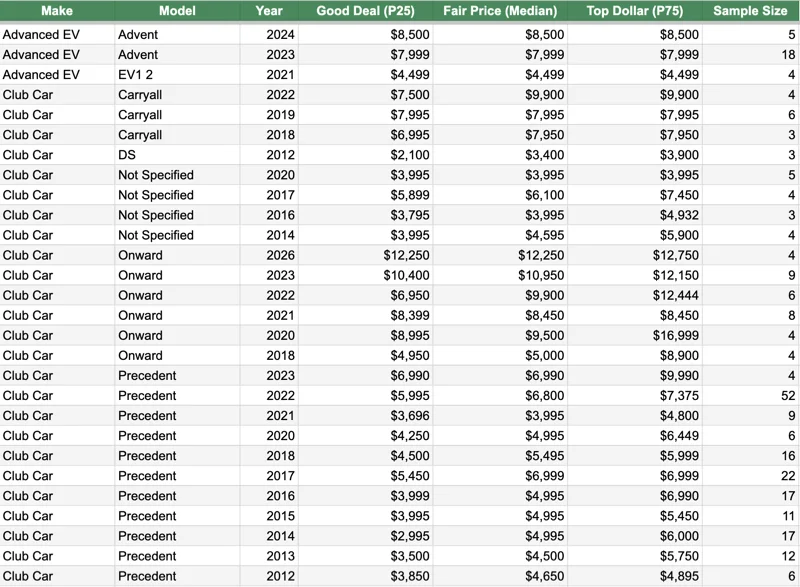
Our archived GolfCartResource collection contains 1,691 usable used-cart dealer listings after filtering for a stated year and make and asking prices from $1,000 to $30,000, inclusive. The overall median is $5,999, but that is too broad to value a particular RXV.
We narrowed the archive to records with year 2020, make E-Z-GO, a model name containing RXV, the raw power label Electric and seating label 4 Passenger. That produced 11 records, reduced to 10 distinct listing URLs by removing one repeated URL.
| Archived comparison group | Distinct listing URLs | Asking price on August 4, 2026 |
|---|---|---|
| Strasburg, Ohio; RXV, Electric, four passengers | 9 | $5,999 each |
| Weatherby Lake, Missouri; Freedom RXV, Electric, four passengers | 1 | $5,950 |
Examples are the archived Strasburg RXV listing and Weatherby Lake Freedom RXV listing. These links identify the saved advertisements; they do not promise that the units are still available or priced the same today.
The observed range is only $49, and the upper-middle median is $5,999. That tight spread is not an appraisal confidence interval. Nine URLs share one location and one asking price, so they do not provide nine independent markets. Distinct URLs also do not prove distinct VINs.
There is a further classification problem: some records labeled “Electric” have ELiTE in the listing URL. We did not verify their installed chemistry, battery health, charger, options or condition. A buyer cannot assume these are comparable lead-acid carts solely from the raw label.
This comparison illustrates the work a valuation needs: inspect the underlying offers, not just the median. Without matched condition and a final transaction, we cannot say your cart would sell for $5,999, or that the $5,950 cart is a bargain.
Build a comparison sheet for your cart
Start with the vehicle's manufacturer plate, year and model, not the body style alone. Use the serial/VIN guide to help identify it. A replacement body or aftermarket seat does not change the original model year.
Collect five to ten current advertisements within a practical buying area. Prioritize exact model, year, seating and powertrain; record every mismatch. Include dealer and private advertisements, but keep their selling channels separate.
| Field | What to record |
|---|---|
| Identity | URL, check date, seller, year/model and stated VIN or serial |
| Configuration | Passenger orientation, powertrain, battery model/capacity and installed options |
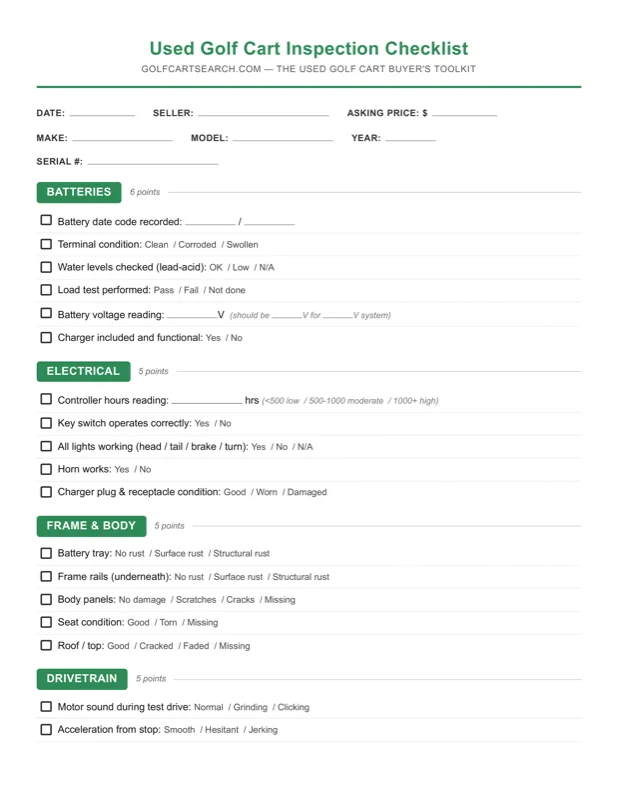
| Condition | Documented defects, inspection results, service history and charger operation |
| Price | Ask, excluded fees, included equipment and whether reduced |
| Evidence quality | Seller assertion, invoice, technician result or your inspection |
| Sale status | Still advertised, withdrawn or documented sold price; unknown remains unknown |
Remove duplicate URLs and inspect matching photos or identifiers for reposted units. A disappeared advertisement is not proof of a sale at its last price. Note whether your sample is concentrated in one dealer or contains several markets.
For a small group, show its count and observed range alongside the median. Do not present the range as guaranteed sale proceeds. Our used-price analysis explains the broader sample and its upper-middle median convention.
Price condition with evidence
Get a documented assessment for battery capacity, drivetrain, brakes, steering and structural condition. Battery resting voltage alone cannot establish usable capacity, and a universal “above 5.5V under load” rule omits the model, current, duration and temperature needed to interpret a test.
For a lithium cart, collect the installation date, exact pack, compatible charger, service/diagnostic records and applicable warranty. Lithium does not establish another eight to ten years of life or a fixed $1,000–$2,500 resale increment. Obtain written confirmation of any transferable remaining coverage; do not assume every E-Z-GO ELiTE pack transfers.
For other repairs, use written local quotes identifying parts, labor and tax. Keep a repair quote separate from a value adjustment: a buyer may price unresolved risk differently from the work's invoice cost. Disclose known problems and avoid a test drive with unsafe brakes, steering or structural damage.
Accessories need individual checks. A lift, rear seat or lighting package is not automatically worth its purchase and installation cost to the next buyer. Road eligibility also depends on the actual vehicle's certification and local requirements; lights and a faster controller do not establish it.
A hypothetical repair decision
Suppose you have an actual $4,800 as-is offer and a $700 repair quote. Spending $700 breaks even only if the eventual net proceeds rise by at least $700, before your extra time or other costs. An assumed post-repair $5,500 asking price is not enough: it is an advertisement, not an accepted offer. These numbers illustrate the decision, not typical market or repair prices.
Compare selling channels by net proceeds
A private listing, dealer trade-in and consignment agreement can offer different convenience, costs and uncertainty. Obtain actual offers and terms instead of applying a fixed 20–30% rule.
Here is a hypothetical comparison, using assumed amounts rather than observed sale results:
| Channel | Assumed gross amount | Assumed selling costs | Net before other costs |
|---|---|---|---|
| Private sale | $5,500 | $300 | $5,200 |
| Trade-in offer | $4,000 | $0 in this example | $4,000 |
| Consignment | $5,500 | 10% fee ($550) plus $100 | $4,850 |
The private-sale net exceeds the trade-in by $1,200, or 30% of the $4,000 trade-in baseline. That arithmetic does not predict what a seller will achieve. Account for transport, preparation, payment costs, time and the chance the asking price is not accepted. Check any applicable tax treatment and contract terms for the real transaction.
When buying another cart at the same dealer, request the replacement cart's cash price and the trade-in allowance separately. A larger allowance paired with a larger new-cart price is not automatically a better deal.
Use our trade-in versus private-sale guide and selling checklist to compare the actual terms. No channel has a guaranteed selling time or fixed percentage return.
Set and review your asking price
Choose an initial ask supported by the closest current offers and your cart's documented condition. Record a minimum acceptable net amount separately. Review the listing against actual inquiries and new comparable advertisements rather than promising a spring premium or a particular day-of-week advantage.
If you want to calculate how much your own cart depreciated, use its original invoice and a documented later sale or clearly labeled current offer. Current replacement MSRP is not the historical purchase price of an older cart. Our archived dealer asks cannot establish a universal first-year loss, five-year retention rate or best-resale brand.
Prepare accurate photographs and gather ownership papers, charger details, battery invoices and service records. Clean according to the cleaning guide, disclose defects, and avoid spending on improvements purely because a generic guide promises repayment.
The Buyer's Toolkit contains the saved pricing context and inspection materials. Treat its historical reference figures as a starting point for checking current offers, not a certified appraisal.
Frequently asked questions
What is my golf cart worth?
Use current local offers for the closest model, year, seating, powertrain and documented condition. Separate seller asking prices from completed sales and calculate net proceeds after actual selling costs.
Is there a KBB golf cart value?
On October 10, 2026, the cited KBB golf-cart URL redirected to motorcycle values without a displayed golf-cart category. We have not established a usable exact-cart valuation through that link.
Can I use a NADA or J.D. Power number?
Ask for the exact provider, lookup date, model, condition and value type. We have not verified an exact golf-cart result through the checked powersports page; a similar UTV or motorcycle is not a substitute.
How much do golf carts depreciate?
Our dealer-asking-price snapshot cannot establish a universal annual rate. Measuring your cart’s depreciation needs its historical purchase price and a comparable later sale or clearly labeled offer.
Does lithium increase my cart’s value by a fixed amount?
No fixed premium is established here. Compare the exact pack, age, installation, health, charger and applicable warranty with otherwise similar carts.
Should I replace the batteries before selling?
Obtain a documented battery assessment and an installed quote, then compare real as-is offers with realistic net proceeds after repair. Neither resting voltage nor a generic load-voltage threshold proves battery capacity.
Is private sale always 20–30% better than trade-in?
No. Compare actual offers and net proceeds. The example in this guide is hypothetical and uses the trade-in amount as the percentage baseline.
Should I use current MSRP as the original price?
No. Use the historical invoice or a year-specific price and options record. If unavailable, base the asking-price comparison on current matched offers and state the missing information.
Golf Cart Search
Find the Best Golf Carts of 2026
Compare top-rated models, read expert reviews, and find the perfect cart for your needs.