As an Amazon Associate, we earn from qualifying purchases. This helps support our site at no extra cost to you.
Convert Gas Golf Cart to Electric: Kits & Cost
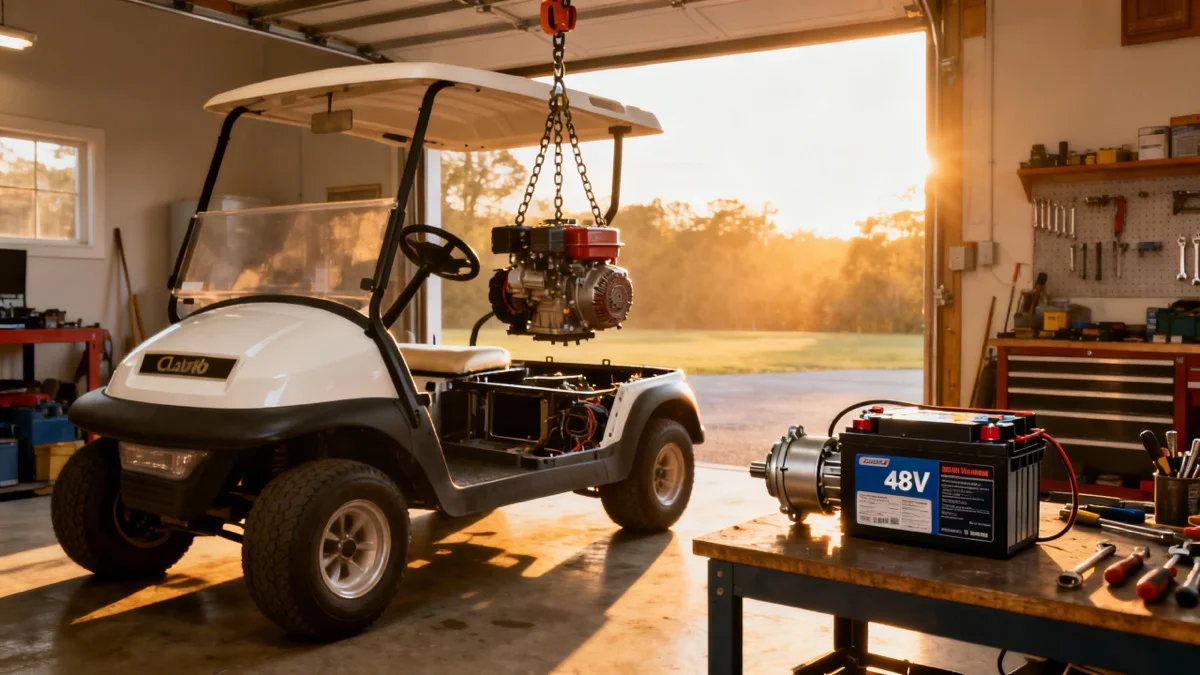
If you want to convert a gas golf cart to electric, start with the honest answer: yes, it can be done, but it is a custom drivetrain project. If you are asking "can you convert a gas golf cart to electric?", the real question is whether your exact donor cart has a documented motor-to-axle solution or needs an electric transaxle swap. You are not just replacing an engine with a motor. You are removing the gas powertrain and rebuilding the cart around a matched motor, controller, battery, charger, throttle, protection devices, and wiring system.
If you own a gas cart and want to go electric, you have three options: convert the cart you have, sell it and buy a used electric, or buy new. This guide covers the first option while showing when the other two make more financial and service sense.
We break down the components, planning costs, what to look for in a golf cart gas-to-electric conversion kit, and model-specific fitment questions for EZGO, Club Car, and Yamaha.
Convert Gas Golf Cart to Electric: Quick Answer
| Question | Short Answer |
|---|---|
| Can you convert a gas golf cart to electric? | Yes, if the frame, rear axle, body, brakes, and suspension are worth saving. Expect a full drivetrain swap, not a simple bolt-on part. |
| How much does converting gas golf cart to electric cost? | $1,500-$3,000 for a budget DC/lead-acid build, $3,500-$5,500 for AC/lithium, and $5,000-$7,000+ for premium 72V lithium. |
| What is in a golf cart gas to electric conversion kit? | Motor, controller, adapter plate/coupler, wiring, solenoid, throttle interface, forward/reverse controls, charger, and battery guidance. |
| Is a conversion kit the same as a DC-to-AC upgrade? | No. Many "conversion kits" are for carts that are already electric. A gas cart needs a complete electric drivetrain package. |
| What about electric to gas golf cart conversion? | It is usually a bad deal because it needs fuel, exhaust, clutch/CVT, mounts, gas wiring, and fabrication. Buy a gas cart instead. |
Can You Convert a Gas Golf Cart to Electric?
Yes. A solid golf cart chassis can be rebuilt as electric, but major-brand donor carts are only practical when the drivetrain path is documented. A gas EZGO TXT, Club Car DS, or Yamaha Drive is not automatically compatible with parts sold for the electric version of that model. Rare carts and unsupported years may require a different transaxle, custom motor mounts, custom battery trays, and substantial fabrication.
The decision should start with the donor cart, not the motor. If the frame has rust, the rear axle is noisy, the brakes are weak, the body is cracked, or the suspension is worn out, the conversion math falls apart quickly. Fixing those issues plus buying the electric drivetrain can cost more than a clean used electric cart.
Use manufacturer fitment resources before ordering parts. Navitas publishes make/model applications for electric golf car AC packages, while Alltrax describes DC-to-AC kits for factory-electric carts. Those resources help identify compatible electric components, but neither proves that a gas axle can accept the motor. Require a supplier to identify the exact transaxle or adapter, motor mount, throttle, controller, battery, fuse, cables, and charger for your donor.
Convert, Buy Used, or Buy New?
Before you order a single part, run the numbers. Converting is not always the cheapest path to an electric golf cart.
| Option | Cost | Time | Risk | Best When... |
|---|---|---|---|---|
| DIY conversion | $1,500-$7,000 | 20-40 hours | Moderate (wiring, compatibility) | Your gas cart has a solid frame, good body, and you enjoy hands-on projects |
| Sell gas + buy used electric | $3,000-$6,000 net | 1-2 weeks | Low | Your gas cart is common (EZGO, Club Car) and the used electric market is strong locally |
| Buy new electric | $6,000-$12,000+ | Immediate | None | You want a warranty and factory reliability |
The honest math: A mid-range conversion with an AC motor and lithium batteries runs $3,500-$5,500 in parts alone. A clean used electric EZGO or Club Car sells for $3,000-$6,000. If your gas cart is worth $2,000-$3,000 on the used market, selling and buying electric often comes out cheaper with less risk.
Conversion makes the most sense when:
- Your cart has sentimental value or is a rare model worth preserving
- The frame, body, suspension, and tires are in excellent condition
- You want a project and enjoy working on vehicles
- Your community or HOA is banning gas carts (noise or emissions rules)
- You want a specific high-performance electric setup that factory carts do not offer
What About Electric to Gas Golf Cart Conversion?
Electric to gas golf cart conversion is the reverse project, and it is almost never the right path. You would need to add a gas engine, fuel tank, fuel lines, exhaust, clutch/CVT hardware, gas-specific wiring, throttle linkage, engine mounts, and heat shielding. On many electric frames, those parts do not bolt in cleanly.
If you need gas-cart range, quick refueling, or better remote-property use, compare the total conversion cost against a factory gas cart first. For most owners, selling the electric cart and buying a gas golf cart is cheaper, easier to insure, and easier to service later.
What a Gas-to-Electric Conversion Involves
A true gas-to-electric conversion is more involved than most online articles suggest. You are replacing the entire drivetrain, not just swapping a motor.
What Gets Removed
- Gas engine (typically 9-13 HP)
- Fuel tank and fuel lines
- Exhaust system
- Clutch and belt-drive transmission
- Carburetor and air filter
- Starter motor and starter-generator
- Engine wiring harness
What Gets Installed
| Component | Purpose | Typical Cost |
|---|---|---|
| Electric motor (DC or AC) | Replaces gas engine | $500-$1,500 |
| Motor controller | Regulates power to motor | $300-$800 |
| Motor adapter plate | Bolts motor to existing axle | $50-$200 |
| Battery pack (48V) | Powers everything | $600-$3,000 |
| Battery charger | Recharges batteries | $150-$600 |
| Heavy-duty solenoid | Main power relay | $40-$80 |
| Wiring harness and cables | Electrical connections (2-4 gauge) | $50-$200 |
| Throttle/accelerator sensor | Speed control input | $30-$80 |
| Forward/reverse switch | Directional control | $30-$60 |
| Key switch and battery meter | On/off and charge level | $35-$80 |
| Safety components | Fuse, resistor, diode | $20-$40 |
The Drivetrain Challenge
This is the part most articles gloss over. Gas golf carts and electric golf carts use fundamentally different drivetrains:
- Gas carts use a clutch and belt-driven system between the engine and transaxle
- Electric carts commonly mount the traction motor directly to an electric transaxle with internal reduction gearing
During conversion, the clutch and belt system are removed. What happens next is design-specific: a proven conversion may use a purpose-built adapter, while another needs the electric version's transaxle or a custom drive system. This is the first compatibility question to settle. Do not order the motor, controller, or battery until the supplier documents how torque reaches the axle on your exact gas chassis.
Golf Cart Gas to Electric Conversion Kit: What to Buy
A real golf cart gas to electric conversion kit should be a complete drivetrain plan, not just a motor/controller box. Before buying, ask the seller to confirm every item below for your exact make, model, year, rear axle, and throttle setup.
| Kit Piece | Why It Matters |
|---|---|
| Motor and controller | Must match voltage, current, torque needs, and your target speed. |
| Adapter plate and coupler | The hard fitment piece that mates the electric motor to the gas cart axle. |
| Battery pack and charger | Must match the controller voltage and battery chemistry. |
| Wiring harness and 2-4 gauge cables | Undersized cables create heat, voltage drop, and controller faults. |
| Solenoid, fuse, resistor, and diode | Protect the high-current circuit and controller. |
| Throttle interface | The controller must understand your pedal sensor or throttle conversion. |
| Forward/reverse controls | Direction switching differs by controller and motor type. |
| DC-DC converter | Needed if lights, horn, turn signals, or USB accessories need 12V power. |
| Wiring diagram and support | A missing diagram can turn a weekend project into weeks of troubleshooting. |
The biggest buying mistake is ordering a kit labeled "golf cart conversion kit" without checking what kind of conversion it means. Many Navitas, Alltrax, and SilverWolf/TEEKON products are excellent DC-to-AC upgrades for carts that are already electric. They can still be part of a gas-to-electric project, but only if the seller or installer supplies the missing gas-swap pieces: adapter/coupler, throttle solution, battery mounting, charger setup, and safety wiring.
Complete Cost Breakdown
The following tables are parts-planning allowances, not quotes for verified turnkey gas-to-electric packages. They can omit a replacement transaxle, custom fabrication, engineering, shipping, tax, tools, and rework. Price the exact supported design before approving the project.
Budget Build: DC Motor with Lead-Acid Batteries
Best for older carts where you want to spend as little as possible.
| Component | Specification | Cost |
|---|---|---|
| DC motor (10HP) | D&D Motor Systems or equivalent | $500-$700 |
| Controller (350A) | Alltrax SR48300 or similar | $300-$400 |
| 6x 8V lead-acid batteries | Trojan T-875 or equivalent (48V total) | $600-$900 |
| Lead-acid charger | Lester Summit Series or equivalent | $150-$250 |
| Solenoid, wiring, hardware | Various | $150-$300 |
| Motor adapter plate | Model-specific | $50-$150 |
| Throttle, switches, meter | Various | $60-$100 |
| Total (DIY) | $1,810-$2,800 |
Expected performance: 14-18 MPH top speed, 25-35 mile range, 300-350 lbs of battery weight.
Mid-Range Build: AC Motor with Lithium Batteries
The sweet spot for most conversions. Better performance, much lighter, and lower long-term cost.
| Component | Specification | Cost |
|---|---|---|
| AC motor + controller kit | Navitas TAC2 5KW/600A or TEEKON 9KW/840A | $1,600-$2,000 |
| 48V lithium battery (100-105Ah) | LiFePO4 with BMS | $1,500-$2,500 |
| Lithium-compatible charger | Included with battery or standalone | $0-$400 |
| Solenoid, wiring, hardware | Heavy-duty, 2-gauge cables | $150-$300 |
| Motor adapter plate | Model-specific | $50-$150 |
| Throttle, switches, meter | Various | $60-$100 |
| Total (DIY) | $3,360-$5,450 |
Expected performance: 19-25 MPH top speed, 40-60 mile range, only 50-110 lbs of battery weight (200-250 lbs lighter than lead-acid).
Cloudenergy 48V 105Ah LiFePO4 Golf Cart BatteryPremium Build: 72V AC with High-Performance Lithium
For maximum speed, range, and hill-climbing ability.
| Component | Specification | Cost |
|---|---|---|
| AC motor + controller (72V rated) | Navitas 5KW/600A or custom | $2,000-$2,500 |
| 72V lithium battery pack | Custom or Eco Battery | $2,500-$4,000 |
| Heavy-duty solenoid + upgraded wiring | Rated for higher voltage | $150-$300 |
| Charger, adapters, controls | 72V compatible | $300-$500 |
| Total (DIY) | $4,950-$7,300 |
Expected performance: 25-32 MPH top speed, 50-80 mile range. Note that speeds above 25 MPH may require street-legal equipment and LSV registration in your state. Check your state's golf cart laws.
Professional Labor
| Service | Cost |
|---|---|
| Full conversion (shop does everything) | $500-$1,500 labor + parts |
| Consultation and wiring only | $200-$500 |
| Motor mounting and drivetrain work | $300-$800 |
Find conversion shops near you through our repair directory or dealer directory.
Step-by-Step Conversion Process
This overview covers the general process. Specific steps vary by cart model and kit. Always follow your kit manufacturer's instructions.
Step 1: Document and Remove the Gas Drivetrain
Before touching anything, photograph the entire cart: engine bay, wiring, fuel lines, throttle linkage, exhaust routing. You will reference these photos throughout the project.
Disconnect the battery. Drain the fuel tank and remove it. Disconnect the exhaust, throttle cable, and all engine wiring. Unbolt the engine from the frame. On most golf carts, the engine mounts to a plate on top of the rear axle assembly. Remove the clutch and belt from the axle input shaft.
Set the gas components aside. The engine, clutch, and starter-generator have resale value on forums and eBay.
Step 2: Install the Electric Motor
Follow the documented drivetrain design for your exact donor. That may mean installing an electric transaxle, using a purpose-built adapter and coupling, or fabricating mounts around a supported drive unit. Do not improvise from a kit intended for the factory-electric version of the cart.
Use the supplier's alignment procedure and torque specifications. Misalignment can create vibration, heat, bearing wear, or shaft damage. If the design has no documented alignment method, pause and involve a qualified fabricator or drivetrain specialist.
Step 3: Mount the Batteries
The battery pack typically mounts where the gas engine and fuel tank sat, under the rear seat or in a custom battery tray. Lithium batteries are small and light enough to fit in the original engine bay with room to spare. Lead-acid batteries require a larger battery tray and careful weight distribution.
Secure batteries with straps or brackets. They must not shift during driving, especially on hills or rough terrain. Poor mounting is a safety hazard and can damage battery terminals.
Step 4: Wire the Electrical System
This is the most technical step and where most DIY problems occur.
Connect the battery pack to the controller. Connect the controller to the motor. Install the solenoid between the battery pack and controller. Wire the throttle sensor, forward/reverse switch, key switch, and battery meter.
Follow the wiring diagram from your kit manufacturer exactly. Every wire, terminal, and connection point matters. A single misconnected wire can fry the controller (a $300-$800 mistake).
Step 5: Install the Charger
Mount the charger in a protected location (under the seat or in the engine bay). Connect it to the battery pack according to the charger's wiring diagram. Make sure the charger matches your battery type: a lead-acid charger will damage lithium batteries, and vice versa.
For a complete charger comparison, see our golf cart charger guide.
FORM 48V Lithium Golf Cart Charger →Step 6: Test and Tune
Before driving, check every connection. Verify battery voltage matches expectations. Turn the key and listen for the solenoid click. Press the accelerator gently and confirm the motor spins in the correct direction. Test forward and reverse.
Many AC motor controllers (Navitas, Alltrax) have Bluetooth apps or USB programming software for tuning acceleration curves, top speed, and regenerative braking strength. Take time to dial these in. The default settings are usually conservative, and gradual adjustments will optimize performance for your specific setup.
Motor and Controller Brands You May Encounter
The brands below sell electric drivetrain components or upgrades. Their presence in a parts list does not make that list a complete gas-to-electric kit. The seller still needs to document the gas-chassis drivetrain solution, battery mounting, throttle, charger, fuse protection, cables, and wiring.
Navitas Vehicle Systems
Navitas publishes fitment tools for electric EZGO, Club Car, Yamaha, and other golf car/LSV applications. Its own pages describe AC packages and DC-to-AC conversions. For a gas cart, that means the Navitas motor/controller may be one part of a custom build, not proof of gas-chassis compatibility.
D&D Motor Systems
D&D publishes specialty DC motor information for golf cars and other small electric vehicles. Ask D&D or the reseller to match the motor to the target voltage, controller, duty cycle, gearing, vehicle weight, and axle interface. A motor recommendation is not a full conversion design.
SilverWolf / TEEKON
SilverWolf/TEEKON systems are marketed mainly as performance conversions for supported electric carts. If a reseller proposes one for a gas donor, require the complete bill of materials and the exact gas-to-electric drivetrain solution before paying.
Alltrax
Alltrax's current AC page describes controllers and DC-to-AC kits for supported factory-electric carts, including specific Club Car and EZGO applications. That makes Alltrax a component source, not a published turnkey answer for a gas-to-electric swap.
Compatibility Questions to Get Answered in Writing
| Question | Acceptable evidence |
|---|---|
| Does this fit my gas cart's exact year and serial range? | Supplier fitment sheet naming the gas model, not only the electric version |
| Does the build keep or replace the gas transaxle? | Part number, drawing, or installation manual for the adapter or replacement axle |
| How is the motor mounted and aligned? | Bracket details, torque values, and alignment procedure |
| How does the pedal command the controller? | Named throttle sensor/interface and calibration instructions |
| What protects the high-current circuit? | Fuse, contactor, cable gauge, connector, and wiring diagram specifications |
| Who supports commissioning problems? | A named supplier or installer who will troubleshoot the completed system |
AC vs DC Motors: Which to Choose
This decision affects your budget, performance, and long-term maintenance.
For a deeper motor-only comparison before you buy parts, read our AC vs DC golf cart motor guide. The short version for gas conversions: DC is cheaper and simpler, while AC is smoother, more efficient, and usually better if you are already spending for lithium batteries.
| Feature | DC Motor | AC Motor |
|---|---|---|
| Cost | $500-$700 | $800-$1,500 |
| Maintenance | Motor brushes are wear items | No traction-motor brushes; inspect wiring and bearings per supplier guidance |
| Efficiency | Depends on motor, controller, gearing, and duty cycle | Depends on motor, controller, gearing, and duty cycle |
| Regenerative braking | System-dependent | Available on many matched AC systems |
| Service life | Depends on load, heat, brushes, alignment, and maintenance | Depends on load, heat, bearings, alignment, and electronics |
| Installation | Simpler wiring | More complex controller setup |
| Best for | Budget builds, simple installs | Long-term value, performance builds |
Our recommendation: Choose the best-supported complete system for your donor rather than setting a budget threshold first. If only one supplier can document the axle, throttle, controller, battery, and charger as a working package, that support is more valuable than a generic AC-versus-DC rule.
Battery Options for Your Conversion
The battery is the single most expensive component and the one that most affects range, weight, and long-term cost. For a full breakdown of golf cart battery technology, see our complete battery guide.
| Type | Main planning advantage | Main planning risk | What to verify |
|---|---|---|---|
| Flooded lead-acid | Familiar and widely serviceable | High weight, watering, ventilation, and pack balancing | Pack dimensions, total weight, charger profile, and maintenance access |
| AGM lead-acid | Sealed construction and no watering | Still heavy; charging requirements vary | Exact charger profile and replacement availability |
| Lithium LiFePO4 | Lower weight and integrated battery management | Current limits, charger mismatch, cold-temperature rules, and warranty terms | Usable energy, continuous/peak current, BMS protections, charger, and written warranty |
Why We Recommend Lithium for Conversions
Weight is the deciding factor. Lead-acid batteries add 300-350 pounds to a cart that just lost roughly 100 pounds of engine, fuel, and exhaust. That extra weight strains the suspension, eats into range, reduces hill-climbing ability, and accelerates tire and brake wear.
Lithium packs are often substantially lighter than an equivalent lead-acid bank, but do not assume every advertised amp-hour rating is equivalent. Compare usable watt-hours, pack current limits, vehicle weight, controller demand, and the supplier's range test conditions. Any total-cost claim should also include the exact written warranty and expected replacement price.
CHINS 48V 100Ah LiFePO4 Battery with ChargerCommon Problems and How to Avoid Them
These issues come directly from golf cart forums (Cartaholics, BuggiesGoneWild, and Endless Sphere) where real owners document their builds. Learn from their mistakes.
Controller Wiring Errors
The problem: The controller does not respond after installation. No solenoid click, no motor movement.
The cause: Incorrect wiring. Different controller revisions (e.g., Alltrax Rev B vs Rev C) have different wiring requirements that are not interchangeable. A single swapped wire can prevent the entire system from functioning.
The fix: Download the wiring diagram from the controller manufacturer's website before you start. Match your exact controller model and revision. Test continuity at every connection point before powering on.
Throttle Calibration Issues
The problem: The cart moves in lurches, has no throttle response, or runs at full speed the moment you tap the pedal.
The cause: The controller's throttle type setting does not match the physical throttle sensor installed on the cart. Alltrax controllers in particular require exact throttle type selection in their Toolkit programming software.
The fix: Use the controller's programming software to configure the correct throttle type. Run the throttle calibration procedure (usually: set minimum, press pedal fully, set maximum, save).
Motor Adapter Alignment
The problem: Vibration, grinding noise, or excessive heat from the motor area during operation.
The cause: The motor adapter plate is not perfectly aligned with the rear axle input. Even a fraction of a degree of misalignment creates vibration that wears bearings and can damage the motor shaft.
The fix: Use feeler gauges or a dial indicator during installation to verify alignment. Most kits include shims for adjustment. If vibration appears after installation, stop driving and realign before permanent damage occurs.
Scope Creep
The problem: The project costs twice as much and takes three times as long as planned.
The cause: You discover that the frame needs repair, the suspension is worn, the brakes need rebuilding, or the existing wiring is corroded. Each discovery adds cost and time.
The fix: Budget 30-50% more than your initial estimate. Inspect the cart thoroughly before ordering parts. If the frame, axle, or body need significant work, the math may favor selling and buying electric instead.
The Most Common Forum Advice
Across Cartaholics, BuggiesGoneWild, and Reddit's r/golfcarts, the single most repeated piece of advice for gas-to-electric conversions is: "Sell the gas cart and buy a used electric." This is not discouragement. It is experienced owners pointing out that once you add up the motor, controller, batteries, charger, wiring, adapter plates, and your time, you are often spending more than a used electric cart costs.
If you decide to convert anyway, these same forum members recommend:
- Use a model-specific kit, not a universal one
- Buy lithium batteries (the weight savings alone justify the cost)
- Photograph everything before disconnecting it
- Budget 50% more than you think the project will cost
- Get the wiring diagram from the controller manufacturer's website, not a forum post
Electric Operating Costs vs Gas
One of the biggest motivations for conversion is the dramatic drop in operating costs.
| Cost Category | Gas Cart | Electric Cart |
|---|---|---|
| Fuel/charging per mile | $0.08-$0.12 | $0.01-$0.03 |
| Annual fuel/electricity (1,500 miles) | $120-$180 | $15-$45 |
| Oil changes | $30-$50 every 100 hours | None |
| Belt/clutch service | $50-$150/year | None |
| Engine tune-ups | $100-$200/year | None |
| Noise level | 70-85 dB (lawn mower) | 50-60 dB (conversation) |
| Emissions | Exhaust fumes | Zero direct emissions |
Over 5 years, an electric cart saves $800-$1,500 in fuel and maintenance compared to gas. This offset helps justify conversion costs, especially on a cart you plan to keep for a decade or more.
For a full comparison of electric and gas carts, read our electric vs gas guide.
After the Conversion
Breaking In Your New Electric Drivetrain
Run the cart at moderate speed (50-75% throttle) for the first 10-20 miles. This allows the motor, controller, and connections to settle. Check all connections after the break-in period. Tighten any that have loosened from vibration.
Ongoing Maintenance
Electric drivetrains are far simpler to maintain than gas engines. Your new maintenance routine will include:
- Monthly: Check battery connections for corrosion. Verify tire pressure. Test brakes.
- Quarterly: Inspect wiring for chafing or loose connections. Check motor mounting bolts.
- Annually: Test battery capacity. Clean controller heat sink. Lubricate axle and suspension.
- Lead-acid only: Check water levels weekly and add distilled water as needed.
Street-Legal Considerations
If your cart was previously street-legal as a gas cart, the conversion does not automatically maintain that status. Some states require re-inspection after major drivetrain modifications. Check your state's golf cart laws for specific requirements.
If you want to make your converted cart street-legal, you will need the standard LSV equipment: headlights, tail lights, turn signals, mirrors, seat belts, and a windshield. See our full street-legal guide for a step-by-step walkthrough.
Adding Solar
Some owners add solar panels to their converted carts for supplemental charging. A 200-400W panel on the roof can add 3-8 miles of range per day of sunlight, reducing how often you need to plug in.
Frequently Asked Questions
Can you convert a gas golf cart to electric?
Yes, you can convert a gas golf cart to electric, but it is a full drivetrain swap. You remove the gas engine, fuel tank, exhaust, clutch, and starter-generator, then install an electric motor, controller, battery pack, charger, throttle wiring, solenoid, and safety wiring. Most DIY conversions cost $1,500-$7,000 in parts before labor.
What is in a golf cart gas to electric conversion kit?
A true golf cart gas to electric conversion kit should include an electric motor, motor controller, motor adapter plate or coupler, wiring harness, solenoid, throttle interface, forward/reverse controls, battery meter, charger, and battery-pack guidance. Many kits sold online are only DC-to-AC upgrades for carts that are already electric, so verify that the kit is built for a gas-engine removal project.
Is electric to gas golf cart conversion worth it?
Electric to gas golf cart conversion is usually not worth it. It requires adding an engine, fuel system, exhaust, clutch/CVT hardware, gas-specific wiring, mounts, and often major fabrication. If you need gas range or quick refueling, selling the electric cart and buying a factory gas cart is usually cheaper and more reliable.
Can any gas golf cart be converted to electric?
Technically, yes. Any cart with a solid frame and functioning rear axle can be converted. In practice, carts from the major brands (EZGO, Club Car, Yamaha) are easiest because model-specific kits are available. Carts from less common brands may require custom fabrication for the motor adapter plate and wiring, adding $200-$500 and significant complexity.
How much weight does a conversion add or remove?
It depends on battery choice. Removing the gas engine, fuel tank, exhaust, and clutch saves roughly 100-120 pounds. Lead-acid batteries add 300-350 pounds, for a net gain of about 200 pounds. Lithium batteries add only 50-110 pounds, for a net loss of about 10-50 pounds. A lithium conversion can actually make the cart lighter than it was with the gas engine.
Is there a tax credit for converting a golf cart to electric?
No. Federal EV tax credits (Section 30D) and state EV rebate programs apply only to highway-capable vehicles, not golf carts. There are no federal or state incentives specifically for golf cart conversions as of 2026. The savings come from lower operating costs over time.
What tools do I need for a conversion?
Standard automotive hand tools: socket set, wrenches, screwdrivers, pliers, wire strippers, and a crimping tool. You will also need a multimeter for testing electrical connections, a torque wrench for motor mounting bolts, and a drill with bits for mounting brackets. Specialty tools are rarely needed if you use a model-specific kit.
Can I keep my gas cart's existing electrical system?
The low-voltage electrical system (lights, horn, turn signals) can remain intact. Most conversion kits include a DC-DC converter that steps down the main battery voltage (48V or 72V) to 12V for accessories. The starter motor, ignition system, and engine sensors are removed since they are no longer needed.
Where can I find a shop to do the conversion for me?
Search our repair directory for golf cart service shops in your area. Call ahead and ask specifically about gas-to-electric conversions, as not all repair shops offer this service. Expect professional labor to add $500-$1,500 to the total project cost. You can also browse our dealer directory to find shops that sell and service electric carts from all major brands.
Golf Cart Search
Find the Best Golf Carts of 2026
Compare top-rated models, read expert reviews, and find the perfect cart for your needs.