
As an Amazon Associate, we earn from qualifying purchases. This helps support our site at no extra cost to you.
Quick Answer: Are Denago Golf Carts Any Good?
Yes, Denago golf carts can be a good buy if you want a feature-loaded lithium cart and have a responsive authorized dealer nearby. Denago is strongest on price, standard equipment, aluminum-chassis appeal, and its current 8-year battery warranty. The trade-off is a shorter reliability record, less certain resale value, and a smaller service and parts network than Club Car, EZGO, or Yamaha.
Current official Denago pages for the Nomad XL, Rover XL, Rover XL6, and Rover XXL list 40-plus-mile or load-tested range claims, 5 kW/6.3 kW AC motors, 51.2V lithium packs, Apple CarPlay and Android Auto, 4-wheel disc brakes, and an 8-year lithium battery warranty. That combination makes a compelling first impression and explains why buyers cross-shop Denago against ICON, Evolution, Advanced EV, Club Car, EZGO, and Yamaha.
The harder part of a Denago review is judging what happens after the test drive. You need to know who will service the cart, how quickly parts arrive, whether warranty labor is covered, and whether the selling dealer is strong enough to make the written coverage useful.
This is a research-based buyer review, not a firsthand road test. We checked manufacturer specifications, dealer prices, and published warranty terms on September 6, 2026; we have not measured Denago failure rates or tested its advertised range. The current product lineup lists Rover XL, Nomad XL, Rover XL6, Rover XXL, Scout 2, CITY, and OXEN, while older dealer listings may still mention Nomad or Rover XXL Limo. This review covers the models that matter, realistic dealer price signals, ownership risks, and which buyers should choose Denago instead of a used Big 3 cart or another new value cart. If you are comparing Denago with another newer 72V value brand, our DACH golf cart review covers Apollo and Falcon pricing, warranty terms, and support risks.
Market Position Budget-premium value brand
Current Price Signal About $10K to $13K on common dealer signals
Battery Warranty 8 years on current official model pages
Top Speed 25 mph class on core models
Best Fit Feature-focused neighborhood buyers
Biggest Risk Dealer depth and resale uncertainty
Denago Review Evidence Summary
| Claim | Evidence type | Source date | Confidence |
|---|---|---|---|
| Current Rover XL and Nomad XL pages advertise 40-plus miles of range | Denago manufacturer specifications | September 6, 2026 | Medium: manufacturer claim, not an independent range test |
| Current model pages advertise an 8-year lithium battery warranty, lifetime aluminum chassis warranty, and 2-year major-parts coverage | Denago manufacturer warranty language | September 6, 2026 | Medium: verify the written model and dealer terms before purchase |
| Rover XL asking-price examples are $9,995; an XL6 listing and dealer catalog both show $12,995 | Named dealer examples below | September 6, 2026 | Medium: asking prices vary by location, fees, and equipment |
| A comparative reliability or resale ranking is not established here | No matched fleet study or completed-sale dataset used | September 6, 2026 | Unresolved; do not infer a failure rate from anecdotes |
| This review does not use a fleet-wide Denago failure rate | Editorial source review | September 6, 2026 | High: no unsupported failure percentage is presented |
Denago Golf Cart Reviews: Quick Verdict
If you want the fastest route to a modern-looking, lithium-powered 2-seat, 4-seat, or 6-seat cart with a lot of standard features, Denago deserves a serious look. The value story is real. Compared with many legacy-brand carts, you get more visible equipment for less money.
| Buyer question | Denago verdict |
|---|---|
| Are Denago golf carts good? | Yes, if local dealer support is strong |
| Best Denago model for most buyers | Rover XL for forward-facing four-seat use |
| Best reason to buy Denago | Modern equipment and lithium value for the price |
| Biggest Denago reliability risk | Dealer-dependent parts and warranty support |
| Current core price signal | Roughly $9,000 to $13,000 before local fees |
| Better long-term-resale alternative | Club Car, EZGO, or Yamaha |
If long-term ownership is your priority, compare local parts and service options for Denago with Club Car, EZGO, and Yamaha. A specification comparison cannot establish which individual cart will last longer, and this review does not supply a nationwide reliability ranking.
My verdict: Denago is a strong value buy for the right local market, not a blind nationwide recommendation. If you have a solid Denago dealer nearby and want the most specs per dollar, it can make sense. If your closest support is weak, or if you care a lot about resale and long-term parts confidence, a used Big 3 cart is often the smarter move.
For the same risk check across the wider value-brand market, read our golf cart brands to avoid guide before comparing Denago against direct-buy carts or premium newer brands.
The quick model answer:
- Rover XL is the cleanest Denago pick for most four-seat neighborhood buyers.
- Nomad XL is the better fit if you like the lifted 2+2 layout and want the lowest practical entry into the current core lineup.
- Rover XL6 or Rover XXL make more sense only if you truly need six seats.
- Scout 2, CITY, and OXEN are newer or more specialized models, so confirm availability, price, and support locally before treating them like proven defaults.
Who Makes Denago Golf Carts, and Where Are They Made?
Denago EV markets its golf carts and low-speed vehicles from Plano, Texas. Its official homepage describes Texas manufacturing, 400-plus Texas jobs created in 2024-2025, and more than $180 million invested in U.S. factories in Texas. These are company statements, not an independent audit of production or domestic component content.
The lineup is built around the things modern buyers notice immediately:
- 25 mph performance instead of 19 mph or slower
- lithium batteries as a standard talking point, not an upgrade afterthought
- Apple CarPlay and Android Auto
- rear cameras, LED light bars, and modern dash screens
- aluminum-chassis messaging and rust-resistance claims
That approach has worked. Denago is now regularly cross-shopped against ICON, Evolution, Star EV, and Club Car for buyers who want a neighborhood cart that looks fully loaded from day one.
The real question is not whether Denago can win the parking-lot walkaround. It usually can. The real question is whether the dealer, the warranty, and the ownership support are strong enough to keep the value story intact after the honeymoon phase.
2026 Denago Golf Cart Models Reviewed
Denago's lineup is not as static as older dealer pages make it look. Current official Denago navigation lists seven personal or utility models: Rover XL, Nomad XL, Rover XL6, Rover XXL, Scout 2, CITY, and OXEN. Older model pages and some dealer inventory may still show the Nomad or Rover XXL Limo, so match the exact cart on the dealer quote to the current Denago page before you compare prices.
| Model | Seats | Current Official Range Signal | Best For | Price Signal |
|---|---|---|---|---|
| Rover XL | 4 | 40+ miles | Best true 4-seat Denago | about $9,995 in common dealer listings |
| Nomad XL | 2+2 | 40+ miles | Lifted value / rear flip-seat layout | usually quote-dependent, often near the high-$8K to $10K range |
| Rover XL6 | 4+2 | 32 miles with 992 lb load | Families that need 6 seats without going full XXL | about $12,995 in dealer signals |
| Rover XXL | 6 | 32 miles with 992 lb load | Maximum passenger space | dealer quote required |
| Scout 2 | 2 | 40+ miles | Compact two-seat Denago | newer model, confirm locally |
| CITY | 6 | 40+ miles | Street-style urban LSV use | newer model, confirm locally |
| OXEN | Confirm configuration: page shows 2 and 2+2 | 70+ miles | Utility and work use | newer model, confirm locally |
Denago Nomad XL Review
The Nomad XL is the Denago I would start with if you want the lifted 2+2 layout. Denago's official page currently lists a 5 kW/6.3 kW AC motor, 51.2V/105Ah LiFePO4 battery, 40-plus miles of range, a 5-hour full charge, independent front and rear suspension, Apple CarPlay/Android Auto, and 4-wheel disc brakes. It also highlights the 8-year lithium warranty and lifetime aluminum-chassis warranty language that makes Denago's value pitch stronger than many generic import carts.
Why the Nomad XL stands out:
- It is the cleanest lifted 2+2 option in the current Denago lineup
- It has the same 105Ah lithium spec and 40-plus-mile range claim as the Rover XL
- Its published equipment list includes features often sold as upgrades
- It has enough range for the overwhelming majority of neighborhood and community driving
For a test drive, compare the Nomad XL with a similarly equipped cart at the same total price, including batteries and dealer fees. Just do not assume every dealer's Nomad XL quote includes the same accessories, freight, registration, or setup.
Denago Rover XL Review
The Rover XL is the model I would call Denago's cleanest mainstream buy. Denago's current official page again shows the 5 kW/6.3 kW AC motor, 51.2V/105Ah LiFePO4 battery, 40-plus mile range, Apple CarPlay/Android Auto, 5-hour charge time, 4-wheel disc brakes, and independent front and rear suspension.
This is the model for buyers who like Denago's value proposition but want a true forward-facing 4-seater instead of a rear flip-seat layout. Recent dealer listings commonly show Rover XL pricing around $9,995, which still usually comes in below alternatives like the ICON i40, Yamaha Drive2 Concierge 4, or Club Car Onward 4 Passenger.
Denago Rover XL6 and Rover XXL Reviews
Denago's six-seat story now splits into the Rover XL6 and Rover XXL. This is where the brand starts to look especially attractive for large families. Current official pages list:
- 5 kW/6.3 kW AC motor
- 51.2V/105Ah LiFePO4 battery
- 32 miles of range with a 992-pound load
- 5-hour charge time
- independent front and rear suspension
- Apple CarPlay and Android Auto
- 4-wheel disc brakes
That load-specific range claim is more useful than the generic 40-mile claims many brands throw around for 6-passenger carts. If your household really needs six seats, the XL6 or XXL is one of Denago's strongest arguments against paying more for a Yamaha Drive2 Concierge 6 or similar legacy-brand cart.
Denago Scout 2, CITY, and OXEN Reviews
The newer Scout 2, CITY, and OXEN pages show Denago widening beyond the original Nomad/Rover conversation. All three official pages list 5 kW/6.3 kW motors, four-wheel disc brakes, and independent front and rear suspension. Scout 2 lists a 105Ah battery; CITY and OXEN list 205Ah. Scout 2 and CITY advertise 40-plus miles, five-hour charging, and Apple CarPlay/Android Auto. OXEN instead lists 70-plus miles and eight-hour charging, without the same infotainment specification. Its page shows both two-seat and 2+2 labels, so confirm the actual seating configuration. These are manufacturer claims, not measurements from this review.
Those models may become important, but I would treat them as newer and more specialized until dealer inventory, pricing, and owner feedback are easier to compare. Most buyers should still start with Rover XL, Nomad XL, or Rover XL6.
Denago Pricing and Warranty
Denago's price story is the reason most buyers end up here in the first place. Denago's current official pages emphasize specs and dealer contact rather than a single national MSRP, so price comparisons need to use dealer quotes and current inventory.
The examples below were checked September 6, 2026. Asking prices and dealer catalog prices are different from completed sales or a national manufacturer MSRP. Availability and local fees can change.
| Model | Price example | Source and price type |
|---|---|---|
| Rover XL | $9,995 | TIGON live inventory, advertised unit price |
| Nomad XL | $8,995 | TIGON live inventory, advertised unit price |
| Rover XL6 | $12,995 | Mission Golf Cars, Corpus Christi, advertised unit price; TIGON lists $12,995 in its catalog |
| Rover XXL | $12,995 | TIGON catalog; request a unit-specific quote |
| Scout 2 / CITY / OXEN | Request a quote | Compare the exact model, equipment, and fees locally |
Before you treat any Denago quote as a deal, compare it with the broader 2026 golf cart pricing guide and use the golf cart value calculator if you are looking at a used Denago or trade-in.
Those prices matter because they put Denago in the middle of two strong shopping lanes:
- cheaper than many premium carts from Club Car, EZGO, and Yamaha
- more polished, at least on paper, than some other budget or off-brand carts
The warranty is also stronger than many buyers assume. Current official Denago model pages say the carts carry:
- lifetime warranty on the aluminum chassis
- 8-year warranty on the LiFePO4 lithium battery
- 2-year warranty on major parts and components
The Denago warranty document hosted by a dealer specifies parts-only coverage for the original purchaser, excludes transport costs, and limits eight-year battery replacement to personal use. Battery claims require specified testing; unapproved modifications can void coverage. The current model-page headline does not spell out those limits. Obtain the terms applicable to your exact cart and a separate written answer about dealer labor charges before purchase. Do not assume coverage transfers to a used-cart buyer.
Denago Golf Cart Problems: 5 Risks Before You Buy
This is the section most competing reviews gloss over. The Denago decision is not hard because the features are confusing. It is hard because the value is obvious and the ownership risk is harder to price.
1. Your dealer matters more than the badge
Denago is a dealer-dependent buy. If your local Denago dealer is strong, responsive, and likely to be around for years, the brand makes much more sense. If your local support is weak, the feature advantage can disappear the first time you need warranty help.
This is the single biggest reason I would not recommend Denago blindly to every buyer the way I might recommend a clean used legacy-brand cart from the dealer directory.
2. Parts availability and warranty labor need a local answer
We did not find a representative failure-rate study that establishes how often Denago carts break down. The public owner-report page contains self-submitted praise and complaints, but purchase verification and sampling are unclear. Those reports cannot establish the most common defect or rank Denago against another brand. Ask your dealer which parts it stocks, how it handles an immobilized cart, and who pays labor under the parts-only warranty.
3. The lineup and spec language move fast
The current OXEN page illustrates the problem: its two passenger labels disagree. Current Denago pages clearly say models like the Nomad XL, Rover XL, Rover XL6, Rover XXL, Scout 2, CITY, and OXEN include lifetime aluminum-chassis warranty language, but the public lineup has changed quickly and older dealer/model content is still floating around. Read the exact current model page and warranty terms before assuming every Denago cart shares the same frame story, equipment package, or battery spec.
4. Resale value is still unproven
We do not have matched completed-sale data that establishes Denago depreciation against Club Car, EZGO, or Yamaha. Compare actual local trade-in offers and similar used listings rather than treating brand age as a measured resale penalty.
If you swap carts often or care about resale value, Denago gets harder to justify.
5. A great spec sheet does not guarantee a great long-term cart
This is true for every value brand. Apple CarPlay, backup cameras, light bars, and big screens are easy to market. Long-term reliability is harder. A Denago can absolutely be the right buy. It just should not be bought for the dashboard alone.
If your main objective is “buy once, keep it 15 years,” the safer path is usually a cleaner used legacy-brand cart or a new premium-brand cart you know your local dealer will support.
Where Denago Actually Beats Many Competitors
With all the caveats above, Denago still does several things very well.
Denago makes feature-loaded carts feel attainable
Many buyers want a lithium cart with modern tech, CarPlay, a rear camera, disc brakes, and a real neighborhood/LSV feel, but they do not want to spend $12,500 to $16,000. Denago is one of the few brands consistently showing up below or near that line with a believable feature package.
Denago's core lineup is easier to shop than many brands
There is no giant maze of trims and cryptic model names here. Buyers can usually understand the current lineup in one conversation: compact two-seat Scout 2, lifted 2+2 Nomad XL, true four-seat Rover XL, six-seat Rover XL6/XXL, urban CITY, and utility OXEN.
That simplicity matters, especially for first-time buyers who are also comparing best carts under $10,000, 2 vs 4 vs 6 seaters, and best carts for neighborhoods.
Denago has real value in humid and coastal markets
If the aluminum-chassis warranty language applies to the model you are buying, Denago's rust-resistance story is a serious advantage versus steel-frame value carts. That matters in Florida, the Carolinas, Texas beach markets, and any salt-air community. Read our best golf carts for beach towns and rust prevention guide if that is your use case.
If you are cross-shopping other aluminum-frame newcomers, our Atlas golf cart review covers how Atlas compares on pricing, warranty language, and dealer-dependent risk.
Denago looks current without needing immediate upgrades
A lot of legacy-brand carts need accessories added before they feel finished to modern buyers. Denago already leans into cameras, screens, CarPlay, lighting, and chargers. That lowers the temptation to spend another $1,500 right after purchase on customization.
Denago vs Club Car, EZGO, Yamaha, ICON, and Evolution
Here is the easiest way to think about it.
| If you care most about... | Choose... |
|---|---|
| Lowest price with modern features | Denago |
| Local used-cart resale options | Compare Club Car listings and actual trade-in offers |
| Dealer depth and parts support | EZGO |
| Ride comfort | Test-drive Yamaha alongside Denago |
| Better-established value brand ecosystem | ICON |
| Another feature-heavy value option | Evolution, if local support is strong |
More specifically:
- Choose Denago over Club Car if upfront price matters much more than resale value.
- Choose Denago over EZGO if you want a lithium cart with more visible tech for less money.
- Choose Denago over Yamaha if you can live without decades of reputation in exchange for better price-per-feature value.
- Choose ICON over Denago if you want the safer middle ground between value and established dealer support.
- Choose Denago over Evolution if your local market has stronger Denago support and you prefer the aluminum-frame value pitch.
If you want the cleanest Denago head-to-heads, start with:
- Denago Nomad vs ICON i40
- Club Car Onward 4 Passenger vs Denago Nomad
- Yamaha Drive2 Concierge 4 vs Denago Nomad
Should You Buy a Denago New or Used?
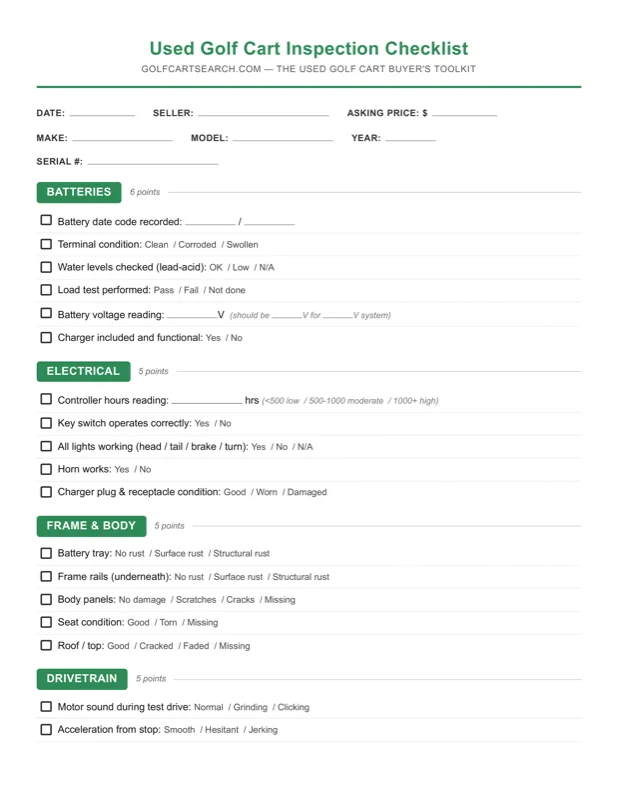
Buying new makes more sense with Denago than buying used, because a big part of the appeal is the warranty and current feature package. A used Denago can work, but only if the discount is meaningful and the local dealer will still support the cart.
I would look much harder at a used Denago if:
- the battery-health story is documented
- the price is clearly below a comparable used Big 3 cart
- the seller can confirm warranty transfer details
- there is a real dealer nearby for future service
I would lean away from a used Denago if:
- the price is too close to a used Club Car, EZGO, or Yamaha
- the seller cannot show battery or warranty documentation
- the local service answer is vague
For many buyers, the smarter alternative is either a new Denago from a strong dealer or a used Big 3 cart with proven support. That middle ground, a lightly used Denago with unclear support, is where mistakes happen.
If you are shopping locally, use our dealer directory to find sellers near you and compare them against repair shops in the same area.
Useful Upgrades If You Buy a Denago
Denago carts already come loaded compared with many competitors, so I would keep upgrades simple and practical.
Our Denago accessories guide ranks 12 useful additions with separate fitment notes for Nomad XL, Rover XL, XL6, and XXL owners.
The first one is a good phone mount. The A2C Magnetic Alloy Phone Holder is about $27 and useful for maps or music only if the Denago has a square iron roof strut that passes a magnet test; otherwise use a clamp or strap mount.
If you are shopping Denago mainly because you want a new cart shipped to your door and do not have strong legacy-brand dealer options, one online alternative is also worth comparing before you buy:
That is not a direct Denago replacement, but it is a useful reference point if your buying process is centered on price and convenience.
Are Denago Golf Carts Worth Buying?
Denago has figured out how to get buyers excited quickly. The carts look current, the range and speed claims are competitive, the feature set is strong, and the price points are often aggressive enough to make premium brands feel expensive fast.
That is the good news.
The caution is that Denago is still a newer brand. This review does not establish how its long-term failure rates or resale results compare with Club Car, EZGO, or Yamaha.
If you have a strong Denago dealer, want a 25 mph lithium cart, and care about getting the most visible equipment for your money, Denago is absolutely worth a test drive. If you want the safest long-term ownership play, the answer is still usually a legacy brand or a carefully chosen used cart.
Check your state golf cart laws, compare insurance rules, and do not skip the dealer-support question just because the screen and light bar look good.
Denago Golf Cart FAQ
Are Denago golf carts any good?
Yes, for the right buyer. Denago is strongest for value-focused shoppers who want a modern, 25 mph lithium cart with lots of standard features for less money than the premium brands.
How much does a Denago golf cart cost?
Current dealer price signals commonly put Rover XL around $9,995 and Rover XL6 around $12,995. A Nomad XL listing is $8,995. Rover XXL, Scout 2, CITY, and OXEN pricing depends on dealer package and availability. Final pricing can move based on setup, freight, accessories, tax, registration, and local demand.
Does Denago really offer an 8-year battery warranty?
Yes, the current model pages advertise eight years. The published terms limit that battery coverage to personal use and specify parts-only original-purchaser coverage. Confirm the applicable document and dealer labor charges before buying.
Is Denago better than ICON?
Compare equivalent dealer quotes, included equipment, and local service. Neither a lower price nor a longer advertised warranty proves a lower failure rate; choose the package and support that fit your needs.
Is Denago better than Club Car?
Denago may be attractive on included equipment and quoted price. Compare local service, warranty labor, battery condition, and resale offers before paying more for either badge.
What is the best Denago model?
For most buyers, the Rover XL is the safest starting point if you want a true four-seater. Choose the Nomad XL if you want a lifted 2+2 layout, and choose the Rover XL6 or Rover XXL only if you really need six seats.
Are Denago carts street legal?
Many are equipped like neighborhood LSVs, but legality still depends on your state and local rules. Start with our street-legal guide and then check your specific state law page.
Should you buy a used Denago?
Only if the discount is real, the local support is solid, and the battery and warranty paperwork are clear. Otherwise, a used legacy-brand cart is often the safer used buy.
Golf Cart Search
Find the Best Golf Carts of 2026
Compare top-rated models, read expert reviews, and find the perfect cart for your needs.