
Golf Cart Registration Cost by State (2026)

Golf cart registration cost by state in 2026. Compare permit fees, title fees, plate costs, and LSV registration totals before you buy.

Michael
Michael
Apr 19th, 202611 min read
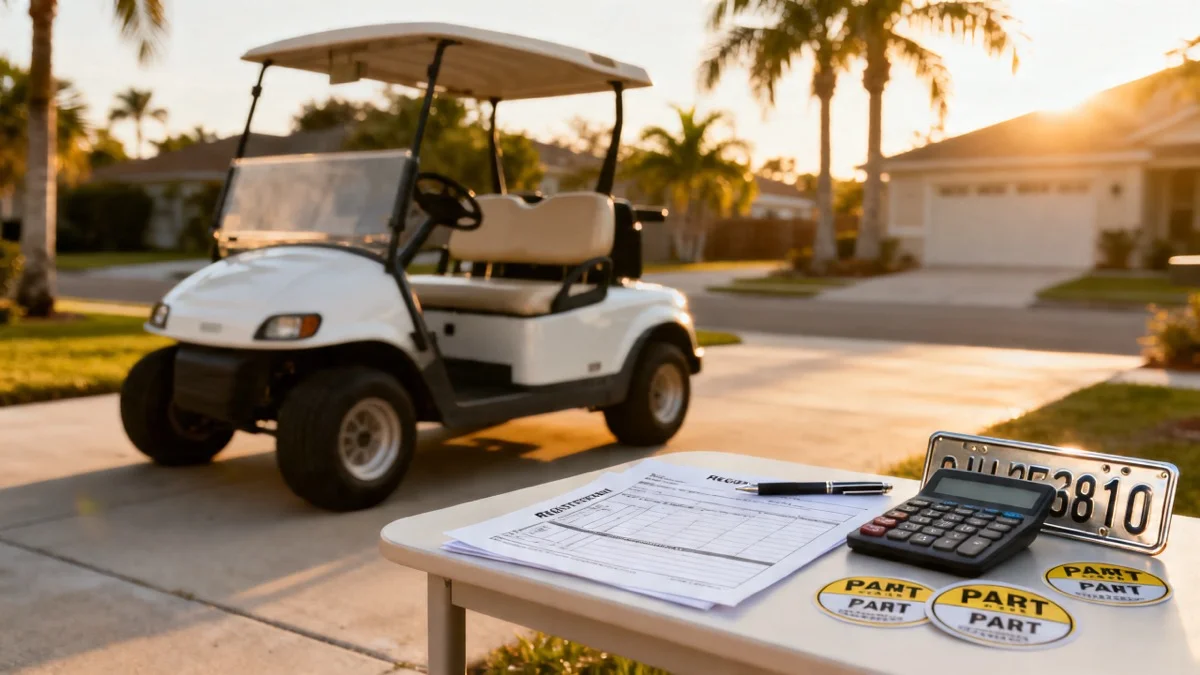
Golf cart parked beside DMV paperwork, permit decals, and a license plate on a sunny driveway

As an Amazon Associate, we earn from qualifying purchases. This helps support our site at no extra cost to you.

If you are searching for golf cart registration cost by state, the most important thing to understand is that the sticker price on the permit is rarely the full answer.

In one state, the direct fee is only $5. In another, the state does not even register standard golf carts, so your real cost comes from a local permit or a full LSV / NEV title-and-plate process instead. That is why this post is different from our broader golf cart registration by state guide. That page tells you whether a cart can be permitted or plated. This one focuses on what it usually costs.

If you are still deciding whether to stay with a standard neighborhood cart or move into full road-ready territory, read our LSV vs golf cart guide, street-legal golf cart guide, and best street-legal golf carts guide alongside this page.

$5 South Carolina permit, valid for 5 years

$10 Texas golf cart plate fee

$10 to $50 Common local permit range in city-run programs

$225 Florida initial registration fee for many first-time LSV titles

Quick Answer: What Buyers Really Pay

There are four common cost patterns in the United States.

SituationTypical direct registration costWhat usually makes the bill grow
Private-property golf cart$0No state road registration, but you may still spend on insurance or HOA requirements
Standard golf cart with city permitOften $10 to $50Inspection, sticker replacements, and local renewal cycles
State-issued golf cart permit or plateOften $5 to $10Insurance, county processing, and local route restrictions
Full LSV / NEV title and registrationUsually much higher than a simple permitTitle fee, plate fee, registration, inspection, insurance, tax, and sometimes VIN paperwork

Buyers get confused because they hear "Texas is only $10" or "South Carolina is only $5" and assume the total road-use budget is tiny.

The real budget usually includes:

  1. Permit, plate, or title fee
  2. Insurance if the state or local program requires it
  3. Sales tax or infrastructure fee in some states
  4. Inspection if the cart is converted or locally permitted
  5. Equipment you still need before the DMV or local office approves it

If you are also pricing the cart itself, keep this guide next to our golf cart pricing guide, dealer fees guide, and used golf cart prices by brand guide.

The Cheapest Official Statewide Fee Examples

The cleanest fee answers come from states that publish a specific golf-cart permit or plate amount instead of hiding the cost inside local ordinances.

South Carolina: $5 Every 5 Years

South Carolina is still the easiest statewide benchmark because the fee is explicit.

  • Direct permit cost: $5
  • Renewal cycle: every 5 years
  • Extra requirement: liability insurance is required
  • Distance rule: stay within 4 miles of the registered address

The SCDMV golf cart page says you need to complete Form GC-2, provide proof of insurance, provide your driver's license number, and pay $5. The current GC-2 form also shows $5 for first-time permits and $5 for renewals.

The permit is cheap. The real cost is higher because South Carolina requires liability insurance for public-road golf cart use. In communities like Hilton Head Island and Myrtle Beach, the insurance matters more than the permit.

For the full rules side, use our South Carolina golf cart laws page and golf cart insurance guide.

Texas: $10 Plate Fee, But It Is Not Full Registration

Texas is the other widely searched example because buyers hear about a golf cart plate and assume it works like normal vehicle registration.

  • Direct plate fee: $10
  • Issued by: county tax assessor-collector
  • Important catch: the plate is not normal vehicle registration
  • Extra cost risk: some cities add their own permit or compliance requirements

TxDMV's unique vehicles page is clear that Texas does not title and register standard golf carts like normal motor vehicles. Instead, counties can issue a golf cart plate for limited road use. TxDMV's current registration rules also state that the golf cart plate fee is $10.

Texas can be cheap for the plate itself and still confusing in practice. In places such as South Padre Island or The Woodlands, the city or county layer can matter just as much as the state plate. If you need the legal map, use our Texas golf cart laws page.

Florida: Cheap for Standard Carts, Expensive for LSVs

Florida is the best reminder that a low standard-cart fee does not mean a low road-use budget.

For ordinary golf carts used under Florida's golf-cart rules, there is no single statewide permit fee comparable to South Carolina's. But once you move into LSV territory, the cost stack grows fast:

  • Original new title fee: $77.25
  • Original used title fee: $85.25
  • Original / replacement plate fee: $28
  • Initial registration fee: $225 in many first-time cases
  • Registration fee: varies by vehicle weight
  • Insurance: Florida requires at least $10,000 PDL and $10,000 PIP for LSVs
  • Converted-cart path: inspection fee may apply

Florida's official low-speed vehicle page says LSVs must be titled, registered, and insured. Florida's current fee schedule lists the title, plate, and initial registration fees above.

So if you are buying a cart for a place like The Villages, Lady Lake, Sun City Center, Key West, or St. Augustine, the right budgeting question is not "what is Florida's golf cart permit fee?" It is "am I staying a golf cart, or am I paying full LSV money?"

Use our Florida golf cart laws page and Florida golf cart insurance page if you are already pricing that path.

Local Permit Programs Are Where Most State Costs Actually Live

In many states, there is no single statewide fee for a standard golf cart. The real benchmark comes from the city or community that actually authorizes road use.

Here are six useful real-world examples pulled from active local programs covered on our site:

CityStateDirect permit costUseful takeaway
Palm DesertCalifornia$10 for 2 yearsVery cheap permit, but only after city inspection and only for qualifying electric carts
PinehurstNorth Carolina$20 one-time feeOne of the cleaner local programs if you stay on village streets
Peachtree CityGeorgia$45 for a 3-year residential cycleFamous golf-cart city, but non-residents pay much more
Hilton Head IslandSouth Carolina$5 SCDMV permit every 5 yearsState permit is cheap, insurance is the bigger cost
South Padre IslandTexas$50 city permitGreat example of a city layer on top of Texas's state plate concept
Catalina IslandCalifornia$50 annual city registrationCheap compared with full-size car ownership, but it is still a real annual line item

Golf Cart Registration Cost by State: 50-State Cost Table

This table is built for budgeting, not fake precision. If your state uses local permits, the honest answer is "local fee varies." If your state pushes you into the LSV / NEV lane, the honest answer is that the real cost is title, plate, registration, insurance, and sometimes inspection.

StateStandard golf cart direct feePractical cost takeaway
AlabamaLocal permit or decal fee set by city or countyBudget local paperwork if your town allows carts, or move to the LSV path
AlaskaUsually motor-vehicle style title, plate, and registration feesThis is mostly an NEV / LSV budgeting problem, not a cheap permit problem
ArizonaNo single statewide fee for standard cartsLocal use can be easy, but buyers still need to check city rules and insurance triggers
ArkansasLocal permit or decal fee set by city or countyLocal ordinance drives the cost in most practical cases
CaliforniaNo single statewide golf cart permit feeCheap local permits exist, but everyday road use usually pushes you toward NEV costs
ColoradoLocal permit or decal fee set by city or countyExpect local approval for standard carts and full LSV costs for broader road use
ConnecticutUsually motor-vehicle style title, plate, and registration feesStandard carts are not the cheap road-use answer here
DelawareNo normal standard-cart registration pathIf road use matters, budget the LSV path instead
FloridaNo standard-cart state permit; LSV path adds title, plate, registration, and often $225 initial registrationFlorida is often cheap only until the cart becomes an LSV
GeorgiaLocal permit or decal fee set by city or countyThe state answer is broad, but city decals are where real numbers appear
HawaiiUsually motor-vehicle style title, plate, and registration feesTreat this like a road-vehicle budgeting question
IdahoLocal permit or decal fee set by city or countyStandard-cart cost is local; LSV cost is bigger and more predictable
IllinoisLocal permit or decal fee set by city or countyPlan around local authorization first
IndianaLocal permit or decal fee set by city or countyLocal ordinance drives the direct fee
IowaLocal permit or decal fee set by city or countySmall city fees are common when carts are allowed
KansasLocal permit or decal fee set by city or countyBudget local approvals, not one statewide amount
KentuckyLocal permit or decal fee set by city or countyInspection and local approval can matter as much as the fee itself
LouisianaLocal permit or decal fee set by city or countyDesignated-road programs create the real cost picture
MaineLocal permit or decal fee set by city or countyLocal approval usually matters more than the state fee question
MarylandNo normal standard-cart registration pathBudget the LSV route if you need public-road legality
MassachusettsNo normal standard-cart registration pathStandard golf carts stay narrow-use here
MichiganLocal permit or decal fee set by city or countyLocal ordinance usually controls direct costs
MinnesotaLocal permit fee set by cityBuyers should expect permit costs to come from the city layer
MississippiLocal permit or decal fee set by city or countyNo clean one-size statewide fee
MissouriLocal permit or decal fee set by city or countyCity approval is usually the first cost checkpoint
MontanaState-specific limited-use pathVerify the exact local or restricted-license setup before spending money
NebraskaLocal permit or decal fee set by city or countyLocal approval is the budget driver
NevadaUsually motor-vehicle style title, plate, and registration feesGolf-cart zones help, but broad road legality still costs LSV money
New HampshireUsually motor-vehicle style title, plate, and registration feesThink NEV / LSV, not cheap golf-cart permit
New JerseyUsually motor-vehicle style title, plate, and registration feesBattery-electric LSV treatment controls the cost
New MexicoLocal permit or decal fee set by city or countyStandard-cart road use is still highly local
New YorkNo normal standard-cart registration pathBuyers needing road use should budget an LSV path, not a golf-cart permit
North CarolinaLocal permit or decal fee set by city or countyPinehurst-style sticker programs are the right benchmark
North DakotaLocal permit or decal fee set by city or countyLocal ordinance usually drives the direct fee
OhioUsually motor-vehicle style title, plate, and registration feesRoad-use budgeting is closer to an LSV than a cart permit
OklahomaLocal permit or decal fee set by city or countyCity authorization is the main cost variable
OregonNo normal standard-cart registration pathCheap road-use permits are not the norm
PennsylvaniaNo normal standard-cart registration pathStandard carts remain narrow-use; NEV costs are the relevant budget line
Rhode IslandUsually motor-vehicle style title, plate, and registration feesThink LSV, insurance, and plate costs
South Carolina$5 SCDMV permit every 5 yearsThe permit is cheap, but insurance is mandatory and route limits matter
South DakotaLocal permit or decal fee set by city or countyLocal programs usually set the real fee
TennesseeUsually motor-vehicle style title, plate, and registration feesConverted LSV or MSV budgeting matters more than a simple permit
Texas$10 golf cart plate plus county processing; some cities add permit feesPlate cost is low, but cities can still add real friction and cost
UtahNo normal standard-cart registration pathStandard carts are not the cheap on-road answer
VermontUsually motor-vehicle style title, plate, and registration feesNEV budgeting is the practical path
VirginiaLocal permit or decal fee set by city or countyLocal ordinance and special local programs drive the direct cost
WashingtonNo one-size statewide fee for standard cartsGolf cart zones and local approval decide the real budget
West VirginiaUsually motor-vehicle style title, plate, and registration feesTreat it as an LSV cost stack
WisconsinLocal permit or decal fee set by city or countyCity approval usually sets the direct fee
WyomingState-specific limited-use or MPV pathVerify the exact classification before buying equipment

If you want the full legal-status version of this same table, use our registration by state guide. If you only care about whether you can legally drive after you pay, our street-legal checker is faster.

Hidden Costs That Blow Up the Budget

This is why cheap-fee stories on forums often feel misleading.

Insurance

Insurance is the biggest hidden line item in states that require it for public-road use. South Carolina makes this obvious. Florida makes it obvious once you cross into LSV status. Other states and cities may not require it on paper for a standard cart, but lenders, HOAs, and common sense still push buyers there.

The question is never just "what is the permit fee?" It is also "what is my annual insurance bill once this cart leaves the driveway?" Our golf cart insurance guide and state pages like Florida insurance are the right follow-up.

Converted carts are where budgets go sideways.

Depending on the state, you may need:

  • an inspection
  • proof of required equipment
  • title paperwork
  • a VIN or VIN-style road-use paperwork trail
  • follow-up visits to DMV or local offices

Read the golf cart titles and registration guide before assuming a pile of accessories is all you need.

Sales Tax, Infrastructure Fees, and County Charges

The permit or plate is not the tax bill.

Some states add sales tax, infrastructure-style fees, or local county charges during titling and registration. That is especially important if you are comparing:

  • dealer purchase vs private-party purchase
  • standard golf cart vs LSV
  • new cart vs used cart

If you are comparing total ownership numbers, keep this page open next to our dealer fees guide and pricing guide.

South Carolina's current GC-2 form is a good reminder that replacements and renewals also matter. It shows $5 for first-time permits, $5 for renewals, $5 for replacement decals, and $1 for a replacement registration document. If you are shopping used, start with our used golf cart prices by brand guide and dealer directory.

When Buying a Factory Road-Ready Cart Is Cheaper Than Converting

This is where registration cost connects to shopping strategy.

If you already own a clean, paid-off cart and only need limited local access, a cheap permit path can make sense.

If you are starting from scratch, conversion math gets ugly fast:

  • street-legal equipment
  • possible inspection
  • title and registration
  • insurance
  • dealer or installer labor
  • downtime if the paperwork does not go smoothly

Some buyers are better off pricing a factory road-ready benchmark first.

The AODES Trailcross is a useful example because it gives you a full-size cart with a road-use-oriented package for about $7,249, which is often less than buyers expect after pricing a base cart plus conversion parts and paperwork.

Check AODES Trailcross Price on Amazon

If you want a longer-range direct-buy comparison, the SDLANCH 45-Mile sits around $9,800 and is useful as a "what would a ready-to-go cart cost me?" benchmark.

Check SDLANCH 45-Mile Price on Amazon

For buyers who really do not need public-road legality and just want a cheaper private-property cart, the Kandi Collapsible Mini is a good reality check at around $3,999.

Kandi Collapsible Mini price benchmark ->

This is also where our best street-legal golf carts guide and golf carts on Amazon buying-risks guide become useful.

How to Budget Registration Before You Buy

Use this sequence and you will avoid most expensive surprises.

  1. Decide whether you need private-property use, limited local road use, or a real LSV / NEV path.
  2. Check your state page on our golf cart laws hub, especially high-confusion states like Florida, Texas, South Carolina, and California.
  3. If your state relies on local ordinances, check whether your city has a permit fee, inspection, or route map.
  4. Price insurance before you buy parts, especially if the cart will operate on public roads.
  5. Compare the total against a factory road-ready cart before committing to a conversion.

The point is simple: the cheapest fee is not always the cheapest ownership path.

FAQ

Is South Carolina really only $5?

Yes for the permit itself. The SCDMV currently lists the golf cart permit at $5, but you also need liability insurance and must follow the four-mile rule from the registered address.

Why is Florida so much more expensive once a cart becomes an LSV?

Because the cost stops being a simple permit. Florida LSVs need a title, plate, registration, and insurance, and many first-time cases also trigger the $225 initial registration fee. If the cart is converted instead of factory-built, inspection can add more friction and cost.

Share this post

Golf Cart Search

Find the Best Golf Carts of 2026

Compare top-rated models, read expert reviews, and find the perfect cart for your needs.
Related posts

Don't Overpay for a Used Golf Cart

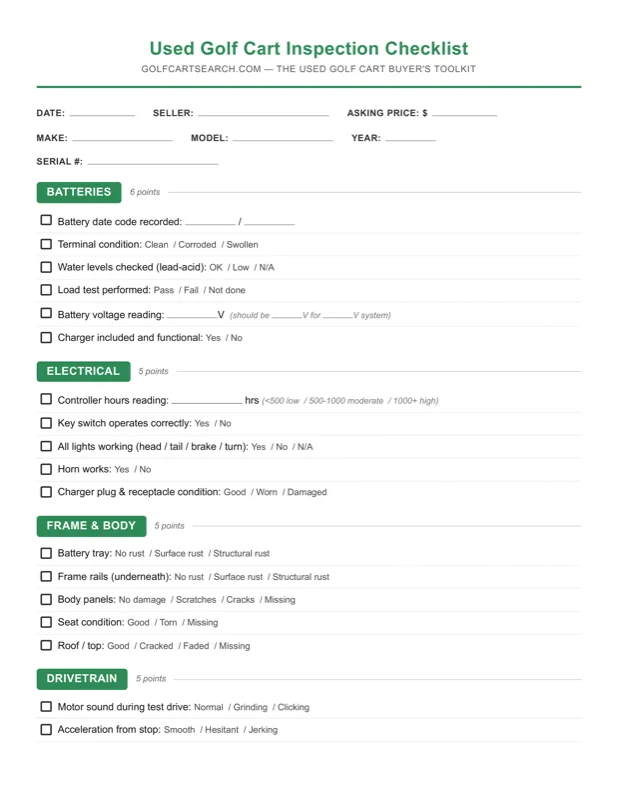
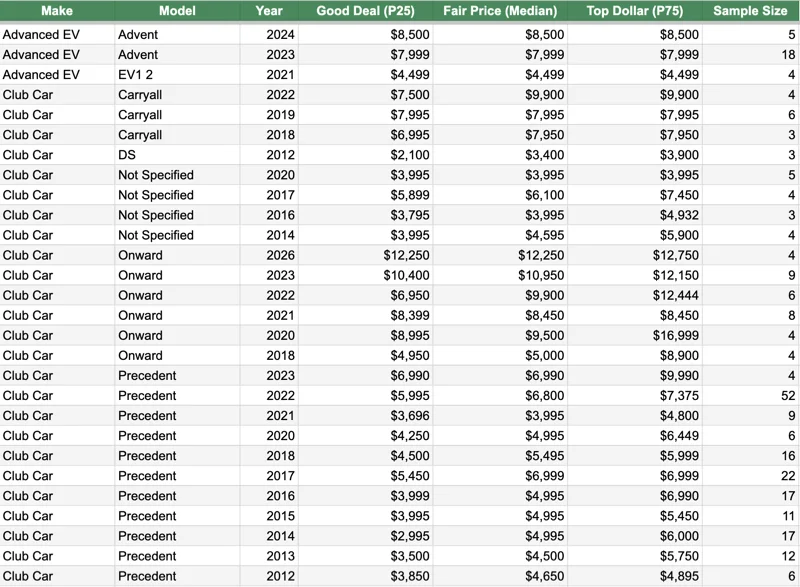
Get pricing data, a printable inspection checklist, and negotiation scripts to help you buy with confidence.

Get the Buyer's Toolkit
Pricing dataInspection checklistNegotiation scripts

Instant download. 30-day guarantee.