

Before paying for a golf cart, identify its legal classification and the paperwork required where you will keep and use it. Document the exact vehicle and seller, resolve any title or lien problem, then complete the buyer application and the seller's separate notification duties.
A bill of sale records the transaction. It does not, by itself, guarantee ownership free of liens, create a state title, transfer a permit or authorize road use. No nationwide “bill of sale is enough” rule is established here.
Start with the right document question
| Situation | What to verify before payment |
|---|---|
| Cart the jurisdiction does not title | Required ownership evidence, tax treatment and any local permit or registration |
| Previously titled LSV or NEV | Valid transferable title or approved electronic process, seller authority and lien release |
| New vehicle with an MCO/MSO | Whether the specific origin document and vehicle qualify for first title/registration |
| Missing title or altered identifier | Have the seller resolve it through the issuing authority before an unconditional purchase |
These are questions to resolve, not a guarantee that every cart fits one national procedure. A manufacturer serial number, 17-digit VIN, lights or advertised top speed alone does not settle the classification.
For example, TxDMV says it does not title and register vehicles classified as golf carts, while its NEV process requires ownership evidence such as a title or Manufacturer Certificate of Origin, Form 130-U and insurance. A golf-cart plate application also uses Form 130-U, so the form name alone does not mean the vehicle receives a title. TxDMV unique vehicles.
Use the title guide, registration guide and local laws to identify questions, then verify the actual vehicle with the responsible office.
Our comparison of official transfer documents
We compared these public agency instructions and forms on October 10, 2026. This is a documentary comparison, not a claim that we completed a transaction or tested acceptance at a counter.
| Jurisdiction and scope | Buyer step or document | Separate seller step |
|---|---|---|
| Texas, applicable titled-vehicle transaction | Signed title, Form 130-U and applicable supporting documents; buyer title within 30 days | TxDMV recommends accompanying the buyer and filing a Vehicle Transfer Notification within 30 days |
| South Carolina, golf-cart permit | Confirm the new owner's permit application; the seller's old decal is not a completed transfer | May 2026 GC-2 says remove the decal and immediately notify SCDMV in writing with the new owner's name/address and sale date |
| Peachtree City, cart used on city paths/streets | Ordinance §78-92(a)(5): registration transfer within ten business days, $15; late transfer adds $20 | Complete the city's ownership-release information; dealer-resale notification has its own ordinance provisions |
| Arizona, applicable titled-vehicle transaction | Title application within 15 days; eligible eTitle transfer or in-person application with required documents | Resolve seller assignment and any lien release; buyer eligibility must be checked for eTitle |
Sources: Texas buying/selling, SC GC-2, May 2026, Peachtree Ordinance 1253, Arizona MVD buying guidance.
The comparison shows why a single signed receipt is not a complete transfer checklist. The relevant action can be a state title application, state permit notification or city registration transfer. A buyer's completion does not automatically discharge the seller's separate duties.
Peachtree City: resolve the deadline wording
The city's current information page uses both “10 days” and “10 business days.” The actual ordinance's transfer clause states ten business days, with a $15 transfer charge and $20 late penalty. It also treats the cart as unregistered after that period. The ordinance is the basis for the specific transfer deadline above; do not treat a simplified webpage phrase as a different statutory period. §78-92(a)(5), PDF page 25.
The city's registration checklist accepts a bill of sale or owner-release form as ownership evidence for that local process, alongside serial/specification and owner requirements. Its ownership-release form requests the decal, VIN/serial, cart details, former/new owner information and former owner's signature; it says the new owner must transfer the cart and pay the associated fees.
That is an identified local document requirement, not proof that a bill of sale clears every lien or meets another state's title law. Check the current city page for submission and residency fees; a $15 transfer is not necessarily the entire amount owed.
Arizona: not every “bill of sale” is the same
Arizona's in-person vehicle instructions allow a signed current title or its official Title Transfer Bill of Sale for Arizona-titled vehicles, together with the application and other required documents. That named state document and scope are different from assuming a generic equipment receipt replaces any missing title. The same page says only some titles qualify for eTitle transfer. Arizona MVD.
Confirm that the vehicle is in the relevant title system and which option it qualifies for before using the 15-day process. These general motor-vehicle instructions do not classify every recreational golf cart.
Florida: verify the LSV path
The Martin County Tax Collector's current guidance confirms that Florida LSVs require title, registration, and PIP/PDL insurance. Its Florida-title transfer instructions require properly completed title information and identification, with lien and representative information where applicable. Official county title guidance.
This provides a readable official starting point for the LSV transaction. Confirm the complete application, deadline, insurance, plate handling and any conversion inspection with your tax collector for the actual vehicle. A factory LSV transfer and first titling of a converted cart are different procedures; this guide does not promise a complete conversion application from a bill of sale.
Verify the vehicle and seller
Photograph the identifier on the actual cart and match every character with the title, origin document, permit and invoice. Ask the manufacturer or selling dealer to identify a missing or altered plate through records; do not stamp or substitute a number yourself.
If a 17-digit VIN exists, the VIN decoder can help identify encoded vehicle information. Decoding is not proof of the seller's authority, a clear lien record or a valid transferable title. Check those separately through the applicable title office and lienholder.
Match the seller with the owner shown in the records. For consignment, business, estate or representative sales, obtain the authority documents the receiving agency requires. Do not treat a matching name on a maintenance receipt as conclusive ownership proof.
Ask directly about loans, liens, prior titles, road registration, damaged identifiers and local permits. Resolve inconsistencies before unconditional payment. A missing title for a vehicle that needs one should be corrected by the recorded owner or lienholder through the issuing authority. A bonded-title procedure, where available, has its own eligibility and does not automatically apply to an untitled golf cart.
Prepare a detailed bill of sale
Record these transaction details, then use any prescribed agency form or notarization requirement:
- Buyer and seller legal names and addresses.
- Make, model, known year and complete serial number or VIN.
- Sale date, price, payment terms and any included charger or accessories.
- Known defects, warranties or agreed repair conditions stated accurately.
- Title/origin-document references and any lien-release arrangements.
- Signatures and any required witnessing or notarization.
Our bill-of-sale tool helps record details. It does not determine whether an agency accepts that form or whether the seller can convey clear ownership. Confirm jurisdiction-specific form, signature, notary and tax rules first.
Keep prior invoices, permit records and maintenance receipts as supporting evidence. Save the signed originals and private digital copies. This documentation helps trace a transaction; it is not a nationwide legal guarantee.
Complete both sides of the handoff
Buyer: obtain the documents, verify seller authority, arrange required insurance, submit the accepted title/registration/permit application promptly, and keep the official receipt or confirmation. Do not drive the cart home until its route, equipment and documents permit that trip; arrange transport when they do not.
Seller: complete the assignment and any release form, handle plates/decals as the authority instructs, submit the separate sale notification, and retain confirmation. South Carolina's May 2026 form specifically requires both decal removal and immediate written notification. Texas's 30-day notification protection is described for parking and toll liability; it is not a blanket promise against every possible claim. SC form, TxDMV notification guidance.
Record the in-service date and warranty paperwork separately. A vehicle sale does not establish that battery or factory coverage transfers; see the warranty guide.
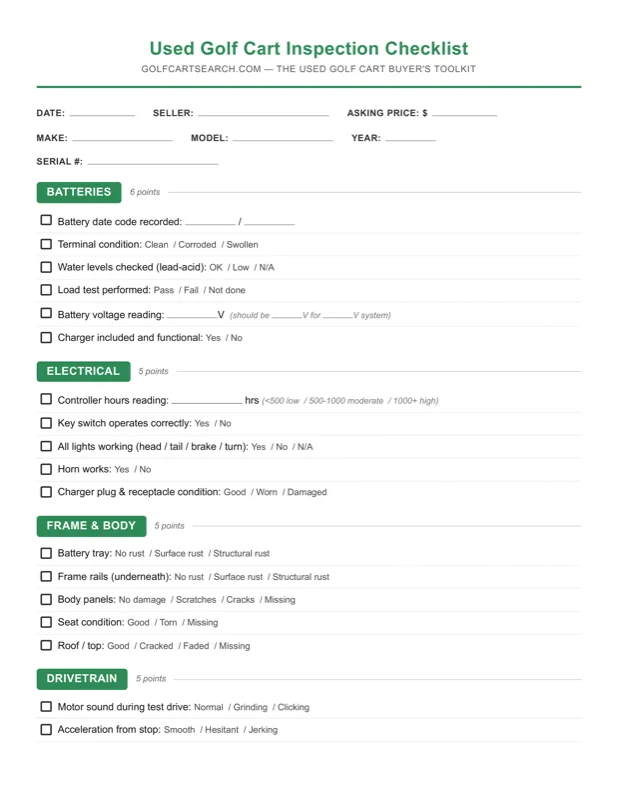
If a seller cannot provide the required title, origin document, lien release or authority, defer the purchase until the relevant office confirms an acceptable solution. Use the used-cart inspection guide alongside the paperwork checks; mechanical condition and ownership are separate buying decisions.
Frequently asked questions
Is a bill of sale enough to transfer a golf cart?
There is no nationwide assurance. Identify the vehicle classification and local requirements. A bill of sale can document the transaction or satisfy a named local evidence requirement, but it does not automatically replace a title, clear liens or transfer permits.
Do all golf carts have titles?
No. TxDMV expressly distinguishes golf carts it does not title/register from NEVs with a title/registration process. Other jurisdictions and actual vehicle classifications need separate checks.
Does a permit decal stay with the cart after sale?
Do not assume it does. South Carolina’s May 2026 GC-2 requires the seller to remove its decal and immediately notify SCDMV in writing. Peachtree City uses a registration-transfer process instead.
How long do I have to transfer the paperwork?
Use the applicable process: Texas titled-vehicle guidance specifies 30 days, Arizona vehicle title guidance 15 days, and Peachtree City’s transfer ordinance ten business days. These are scoped examples, not a nationwide golf-cart deadline.
What if the seller has only an MCO or MSO?
Ask the receiving title office whether that exact origin document and vehicle qualify for first title. An origin document is not an existing state title and does not by itself complete registration or permit road use.
Does decoding a VIN prove ownership?
No. It identifies encoded vehicle information. Seller authority, title status, liens and accepted transfer paperwork must be verified separately.
Golf Cart Search
Find the Best Golf Carts of 2026
Compare top-rated models, read expert reviews, and find the perfect cart for your needs.