As an Amazon Associate, we earn from qualifying purchases. This helps support our site at no extra cost to you.
Used Golf Carts for Sale by Owner: Where to Find Deals and What to Check (2026)
If you are searching for used golf carts for sale by owner, you are usually trying to do two things at once: find a real private-seller deal and avoid buying someone else's problem. That is the right mindset. Private sellers can be cheaper than dealers, but they rarely offer warranties, reconditioning, financing, delivery, or help with paperwork.
This guide is for private-seller shopping. GolfCartSearch does not host owner-submitted golf cart listings. If you decide you would rather compare dealer-backed used carts, use our used golf cart dealer directory, used electric golf cart dealer directory, or used gas golf cart dealer directory.
Short Answer: Where to Look and What to Check
To find used golf carts for sale by owner, check Facebook Marketplace, Craigslist, OfferUp, local golf cart Facebook groups, neighborhood boards, retirement community boards, golf cart communities, and word of mouth. Search both "used golf carts for sale near me by owner" and model-specific terms like "Club Car Precedent private seller" or "EZGO TXT golf cart by owner."
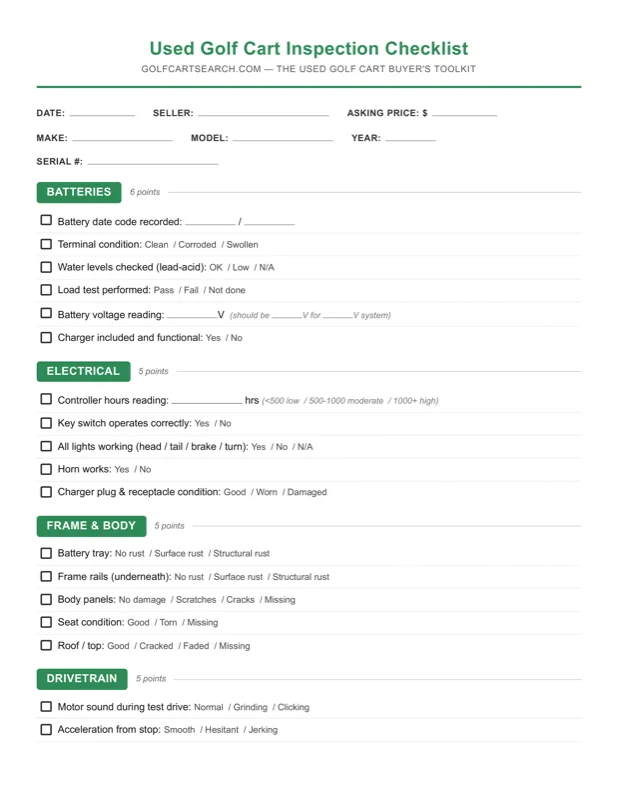
Before buying, verify the serial number, confirm ownership, require a signed bill of sale, inspect batteries or the gas engine, test drive the cart under load, confirm the charger and keys are included, and compare the price against our golf cart value calculator. If the cart will be used on roads, check golf cart laws and golf cart insurance before you pay.
Where to Find Used Golf Carts for Sale by Owner
Private seller golf carts move quickly because many good ones never make it to a dealer lot. The best listings usually come from owners in golf communities, lake neighborhoods, beach towns, RV parks, retirement communities, and course-adjacent areas.
Facebook Marketplace
Facebook Marketplace is usually the first place to check because it has the most casual local listings. Search broadly at first:
- used golf cart
- golf cart by owner
- Club Car
- EZGO or E-Z-GO
- Yamaha golf cart
- golf cart 4 seater
- lithium golf cart
Then search nearby community names. In places like The Villages, Peachtree City, Sun City, Myrtle Beach, Hilton Head, and coastal Florida towns, sellers may mention the community more often than the exact model.
Marketplace is also where scams show up, so do not let the volume lower your standards. Real sellers can show current photos, answer basic questions, meet in person, and provide the cart's serial number or VIN before money changes hands.
Craigslist
Craigslist still works well in many golf cart markets, especially for older carts and sellers who are not active on Facebook. Search your city, nearby cities, and the nearest retirement or golf community.
Craigslist listings can be sparse, but the sellers are sometimes more motivated because they are getting fewer messages than they would on Facebook Marketplace. That can help you negotiate if the cart is real, the paperwork is clean, and the condition checks out.
OfferUp
OfferUp is worth checking for neighborhood carts, especially in larger metro areas. The same rules apply: do not pay before seeing the cart, do not rely on vague listing photos, and do not assume a seller profile proves ownership.
OfferUp can be useful for spotting duplicate listings too. If the same cart appears in multiple cities with different seller names, treat that as a scam signal.
Local golf cart Facebook groups
Search for groups with names like "Florida golf carts for sale," "Arizona golf cart classifieds," "The Villages golf carts," or "[your city] golf carts." These groups often have better context than open marketplaces because members know local dealers, common models, and recurring sellers.
The downside is that some "private" listings are actually unlicensed flippers. That is not always bad, but it changes the risk. Ask whether the seller is the titled owner, how long they have owned the cart, and whether they have sold other carts recently.
Neighborhood and community boards
Community boards can be gold because sellers are often local owners upgrading to a newer cart, not people buying and flipping inventory. Check:
- HOA bulletin boards
- clubhouse boards
- gated community newsletters
- Nextdoor
- RV park boards
- marina or lake community boards
- golf course pro shop boards
These listings may not be optimized for search, so ask around even if you do not see a polished ad.
Golf cart communities
In golf cart-heavy towns, the best deals often come from owners who are moving, downsizing, changing from gas to electric, upgrading to lithium, or replacing a 2-seater with a 4-seater. Walk the community board, ask the local repair shop, and talk to cart owners who already know the area.
If you are shopping in a community with road-use rules, keep our golf cart laws map open. A cheap cart may need lights, mirrors, seat belts, registration, or insurance before you can use it the way the seller used it.
Word of mouth
Word of mouth is boring, and it works. Tell friends, neighbors, course staff, cart repair shops, and community managers what you want. A well-maintained Club Car, EZGO, or Yamaha often sells before the owner ever writes a full listing.
Private Seller vs Dealer: The Real Tradeoffs
Buying a private seller used golf cart is not automatically better or worse than buying from a dealer. It depends on how much risk you can inspect, price, and tolerate.
| Factor | Private seller used golf cart | Dealer used golf cart |
|---|---|---|
| Price | Usually lower, often 10-25% below dealer pricing | Usually higher because reconditioning and overhead are included |
| Warranty | Usually none, sold as-is | Often short limited warranty or service support |
| Inspection | You do it or pay a shop | Dealer may inspect and recondition before sale |
| Financing | Rare | Common at many dealers |
| Delivery | Usually buyer handles transport | Often available, sometimes included locally |
| Paperwork | Buyer must verify ownership and bill of sale | Usually cleaner, especially for titled LSVs |
| Risk | Higher if you miss batteries, frame, engine, or title issues | Lower, but still verify details |
The simplest rule: buy private when the discount is real and you can inspect the cart. Buy from a dealer when you need support, financing, delivery, or a lower-risk first purchase. For a broader inspection framework, read our used golf cart buying guide.
Questions to Ask Before Seeing the Cart
Do not drive across town based on three photos and "runs great." Ask direct questions first. A real seller with a decent cart should be able to answer most of these.
- What is the make, model, and year?
- Can you send a clear photo of the serial number or VIN?
- How long have you owned it?
- Why are you selling?
- Is it electric or gas?
- If electric, are the batteries lead-acid, AGM, or lithium?
- What is the battery age, and do you have receipts?
- Is the charger included, and does it match the cart?
- What voltage is the cart, 36V, 48V, or 72V?
- How far does it go on a normal charge or tank?
- Has it been lifted, rewired, converted to lithium, or made street legal?
- Has it been flooded, wrecked, stored outside, or used in a rental fleet?
- Do you have a bill of sale, title, registration, MCO, MSO, or prior receipt?
- Is there any lien, loan, or ownership dispute?
- Are the keys, charger, accessories, and manuals included?
If the seller will not provide the serial number, will not meet in person, or wants a deposit before you inspect the cart, move on. You can use our golf cart VIN decoder to sanity-check the model and year before negotiating.
Electric Cart Inspection Checklist
Electric carts are quiet, simple, and great for neighborhoods, but battery condition can make or break the deal. If you are comparing electric private-sale carts against dealer-backed options, our used electric golf cart directory can help you see what local dealers are likely to carry.
Battery age and date codes
Ask for the install date and receipts first. Then look for date stickers, stamped post codes, or manufacturer labels on the batteries. Date-code systems vary by battery brand, so photograph the code and verify it before making an offer.
For flooded lead-acid batteries, treat 4 to 5 years old as the danger zone unless the price already accounts for replacement. Batteries can last longer with careful watering, clean terminals, proper charging, and gentle use, but private-sale listings often overstate battery health.
Lithium vs lead-acid
Lithium can be a major plus, but only if the system is legitimate. Ask:
- What battery brand is installed?
- Is it a complete conversion kit or a factory lithium cart?
- Is there a battery management system?
- Does the seller have the invoice?
- Is any warranty transferable?
- Was the charger changed for lithium?
If the cart is an older lead-acid model with a no-name lithium conversion, price it carefully. A clean factory lithium cart from a known brand can be valuable. A sloppy conversion can create charging, controller, and support problems. For background, read our lithium battery conversion guide.
Charger included and correct
A missing charger is not a small detail. Replacement chargers commonly cost a few hundred dollars, and the plug, voltage, and battery chemistry must match.
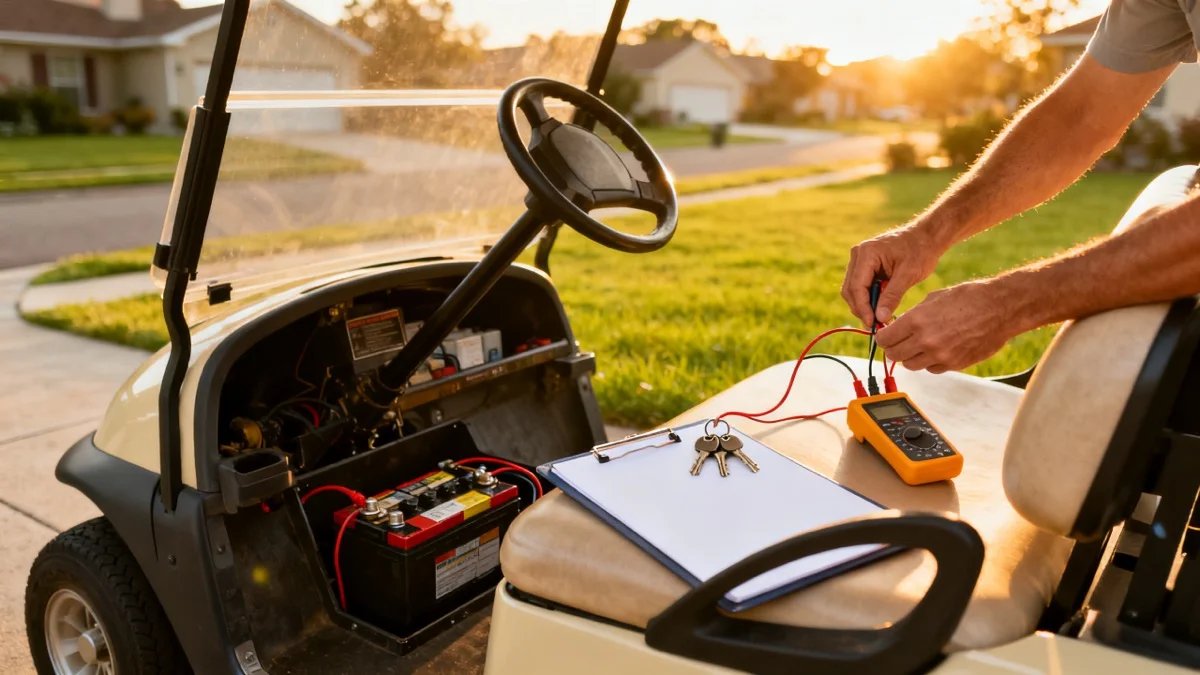
For basic battery checks, bring a simple digital multimeter. If the cart uses flooded lead-acid batteries, a battery hydrometer can reveal weak cells that a dashboard meter will not catch.
If a seller says "charger not included," price the cart as incomplete. For example, a 48V Club Car buyer may compare a compatible EPOWREY 48V Club Car charger, while an older 36V EZGO TXT buyer may compare a FORM 36V EZGO TXT charger. Always confirm compatibility before buying parts.
Voltage and pack health
Confirm whether the cart is 36V, 48V, or 72V. Count the batteries and check the labels. A 36V cart often has six 6V batteries. A 48V cart may have six 8V batteries, four 12V batteries, or a lithium pack. A 72V cart is usually a newer neighborhood or LSV-style setup.
Do not judge battery health from a dash meter alone. Check pack voltage after a full charge, then test drive long enough to see whether voltage sags badly under load. Our battery voltage chart gives the deeper testing steps.
Range in real use
Ask the seller how far the cart goes with two adults, normal hills, lights on if equipped, and real neighborhood driving. "All day" is not an answer. A weak pack may seem fine around a driveway and fall flat after 15 minutes.
If possible, test the cart on a hill and drive it longer than a quick loop. Acceleration should stay smooth, the cart should not crawl after a few minutes, and the charger should start normally when plugged back in.
Corrosion and cable condition
Lift the seat and inspect the full battery area. Look for white or green corrosion on terminals, acid residue on the tray, melted cable insulation, loose hold-downs, swollen battery cases, and mismatched battery ages.
Corrosion does not always kill a deal, but it tells you how the cart was maintained. Heavy corrosion plus vague battery age is a price cut, not a minor cosmetic issue.
Gas Cart Inspection Checklist
Gas carts avoid battery replacement math, but they add engine, fuel, belt, clutch, and service-history risk. If you know you want gas and prefer a dealer-backed option, compare private listings against our used gas golf cart dealer directory.
Cold start
Ask the seller not to warm up the cart before you arrive. A healthy gas golf cart should start cold without excessive cranking, loud knocking, or repeated stalling. A cart that only behaves after it is warm may be hiding carburetor, choke, compression, or fuel-delivery problems.
Smoke
Watch the exhaust on startup and during acceleration.
- Blue smoke points to oil burning.
- Black smoke can mean a rich fuel mixture.
- White smoke that does not clear quickly deserves caution.
A small puff at startup on an older cart is not always fatal. Continuous smoke is a repair budget problem.
Fuel leaks
Smell around the cart before starting it. Then look at the fuel tank, fuel lines, filter, pump, and carburetor area. Wet fuel, cracked hoses, or a strong gas odor are walk-away issues until repaired.
Fuel leaks are not negotiation trivia. They are safety problems.
Belt and clutch behavior
On a test drive, listen for squealing, slipping, rattling, or engine revs that do not match cart movement. A worn belt, sticky clutch, or neglected driveline can make a cart feel weak even when the engine sounds fine.
Use our golf cart drive belt guide to price obvious belt problems before you make an offer.
Service history
Ask for oil changes, air filter replacements, belt service, spark plug work, carburetor cleaning, and fuel system repairs. If the seller has no records, judge the cart by condition and price, not by promises.
Yamaha gas carts often have strong used demand because buyers trust the platform. Still, a neglected Yamaha is not automatically better than a maintained Club Car or EZGO. Compare brand tradeoffs in our electric vs gas golf cart guide and best golf cart brands guide.
Paperwork You Need Before Paying
The paperwork standard depends on whether the cart is a normal untitled golf cart or a titled road-use vehicle. If you want the full process, read our golf cart ownership transfer guide.
Used golf cart bill of sale
For most private seller used golf carts, the bill of sale is the core document. You can use our used golf cart bill of sale template before you meet the seller. It should include:
- buyer name and address
- seller name and address
- sale date
- sale price
- make, model, and year if known
- serial number or VIN
- battery type and charger included
- accessories included
- condition notes
- "sold as-is" language if that is the agreement
- signatures from both buyer and seller
Take photos of the seller's ID, the signed paperwork, the serial number plate, and the cart at pickup. Keep copies in cloud storage and with your insurance file.
Serial number or VIN
Every private sale should include a serial number or VIN check. Standard golf carts usually have manufacturer serial numbers. LSVs and road-going carts usually have a 17-character VIN.
If the plate is missing, altered, painted over, or does not match the paperwork, stop. You may be looking at a stolen cart, a badly documented rebuild, or a cart that will be hard to insure or register.
Title or registration if applicable
Many standard golf carts do not have titles, and that can be normal. The risk starts when the cart clearly should have title or registration paperwork because it has been converted, registered, plated, or sold as an LSV.
Do not accept "the title is coming later" on a cart that needs one. If a title exists, the seller should be able to show it before you pay. If the cart uses an MCO or MSO, make sure your state can use that document for the type of registration you need.
Lien and ownership concerns
Ask directly whether there is a lien, loan, or business ownership issue. If the seller bought the cart recently, ask why they are selling so quickly. If the name on the paperwork does not match the person selling it, require a clear explanation and supporting documents.
This is especially important in golf communities where carts move between neighbors, family members, estates, and seasonal residents. A friendly sale still needs a clean paper trail.
Pricing: Broad Ranges Beat Fake Precision
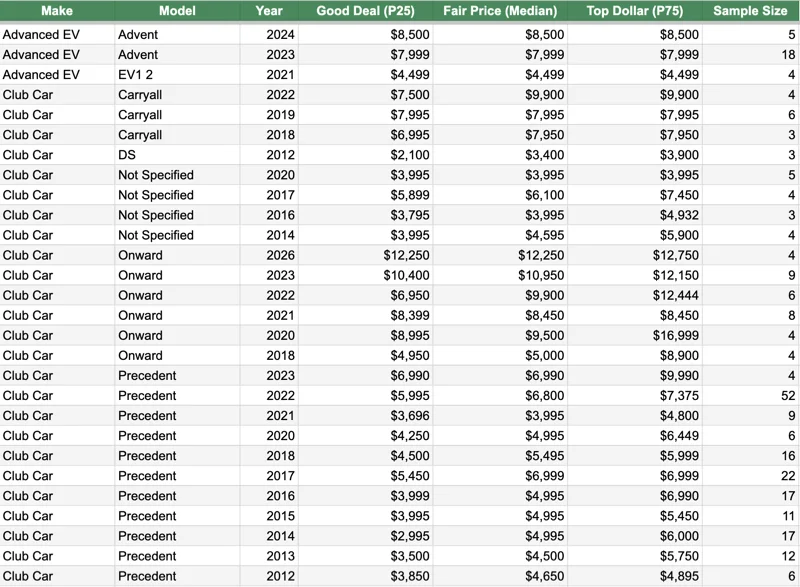
Private seller pricing is messier than dealer pricing. A listing can be fair, overpriced, or suspiciously cheap depending on batteries, charger, age, seating, location, road equipment, and whether you need delivery.
Use these broad anchors:
| Private seller situation | Rough price posture | What to verify |
|---|---|---|
| Older lead-acid 2-seater | Budget range | Battery age, charger, rust, brakes |
| Clean 4-7 year old Big 3 cart | Best value range | Year, battery health, service records |
| Newer lithium 4-seater | Premium used range | Battery brand, warranty, controller compatibility |
| Lifted or customized cart | Highly variable | Quality of parts, install work, alignment |
| Missing charger or weak batteries | Discount hard | Replacement cost and compatibility |
| Titled LSV-style cart | Paperwork-sensitive | Title, VIN, insurance, state rules |
For a number on a specific cart, start with the golf cart value calculator, then cross-check our used golf cart prices by brand guide. Use the private seller discount only after you subtract obvious repair costs.
A $4,500 private seller cart with dead batteries, no charger, bad tires, and no bill of sale is not cheaper than a $5,800 dealer cart that is serviced, delivered, and documented. Price the total deal.
Bring a low-pressure tire gauge, because golf cart tire pressure is lower than car tire pressure and uneven wear can point to alignment or suspension problems. A simple low-pressure tire gauge is enough for the inspection.
Red Flags and Scams
Online marketplace scams hit golf carts because carts are expensive, local, seasonal, and easy to photograph from old listings. The FTC's marketplace buying advice is simple: know who you are buying from, understand the payment method, and be cautious when a platform cannot help after a bad transaction.
Walk away from:
- seller will not meet in person
- seller claims the cart is in storage, with a shipper, or at a military base
- price is far below similar carts with no believable reason
- same photos appear in multiple cities
- seller asks for gift cards, wire transfer, crypto, or unusual payment apps
- seller wants a deposit before you see the cart
- seller will not provide the serial number or VIN
- listing photos look copied, cropped, or inconsistent
- cart is "already packed for delivery"
- seller says an escrow company will protect you
- title, registration, or bill of sale will be handled later
- seller cannot explain why their name is not on the paperwork
The BBB has also warned about vehicle scams involving fake escrow, pressure to use unknown report sites, and sellers who will not let buyers inspect the vehicle. Golf carts are smaller than cars, but the scam pattern is similar.
Meet in daylight, bring another adult, inspect at the seller's address when practical, and do not carry more cash than needed. For larger payments, meet at your bank so the transaction and paperwork can happen in a controlled place.
When to Buy From a Dealer Instead
A private seller is not always the smartest option. Buy from a dealer instead if any of these apply:
- this is your first golf cart
- you cannot inspect batteries confidently
- you need financing
- you need delivery
- you want a warranty
- the cart needs to be street legal
- you need help with title, registration, or insurance
- you are shopping from another state
- the private seller discount is small
- the cart is for daily transportation, not occasional use
This is where the dealer directory pages fit the cluster. They are not owner-listing pages. They help you find businesses that sell used carts so you can compare private seller deals against serviced inventory:
- Used golf carts for sale from dealers
- Used electric golf carts for sale from dealers
- Used gas golf carts for sale from dealers
If a private listing feels risky, call a local dealer or repair shop and ask what a pre-purchase inspection would cost. Spending a small amount before buying can save you from a cart that needs batteries, controller work, brakes, tires, or paperwork cleanup right away.
FAQ
Where is the best place to find used golf carts for sale near me by owner?
Facebook Marketplace usually has the most private seller volume, but the best deals often come from local golf cart Facebook groups, neighborhood boards, golf cart communities, and word of mouth. Check Craigslist and OfferUp too, especially if you are willing to drive to nearby golf communities.
Are used golf carts by owner cheaper than dealer carts?
Usually, yes. Private seller carts are often 10-25% cheaper than comparable dealer carts, but the discount is only real if the cart does not need expensive batteries, a charger, tires, brake work, transport, or paperwork correction.
What is the biggest risk with a private seller used golf cart?
Battery condition is the biggest risk on electric carts, and ownership paperwork is the biggest transaction risk. On gas carts, cold-start problems, smoke, fuel leaks, and poor service history deserve the most caution.
Do I need a bill of sale for a used golf cart?
Yes. Even if your state does not title standard golf carts, a signed bill of sale protects both sides and gives you a paper trail for ownership, insurance, local permits, and future resale. Use a detailed golf cart bill of sale form that includes the serial number or VIN.
Should I buy a golf cart without a title?
Only if it is a standard untitled golf cart and the serial number, seller identity, and ownership trail make sense. If the cart is an LSV, NEV, plated cart, or road-use vehicle that should have a title, do not buy it until the title problem is solved.
How can I tell if golf cart batteries are old?
Ask for receipts, check date stickers or stamped codes, and compare the seller's claim to the battery brand's date-code format. Also inspect for corrosion, swelling, low water, mismatched batteries, and range loss under load.
Is a lithium private seller cart always better?
No. Factory lithium from a known brand can be excellent, but a poor conversion can create charger, controller, warranty, and support problems. Verify the battery brand, BMS, charger, install quality, and warranty transfer before paying a premium.
Should I bring tools to inspect a private seller golf cart?
Bring a flashlight, phone, notepad, tire gauge, and multimeter. For flooded lead-acid batteries, a hydrometer can help. If you are not comfortable checking voltage, ask a local repair shop about a pre-purchase inspection.
How do I avoid golf cart scams on Facebook Marketplace?
Avoid deposits before inspection, copied photos, sellers who will not meet, fake escrow offers, shipping stories, prices far below market, and payment methods that are hard to reverse. Meet in person, verify the cart and paperwork, and trust the serial number more than the listing copy.
Should I use a dealer directory if I want a private seller deal?
Yes, as a benchmark. GolfCartSearch does not list private-owner carts, but dealer pages show where local used inventory may exist. A dealer price helps you decide whether a private seller discount is big enough to justify the extra risk.
Golf Cart Search
Find the Best Golf Carts of 2026
Compare top-rated models, read expert reviews, and find the perfect cart for your needs.