
As an Amazon Associate, we earn from qualifying purchases. This helps support our site at no extra cost to you.
Quick Answer: 36V and 48V Golf Cart Battery Voltage
After a full charge and at least six hours of rest, a healthy flooded lead-acid 36V golf cart battery pack should read about 38.2V, and a 48V pack should read about 50.9V. At 50% charge, the same packs read about 36.3V and 48.4V. These are open-circuit reference values, not proof of battery health. A weak pack can look normal at rest and fail a proper load test.
A golf cart battery voltage chart gives you a fast first check when a cart feels weak, loses range, or refuses to charge. The important part is comparing the right battery chemistry after a full charge and proper rest. A reading taken as soon as you unplug the charger can be artificially high.
The charts below cover 6V, 8V, and 12V batteries plus complete 36V and 48V packs. They also show how to test each battery safely, when specific gravity is more useful than voltage, and how to separate a weak pack from a charger problem. For battery types, lifespan, and replacement costs, use the broader golf cart battery guide.
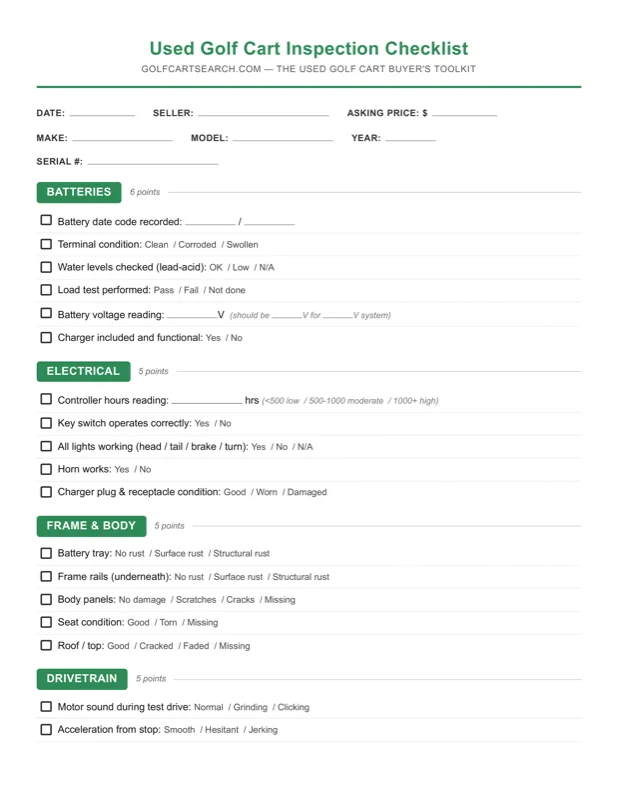
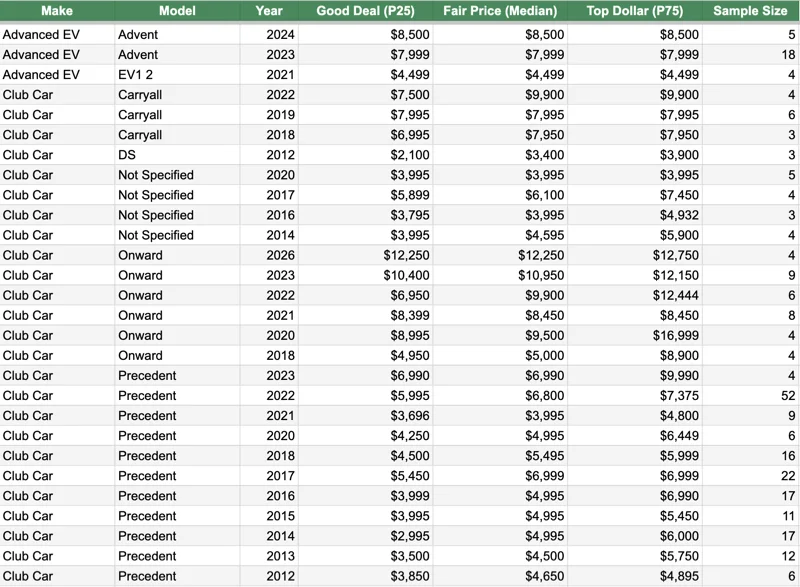
If you are testing batteries on a cart you may buy or sell, confirm the exact year with the golf cart serial number and VIN guide, then price the cart with the golf cart value calculator before treating weak batteries like a small discount.
If the test points to replacement parts instead of more diagnosis, the golf cart batteries parts finder groups lithium packs, chargers, meters, hydrometers, cables, watering systems, and terminal-care tools by fitment.
Golf Cart Battery Voltage Chart: Full and Half-Charge Readings
Use this golf cart battery chart after a full charge and at least six hours of rest, preferably 24 hours. These are open-circuit flooded lead-acid values, not readings taken while charging or driving.
| Battery or pack | 100% charged | 80% charged | 50% charged |
|---|---|---|---|
| 6V battery | 6.37V | 6.25V | 6.02V |
| 8V battery | 8.49V | 8.33V | 8.07V |
| 12V battery | 12.73V | 12.50V | 12.10V |
| 36 volt pack | 38.20V | 37.49V | 36.31V |
| 48V golf cart battery voltage chart | 50.93V | 49.99V | 48.41V |
These values come from Trojan Battery's open-circuit voltage table. Trojan says batteries must remain idle, with no charging or discharging, for at least six hours and preferably 24 hours before this test. Values vary by battery manufacturer, chemistry, temperature, and condition, so use the chart together with your battery manual. Trojan Battery maintenance guide
For the 36 volt golf cart battery voltage chart, remember that 38.2V is a full rested pack, not what you should expect while the charger is still connected. If one battery is lower than the rest after charging and resting, check it with a manufacturer-approved load test and test specific gravity if it is flooded lead-acid.
How to Use This Golf Cart Battery Voltage Chart
Before you trust any number in this article, remember one rule: rested voltage is more useful than fresh-off-the-charger voltage.
Trojan Battery says open-circuit voltage and specific gravity can indicate charge level and help locate a weak battery, but the readings must be taken under the right conditions. Its maintenance guide calls for at least six hours of idle time, with 24 hours preferred, before an open-circuit voltage test. Trojan Battery maintenance guide
In practical golf cart terms:
- Best method: charge the cart fully, disconnect the charger, and let the pack rest overnight
- Minimum method: let it rest at least 6 hours before testing
- Bad method: check voltage the second you unplug the charger and assume the numbers are accurate
Temperature matters too. Cold batteries read a little differently than warm batteries. That is why the chart below is a field guide, not a law of physics. Use it to compare batteries in the same pack and identify the one that is out of line.
If you do not already own the right tools, start with a good multimeter. The Klein Tools MM400 is still the best all-around recommendation for golf cart owners because it reads plenty of DC voltage for 36V and 48V packs and it is much more trustworthy than the bargain-bin meters.
Check Price on AmazonGolf Cart Battery Voltage Chart for 6V, 8V, and 12V Batteries
This first chart is the one most golf cart owners actually need. These are practical rested voltage targets for common lead-acid golf cart batteries after a full charge and a proper rest period.
Flooded Lead-Acid Voltage Chart
| State of Charge | 6V Battery | 8V Battery | 12V Battery |
|---|---|---|---|
| 100% | 6.37V | 8.49V | 12.73V |
| 90% | 6.31V | 8.41V | 12.62V |
| 80% | 6.25V | 8.33V | 12.50V |
| 70% | 6.19V | 8.25V | 12.37V |
| 60% | 6.12V | 8.16V | 12.27V |
| 50% | 6.02V | 8.07V | 12.10V |
| 40% | 5.98V | 7.97V | 11.89V |
These are Trojan Battery's open-circuit reference values. A battery that sits below the expected value after a complete charge and proper rest needs more testing, but voltage alone does not prove that it has failed.
AGM Battery Voltage Chart
AGM batteries can read a little higher than flooded batteries at the same charge level. The values below come from the U.S. Battery user manual, which calls for AGM batteries to remain idle for at least 24 hours before an open-circuit voltage test. Always use the table for your battery's manufacturer when one is available.
| State of Charge | 6V AGM | 8V AGM | 12V AGM |
|---|---|---|---|
| 100% | 6.50V | 8.67V | 13.00V |
| 80% | 6.37V | 8.50V | 12.75V |
| 60% | 6.25V | 8.33V | 12.50V |
| 50% | 6.19V | 8.25V | 12.37V |
| 40% | 6.12V | 8.16V | 12.24V |
If you are not sure whether your batteries are flooded or AGM, stop and verify that first. Using the wrong chart is one of the easiest ways to convince yourself a healthy battery is bad, or a weak battery is fine.
Golf Cart Pack Voltage Chart for 36V and 48V Systems
Testing individual batteries is better, but sometimes you want a quick full-pack reading first. These pack numbers are useful for a fast check before you dig deeper.
36V Pack Voltage Chart
| State of Charge | Typical 36V Lead-Acid Pack |
|---|---|
| 100% | 38.20V |
| 90% | 37.85V |
| 80% | 37.49V |
| 70% | 37.12V |
| 60% | 36.72V |
| 50% | 36.31V |
| 40% | 35.87V |
48V Pack Voltage Chart
| State of Charge | Typical 48V Lead-Acid Pack |
|---|---|
| 100% | 50.93V |
| 90% | 50.47V |
| 80% | 49.99V |
| 70% | 49.49V |
| 60% | 48.96V |
| 50% | 48.41V |
| 40% | 47.83V |
These pack charts are useful for quick screening, not final diagnosis. A 48V pack can still look passable at first glance while one weak battery hides inside it. That is why the next step is always individual-battery testing.
If your cart is already showing weak acceleration, short range, or slow charging, compare your voltage readings against our broader troubleshooting guide, electric golf cart troubleshooting tool, and golf cart won't start guide.
Golf Cart Battery Test Chart: How to Test with a Multimeter
This is the practical sequence I would use in a garage or driveway.
Before opening the battery compartment, park on level ground, switch the cart off, unplug the charger, follow the cart manual's tow or maintenance-mode instructions, remove metal jewelry, and wear eye protection. Never bridge two terminals with a probe or tool. Stop and call a technician if a battery is hot, swollen, leaking, cracked, or producing a strong sulfur odor.
Step 1: Charge the pack fully
Start with a full charge. If you test a half-charged pack and panic at the numbers, you are just measuring charge level, not battery health. If your charger is acting strange, stop here and read our best golf cart chargers guide because a charger problem can look exactly like a battery problem.
Step 2: Let the batteries rest
Rest a flooded lead-acid pack for at least six hours, ideally overnight. For AGM batteries, follow the manufacturer's rest period; U.S. Battery specifies at least 24 hours. This removes surface charge and gives you a more useful open-circuit reading.
Step 3: Set your meter to DC volts
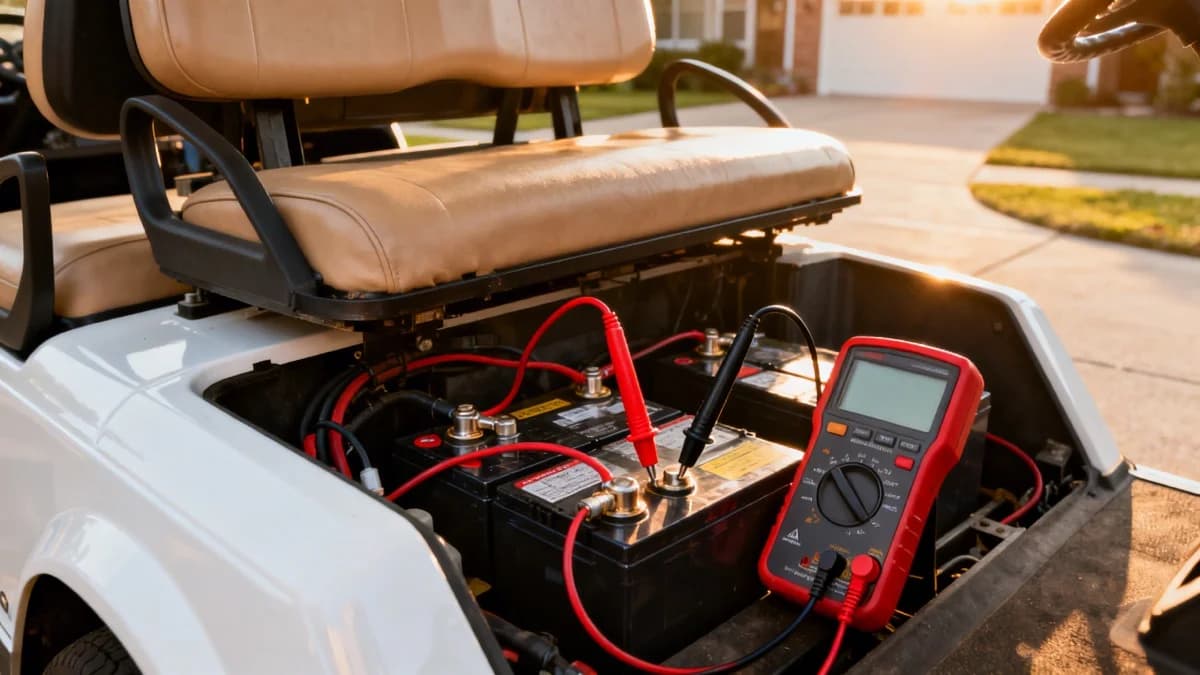
Touch the red probe to the positive terminal and the black probe to the negative terminal on each battery. Write down every number. Do not trust your memory. A simple notepad or your phone is enough.
Step 4: Compare each battery against the chart
If five batteries are clustered tightly and one is way lower, that battery is the problem until proven otherwise.
Rules of thumb:
- a healthy pack has batteries reading close to each other
- a suspect pack has one battery reading noticeably lower than the rest
- a bad pack often shows multiple weak batteries, not just one
Step 5: Test pack voltage too
Now test the whole pack from main positive to main negative. If your individual readings look healthy but total pack voltage is still off, recheck your cable path and pack layout. Loose cables and corrosion matter.
If the pack layout or cable condition looks suspicious, use our golf cart battery cable size and replacement guide before blaming the batteries.
Step 6: Test under load if the readings are borderline
This is where weak batteries get exposed. A battery can show decent resting voltage and still collapse when the cart moves.
Use a battery load tester that is rated for the battery voltage and follow its instructions, or have a golf cart technician perform the test. Do not drive the cart with loose probes, metal jewelry, or hands near the battery pack and moving components. If your cart's service manual gives a model-specific dynamic test, follow that procedure exactly.
Under-load testing is especially useful if the cart feels fine for five minutes and then suddenly gets weak. That pattern often shows up in older packs long before total failure.
For a full DIY setup beyond just a meter, our essential golf cart tool kit guide covers the rest of the tools worth owning.
When Specific Gravity Tells You More Than Voltage
If you run flooded batteries, a hydrometer is one of the best low-cost tools you can own. Trojan says specific gravity is the most accurate way to determine the state of charge of a flooded lead-acid battery. Readings must be corrected for temperature, and a test taken soon after adding water can be misleading. Trojan Battery FAQ
Specific Gravity Chart for Flooded Golf Cart Batteries
| State of Charge | Specific Gravity |
|---|---|
| 100% | 1.277 |
| 90% | 1.258 |
| 80% | 1.238 |
| 70% | 1.217 |
| 60% | 1.195 |
| 50% | 1.172 |
| 40% | 1.148 |
Two details matter here:
- manufacturer differences are normal, so do not obsess over the third decimal place
- cell spread matters a lot, sometimes more than the absolute number
Trojan says a spread greater than 0.030 between cells after a full charge calls for an equalization charge and another test. It is a troubleshooting threshold, not automatic proof of a failed cell. Equalization is for flooded batteries only and should follow the battery manufacturer's procedure. Trojan Battery FAQ
When to use a hydrometer
Use one when:
- the pack uses flooded batteries
- voltage readings are borderline
- one battery looks weak but you want confirmation
- you are inspecting a used cart and do not trust the seller's story
Use a battery hydrometer after charging and after the electrolyte has had time to stabilize. If the battery is stratified or recently watered, your reading can fool you.
Check Price on AmazonWhy Your Dash Battery Meter Can Lie
Many owners trust the stock battery meter until it strands them. That is a mistake.
Dashboard battery meters are useful for trend-watching, not diagnosis. They can:
- stay high right after charging
- plunge faster than expected under hill load
- read differently depending on pack age
- make a weak pack look fine until the last third of the charge
If you hunt, work on acreage, or drive long loops around a neighborhood, you should treat the dash meter as a hint. The real answer still comes from a multimeter, and on flooded batteries, from a hydrometer.
This matters even more when you are evaluating a used cart. A seller can point to a happy-looking meter all day. Your voltage chart and hydrometer readings tell the truth.
If the dash meter itself is blank, wired to one battery, or always showing full, use our battery meter wiring and troubleshooting guide.
For more on shopping used, read our used golf cart buying guide and golf cart value guide.
How to Tell Whether the Charger or the Batteries Are Bad
This is where owners waste a lot of money. They replace batteries when the charger is the problem, or buy a new charger when one battery in the pack is dead.
Signs the batteries are the problem
- one battery reads clearly lower than the others after a full charge and rest
- the pack voltage falls hard under load
- specific gravity varies a lot between cells
- the cart has weak range, slow hill climbing, or dim lights under throttle
- battery cases are swollen, leaking, or smell like sulfur
Signs the charger might be the problem
- the pack never reaches full rested voltage
- all batteries are equally low instead of one standing out
- the charger never starts, clicks off immediately, or runs abnormally hot
- the charge cycle ends too quickly
Some chargers will not begin a charge cycle when pack voltage is below their detection threshold. That threshold is model-specific, so check the charger manual instead of relying on a universal voltage number. Do not bypass a charger's safety controls or try to revive individual batteries unless the battery and charger manufacturers provide an approved procedure.
If you need a replacement charger after testing:
If the bigger question is identifying the connector itself, use our golf cart charger plug compatibility guide to match Club Car, EZGO, and Yamaha connectors before you order.
- for compatible 48V Club Car lead-acid carts, the roughly $100 EPOWREY round-plug charger is an option after checking OBC status
- for 36V EZGO TXT lead-acid carts, the FORM charger is one of the best-value options, usually also in the low-to-mid $100 range
If your numbers still do not make sense, stop guessing and use our electric repair directory or dealer directory to find a shop that can bench-test both the charger and the pack.
Why Lithium Golf Cart Batteries Need a Different Testing Mindset
This is where many voltage charts go wrong. They treat lithium like lead-acid. You should not.
Lead-acid batteries show a broader voltage swing across their state of charge. Lithium iron phosphate batteries stay on a flatter curve, which means voltage alone is a weaker indicator of remaining charge. That is why modern lithium systems lean on:
- Bluetooth apps
- built-in battery monitors
- BMS warning lights
- state-of-charge displays
Trojan's newer OnePack lithium products and Allied's golf cart batteries both emphasize monitor and app-based state-of-charge data instead of telling owners to diagnose the pack with voltage alone.Trojan Battery Allied Lithium
For lithium packs, use voltage as a supporting check, not the only check. If you are considering replacing a tired lead-acid pack instead of babying it through one more season, read our lithium conversion guide and battery replacement guide.
The Fastest Real-World Battery Check Before You Buy a Used Cart
If you are standing in somebody's driveway looking at a used cart, do this:
- ask the seller to leave the cart unplugged before you arrive
- test every battery individually
- look for one battery that sits low compared with the rest
- inspect the terminals for corrosion
- if it is flooded, pull specific gravity from multiple cells
- drive the cart uphill or under moderate load and see if speed falls off sharply
If the cart passes those steps, then worry about paint, seats, tires, or accessories. Batteries are the expensive part. Cosmetics are the easy part.
If the batteries are weak, price the cart accordingly. Our used buying guide, value guide, and pricing guide all help with that math.
Common Battery Testing Mistakes That Waste Money
Testing right after charging
Surface charge fools people into thinking a weak battery is healthy.
Replacing one battery in an old pack
Trojan does not recommend partial replacement of flooded battery banks because old and new batteries respond differently during charging and discharging. If the rest of the pack is already old, diagnose the full set before replacing one battery. The broader battery guide covers this in more detail. Trojan Battery maintenance guide
Ignoring corrosion
Corroded terminals create voltage drop and heat. Sometimes the cart feels like it has a battery problem when it really has a connection problem. A cheap terminal brush and fifteen minutes of cleaning can save you hundreds.
Battery terminal cleaner kit →Using the wrong chart for AGM or lithium
Not every battery chemistry behaves the same. Use the right chart and the right diagnostic method.
Believing the pack is fine because the lights work
A weak pack can still power lights and accessories while collapsing under motor load. That is why under-load testing matters.
My Practical Rule for When to Replace the Pack
I stop trying to save a lead-acid pack when any of these are true:
- the pack is 4 to 6 years old and clearly losing range
- one battery consistently reads low after charging and resting
- specific gravity spread is wide across the cells
- the cart slows dramatically uphill or late in a normal trip
- the charger and wiring have already been verified good
At that point, you are usually deciding between a fresh lead-acid set and a lithium conversion, not between "good batteries" and "maybe one more season."
Common Questions About Golf Cart Battery Voltage
What voltage should a dead 6V golf cart battery read?
A deeply discharged 6V flooded battery can fall into the high-5V range, but the exact number matters less than context. A reading that remains well below the full-charge target after a complete charge and proper rest calls for more testing.
What voltage should a healthy 8V golf cart battery read?
Around 8.49V at full charge after resting if it is a flooded battery. AGM can read a bit higher.
What voltage should a healthy 12V golf cart battery read?
Around 12.73V at full charge after resting for the flooded batteries in Trojan's chart. AGM targets vary by manufacturer; the U.S. Battery table above lists 13.00V at full charge.
Is 48V enough for a 48V golf cart pack?
Not as a rested full-charge number. A healthy fully charged lead-acid 48V pack should be around 50.9V after rest. A rested pack near 48V is no longer fully charged.
Can one bad battery ruin the whole golf cart?
Yes. One weak battery drags down acceleration, range, charging behavior, and the lifespan of the rest of the pack.
Should I use a hydrometer on AGM or lithium batteries?
No. Hydrometers are for flooded batteries only.
Do I need a load tester or is a multimeter enough?
A multimeter is enough to get started, especially if you test each battery and compare the numbers. A load test becomes useful when the pack acts weak under driving load even though resting voltage looks acceptable.
What is better for diagnosis, voltage or specific gravity?
On flooded batteries, specific gravity is usually the more accurate state-of-charge indicator. Voltage is faster and easier. The best diagnosis uses both.
Golf Cart Search
Find the Best Golf Carts of 2026
Compare top-rated models, read expert reviews, and find the perfect cart for your needs.