As an Amazon Associate, we earn from qualifying purchases. This helps support our site at no extra cost to you.
The practical answer to 36V vs 48V golf cart shopping is this: choose 48V for most neighborhood, family, hill, and long-term ownership situations. Choose 36V only when the cart is cheap, clean, healthy, and used on flat ground.
That does not mean every 36V cart is junk. A well-kept older EZGO TXT, Club Car DS, or Yamaha G-series cart can still be a smart budget buy. The problem is that 36V carts are usually older, slower, weaker on hills, and less attractive at resale. If the batteries are tired, the charger is missing, or the wiring has been modified, the "cheap" cart can become expensive before you ever enjoy it.
This guide compares speed, range, hill climbing, battery cost, charger fitment, resale value, and 36V to 48V conversion math. If you are comparing higher-voltage modern carts too, read this first, then use our 48V vs 72V golf cart guide.
Quick Verdict: 36V vs 48V Golf Cart
For most buyers in 2026, a 48V golf cart is the better choice. It accelerates better, handles passengers better, climbs hills with less strain, has stronger parts support, and usually holds value better than an older 36V cart.
A 36V cart is still worth considering when three things are true:
- The price is genuinely low.
- The batteries, charger, frame, brakes, and steering are in good condition.
- Your use is light: flat golf course, campground, short driveway, farm lane, or private property.
| Buyer situation | Better choice | Why |
|---|---|---|
| Flat course use | 36V can work | Low speed and low load are fine |
| Neighborhood driving | 48V | Better acceleration and range confidence |
| Hills or bridges | 48V | Less current draw for the same work |
| Rear seat added | 48V | Extra passenger weight hurts 36V carts |
| Lift kit and big tires | 48V | 36V gets sluggish and hot faster |
| Cheapest possible used cart | 36V | Only if batteries and charger are good |
| Best long-term buy | 48V | Better parts support and resale |
| Lithium conversion | 48V for most owners | More battery and charger options |
| Keeping an older EZGO TXT | 36V or 48V | Use current condition and budget |
| Street-legal style build | 48V minimum | Lights, brakes, speed, and range matter |
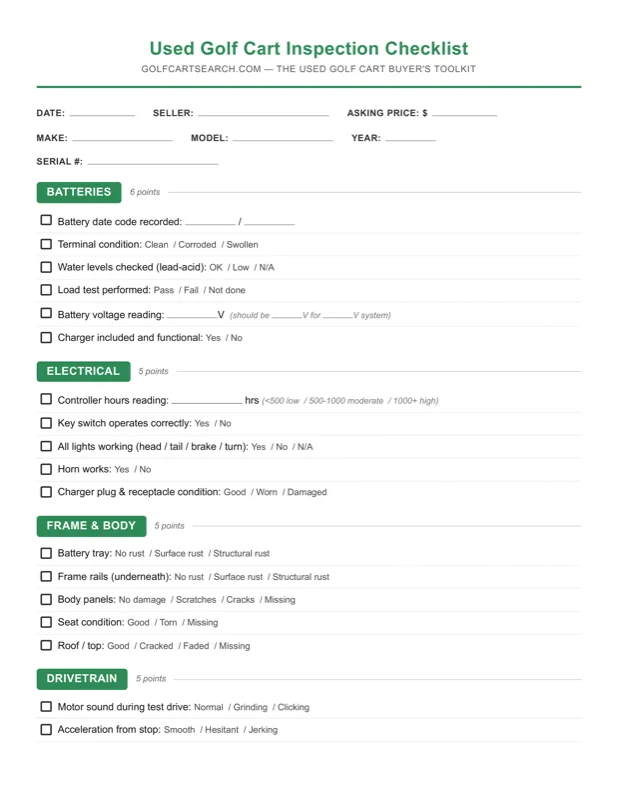
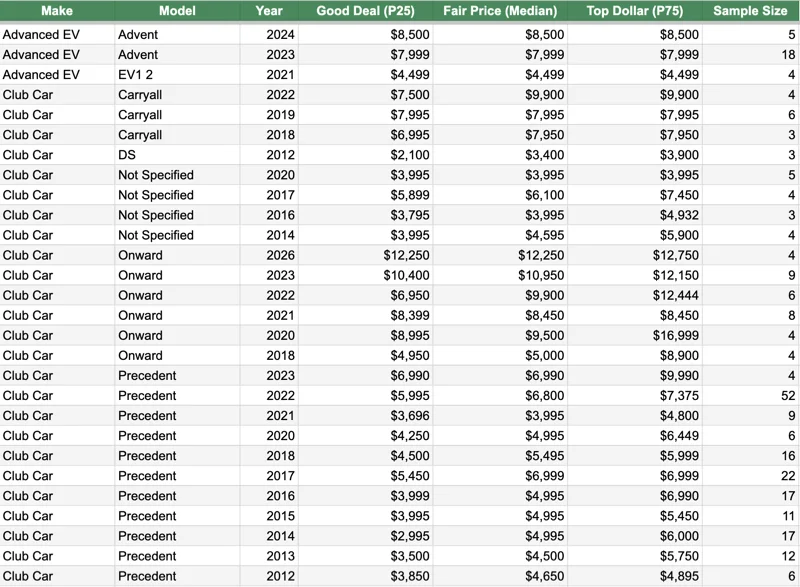
If you are shopping used, treat 36V as a discount category. The cart may be perfectly usable, but it should be priced low enough to cover the risk of batteries, charger replacement, cable cleanup, and age-related repairs. Our used golf cart buying guide and used golf cart prices by brand can help you sanity-check the listing.
How to Tell If a Golf Cart Is 36V or 48V
Do not rely on the seller saying "it is an EZGO" or "it is a Club Car." Model names cover long production runs, and many older carts have been rebuilt or converted.
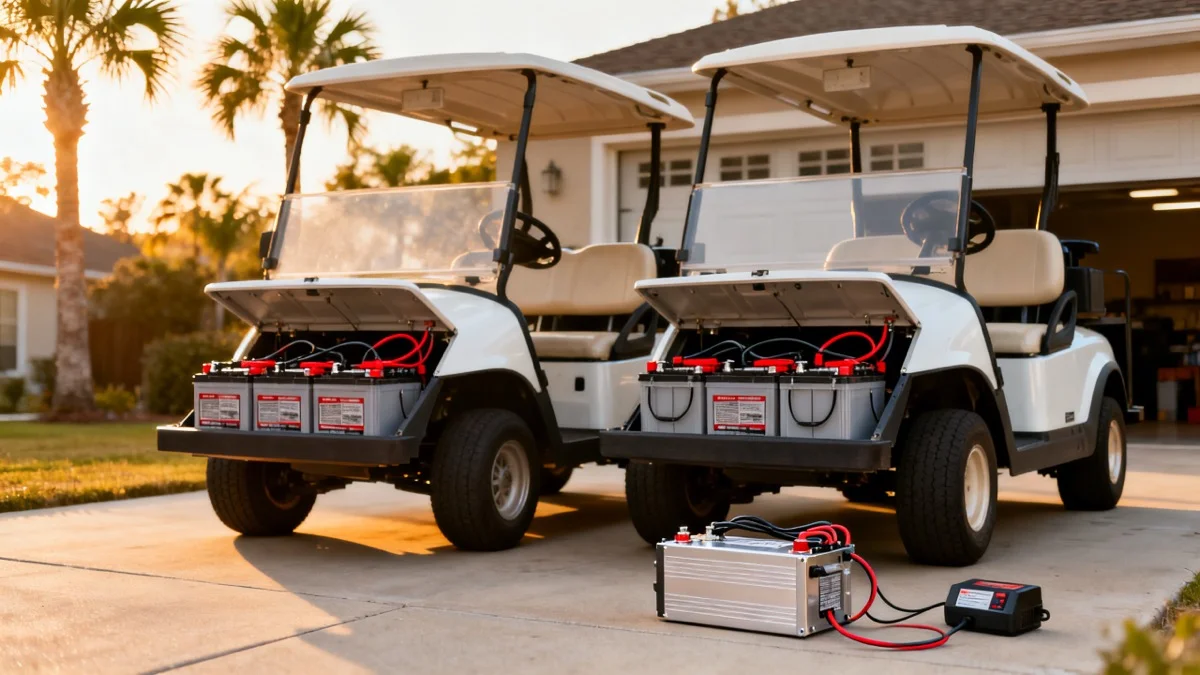
Start under the seat.
| What you see | Common pack voltage | What it usually means |
|---|---|---|
| 6 batteries labeled 6V | 36V | Older EZGO TXT, older Club Car DS, Yamaha G-series |
| 6 batteries labeled 8V | 48V | Common Club Car Precedent, TXT 48, Yamaha, fleet carts |
| 4 batteries labeled 12V | 48V | Some Yamaha, aftermarket replacements, value setups |
| 8 batteries labeled 6V | 48V | Less common, higher-capacity 48V setup |
| 1 large lithium pack labeled 51.2V | 48V class | Modern LiFePO4 replacement for 48V carts |
| 1 large lithium pack labeled 38.4V | 36V class | LiFePO4 replacement for 36V carts |
Next, inspect the charger port and charger label. Many older 36V EZGO TXT carts use a D-style PowerWise plug. Many 48V EZGO TXT and RXV carts use a 3-pin triangular plug. Club Car and Yamaha have their own connector patterns, and converted carts may use an Anderson-style plug or a new onboard charger.
If you own an EZGO TXT, our EZGO TXT charger guide walks through the common 36V D-style and 48V triangle-plug setups. For every brand, use our charger plug compatibility guide before ordering a charger.
The Real Difference: Voltage, Amps, and Heat
Voltage is electrical pressure. Amperage is current flow. Power is the result of both:
Watts = volts x amps
That formula explains why 48V usually feels stronger than 36V. If a cart needs 4,800 watts to accelerate or climb a grade, a 36V system must pull about 133 amps. A 48V system only needs 100 amps to make the same power.
That lower current matters because current creates heat. Heat stresses cables, controllers, solenoids, connectors, and motor windings. A 48V setup can do the same job with less current, which usually means better hill performance and less strain under load.
This is also why a weak 36V cart can feel fine on a flat path but fall apart on a hill with two adults and a rear seat. The cart is not only slower. It is working harder to move the same weight.
For a deeper look at current draw and motor load, see our golf cart motor draw guide and golf cart horsepower and torque guide.
Speed: 36V vs 48V Golf Cart Performance
Most stock 36V golf carts run about 12 to 15 mph on level ground. Some are slower if the batteries are old, tire pressure is low, the controller is tired, or the cart has been weighed down with rear seats and accessories.
Most stock 48V carts run about 15 to 20 mph. Newer lithium, AC-drive, or neighborhood-focused carts may run closer to 20 to 25 mph from the factory. The Club Car Onward Li-Ion sell sheet lists several Onward lithium configurations around 19 mph on level ground, which is a useful real-world benchmark for modern personal carts.
| Setup | Typical stock speed | Best use |
|---|---|---|
| 36V lead-acid | 12-15 mph | Flat course, short private-property trips |
| 36V lithium | 13-18 mph | Lighter, cleaner version of the same old cart |
| 48V lead-acid | 15-20 mph | Standard used-cart sweet spot |
| 48V lithium | 18-25 mph | Neighborhood, range, and lower maintenance |
| 48V controller upgrade | 20-25+ mph | More torque and speed with matching parts |
If your only goal is legal road use, remember that low-speed vehicle rules usually cap public-road LSV speed at 25 mph. More voltage does not remove equipment, registration, insurance, or local-road requirements. Use our street-legal golf cart guide, LSV vs golf cart guide, and golf cart laws hub before building a faster cart.
Range: The Part Most Comparisons Oversimplify
Many 36V vs 48V comparisons say 48V always has more range. That is often true in normal use, but the reason is not simply the bigger voltage number.
Range comes from stored energy:
Watt-hours = volts x amp-hours
A common 36V lead-acid cart uses six Trojan T-105-style 6V batteries. Trojan lists the T-105 6V battery at 225Ah at the 20-hour rate. Six of those batteries create a 36V 225Ah pack, or about 8.1 kWh nominal.
A common 48V lead-acid cart uses six Trojan T-875-style 8V batteries. Trojan Battery Sales lists the T-875 8V battery at 170Ah at the 20-hour rate. Six of those batteries create a 48V 170Ah pack, or about 8.16 kWh nominal.
That is almost the same nominal stored energy.
So why does 48V usually feel better and often go farther in real life?
- It uses less current for the same power.
- It wastes less energy as heat under load.
- It maintains speed better on hills.
- It is usually found in newer carts with better controllers and drivetrains.
- It is more likely to have fresher parts and better charger support.
Battery age can erase all of that. A fresh 36V pack can outperform a neglected 48V pack. A 48V cart with weak batteries can show 50 volts at rest and still collapse under load. That is why voltage testing alone is not enough. Use our battery voltage chart and golf cart range guide before judging a cart.
Hills, Passengers, and Big Tires
This is where 48V pulls away.
A 36V cart can handle flat pavement and golf paths, but it struggles faster when you add:
- Two extra adults
- A rear flip seat
- A cooler, cargo box, or roof rack
- A lift kit
- 22-inch or 23-inch tires
- Hills, bridges, soft turf, sand, or gravel
- Heavy accessories like speakers, light bars, fans, and enclosures
The cart may still move, but it draws more current, heats up faster, and feels lazy from a stop. That strain can show up later as burned cables, weak solenoids, controller faults, and short battery life.
If you already have a 36V cart and want to add a rear seat, read our rear seat kit guide, golf cart weight calculator, and tire pressure guide. Extra load is not only a comfort decision. It changes the electrical load.
Cost: 36V Is Cheaper Until It Needs Work
The main argument for 36V is price. Older 36V carts often sell for less than comparable 48V carts, and a basic 36V charger or lead-acid battery path can be cheaper.
The problem is age. Many 36V carts are old enough that battery age, frame corrosion, worn brakes, loose steering, tired cables, and charger problems matter more than voltage.
| Cost item | 36V typical range | 48V typical range |
|---|---|---|
| Used cart purchase | Lower | Higher |
| Lead-acid battery set | $800-$1,500 | $900-$1,800 |
| Smart charger | $150-$300 | $110-$600 |
| Lithium battery path | $900-$2,500+ | $1,300-$4,500+ |
| Controller replacement | $250-$900 | $300-$1,500 |
| Voltage reducer | $25-$80 | $25-$100 |
| Resale value | Lower | Higher |
| Local shop familiarity | Good for older shops | Better overall |
If you buy a 36V cart for $2,500 and immediately spend $1,200 on batteries, $200 on a charger, $250 on cables and a solenoid, and $400 on tires and brakes, you may be close to the price of a cleaner 48V cart. That is the math to run before you buy.
For broader ownership costs, compare our 2026 golf cart pricing guide, dealer fee guide, and best time to buy a golf cart.
Should You Convert a 36V Golf Cart to 48V?
Sometimes, but it is rarely the first move for a beginner.
A proper 36V to 48V conversion may require:
| Part | Why it matters |
|---|---|
| 48V battery pack | The voltage source changes |
| 48V charger | The 36V charger cannot charge a 48V pack |
| 48V controller | Many 36V controllers are not rated for 48V |
| Solenoid or contactor | Must match pack voltage and current |
| Main cables | Old cables may be corroded or undersized |
| DC-DC converter | 12V accessories need the correct input rating |
| Battery meter | The old gauge may read incorrectly |
| Programming | Some systems need controller setup |
| Brakes and steering | More speed makes weak chassis parts more important |
Do not "convert" by adding a single 12V battery to a 36V pack. That shortcut creates mismatched charging, accessory, controller, and battery-balance problems. The official E-Z-GO TXT 48V owner guide also shows how sensitive chargers can be to pack voltage faults, including battery voltage outside the expected operating window.
If the cart is a clean classic and you enjoy projects, a 48V conversion can be rewarding. If you only want reliable neighborhood transportation, buying a clean factory 48V cart is often cheaper and safer.
The Better Upgrade Path: 36V Lithium or 48V Cart
There are three sane paths for an older 36V owner.
Keep 36V and Refresh It
This is the budget path. Replace bad batteries, clean cables, use a smart 36V charger, and keep the cart close to stock. It makes sense when the cart is used lightly and you do not need more speed.
If you own an older 36V EZGO TXT, the FORM 36V charger is the easiest Amazon-friendly charger recommendation because it fits the common D-style EZGO plug and costs far less than many premium chargers. Expect the category to land around $150 to $300 depending on exact seller and promotion.
Check FORM 36V EZGO TXT Charger PriceConvert to 36V Lithium
This is the simple performance-cleanup path. You keep the cart's voltage class but remove hundreds of pounds, reduce maintenance, shorten charge time, and improve acceleration. A 36V lithium swap is usually simpler than a full 48V conversion because the controller and motor may stay closer to their intended voltage.
This is best for flat routes, seasonal use, and owners who like the cart they already have.
Move to 48V
This is the long-term path. You either buy a 48V cart or do a complete 48V conversion with matched parts. Choose this path if you want hills, rear seats, resale value, better charger options, or daily neighborhood driving.
If you buy a 48V EZGO TXT with the triangle plug and lead-acid batteries, the EPOWREY 48V 15A charger is a reasonable value option in the roughly $110 to $140 category. Confirm plug shape and battery chemistry before buying.
Check EPOWREY 48V TXT Charger PriceWhere a 48V Lithium Battery Fits
A 48V lithium conversion is the sweet spot for many owners because it improves performance without jumping into 60V or 72V complexity. The usual 48V LiFePO4 pack is labeled 51.2V nominal and charges to about 58.4V.
The DC HOUSE 48V 100Ah kit is relevant because it packages a single battery, 200A BMS, 18A charger, LCD monitor, and app support. It is not universal: confirm tray size, cable layout, controller demand, charger connection, and brand-specific charging requirements. Complete Amazon kits in this class commonly land around $850 to $1,200, with premium dealer-supported kits often higher.
Check DC HOUSE 48V 100Ah Lithium Battery PriceDo not buy a lithium battery only by voltage and price. Check:
- Continuous discharge rating
- Peak current rating
- Charger inclusion and output voltage
- Battery tray fitment
- Mounting hardware
- App or display support
- Warranty terms
- Whether your controller and regen braking system are compatible
Our lithium battery conversion guide, lithium not charging guide, and 48V vs 72V guide cover the next layer of that decision.
Brand Notes: EZGO, Club Car, and Yamaha
EZGO TXT 36V vs 48V
EZGO TXT is the most common place buyers run into this decision. Older TXT and Medalist carts are often 36V. Later TXT 48 carts moved to 48V and usually feel stronger under the same load.
The catch is that TXT carts are frequently modified. A seller may call it a "TXT" without knowing whether it is series, PDS, 36V, 48V, lead-acid, or lithium. Count batteries, inspect the charge port, test pack voltage, and check the controller label before buying.
Use our EZGO TXT vs RXV guide if you are comparing older TXT simplicity against newer RXV features.
Club Car DS and Precedent
Older Club Car DS carts can be 36V or 48V depending on year and configuration. Club Car Precedent carts are commonly 48V, and that is one reason they are popular used buys. Club Car also has charger-system wrinkles, especially older OBC setups, so connector shape alone is not enough.
Before buying charger parts, read our Club Car DS vs Precedent guide, Club Car charger guide, and Club Car review.
Yamaha G-Series and Drive2
Older Yamaha G-series carts may be 36V, while newer Yamaha Drive and Drive2 carts are usually in the 48V conversation. Yamaha gas carts are a separate decision entirely, especially if your reason for avoiding electric is range anxiety or battery replacement cost.
Compare our Yamaha golf cart review, electric vs gas golf cart guide, and how long golf carts last before choosing a cheap older electric cart only because the price looks good.
Accessory Wiring: 36V and 48V Both Need 12V
Most golf cart accessories are 12V: lights, turn signals, horns, radios, speakers, USB ports, fans, GPS trackers, and backup cameras. Neither a 36V nor a 48V cart should power those accessories by tapping one battery.
Use a DC-DC voltage reducer that matches your pack input and outputs stable 12V. Tapping one 12V segment of the pack causes uneven battery discharge, which shortens battery life and makes troubleshooting miserable.
This matters even more on older 36V carts because owners often add lights, speakers, and phone chargers over the years. If you see random wires running to one battery, assume you need cleanup. Our voltage reducer wiring guide, fuse box guide, and dashboard tech upgrade guide show the right way to wire accessories.
Used Cart Buying Rules
Use these rules when deciding between a cheap 36V cart and a cleaner 48V cart.
Buy the 36V Cart If
- It is priced well below comparable 48V carts.
- The frame is clean.
- The batteries are recent and matched.
- The charger is included and works.
- You only drive flat routes.
- You do not plan a rear seat, lift kit, or street-legal build.
- You are comfortable doing basic maintenance.
Buy the 48V Cart If
- You want neighborhood driving.
- You carry passengers regularly.
- You have hills, bridges, or uneven surfaces.
- You want better resale value.
- You plan lithium later.
- You want better local shop support.
- You want a street-legal or LSV-style setup.
Walk Away If
- The seller cannot explain the voltage.
- The battery ages do not match.
- The charger is missing.
- The cart only runs after a full charge but dies quickly.
- Cables are hot, melted, corroded, or undersized.
- Accessories are tapped from one battery.
- A 36V cart has a random extra battery added.
- The price is close to a clean 48V alternative.
If you want to compare actual listings, start with the GolfCartSearch dealer directory. For repairs after purchase, use our golf cart repair directory.
Final Recommendation
Buy 48V if your budget allows. It is the cleaner choice for most real-world golf cart owners, especially anyone driving in a neighborhood, carrying passengers, adding accessories, climbing hills, or caring about resale value.
Buy 36V only when the price is right and the use case is simple. A clean 36V cart can still be useful, but do not pay modern-cart money for old-cart performance.
If you already own a 36V cart, do not jump straight to a full 48V conversion. First decide whether you actually need more voltage. For flat, light use, a battery refresh or 36V lithium swap may be enough. For hills, passengers, and long-term ownership, put the money toward a clean 48V cart or a proper professional conversion.
Frequently Asked Questions
Is a 48V golf cart better than a 36V golf cart?
Yes for most buyers. A 48V cart usually accelerates better, handles hills better, supports accessories more comfortably, and holds value better. A 36V cart can still work for flat golf course or private-property use.
How fast does a 36V golf cart go?
Most stock 36V golf carts run about 12 to 15 mph. Weak batteries, low tire pressure, passengers, hills, and old controllers can make them slower.
How fast does a 48V golf cart go?
Most stock 48V golf carts run about 15 to 20 mph. Some newer lithium and LSV-style carts run closer to 20 to 25 mph, depending on programming and local rules.
Does a 48V golf cart have more range than a 36V golf cart?
Usually, but battery condition matters more than the voltage label. A healthy 36V pack can store similar nominal energy to a common 48V lead-acid pack, but 48V usually performs better under load and tends to be found in newer carts.
How do I know if my cart is 36V or 48V?
Count the batteries and read their labels. Six 6V batteries usually means 36V. Six 8V batteries or four 12V batteries usually means 48V. For lithium, read the battery label and charger spec.
Can I convert a 36V golf cart to 48V?
Yes, but do it as a complete system. Batteries, charger, controller, solenoid, cables, voltage reducer, and battery meter may all need attention.
Can I add one 12V battery to a 36V cart?
No. That is a shortcut, not a proper conversion. It can create charging problems, battery imbalance, accessory failures, and controller damage.
Is 36V lithium better than 48V lead-acid?
It depends on the use case. A 36V lithium cart can feel lighter and cleaner than a tired 48V lead-acid cart, but a healthy 48V cart still has the better power platform for hills, passengers, and resale.
Are 36V golf carts still worth buying?
Yes, if they are cheap, clean, and used on flat ground. They are not the best choice for heavy loads, lifted builds, regular road use, or buyers who want modern performance.
Should I buy used 36V or used 48V?
Most buyers should choose used 48V. Buy used 36V only when the discount is large enough to offset battery, charger, and age risk.
Golf Cart Search
Find the Best Golf Carts of 2026
Compare top-rated models, read expert reviews, and find the perfect cart for your needs.