
As an Amazon Associate, we earn from qualifying purchases. This helps support our site at no extra cost to you.
A golf cart lithium conversion typically costs $1,200 to $3,500 as a DIY project or $1,500 to $4,000 installed. The final number depends on battery capacity, whether the charger and mounting kit are included, your cart's wiring and accessory setup, and labor.
The conversion is usually simplest when you keep the cart at its existing voltage and buy a complete, cart-compatible kit. This guide covers current costs, 36V and 48V options, Club Car, EZGO, and Yamaha fitment, installation, and the safety checks that matter before you order. Use the golf cart batteries parts finder to compare packs, chargers, meters, and install hardware. Converting a gas cart to electric is a different project covered in our gas-to-electric conversion guide.
How Much Does It Cost to Convert a Golf Cart to Lithium?
Most owners should budget $1,500 to $2,500 for a normal conversion. A lower-cost DIY setup can land near $1,200, while a dealer-supported premium package with cart-specific hardware and installation can approach $4,000.
| Cost item | Typical price |
|---|---|
| Battery or complete kit | $1,000-$2,700 |
| Compatible charger, if not included | $150-$300 |
| Mounting hardware and cables | $0-$200 |
| 48V-to-12V converter, if needed | $40-$100 |
| Professional installation | $200-$500 |
| Typical DIY total | $1,200-$3,500 |
| Typical installed total | $1,500-$4,000 |
For a quick shopping pass, compare a lower-cost LiTime 48V 100Ah kit, a higher-capacity Vatrer 48V 105Ah kit, and dealer-supported Eco Battery or Allied options. Sale prices change, so compare the complete package rather than the battery price alone.
For Eco Battery's dealer commitments and the separate GCMOD 76V pack's warranty terms, see our September 2026 Golf Carts Modified acquisition report. Those 76V terms apply to that product, so use the policy for the exact pack in your quote.
The most commonly omitted costs are the charger, a secure cart-specific mount, a state-of-charge display, and a DC-to-DC converter for 12V lights or accessories. Confirm what comes in the box before comparing two kits.
Is a Golf Cart Lithium Battery Conversion Worth It?
If you already know you want lithium and just need to pick a battery, skip to the comparison table. For a deeper breakdown of battery types and chemistries, see our complete golf cart battery guide.
Lithium is usually a better fit when the cart is mechanically sound, gets regular use, and will stay in your ownership for several years. It is less compelling when the cart also needs a motor, controller, brakes, tires, or major frame work.
Performance gains:
- Usable range: Current 100Ah to 105Ah kit makers commonly advertise up to 40 to 50 miles, but the real result depends on cart efficiency, terrain, speed, tires, passengers, and accessories. See our full range guide for the variables.
- Lower weight: Replacing a full lead-acid pack with a single lithium pack can remove well over 200 pounds, depending on the old battery configuration and new pack. That can improve acceleration and reduce the load carried by the cart. Compare exact published specs in our golf cart weight calculator and chart.
- More consistent voltage: A correctly sized lithium pack generally holds voltage more consistently under load than an aging lead-acid pack.
- Shorter charging: Current complete kits often pair a roughly 100Ah pack with an 18A to 20A charger, putting a full charge near five to six hours under the maker's test conditions.
Financial case:
- Compare the complete installed price, not just the advertised battery price.
- Read the warranty exclusions, registration deadline, transferability, and prorated coverage.
- Base the decision on how long you expect to keep the cart and how often you use it. There is no universal three-year or five-year payback.
No routine cell maintenance:
- No more checking water levels monthly
- No more cleaning corroded terminals
- No more equalization charges
- No more acid spills or sulfur smell
For a complete maintenance comparison, check our golf cart maintenance guide.
Golf Cart Lithium Battery Conversion Kit: What You Need
Before you order a battery, make sure you know your cart's voltage system and have the right supplies on hand.
Step 1: Identify Your Voltage System
Count your existing batteries and check their voltage labels:
| Battery Configuration | System Voltage | Common Carts |
|---|---|---|
| Six 6-volt batteries | 36V | Older EZGO TXT, vintage Club Car DS |
| Six 8-volt batteries | 48V | Club Car Precedent/Onward, EZGO TXT (newer) |
| Four 12-volt batteries | 48V | Yamaha Drive/Drive2, some EZGO RXV |
| Eight 6-volt batteries | 48V | Some Club Car models |
Most carts manufactured after 2008 use 48-volt systems. If you are not sure, check the owner's manual or count the batteries. If you are deciding whether to keep an older 36V cart or move to 48V before converting, read our 36V vs 48V golf cart guide first.
Step 2: Gather Your Tools
You likely already own most of what you need:
- Socket wrench set (10mm, 13mm, and 5/16" are most common for battery terminals)
- Wire crimpers and wire strippers
- Torque wrench (for terminal connections)
- Zip ties and electrical tape
- Safety glasses and insulated gloves
- Wire brush for cleaning the battery tray
- Phillips and flathead screwdrivers
Step 3: Shopping List
Every lithium conversion requires these components:
- Lithium LiFePO4 battery sized for your voltage system (see comparison below)
- Manufacturer-approved lithium charger (included in many kits, otherwise about $150-$300; confirm voltage, charge profile, amperage, and connector before buying a standalone option such as the FORM 48V Lithium Charger)
- Battery cables (your existing cables may work if they are in good condition and fit the new terminal layout)
- Mounting hardware (brackets, straps, or spacers to secure the battery in your tray)
- State-of-charge monitor (included in most kits)
Optional but recommended:
- New battery cables if yours show corrosion or fraying
- DC-DC converter if you tap 12V accessories from the battery pack
- Battery terminal protectant spray
Best 48V Lithium Battery for Golf Cart Conversion
The right 48V pack must fit the battery tray, supply the controller's required continuous and peak current, work with regenerative braking if the cart uses it, and include or support the correct charger. Capacity alone does not establish compatibility.
| Current option | What is included | Advertised range | July 2026 price |
|---|---|---|---|
| LiTime 48V 100Ah kit | Battery, 18A charger, monitor | Up to 40-50 miles | About $1,275 |
| Vatrer 48V 105Ah kit | Battery, 20A charger, LCD, mounting parts and cables | Up to 50 miles | About $1,660 |
| Eco Battery 51V 105Ah | Battery only at listed MSRP | Not stated on product page | $2,178 |
| Allied RS 48V 105Ah | Dealer-oriented integrated package | Varies by cart and use | $2,700 |
Range figures are manufacturer estimates, not guarantees. Prices can change with sales and configuration choices. Always compare the exact contents and warranty terms of the package you are ordering.
Understanding the Specs
BMS (Battery Management System) limits determine how much current the battery can deliver and accept. Do not rely on the BMS name alone. Check continuous current, timed surge current, charge current, low-temperature protection, and regenerative-braking compatibility against the cart and controller. This is especially important if you have upgraded your controller for more speed.
Cycle count is meaningful only with its test conditions. LiTime, for example, publishes 4,000 cycles at 100% depth of discharge, 6,000 at 80%, and 15,000 at 60%. Compare equivalent depth-of-discharge ratings rather than choosing the largest number in a product title.
Package contents can change the apparent price by hundreds of dollars. Confirm the charger, monitor, mounting brackets, cables, charge-port adapter, and DC-to-DC converter before you compare totals.
Shopping for a complete 48V lithium golf cart instead of converting your current cart? Compare the current online-cart caveats in our Amazon golf cart guide before you trust a low delivered price.
Our Top 48V Lithium Battery Picks
If you want the short list, start with these three Amazon options, then verify tray dimensions, controller current, charger profile, and warranty terms before ordering.
Best Lower-Cost Complete Kit: LiTime 48V 100Ah
LiTime's 48V 100Ah kit is the first option to check if you want a lower-cost complete package instead of a dealer-installed premium system. The current kit includes the battery, charger, and monitor, which keeps the shopping list simple. Confirm its dimensions, continuous current, peak current, low-temperature behavior, and charger connector against your cart before ordering.
Check LiTime 48V 100Ah Kit PriceBest 105Ah Kit to Compare: Vatrer 48V 105Ah
Vatrer is the better Amazon comparison if you want a 105Ah package with a charger, LCD monitor, mounting hardware, and cables. It is a good fit for shoppers who are comparing value kits by capacity and included hardware. Check the battery-compartment dimensions carefully because some cart models do not fit.
Best Alternate 48V Kit to Check: LOSSIGY 48V 100Ah
LOSSIGY is worth price-checking when you want another 48V lithium kit with a charger and monitor included. Treat the Amazon listing as the current source of truth for dimensions, BMS rating, warranty, and included parts, then compare it against LiTime and Vatrer before you buy.
Check LOSSIGY 48V 100Ah Kit PriceDealer-Supported Options: Eco Battery and Allied
Eco Battery lists its 51V 105Ah Gen3 thru-hole battery at $2,178 and offers cart-specific installation bundles through dealers. Allied lists its 48V 105Ah RS package at $2,700 with a 10-year limited warranty. These are worth comparing when local installation, model-specific hardware, and dealer support matter more than the lowest purchase price.
Find a local golf cart dealer who carries these brands if you want hands-on support and professional installation.
Best 36V Lithium Golf Cart Battery Conversion Kits
If your cart runs on 36 volts, common in older EZGO TXT and Club Car DS models, staying at 36V avoids turning a battery replacement into a controller, solenoid, motor, charger, and wiring project.
Vatrer currently lists a 36V 105Ah conversion kit at about $1,500 with a 20A charger, LCD monitor, 200A BMS, and mounting accessories. Allied also offers dealer-supported 36V packages. Compare physical fit, current limits, charger connection, and support terms before buying.
If you are also considering a high-voltage build, read our 48V vs 72V golf cart guide before ordering a battery, controller, or charger.
How to Convert a Golf Cart to Lithium Batteries
This process applies to most drop-in lithium kits on 48V and 36V carts. Total time: 1-3 hours for a DIY install.
Preparation and Safety
Before touching anything, follow the cart service manual and battery installation manual. High-current DC systems can arc, overheat, or damage electronics if they are disconnected or reconnected incorrectly.
- Park on level ground and engage the parking brake
- Turn the key switch to OFF and remove the key
- Disconnect the charger if plugged in
- Set the cart to tow or maintenance mode if the manufacturer specifies that step
- Wear safety glasses and insulated gloves. Lead-acid batteries contain sulfuric acid
- Take a photo of the current wiring layout, then label the cart's main positive, main negative, charger, and accessory connections
Removing Old Lead-Acid Batteries
- Disconnect the pack in the order specified by the cart manual. This is commonly main negative first, followed by main positive, but verify the procedure for your model.
- Remove the inter-battery cables only after the pack is isolated. Use insulated tools and keep metal objects away from exposed terminals.
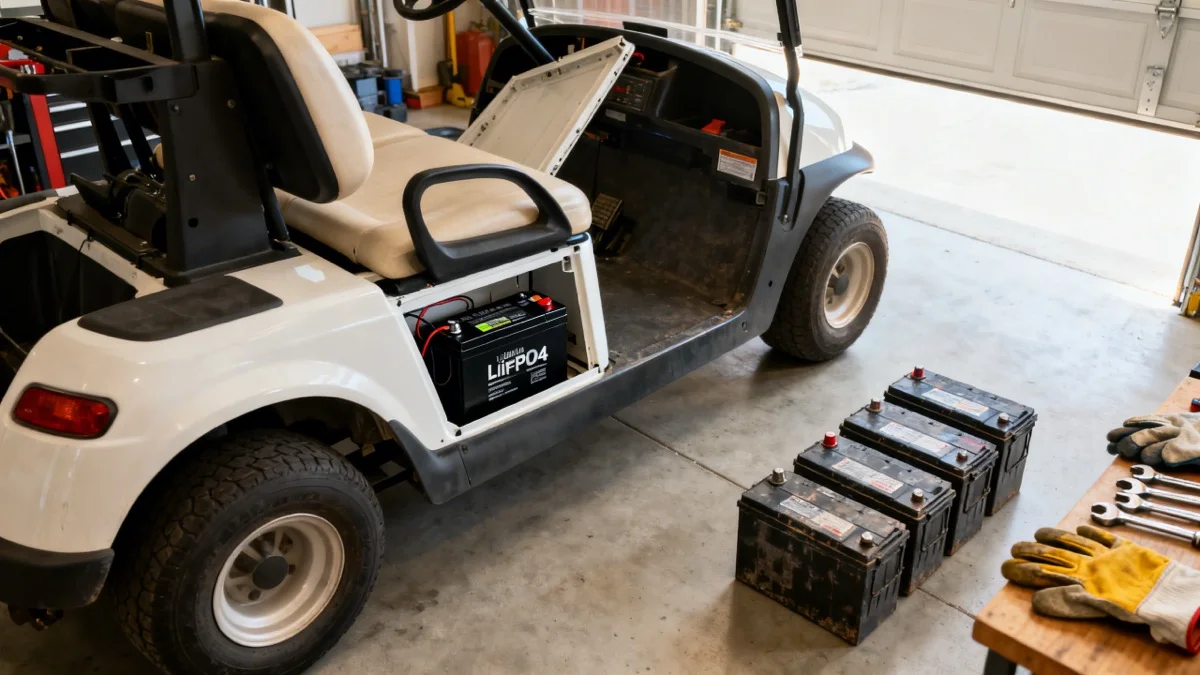
- Unbolt each battery from the tray. Use a battery carrier or a second person for heavy lead-acid batteries.
- Clean and inspect the tray. Neutralize lead-acid corrosion using the procedure in the cart manual, then repair rust or damage before installing the new pack.
Installing the Lithium Battery
- Position and secure the new battery with the maker's cart-specific brackets, straps, or spacers. It must not move or place strain on the terminals when the cart turns, brakes, or crosses rough ground.
- Install any required fuse, contactor, converter, charger, and monitor wiring exactly as shown in the kit manual.
- Connect the main cables in the specified order and confirm polarity before the final connection.
- Torque every terminal to the battery maker's specification. The correct value varies by terminal and product. Loose connections create resistance and heat, while overtightening can damage the terminal.
- Protect and route the cables so they cannot rub, pinch, touch sharp edges, or contact moving parts.
Charger Setup
- Remove or isolate the old charger unless the battery maker explicitly approves its charge profile.
- Install the matched charger in the location and wiring configuration specified by the kit maker. Verify charge voltage, amperage, connector, polarity, and ventilation.
- Complete the maker's commissioning charge and setup. Do not assume every lithium pack uses the same full-charge voltage or first-charge procedure.
Compare lithium-compatible chargers by brand and voltage in our golf cart charger buyer's guide.
Post-Installation Checks
- Confirm pack voltage, polarity, monitor operation, and fault status against the installation manual before turning on the cart.
- Test drive at low speed in a safe area. Confirm normal acceleration and braking, especially on a regenerative-braking cart.
- Verify the charger cycle and confirm it stops normally without a BMS or charger fault.
- Reinspect the installation after the first drive and at the interval specified by the battery maker. Look for loose hardware, heat, chafing, or movement.
Club Car, EZGO, and Yamaha Lithium Conversion Notes
Every golf cart brand has quirks. Here is what to watch for on the three most popular brands.
Club Car Precedent and Onward (48V)
Club Car Precedent and Onward models are the easiest carts to convert. The battery compartment is accessible, the wiring is straightforward, and most aftermarket lithium kits are designed with Club Car fitment in mind.
Key details:
- Stock system: 48V (six 8-volt lead-acid batteries)
- Charger plug: 3-pin round connector (verify your new charger matches)
- Some Precedent carts with a legacy OBC require a bypass when converting to a standalone lithium charger; follow the battery and charger manufacturers' cart-specific instructions and preserve drive lockout.
- No controller modifications needed for standard use
Check Club Car models and specs for more details on specific model years.
Our Club Car OBC bypass guide explains how to choose the matching kit diagram and verify the charging and lockout functions separately.
EZGO TXT and RXV (36V and 48V)
EZGO carts come in both 36V (older TXT models) and 48V (newer TXT and all RXV models). The conversion process differs slightly depending on voltage and model.
EZGO TXT (36V):
- Stock system: 36V (six 6-volt batteries)
- Straightforward drop-in conversion
- Use a 36V lithium battery (not 48V unless you are upgrading the entire electrical system)
EZGO TXT (48V):
- Stock system: 48V (six 8-volt batteries)
- Similar to Club Car conversion, very straightforward
EZGO RXV (48V): Regenerative Braking Warning
- The RXV uses regenerative braking, which sends current back into the battery pack when you let off the accelerator or press the brake
- Regen current can exceed what the lithium battery's BMS allows for charging, causing the BMS to disconnect and your cart to lose power suddenly while braking
- Use a battery, charger, and controller configuration that the battery maker explicitly supports for the RXV. Have a qualified technician verify the regenerative-braking settings and test braking behavior before normal use. Allied, for example, specifically documents RXV regenerative-braking compatibility for its system.
See all EZGO models for specifications.
Yamaha Drive and Drive2 (48V)
Yamaha Drive and Drive2 carts use a 48V system with four 12-volt batteries in a slightly different compartment layout than Club Car or EZGO.
Key details:
- Stock system: 48V (four 12-volt batteries)
- The battery compartment sits under the front seat
- Yamaha's wiring harness and terminal positions differ from Club Car and EZGO, so double-check cable lengths
- No controller modifications needed for standard conversions
- The stock charger plug is unique to Yamaha. Verify your lithium charger kit includes the correct Yamaha adapter.
Browse Yamaha models for details on your specific cart.
Other Brands
Newer brands like Star EV, ICON, Evolution, and Advanced EV often ship with lithium batteries from the factory. If you own one of these with lead-acid, the conversion process follows the same general steps above. Check our brand comparison pages for model-specific details, browse the best golf cart brands, or see our top 10 golf carts for 2026 to compare options.
10 Common Golf Cart Lithium Conversion Mistakes
These are the problems that trip up first-timers. Avoid them and your conversion will go smoothly.
1. Assuming any charger labeled 36V or 48V will work. Charge voltage and profile vary by pack. Use the charger or profile approved by the battery maker and verify the connector and polarity.
2. Wiring 12V lithium batteries in series without checking the manual. Some lithium batteries support series use and others do not. A purpose-built 48V pack is the simplest route, but a series bank is valid only when the manufacturer explicitly supports it and you follow its balancing and charging instructions.
If your new pack already refuses to charge or the BMS keeps tripping, use our lithium battery not charging guide before buying another charger or battery.
3. Skipping the torque wrench on terminal connections. Loose battery terminals cause electrical resistance. Resistance creates heat. Heat melts cable insulation, damages terminals, and in extreme cases starts fires. Torque every connection to spec.
4. Not securing the battery in the tray. A single lithium battery is much smaller and lighter than six lead-acid batteries. Without proper mounting brackets or straps, the battery slides around during driving, stressing cable connections and potentially short-circuiting against the metal tray.
5. Forgetting the voltage reducer for 12V accessories. If your cart has headlights, a stereo, a USB charger, or other 12V accessories, they were probably tapped from one battery in the lead-acid pack. With a single lithium battery, you need a DC-DC converter (48V to 12V) to power these accessories. Tapping directly from the battery pack gives you 48V, which will fry 12V components. If you have street-legal accessories like lights and turn signals, this step is especially important.
6. Ignoring regenerative braking compatibility. On carts with regenerative braking, notably the EZGO RXV, charging current from the controller must remain within the battery's limits. Use an approved battery and controller combination and have braking behavior verified after installation.
7. Not updating the state-of-charge meter. Your old fuel gauge was calibrated for lead-acid voltage curves. Lithium has a flatter discharge curve, so the gauge will read inaccurately (often showing "full" until the battery is nearly empty, then dropping fast). Install the lithium-compatible monitor that comes with your kit, and use our battery meter wiring guide if you need to separate wiring issues from battery-profile issues.
8. Ignoring the pack's temperature limits. Many LiFePO4 packs block charging below 32 degrees Fahrenheit, while self-heating models may support a different procedure. Follow the exact charging, discharging, and storage limits in the battery manual. Read our winterization guide for cold-weather battery care.
9. Choosing on price and amp-hours alone. Check third-party certification claims, BMS limits, enclosure rating, warranty exclusions, support, physical fit, charger, and mounting hardware. A low battery price can become an expensive conversion if critical components are omitted.
10. Not testing the system before driving at full speed. After installation, do a slow test drive first. Check for unusual sounds, smells, or behavior. Verify the charger works correctly. Re-torque connections after 24 hours.
After the Conversion: Lithium Maintenance
One of the best things about lithium is how little maintenance it requires. Here is your entire maintenance routine:
Monthly
- Check connections: Make sure battery terminals are tight and free of debris. Unlike lead-acid, lithium terminals do not corrode, but vibration can loosen bolts over time.
- Monitor state of charge: Glance at your battery monitor. Most lithium batteries with Bluetooth let you check charge level, voltage, and cell balance from your phone.
Seasonally
- Clean the battery tray: Wipe down the area. Keep it dry and free of debris.
- Inspect cables: Look for chafing, cracking, or wear on cable insulation.
- Verify charger operation: Plug in and confirm the charger starts and stops automatically.
Winter Storage
Storage instructions vary by pack, so use the battery maker's required state of charge, disconnect procedure, temperature range, and inspection interval. Do not copy a generic 50% or 100% storage rule from another brand. If the pack has low-temperature charging protection or self-heating, confirm how those features behave while the cart is stored.
Our winterization guide covers the full seasonal storage checklist.
When to Hire a Professional
DIY installation works great for most drop-in kits, but some situations call for professional help. Find a golf cart repair shop near you or browse dealers in your state if any of these apply:
- Your cart has regenerative braking (EZGO RXV) and the battery maker requires controller verification or setup
- You want to change voltage (36V to 48V) and need controller and wiring upgrades
- Your cart is pre-2005 and may need controller reprogramming
- You are adding a high-speed controller at the same time as the lithium conversion
- You want warranty assurance. Some battery manufacturers require professional installation for full warranty coverage. Check your battery's warranty terms.
Professional installation typically runs $200-$500 in labor and takes 2-4 hours. Many dealers also offer lithium conversion packages that bundle the battery, charger, and installation at a discount.
Check our repair directory for tips on finding a qualified technician, or search our best repair shops by state directory.
Golf Cart Lithium Battery Conversion FAQ
How much does it cost to convert a golf cart to lithium batteries?
A golf cart lithium conversion typically costs $1,200 to $3,500 for DIY installation or $1,500 to $4,000 installed. A complete mainstream 48V kit currently lands around $1,275 to $1,660 before any extra cart-specific work, while dealer-oriented 105Ah options list around $2,178 to $2,700 before or as part of their installation packages.
How do you convert a golf cart to lithium batteries?
To convert a golf cart to lithium, identify whether the cart is 36V or 48V, remove the full lead-acid pack, install one compatible LiFePO4 battery or matched drop-in kit, secure it in the tray, connect the main positive and negative leads, install a lithium-compatible charger and state-of-charge monitor, then test drive and recheck terminal torque.
What is the best 48V lithium battery for a golf cart?
For many stock 48V carts, a 100Ah to 105Ah pack is a useful starting point. Then verify physical dimensions, continuous and surge current, regenerative-braking support, charger, mounting hardware, warranty, and model-specific fitment. Current options worth comparing include LiTime, Vatrer, Eco Battery, and Allied.
Can you convert a 36V golf cart to lithium?
Yes. The simplest route is a 36V LiFePO4 drop-in kit that matches the cart's existing voltage. A 36V-to-48V upgrade is a larger project because it can require a controller, charger, wiring, solenoid, and sometimes motor changes.
Can you convert a Club Car to lithium batteries?
Yes. Many Club Car Precedent and Onward carts are straightforward 48V lithium conversions, but some older Precedent carts with an onboard computer may require an OBC bypass or compatible charger setup.
Can you convert a Yamaha golf cart to lithium batteries?
Yes. Most Yamaha Drive and Drive2 conversions use a 48V lithium kit, but cable length, charger plug, and battery-compartment layout differ from Club Car and EZGO, so verify fitment before ordering.
Is a lithium conversion worth it for an older golf cart?
It can be worthwhile when the frame, motor, controller, brakes, and wiring are in good condition and you expect to keep using the cart. If the cart also needs significant mechanical or electrical work, compare the combined repair and conversion cost against a used cart that already has lithium.
How much range will I gain after converting to lithium?
Current 100Ah to 105Ah manufacturers commonly advertise up to about 40 to 50 miles, but there is no universal percentage gain over lead-acid. The result depends on the condition and capacity of the old pack, cart efficiency, terrain, speed, passenger load, tires, accessories, and temperature. Check our complete range guide for the variables.
Can I mix lithium and lead-acid batteries?
Never. Lithium and lead-acid have completely different voltage profiles, charge characteristics, and discharge behaviors. Mixing them will damage both battery types, void your warranty, and create a safety hazard. Replace the entire pack with one chemistry.
Do lithium batteries void my golf cart warranty?
If the cart is still under warranty, get the manufacturer or dealer's written position before modifying it. Coverage depends on the warranty terms and whether the modification caused or contributed to the failure. Also check whether the battery warranty requires registration, approved charging equipment, or professional installation.
What size lithium battery do I need?
For regular neighborhood driving, golf-course use, or community cruising, many owners compare 100Ah to 105Ah packs. Capacity is only one part of sizing: controller current, hills, passenger load, speed, accessories, and expected reserve also matter. For more on choosing the right battery size, see our battery guide.
Are lithium golf cart batteries safe?
LiFePO4 is generally more thermally stable than several other lithium-ion chemistries, and a well-designed BMS can protect against overcharge, over-discharge, overcurrent, temperature, and short circuits. The risk is not zero. UL's large lithium-ion system guidance notes that damaged, defective, overheated, or improperly charged systems can enter thermal runaway. Prefer a pack evaluated to an applicable standard such as UL 2271, use the approved charger, secure it against impact and vibration, and follow the installation manual.
How do I know which voltage system my cart uses?
Count your batteries and check their labels. Six 6-volt batteries equals 36V. Six 8-volt batteries or four 12-volt batteries equals 48V. You can also check the data plate on your cart (usually under the seat or on the frame) which lists the system voltage. When in doubt, search your cart model on our brand pages for specifications.
Should I convert to lithium before selling my golf cart?
A documented lithium conversion may make the cart more attractive to some buyers, but there is no guarantee that resale value will recover the project cost. If you plan to sell soon, compare local sale prices for similar lead-acid and lithium carts before investing. Keep the battery receipt, warranty registration, installation records, and charger with the cart.
Do golf cart dealers install lithium batteries from Amazon?
Some dealers will install customer-supplied batteries, but many prefer to sell and install their own inventory (Allied, Eco Battery, or Trojan). Call ahead and ask. If your dealer charges a higher labor rate for customer-supplied parts, factor that into your cost comparison. Search our dealer directory to find shops in your area.
Is there a fire risk with lithium golf cart batteries?
LiFePO4 is generally more thermally stable than several other lithium-ion chemistries, but fire and thermal-runaway risk is not zero. UL identifies overcharge, over-discharge, heat, internal or external short circuits, manufacturing defects, and physical damage as hazards in large lithium-ion systems. Reduce risk by choosing an appropriately certified pack, using the approved charger, installing the required fuse and secure mount, protecting cables, and removing a damaged or overheating battery from service according to the maker's instructions.
Golf Cart Search
Find the Best Golf Carts of 2026
Compare top-rated models, read expert reviews, and find the perfect cart for your needs.