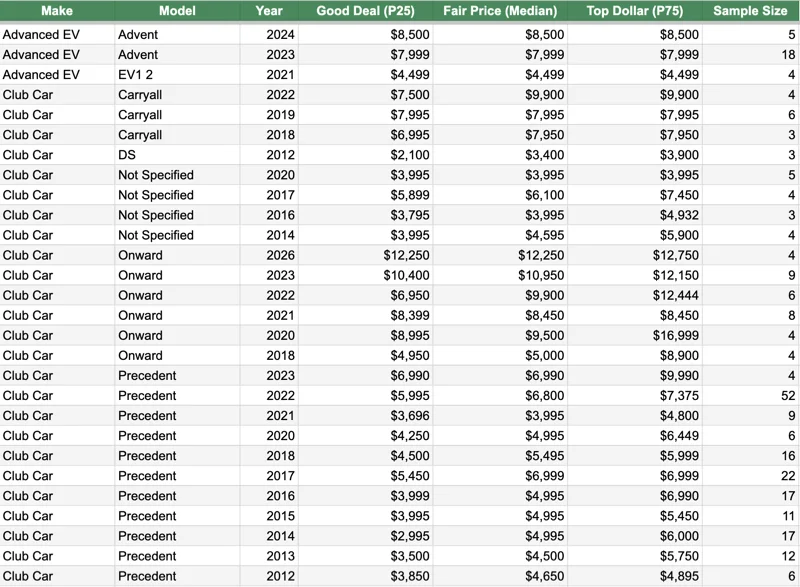


Our saved August 4, 2026 dealer-listing sample has a $5,999 median asking price and a $6,479 mean, across 1,691 usable used-cart listings. These are observed advertisements, not completed sales or a nationwide appraisal for your cart.
We reproduced the statistics from the saved raw listings on October 10, 2026. The snapshot remains dated August 4; rechecking the arithmetic does not make the market data newer. Use it to choose a comparison group, then inspect current local listings and the actual cart.
How we calculated the prices
The source is our archived GolfCartResource dealer-listing collection: 1,812 raw records, reduced to 1,691 with condition “Used,” a stated year and make, and a numeric asking price between $1,000 and $30,000, inclusive. Missing-price and out-of-band records are excluded, so this is not a complete census of every cart offered.
For each group, we sorted prices and selected the observation at zero-based index floor(n/2) as the median. For an even-sized group, that uses the upper middle observation, rather than averaging the two middle prices. The 25th and 75th percentile figures use floor(n×0.25) and floor(n×0.75). Means are rounded to whole dollars.
The overall middle interval is $4,695–$7,895. This is the observed 25th–75th percentile interval, not a fair-price guarantee. Rows mix ages, models, batteries, condition, equipment and locations. We did not verify every listing against its VIN, deduplicate identical vehicles across dealers, or observe final selling prices.
Used asking prices by brand
These are all 14 stored make groups with at least five usable listings. “Other” is a source category, not a manufacturer. Small samples deserve particular caution.
| Make group | Listings | Median ask | 25th–75th percentile asks |
|---|---|---|---|
| Club Car | 784 | $6,195 | $4,550–$7,995 |
| E-Z-GO | 463 | $5,795 | $4,299–$6,995 |
| Yamaha | 234 | $6,295 | $4,799–$7,995 |
| Cushman | 39 | $6,499 | $5,799–$7,999 |
| Evolution | 28 | $6,995 | $6,495–$8,495 |
| Bintelli | 16 | $11,995 | $7,495–$15,245 |
| ICON | 16 | $5,595 | $4,995–$7,650 |
| Star EV | 15 | $6,995 | $4,995–$6,995 |
| Tomberlin | 13 | $11,000 | $8,495–$13,995 |
| Polaris GEM | 7 | $10,199 | $3,995–$12,500 |
| Royal EV | 6 | $7,500 | $7,250–$8,500 |
| Advanced EV | 5 | $7,500 | $7,495–$8,000 |
| Other | 5 | $5,499 | $3,995–$6,995 |
| Denago EV | 5 | $9,195 | $8,495–$9,499 |
The Club Car, E-Z-GO and Yamaha groups account for 1,481 listings, or 87.6% of the usable sample. That describes this source's composition; it does not prove national market share or that these brands are better purchases.
Notice that Yamaha's median is above Club Car's here, while the Advanced EV median is higher still with only five records. A brand-wide resale ranking would ignore the mix of years and configurations. The table is a starting point for finding peers, not evidence that one badge deserves a fixed premium.
For brand equipment and service questions, see the individual Club Car, E-Z-GO and Yamaha reviews. Match the actual model and year before using a specification or warranty claim.
What the seating groups show
| Advertised seating | Listings | Median ask |
|---|---|---|
| Two passengers | 598 | $5,000 |
| Four passengers | 804 | $6,595 |
| Six passengers | 78 | $10,900 |
The four-passenger group's median is $1,595 above the two-passenger group's median; the six-passenger median is $4,305 above the four-passenger median. These are differences between groups. They do not isolate the value of adding seats to an otherwise identical cart.
Other rows include utility carts and missing or malformed seating labels. The three groups above therefore do not total 1,691. Inspect seat layout, passenger capacity and the installed rear-seat kit; an advertisement's seat count does not establish payload or road certification. Our seating comparison explains the practical checks.
Battery labels do not establish a lithium premium
| Normalized power label | Listings | Median ask |
|---|---|---|
| Gas | 527 | $6,495 |
| Electric | 642 | $5,595 |
| Lithium | 359 | $6,945 |
| Unknown | 163 | $5,750 |
The script maps seller labels into these categories. “Electric” is not independent confirmation that every cart has lead-acid batteries. “Lithium” does not establish whether a pack is original, converted, healthy or under warranty.
The lithium median is $1,350 above the electric median in this snapshot. We cannot convert that into a percentage premium for identical carts: the groups differ in model, age, equipment and condition. Check the pack label, capacity, installation, correct charger, invoice and measured health before comparing two individual offers.
Do not assume a battery warranty transfers. For example, the current Eco Battery overview, checked October 10, 2026, expressly says warranties are non-transferable. A used ICON or another cart with an Eco pack needs its exact generation and applicable purchase-year documents checked, rather than a generic transfer benefit.
A model-year comparison shows the limits
The stored RXV groups provide a more specific example:
| E-Z-GO RXV model year | Listings | Median ask | 25th–75th percentile asks |
|---|---|---|---|
| 2018 | 16 | $4,595 | $3,799–$5,500 |
| 2020 | 60 | $6,399 | $5,995–$6,995 |
| 2022 | 52 | $5,950 | $5,950–$7,200 |
The newer 2022 group has a median $449 below the 2020 group. Different configurations, condition, seller inventory and asking strategies remain in the groups. A one-day cross-section cannot measure how one cart depreciated over time.
Similarly, we cannot establish “the best age is four to seven years” from this sample. Compare maintenance records and total expected cost, rather than choosing a year purely from an assumed depreciation curve.
Compare the total deal
Use five to ten current local advertisements for the closest year, model, seating and powertrain you can find. Record each listing's date, ask, included charger, battery documentation, service records, warranty terms and excluded charges. Keep dealer, private-sale and trade-in figures in separate columns.
Our sample supplies no verified private-sale or trade-in discount. A dealer may include reconditioning or a limited warranty; obtain the actual scope. A private seller may provide excellent records or none. Price those differences rather than subtracting a fixed 15–25% from every dealer ask.
For example, suppose two comparable carts are advertised at $6,000 and $5,400. If the second needs a written $900 installed repair quote, its immediate cart-plus-repair total is $6,300, before other charges. This is hypothetical arithmetic, not a repair price estimate or proof the $6,000 cart is healthy. Inspect both and obtain real quotes.
Battery age alone is not a tested replacement requirement. Accessories also have no guaranteed resale percentage: establish that they fit, work and matter to you. Check title or ownership documents and the actual vehicle's road eligibility separately from lights and top speed.
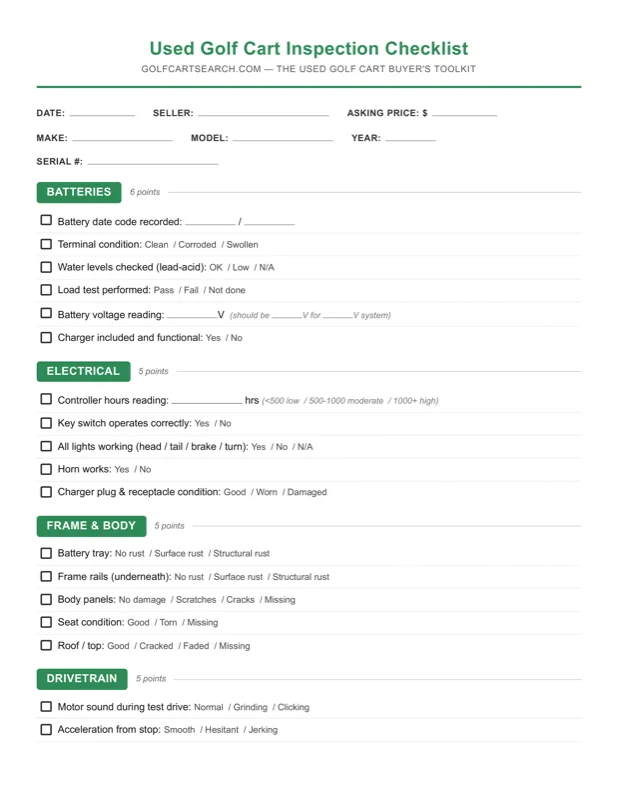
Use the used-cart inspection guide and value worksheet before negotiating. The Buyer's Toolkit provides the saved pricing context and inspection materials; the for-sale directory is a place to begin looking for current offers.
Frequently asked questions
What is the average used golf cart price in 2026?
Our August 4, 2026 sample of 1,691 usable dealer listings has a $6,479 rounded mean and $5,999 median asking price. Those statistics describe that dated sample, not completed sales or every local cart.
How much is a used Club Car, E-Z-GO or Yamaha?
The sample medians are $6,195 for Club Car, $5,795 for E-Z-GO and $6,295 for Yamaha, across mixed years and configurations. Use the counts and percentile intervals above, then compare exact local peers.
Which brand holds value best?
This dealer-asking-price snapshot cannot establish value retention. That needs comparable original purchase prices and later sale results, with age, model, battery and condition controlled.
How much more is a used four-seater?
The four-seat median is $6,595 versus $5,000 for two seats, a $1,595 observed group difference. It is not the isolated value of adding a rear seat.
Are private sellers always cheaper?
No fixed discount is established by our dealer sample. Compare actual private offers, inspection results, included equipment and charges with similar dealer offers.
Do lithium batteries add a fixed resale premium?
The sample does not establish that. Its lithium and electric groups are unmatched, and seller labels do not verify chemistry, installation or health. Check the exact pack and applicable warranty.
Is the August data current in October?
It remains an August 4 snapshot. We reproduced its arithmetic on October 10, 2026; current advertisements and written quotes are still needed for a purchase today.
Golf Cart Search
Find the Best Golf Carts of 2026
Compare top-rated models, read expert reviews, and find the perfect cart for your needs.