
As an Amazon Associate, we earn from qualifying purchases. This helps support our site at no extra cost to you.
Golf Cart Battery Charging Time: 36V, 48V, Lithium
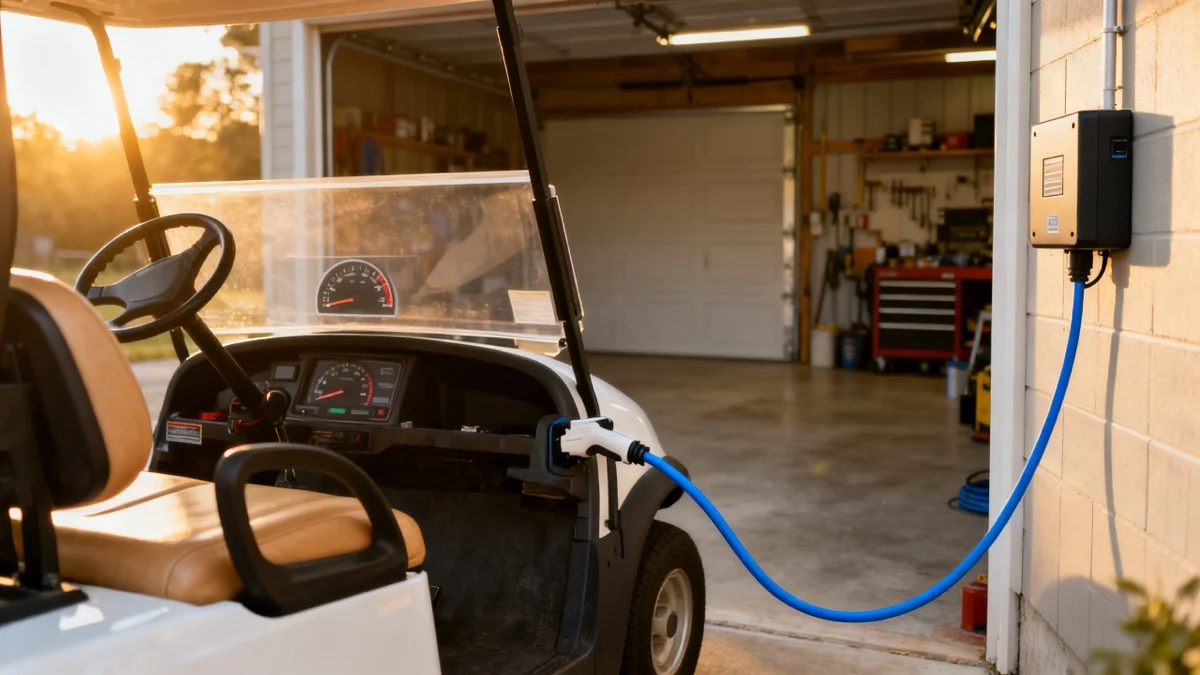
If you are wondering how long it takes to charge a golf cart, the short answer is this: most lead-acid carts take about 8 to 10 hours, while most lithium carts take about 3 to 5 hours.
The long answer is more useful, because voltage alone does not tell the story. A 36V cart does not automatically charge faster than a 48V cart, and a newer charger will not fix an old, sulfated battery pack. Charge time comes down to battery chemistry, pack size, charger amperage, and how deeply you ran the cart before plugging it in.
This guide breaks that down in plain English. We will cover real charge-time ranges for 36V, 48V, and lithium golf carts, explain why two different carts can take almost the same time to charge, show you the easiest way to estimate your own charge time, and point out when "it takes all night" is normal versus when it means something is wrong.
Golf Cart Battery Charging Time Chart
Use this chart as the first-pass answer before doing any math. It assumes the cart has a healthy pack, the correct charger, and normal garage-temperature charging conditions.
| Charging situation | 36V lead-acid | 48V lead-acid | 48V lithium |
|---|---|---|---|
| Short top-off after a light ride | 2 to 4 hours | 2 to 4 hours | 1 to 2 hours |
| Around half empty | 6 to 9 hours | 5 to 7 hours | 2 to 4 hours |
| Near empty | 8 to 10 hours | 8 to 10 hours | 3 to 5 hours |
| Old pack, weak charger, or cold weather | 10 to 12+ hours | 10 to 12+ hours | 4 to 6 hours |
If you are asking how long does it take to charge a 36 volt golf cart, the realistic answer is usually 6 to 10 hours, not automatically faster than a 48V cart. A common 36V pack can store about as much energy as a common 48V lead-acid pack.
Battery Tender's 36V and 48V golf cart charging guide gives the same practical baseline: deeply discharged 36V or 48V lead-acid banks commonly need 8 to 10 hours, partial charges can be closer to 4 to 6 hours, and lithium packs often charge faster.
Typical Golf Cart Charge Times by Use
These ranges assume a healthy cart, the correct charger, and a normal garage-temperature charging environment.
| Scenario | Lead-acid cart | Lithium cart |
|---|---|---|
| Short top-off after a light ride | 2 to 4 hours | 1 to 2 hours |
| Roughly half empty | 5 to 7 hours | 2 to 4 hours |
| Near empty | 8 to 10 hours | 3 to 5 hours |
| Old pack or weak charger | 10 to 12+ hours | 4 to 6 hours |
That table is the practical answer most owners actually need. If you drove a few neighborhood miles in your Club Car, EZGO, or Yamaha, you are usually looking at a top-off, not a full "from dead" recharge. That is why a cart can seem to "finish fast" one day and take all night the next.
For owners who want exact product recommendations after this explainer, use our best golf cart chargers guide, best EZGO TXT chargers guide, and golf cart battery voltage chart guide. If you are still matching connector types, use our golf cart charger plug compatibility guide. If the charger fits but the handle gets hot or the cart never wakes up, jump to our golf cart charging port problems guide. If you also want the ownership-cost side, our golf cart cost calculator estimates electricity, maintenance, and fuel costs. This page is focused on charge time first, not charger shopping first.
If a lithium cart will not start a charge cycle at all, the issue may be BMS protection or charger mismatch, so use our lithium battery not charging guide before assuming the pack is bad.
Looking for a 48V lithium battery golf cart recommendation instead of charging time? Use the lithium conversion guide if you are replacing batteries, or the Amazon golf cart buying guide if you are comparing complete 48V lithium carts online.
Why 36V and 48V Can Take Similar Time
Most people assume a 36V golf cart charges faster than a 48V golf cart because the number is smaller. In real life, that is often wrong.
Here is why:
- A common 36V lead-acid cart uses six Trojan T-105 6V batteries, and Trojan lists each one at 225Ah at the 20-hour rate on the T-105 product page.
- A common 48V lead-acid cart uses six Trojan T-875 8V batteries, and Trojan lists each one at 170Ah at the 20-hour rate on the T-875 product page.
Now look at the pack energy:
- 36V x 225Ah = 8.1 kWh
- 48V x 170Ah = 8.16 kWh
That is basically the same amount of stored energy.
So if both carts are using similar 15A chargers, and both came home from similar use, the real-world charge times can be surprisingly close. That is why blanket answers like "36V is faster" are misleading. Common 36V and 48V lead-acid packs often store almost the same energy.
This matters most for owners of older EZGO carts and other classic 36V systems, because a long charge time does not automatically mean the cart is weak. It may simply mean you are charging a large lead-acid pack with a standard amp charger.
The Four Things That Actually Decide Charge Time
1. Battery chemistry
This is the biggest factor.
Lead-acid batteries charge slower because they are less efficient and spend more time in the slow finishing stage. They also hate being left deeply discharged, which is why our battery guide and maintenance guide keep hammering the same advice: charge after every use.
Lithium batteries charge faster because they waste less energy as heat, accept higher current more willingly, and do not need the same long absorption stage. Club Car says its Onward lithium batteries charge up to 40% faster than flooded lead-acid packs. Owner reports vary by charger and pack size, but the practical pattern is consistent: lithium usually turns an overnight lead-acid routine into a shorter same-day charging window.
2. Pack size in amp-hours
More amp-hours means more energy to refill. A cart with a big 225Ah lead-acid pack will take longer than a cart with a 105Ah lithium pack, even if both are called "48V carts" in casual conversation.
This is why asking only for voltage is not enough. The better question is:
- What voltage is the pack?
- How many amp-hours does it store?
- What charger amperage do I have?
3. Charger amperage
A charger's amp rating is the speed limit of the charging session.
- 10A to 13A chargers are slower but common on older setups
- 15A is the mainstream sweet spot
- 18A to 20A chargers cut time noticeably on compatible packs
- 25A+ chargers are mostly a lithium conversation
That is why two lithium carts can have totally different charge times. A 48V 105Ah pack on a 15A charger might take around 5 to 6 hours from 20% to full, while the same pack on a 25A charger can drop much closer to 4 hours.
4. State of charge, age, and temperature
A cart that came home half empty should not be compared with a cart that was nearly dead.
Older batteries also take longer because they become less efficient and struggle to accept a clean full charge. Cold weather slows things down further, which is why winter storage and garage setup matter more than many owners realize.
A Simple Way to Estimate Your Own Charge Time
If you want more than a generic range, use this rule:
Charge time in hours ≈ amp-hours you need to replace ÷ charger amps
Then add:
- 15 to 25% extra for lead-acid
- 5 to 10% extra for lithium
That adjustment matters because real charging slows near the top of the cycle.
Example 1: 48V lead-acid cart with six T-875 batteries
- Pack size: 170Ah
- Used about half the charge: 85Ah to replace
- Charger: 15A
Math:
- 85 ÷ 15 = 5.7 hours
- Add about 20% for lead-acid inefficiency and taper
- Real charge time: about 6.5 to 7 hours
Example 2: 36V lead-acid cart with six T-105 batteries
- Pack size: 225Ah
- Used about half the charge: 112.5Ah to replace
- Charger: 15A
Math:
- 112.5 ÷ 15 = 7.5 hours
- Add about 20%
- Real charge time: about 9 hours
That example is exactly why many 36V carts do not "charge fast" just because they are 36V.
Example 3: 48V 105Ah lithium pack from 20% to 100%
- Pack size: 105Ah
- Energy needed: 84Ah
- Charger: 15A
Math:
- 84 ÷ 15 = 5.6 hours
- Add about 10%
- Real charge time: about 6 hours
Use a higher-amp compatible lithium charger and that number drops quickly. This is the biggest reason lithium conversions feel better in daily life even before you notice the weight savings or extra range.
Typical Charge Times by Battery Type
Flooded lead-acid
This is still the default for a huge share of used carts.
Typical real-world timing:
- Top-off after a short ride: 2 to 4 hours
- Half empty: 6 to 8 hours
- Near empty: 8 to 10 hours
- Old neglected pack: 10 to 12+ hours
Lead-acid also gets punished hardest by bad habits. If you repeatedly leave it discharged, water levels drop, cables corrode, or one battery goes weak, charge time stretches and range collapses. That is why the phrase "it still charges, just slower now" is often the beginning of a battery replacement conversation.
AGM
AGM is a little cleaner and maintenance-friendlier than flooded lead-acid, but from a charge-time perspective it is still much closer to lead-acid than to lithium.
Typical real-world timing:
- Top-off: 2 to 4 hours
- Half empty: 5 to 7 hours
- Near empty: 6 to 8 hours
If you care mostly about faster charging, AGM is not the magic answer. It helps with maintenance. Lithium is what changes the daily ownership experience.
Lithium
Lithium is where charge time finally feels modern.
Typical real-world timing:
- Top-off after a light ride: 1 to 2 hours
- Half empty: 2 to 4 hours
- Near empty: 3 to 5 hours
Large lithium packs with small onboard chargers can still take longer, but the overall pattern is consistent: lithium charges quicker, wastes less time in the last stage, and handles partial top-offs better.
That lines up with the pattern now showing up regularly in golf cart communities: a 48V lithium conversion with a matched charger usually finishes far sooner than the old lead-acid pack did. The exact number still depends on battery capacity, starting charge, and charger amperage.
Brand and Cart Examples That Matter
Brand names matter less than battery chemistry, but a few patterns are worth knowing.
Club Car
Most 48V Club Car carts on lead-acid still live in the 8 to 10 hour world if the pack is meaningfully depleted.
Club Car's own Onward materials say its lithium batteries charge up to 40% faster than flooded lead-acid. In practice, that usually moves a cart from "overnight" into something more like 5 to 7 hours for heavy use and faster for top-offs.
If you need a replacement charger for a compatible 48V Club Car lead-acid pack, the EPOWREY 48V charger is a strong value option.
Check Price: EPOWREY 48V Charger for Club CarEZGO TXT and other 36V EZGO carts
The most common charge-time misunderstanding on EZGO is assuming a 36V TXT should always finish faster than a 48V cart. It often does not, because the common six-T-105 pack is so large.
For healthy lead-acid setups, expect 6 to 10 hours depending on how much charge you used. For lithium-converted TXT carts, 3 to 5 hours is much more realistic.
If your 36V charger is old or inconsistent, the FORM 36V EZGO TXT charger is still the cleanest replacement pick.
Check Price: FORM 36V Charger for EZGO TXTYamaha Drive2 and similar AC carts
In our Yamaha review, the Drive2 PowerTech AC lead-acid setup lands at roughly 8 to 10 hours for a full charge. That is a good reality check for owners who think their Yamaha is "charging too slowly" when it is actually behaving normally for a lead-acid cart.
Where Yamaha owners get caught is assuming that a good lead-acid cart should feel like a lithium cart. It will not. If your priority is faster turnaround rather than just stable overnight charging, the answer is battery chemistry, not brand loyalty.
If you are shopping newer lithium-ready carts instead of upgrading your current one, compare local inventory on our dealer directory and start with our best golf carts guide.
When Slow Charging Means Something Is Wrong
Charging slowly is not always a problem. Charging slower than your cart used to charge often is.
Here are the most common warning signs:
- it used to finish in 8 hours and now takes 10 or 12
- the charger never seems to finish cleanly
- range has dropped along with charge speed
- one battery reads weak compared with the others
- cables or terminals are corroded
- the pack gets unusually hot
If that sounds familiar, work through these pages next:
- golf cart battery voltage chart and test guide
- golf cart charger plug compatibility guide
- golf cart charging port problems guide
- golf cart batteries guide
- golf cart won't start fix guide
- golf cart troubleshooting guide
One of the easiest mistakes is blaming the charger when the real problem is battery condition. The charger is just revealing the weakness of the pack.
If you would rather have a shop load-test the pack instead of guessing, start with local electric golf cart repair listings.
How to Reduce Charge Time Without Hurting the Batteries
You cannot cheat physics, but you can avoid wasting hours.
Charge after every use
This is the biggest one. Lead-acid batteries prefer frequent recharging over deep discharge. If you wait until the cart feels weak, you are adding time now and shortening battery life later.
Keep the batteries healthy
Low water, corroded terminals, and loose cables all slow charging. Our spring maintenance checklist, battery watering systems guide, and maintenance guide go deeper on the routine.
Use the right charger
An undersized or failing charger adds hours. A proper modern charger is the difference between "this always finishes overnight" and "this never seems done."
If you run lithium, a lithium-compatible charger is non-negotiable. The FORM 48V lithium charger is a solid standalone option if your conversion kit did not include one or if your current charger is underperforming.
Check Price: FORM 48V Lithium ChargerMonitor state of charge more accurately
A lot of owners think their cart is "taking forever to charge" because the dash gauge was lying to them all along. A battery monitor gives you a clearer picture of where you started and how much energy you are actually putting back in.
Check Price: OMEIPMEO Battery Monitor MeterFor more options, our dashboard tech upgrades guide covers simple battery monitors and display upgrades that make daily charging a lot less guessy.
The Most Practical Rule of Thumb
If you want one answer to remember, use this:
- Lead-acid cart: plan on overnight charging
- Lithium cart: plan on charging during part of the afternoon or evening
- Short top-off: usually much less than a full-cycle number
That is the practical planning answer for daily ownership. It is also why lithium changes how a cart fits into real life. With lead-acid, you finish the day and plug in. With lithium, you can realistically run an errand, come home, plug in for a few hours, and head back out.
Frequently Asked Questions
How long does it take to charge a golf cart from empty?
Most lead-acid carts need about 8 to 10 hours from near empty. Most lithium carts need about 3 to 5 hours. Weak batteries and cold weather can push both higher.
How long does a 36V golf cart take to charge?
A typical 36V lead-acid cart takes about 6 to 10 hours. The wide range exists because common 36V packs are large in amp-hours, so voltage alone does not tell the whole story.
How long does a 48V golf cart take to charge?
A healthy 48V lead-acid cart often takes about 6 to 10 hours. A 48V lithium cart is usually closer to 3 to 5 hours unless the pack is very large or the charger is small.
Why does my golf cart take overnight to charge?
That is normal for many lead-acid carts. It becomes a concern when the cart now takes much longer than it used to, or when charge time gets longer while range gets shorter.
Does lithium really charge that much faster?
Yes. It is one of the clearest daily-life benefits of lithium ownership. Club Car says its lithium batteries charge up to 40% faster than flooded lead-acid, and real-world lithium setups commonly move from overnight charging into the 3 to 5 hour range.
Does 48V always charge slower than 36V?
No. In many common setups, the total stored energy is almost identical. A 36V six-T-105 pack and a 48V six-T-875 pack both land around 8.1 kWh, so similar chargers can produce similar charge times.
Can I leave my cart charging overnight?
Yes, with a healthy smart charger and a safe, ventilated charging space. That is standard practice for many lead-acid carts.
What charger amp rating is best for most carts?
About 15A is the everyday sweet spot. Going higher can reduce time, but only if the battery and charger pairing are designed for it.
If my cart charges slowly, should I replace the charger first?
Not automatically. Check battery health, water levels, cable condition, and individual battery voltage first. Slow charging is often a battery problem wearing a charger costume.
What is the cheapest way to shorten charge time?
Keep the existing pack healthy, charge after every use, and replace a weak old charger with the correct smart charger. That is a lot cheaper than buying batteries you do not need yet.
Golf Cart Search
Find the Best Golf Carts of 2026
Compare top-rated models, read expert reviews, and find the perfect cart for your needs.